
Quick Answer
When the driver who hit you has the same insurance company as you, the claim should be handled separately, but you should not assume the insurer is neutral. In Texas, the company may be handling two different roles at once: the other driver’s liability claim and your own possible claim for collision, personal injury protection (PIP), medical payments (MedPay), or uninsured/underinsured motorist (UM/UIM) coverage. Ask for separate adjusters, keep communication in writing, avoid recorded statements until you understand the claim strategy, and get independent advice before accepting shared fault or signing a release. (Texas Department of Insurance)
Key Takeaways
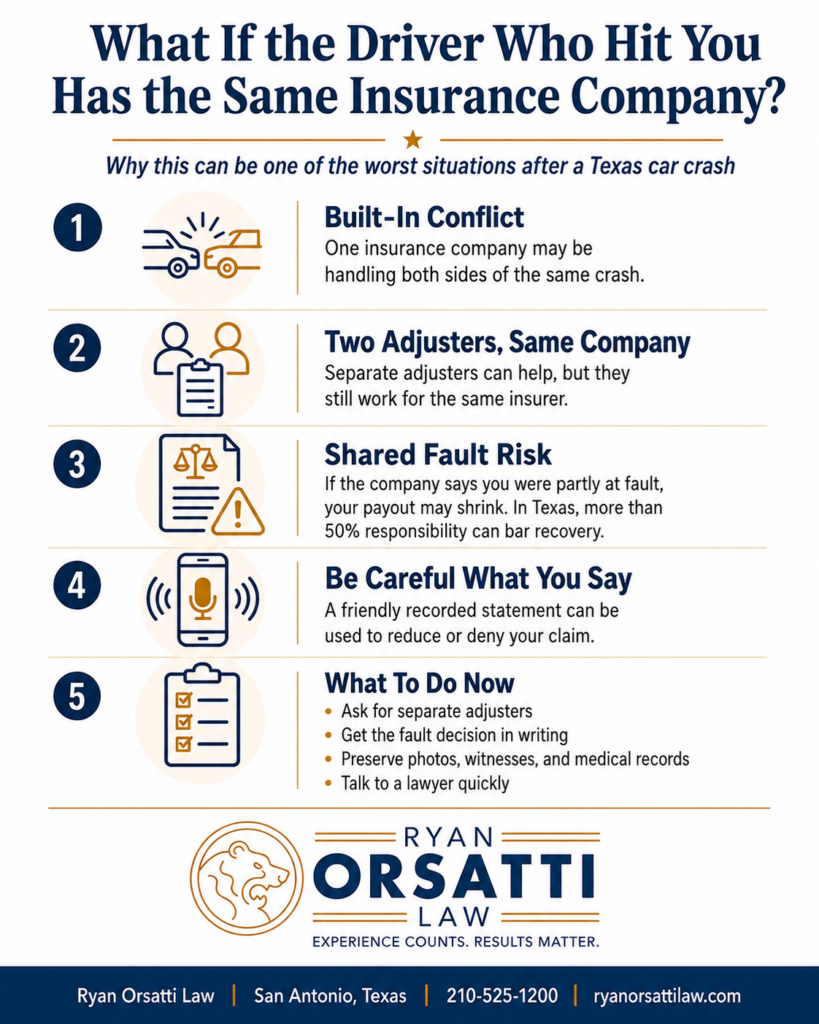
- A same-insurance crash is not automatically illegal, but it creates a built-in practical conflict because one company is evaluating both sides of the same collision.
- In Texas, shared fault matters. If you are found more than 50 percent responsible, you may be barred from recovering damages. If you are 50 percent or less responsible, your recovery can be reduced by your percentage of responsibility. (Texas Statutes)
- Two adjusters are better than one, but they are not a complete solution because both adjusters still work for the same insurer.
- Your own policy may include collision, PIP, MedPay, or UM/UIM coverage, each of which must be evaluated separately from the other driver’s liability coverage. (Texas Department of Insurance)
- Ask the insurance company to put its fault decision, coverage position, and settlement reasoning in writing.
- Talk to a Texas personal injury attorney before giving a broad recorded statement or signing a full release.
Why Is It Risky When the Driver Who Hit Me Has the Same Insurance Company as Me?
It is risky because the same insurance company may control both claim files, both adjuster assignments, and both payment decisions after the crash. That does not mean every same-insurer claim is handled improperly. It does mean you should treat the situation carefully.
In a normal two-company claim, your insurer and the other driver’s insurer have different financial interests. In a same-insurance claim, one company may benefit if it finds both drivers partly at fault, questions injury causation, or delays payment while it collects statements.
In a Texas same-insurance car accident claim, the conflict is practical, not just legal: the same corporation may benefit if it assigns partial fault to both customers. Under Texas Civil Practice and Remedies Code § 33.001, a claimant whose percentage of responsibility is greater than 50 percent cannot recover damages. (Texas Statutes)
This matters in San Antonio crashes on I-10, I-35, Loop 410, Loop 1604, US-281, and neighborhood roads across Bexar County. Many wrecks turn on small factual disputes: speed, lane position, braking, traffic signal timing, prior pain, and when symptoms started.
According to TxDOT’s final comparison report for 2003 to 2025, Texas had 3,769 motor vehicle traffic deaths in 2025 and an estimated $54.2 billion in economic loss from all motor vehicle crashes. TxDOT states that 2024 and 2025 figures were based on reportable crash data from Texas Peace Officer’s Crash Reports (CR-3) processed as of April 7, 2026. (Texas Department of Transportation)
Does the Insurance Company Owe Me a Legal Duty If We Both Use the Same Insurer?
The answer depends on which claim the insurer is handling. Your own insurer has duties under your policy and Texas insurance law when you make a first-party claim, which means a claim under your own policy. The same company, acting as the other driver’s liability carrier, is evaluating a third-party claim against that driver’s policy.
That distinction is critical. TDI explains that when you file against the other driver’s insurance, you do not have the same options you would have with your own company because you do not have a contract with the other driver’s insurer. In a same-insurance case, you may have a contract with the company for your own policy, but not for the liability claim made against the other driver’s policy. (Texas Department of Insurance)
Texas Insurance Code Chapter 542 and 28 Texas Administrative Code § 21.203 prohibit unfair claim settlement practices. TDI identifies examples such as failing to acknowledge claim communications, failing to affirm or deny coverage within a reasonable time, refusing to pay without a reasonable investigation, and not attempting in good faith to settle a claim when liability has become reasonably clear. (Texas Department of Insurance)
A same-insurer crash can involve two different legal relationships at the same time. When you use collision, PIP, MedPay, or UM/UIM, you are dealing with your own policy. When you pursue the other driver’s liability coverage, you are making a claim against the other driver’s policy, even if the company name is identical.
Will the Same Insurance Company Assign One Adjuster or Two Adjusters?
Most insurers should assign separate adjusters when both drivers are insured by the same company, but you should confirm it in writing. Separate adjusters reduce the risk that one person is directly managing both sides of the dispute.
That protection has limits. Two adjusters may still use the same claim system, the same internal guidelines, the same supervisors, and the same company valuation software. They may also share liability notes, recorded statements, photos, repair estimates, and medical summaries.
A single adjuster handling both files is a major red flag. If that happens, ask for separate adjusters immediately and ask the company to confirm the change by email or letter. You should also ask whether any recorded statement, damage estimate, or liability decision already made by the first adjuster will be reviewed by a separate supervisor.
Attorney Insight: In matters we handle, the biggest same-insurer problem is often not an outright denial. It is the quiet drift toward shared fault. The file starts with friendly calls, then the questions focus on what the injured person “could have done differently.” That framing can affect liability, injury value, and settlement posture.
How Can Shared Fault Reduce My Texas Car Accident Claim?
Shared fault can reduce or eliminate a Texas car accident claim because Texas uses proportionate responsibility. Proportionate responsibility means your damages can be reduced by your percentage of fault, and if your percentage of responsibility is greater than 50 percent, you may not recover damages. (Texas Statutes)
For example, assume a jury finds your damages are $100,000. If you are found 20 percent responsible, the recovery is reduced by 20 percent. If you are found 51 percent responsible, Texas Civil Practice and Remedies Code § 33.001 may bar recovery.
That is why a same-insurance company’s fault decision matters so much. A small shift in blame can change the economics of the claim.
| Fault assigned to you | General Texas effect | Why it matters in a same-insurer claim |
|---|---|---|
| 0 percent | No reduction for your fault | The other driver’s liability side carries the loss |
| 10 percent | Recovery may be reduced by 10 percent | The insurer saves money by reducing the payout |
| 50 percent | Recovery may be reduced by 50 percent | The insurer may frame the crash as “both drivers caused it” |
| 51 percent or more | Recovery may be barred | The insurer may deny the injury claim based on your assigned fault |
A 50/50 decision in Texas is not the same as a complete bar, but it can still cut the claim dramatically. A 51 percent decision is much more serious because Texas law bars recovery when the claimant’s percentage of responsibility is greater than 50 percent. (Texas Statutes)
What Claims May Be Open When Both Drivers Have the Same Insurance Company?
Several claim tracks may be open at the same time, and each one should be evaluated separately. The label on the insurance card does not tell you which coverage applies, what deductible applies, or which adjuster is making the decision.
| Claim track | What it may pay | Key issue when the insurer is the same |
|---|---|---|
| Liability claim against the other driver | Medical bills, lost income, pain and suffering, property damage, rental | The company is defending its other customer while evaluating your claim |
| Collision claim under your policy | Repair or total-loss payment for your vehicle | You may owe a deductible first, but reimbursement may be possible if the insurer recovers from the at-fault side |
| PIP | Medical bills, lost wages, and some nonmedical costs | Texas auto policies include PIP unless rejected in writing |
| MedPay | Medical bills for you or passengers | It may apply regardless of fault, depending on the policy |
| UM/UIM | Damages if the at-fault driver has no insurance or not enough insurance | The carrier may evaluate both the liability limits and your own UIM exposure |
| Health insurance, ERISA plan, or hospital lien | Medical bill payment or reimbursement claims | Subrogation and lien claims can affect your net recovery |
TDI explains that Texas minimum liability coverage is 30/60/25, meaning at least $30,000 for injuries per person, $60,000 total per accident, and $25,000 for property damage. TDI also explains that PIP is included in Texas auto policies unless rejected in writing, and UM/UIM must be offered unless rejected in writing. (Texas Department of Insurance)
Subrogation means a health insurer, Medicare plan, ERISA plan, or other payer may claim a right to be reimbursed from the settlement. A hospital lien is a legal claim by a hospital against part of an injury recovery. A letter of protection is an agreement where a provider may treat now and wait for payment from a later settlement.
What Should I Do After a Same-Insurance Crash in San Antonio?
You should protect the evidence, separate the claim files, and avoid giving the insurer unnecessary statements before the facts are clear. Use this checklist after a same-insurance crash in San Antonio, Bexar County, or elsewhere in Texas.
- Get the police report information. If police responded, request the CR-3 crash report when available and send only accurate documents.
- Take photos and video. Photograph vehicle positions, damage, skid marks, debris, traffic controls, weather, visible injuries, and the other driver’s insurance card.
- Ask for separate adjusters. Request written confirmation that different adjusters are handling your claim and the other driver’s claim.
- Ask for written liability reasons. If the insurer blames you at all, ask for the factual basis, policy basis, and evidence it relied on.
- Do not speculate. Do not guess about speed, distance, injuries, prior conditions, or what you “could have done.”
- Track medical care and symptoms. Keep ER records, urgent-care records, imaging orders, prescriptions, referrals, work notes, and pain logs.
- Preserve outside evidence. Look for dashcam video, nearby business footage, 911 information, witness names, vehicle event data, and repair estimates.
For broader guidance on handling the insurance company after a wreck, see Ryan Orsatti Law’s article on the insurance adjuster’s friendly phone call and the firm’s guide to how car accident settlements work.
Should I Give a Recorded Statement to the Same Insurance Company?
You should be careful before giving a recorded statement, even if the adjuster sounds friendly and reminds you that you are a long-time customer. A recorded statement can be used to test fault, injuries, treatment gaps, prior medical history, and whether your story changes later.
There may be policy duties to cooperate with your own insurer, but cooperation does not mean guessing, minimizing injuries, or answering broad questions without understanding the claim. You can ask whether the statement is for your own policy, the other driver’s liability claim, or both.
A recorded statement in a same-insurance crash can create one statement for multiple claim files. Before answering, ask which policy the adjuster represents, whether the call is recorded, whether the statement will be shared with the other driver’s liability file, and whether you may provide written information instead.
This is especially important when injuries are still developing. Neck pain, back pain, concussion symptoms, radicular pain, headaches, numbness, and shoulder problems may worsen over days. A statement like “I’m okay” or “I don’t think I’m badly hurt” can be taken out of context later.
What Evidence Matters Most When the Insurer Says Both Drivers Were at Fault?
The best evidence is evidence that does not depend only on either driver’s memory. Same-insurer cases often turn on independent proof because both policyholders may give different versions of the same crash.
Useful evidence may include:
- Crash report diagrams and officer narratives
- Dashcam, TeslaCam, or surveillance video
- Witness names and written witness statements
- Scene photos showing lane markings, traffic lights, debris, and impact points
- Vehicle damage photos before repair or salvage
- Downloadable event data, sometimes called black box data
- 911 call details and EMS records
- Medical records connecting symptoms to the crash
- Repair estimates showing angle and severity of impact
- Prior claim notes showing whether the insurer changed its fault theory
Spoliation means the loss, destruction, or failure to preserve relevant evidence. When a serious injury claim depends on vehicle data, surveillance footage, or company records, a preservation request should go out quickly.
What If the Same Insurance Company Delays, Undervalues, or Blames Me?
Ask for the company’s position in writing and consider escalating the claim if the insurer delays, undervalues, or blames you without a clear factual basis. TDI says the other driver’s insurance may say its driver was not at fault, say both drivers were at fault, claim the policy is not enough, fail to return communications, or delay while waiting on its policyholder. TDI recommends asking for the reason in detail and in writing if the other insurance will not pay. (Texas Department of Insurance)
For complaints involving your own insurer, TDI may help determine whether the company is following the law and paying according to the policy. TDI also states that it cannot decide who was at fault in an accident and generally cannot help with complaints against another person’s insurance company when that company will not accept liability. (Texas Department of Insurance)
That means a TDI complaint can be useful for certain claim-handling problems, but it is not a substitute for proving fault, proving injuries, preserving evidence, or filing a lawsuit before the deadline.
How Long Do I Have to File a Texas Car Accident Lawsuit?
Most Texas personal injury and property damage lawsuits must be filed within two years after the claim accrues. Texas Civil Practice and Remedies Code § 16.003 contains the two-year limitations period for personal injury and property damage claims. (Texas Statutes)
Do not wait for the same insurance company to “finish investigating” if the deadline is approaching. Negotiations do not automatically extend the statute of limitations. Some claims can have shorter notice requirements, especially when a government vehicle, road defect, city department, or public entity is involved.
How Can a Lawyer Help When Both Drivers Have the Same Insurance Company?
A lawyer can separate the claim issues, preserve evidence, challenge shared-fault findings, and evaluate every available coverage source. The goal is not to create a dispute where none exists. The goal is to make sure the insurer’s decision is based on evidence, not convenience.
In a same-insurance crash, a lawyer may:
- Request separate adjusters and written claim-file separation
- Send evidence-preservation letters
- Obtain the crash report and available video
- Identify all coverages, including liability, collision, PIP, MedPay, and UM/UIM
- Track medical causation and damages
- Address health insurance subrogation, hospital liens, and treatment balances
- Push back against unsupported shared-fault findings
- Prepare a demand only after the injury picture, treatment plan, and lien issues are clear
Ryan Orsatti Law handles Texas car accident claims from San Antonio and Bexar County to other communities across the state. For related information, see the firm’s San Antonio car accident lawyer page and its guide to UM/UIM coverage in Texas.
FAQ
Is it a conflict of interest if the driver who hit me has the same insurance company?
It can create a practical conflict, even if the insurer says it has internal procedures to separate the files. The company may assign two adjusters, but both still work for the same insurer. Ask in writing who handles each claim, whether information is shared, and what evidence supports any fault decision.
Can the same adjuster handle both drivers’ claims?
It can happen, but it is a serious concern because one person may be managing both sides of the liability dispute. Ask for separate adjusters immediately. If the company refuses or has already made a fault decision, ask for the reason in writing and consider getting independent legal advice before giving statements or signing releases.
Can my insurance company blame me even though I am their customer?
Yes. Your insurer may still assign fault to you, especially if it is evaluating the other driver’s liability claim or your own collision, PIP, MedPay, or UM/UIM claim. In Texas, a fault finding can reduce your recovery, and if your responsibility is greater than 50 percent, it may bar recovery. (Texas Statutes)
Should I use my collision coverage if the other driver caused the crash?
You may use collision coverage if you have it, especially when liability is disputed or repairs cannot wait. TDI explains that collision can pay repair costs and that your insurer may try to recover what it paid from the other driver’s insurance. Deductible reimbursement may depend on recovery and policy facts. (Texas Department of Insurance)
Do I have to give a recorded statement to the same insurance company?
Do not give a broad recorded statement without first knowing whether the adjuster is calling for your own policy, the other driver’s liability file, or both. You may have cooperation duties under your policy, but you should not guess, minimize injuries, or discuss legal fault without understanding the consequences.
What should I ask the insurance company in writing?
Ask for the claim numbers, the names of both adjusters, confirmation that the files are assigned separately, the basis for any shared-fault decision, the coverages available under your policy, and whether the company is asking for a full release or a property-damage-only release. Keep every response.
Can I file a TDI complaint about a same-insurance claim?
A TDI complaint may help with certain problems involving your own insurer, such as delays, claim handling, or policy payment issues. TDI says it cannot decide who was at fault and generally cannot help when another person’s insurance company refuses to accept liability. Legal advice may be needed when fault or injury damages are disputed. (Texas Department of Insurance)
When should I call a lawyer after a same-insurance crash?
Call a lawyer before giving a recorded statement, accepting shared fault, signing a release, settling injury claims, or letting the insurer dispose of key evidence. Same-insurer claims can look simple at first, but they often involve overlapping coverage, fault allocation, medical causation, liens, and policy-limit issues.
Ryan Orsatti Law
4634 De Zavala Rd, San Antonio, TX 78249
Phone: 210-525-1200
ryanorsattilaw.com
This blog is for informational purposes only, not legal advice. Reading it does not create an attorney-client relationship. Past results do not guarantee future results.
Hurt in an accident in San Antonio? Learn how a San Antonio personal injury lawyer can help with your claim. Call 210-525-1200 or request a free consultation.
The firm works on a contingency fee. You pay nothing unless the firm recovers money for you, and that covers case expenses as well as the fee: if there is no recovery, you owe no attorney's fee and no case expenses. Ask for the fee agreement and read the fee and expense section before you sign anything.
Related San Antonio legal resources
Primary legal and public-data sources
- Texas Civil Practice and Remedies Code Chapter 16: limitations
- Texas Civil Practice and Remedies Code Chapter 33: proportionate responsibility
Ryan Orsatti Law
4634 De Zavala Road, San Antonio, TX 78249
General reference links. Consult each source for its current text.