
Quick Answer
If you gave a recorded statement about an oilfield accident and later realized you forgot key facts, your case is not automatically ruined. The safer move is to stop giving more informal statements, request a copy or transcript of what you said, write down the missing facts while they are fresh, and talk to a Texas oilfield injury lawyer before sending any correction.
A forgotten detail should usually be handled as a careful clarification, not a casual “I changed my story” phone call. The goal is to make the record more complete with evidence, dates, names, photos, medical records, job documents, and witness information.
Key Takeaways
- A recorded statement can be used to challenge fault, injury severity, timing, and credibility.
- Forgetting facts after an oilfield accident is common because pain, shock, medication, fatigue, and incomplete information can affect memory.
- Do not give a second recorded statement without preparing first.
- Ask for the recording, transcript, claim notes, and any written summary the adjuster created.
- Corrections should be factual, specific, dated, and supported by other evidence whenever possible.
- In Texas, oilfield claims may involve workers’ compensation, non-subscriber claims, third-party negligence claims, or several of these at once.
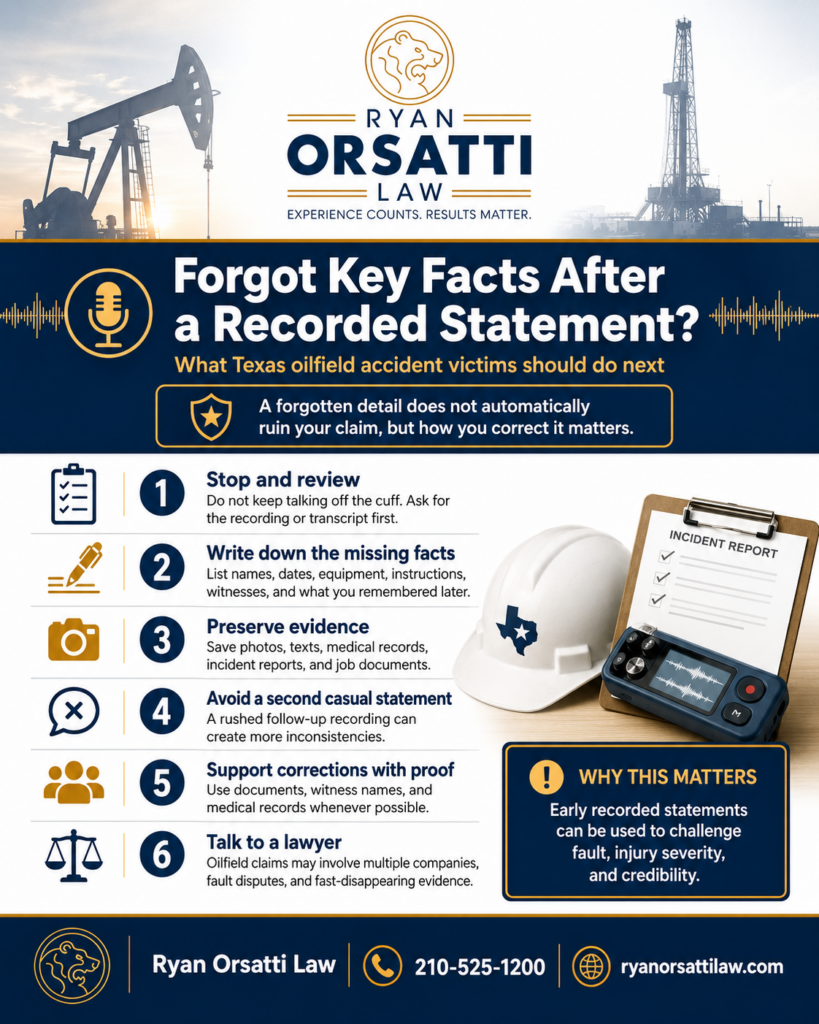
Will a Forgotten Fact Ruin My Oilfield Accident Claim?
A forgotten fact does not automatically ruin an oilfield accident claim, but it can create a credibility issue if it is not handled carefully.
Oilfield accidents are rarely simple. One event may involve a site operator, drilling company, trucking company, equipment owner, subcontractor, safety company, tool company, and insurance adjuster. When an injured worker gives a recorded statement early, the questions may focus on only part of the event. Later, after medical treatment, witness conversations, or review of photos, the injured person may remember missing facts.
That is not unusual. The problem comes when the insurance company argues that the new fact is not a correction, but a contradiction.
A recorded statement means an audio or video interview where an adjuster, employer representative, investigator, or claims handler records your answers. A correction means a later, accurate clarification of something incomplete, mistaken, or missing. A contradiction means two versions that cannot both be true.
Your job is not to argue with the adjuster. Your job is to preserve accuracy.
Why Are Recorded Statements Risky After an Oilfield Accident?
Recorded statements are risky because they freeze an early version of events before the injured person knows the full facts, injuries, witnesses, and evidence.
According to the U.S. Bureau of Labor Statistics, oil and gas extraction industries had 65 fatal work injuries in 2024. That number helps explain why early evidence matters in these cases. Serious oilfield incidents often involve heavy equipment, vehicle movement, pressure lines, confined spaces, falls, burns, crush injuries, and multiple companies on the same job site. See the BLS data on fatal occupational injuries in mining, quarrying, and oil and gas extraction.
Insurance companies use recorded statements for several purposes:
- To lock in your first description of what happened
- To identify facts they can use to shift blame
- To compare your early injury description against later medical records
- To find gaps in what you remembered
- To argue that later details were added after you hired a lawyer
- To test whether you know who controlled the worksite, equipment, or safety procedures
The danger is not always one dramatic mistake. More often, the danger is an incomplete answer that sounds harmless in the moment.
For example, saying “I did not see anything wrong with the equipment” may be used differently than “I had not inspected the equipment before the incident and did not know the guard was missing until later.” Those are not the same statement.
How Can I Correct a Recorded Statement After an Oilfield Accident?
You can often correct or supplement a recorded statement, but the correction should be organized, accurate, and supported by evidence.
Do not call the adjuster and freestyle a second version. That can create more inconsistency. Instead, take a disciplined approach.
Under Texas Rule of Evidence 801(e)(2), your own recorded statement can sometimes be offered against you as an opposing party’s statement. That does not mean a forgotten detail destroys the case. It means the correction should be careful, dated, factual, and supported by independent evidence such as photographs, witness names, job records, and medical notes.
A good correction usually identifies:
- What you said before
- What was incomplete or mistaken
- What you now remember
- Why the missing fact matters
- What evidence supports the correction
- Whether you were in pain, medicated, tired, rushed, or lacking key information when the statement was taken
A bad correction sounds defensive, vague, or exaggerated. Avoid phrases like “I need to change my story.” Better phrasing is: “After reviewing the timeline and speaking with witnesses, I realized my recorded statement did not include several important facts.”
What Key Facts Do Injured Oilfield Workers Often Forget?
Injured oilfield workers often forget facts about who was present, who gave instructions, what equipment was used, what warnings were missing, and what happened immediately before the incident.
Those details matter because Texas oilfield accident claims often turn on control. Control means who had the right to direct the work, inspect the equipment, enforce safety rules, or stop the job.
| Forgotten fact | Why it matters | How to document it |
|---|---|---|
| Supervisor instructions | Shows who directed the task and whether the job was rushed | Texts, job tickets, witness names, daily reports |
| Job Safety Analysis or tailgate meeting | Shows known hazards and required safety steps | JSA forms, sign-in sheets, safety meeting notes |
| Equipment condition | Shows defect, poor maintenance, missing guard, or unsafe setup | Photos, inspection records, maintenance logs |
| Contractor names | Identifies possible third-party defendants | Badges, truck logos, invoices, master service agreements |
| Weather, mud, lighting, or lease-road conditions | Explains visibility, traction, and site hazard issues | Photos, weather history, worksite video |
| Prior complaints | Shows notice of a hazard before the incident | Emails, texts, prior incident reports |
| Pain, confusion, shock, or medication | Explains why the first statement was incomplete | EMS records, ER records, prescription records |
| Witness locations | Helps confirm what happened before memories fade | Names, phone numbers, crew lists |
OSHA lists common oil and gas extraction hazards such as vehicle accidents, struck-by and caught-in hazards, explosions and fires, falls, confined spaces, and chemical exposures. Those categories are broad, but they match the real-world evidence questions lawyers often investigate after oilfield incidents. See OSHA’s oil and gas extraction overview.
How Do Texas Fault Rules Affect a Forgotten Fact?
Texas fault rules matter because an incomplete recorded statement can be used to argue that you were partly or mostly responsible for the accident.
Proportionate responsibility means Texas compares fault among responsible parties. Under Texas Civil Practice & Remedies Code § 33.001, a claimant may not recover damages if the claimant’s percentage of responsibility is greater than 50 percent.
Texas Civil Practice & Remedies Code § 33.001 uses proportionate responsibility, which means a claimant cannot recover damages if found more than 50 percent responsible. In oilfield accident claims, an early recorded statement that misses a hazard, supervisor instruction, equipment defect, or third-party role can become fuel for a blame-shifting argument.
That is why forgotten facts matter. An adjuster may try to use gaps like these:
- “You did not mention the missing guard in your first statement.”
- “You said you were not rushed.”
- “You did not identify any unsafe condition.”
- “You did not mention the other contractor.”
- “You said you were fine at first.”
- “You did not report back pain until later.”
Those arguments are not always fair. Early statements often happen before full medical evaluation, before the worker sees incident documents, and before witnesses are interviewed. Still, the correction should be handled with precision.
What if the Statement Was Given to My Employer, My Insurer, or Another Company’s Insurer?
Who took the statement matters because your obligations and risks may change depending on whether the statement was given to your employer, your own insurer, a workers’ compensation carrier, or a third-party liability insurer.
Texas oilfield claims can involve different systems at the same time.
| Who took the statement? | Common issue | Practical next step |
|---|---|---|
| Your employer | They may frame the event as worker error or policy violation | Request incident reports and preserve witness names |
| Workers’ compensation carrier | They may evaluate whether the injury is work-related and compensable | Confirm DWC deadlines and medical documentation |
| Non-subscriber employer or plan administrator | They may use the statement to limit employer liability | Determine whether the employer carried Texas workers’ compensation |
| Another company’s liability insurer | They may use the statement to reduce or deny a third-party claim | Do not give another recorded statement without legal review |
| Your own auto insurer | UM/UIM, MedPay, or PIP issues may arise after an oilfield vehicle crash | Review policy duties before any further statement |
Texas private employers can choose whether to carry workers’ compensation coverage in most cases. TDI explains this on its workers’ compensation coverage verification page. A non-subscriber is an employer that does not provide Texas workers’ compensation coverage. That status can change the legal analysis.
If workers’ compensation applies, injured workers should pay close attention to DWC rules and deadlines. The Texas Department of Insurance states that injured employees should report the injury and may need to file DWC Form-041. Under Texas Labor Code § 409.003, a claim for compensation generally must be filed not later than one year after the injury date, with different rules for occupational disease.
What Should I Do After Realizing I Forgot Key Facts?
After realizing you forgot key facts, make a written timeline immediately and avoid giving more recorded statements until the first statement is reviewed.
Use this checklist.
- Write down the missing facts today. Include dates, times, names, company names, equipment, location, weather, lighting, supervisor instructions, and what you remember now.
- Separate facts from assumptions. “The winch line snapped” is different from “I think poor maintenance caused the winch line to snap.” Keep both notes, but label them clearly.
- Request the recording and transcript. Ask for the audio file, transcript, written summary, and claim notes that describe your statement.
- Preserve supporting evidence. Save photos, texts, dispatch messages, job tickets, time records, safety documents, medical records, and witness contact information.
- Do not give a second recorded statement casually. A second recording can make the problem worse if it is not planned.
- Get medical documentation. Tell your doctors exactly how the incident happened and when symptoms began. Medical records often become key evidence.
- Have counsel send preservation notices. A spoliation letter is a written notice demanding that a company preserve evidence. In oilfield cases, that may include camera footage, job safety analyses, inspection records, electronic logging device data, telematics, maintenance logs, incident reports, and contractor rosters.
For more on immediate post-accident evidence steps, see Ryan Orsatti Law’s guide on what to do immediately after an oilfield accident in Texas and the firm’s discussion of oilfield truck data preservation.
How Should the Correction Be Written?
A correction should be written as a factual supplement, not an emotional argument.
The format matters. The correction should avoid exaggeration and should not guess. It should say what was missing, why it was missing if known, and what documents or witnesses support the added facts.
A clean correction might include:
- “My earlier recorded statement was taken on [date].”
- “At that time, I was still in pain and had not reviewed photos, witness names, job documents, or medical findings.”
- “I later realized the statement did not include the following facts.”
- “The missing facts are listed below.”
- “These facts are based on my memory, documents I reviewed, and witness information currently available.”
- “I am not waiving any rights or agreeing that the prior statement was complete.”
This kind of correction is not magic. It will not erase the first recording. But it can help frame the issue accurately.
Under Texas Rules of Evidence 106 and 107, Texas recognizes fairness concepts involving the remainder of writings, recorded statements, conversations, and related statements when only part is offered. Those rules do not automatically fix every recorded statement problem, but they show why completeness can matter.
What Evidence Can Support the Missing Facts?
The strongest support usually comes from documents, physical evidence, witness testimony, electronic data, and medical records.
In oilfield cases, evidence can disappear quickly. Companies may have retention systems that overwrite video, vehicle data, dispatch messages, or electronic logs. The sooner a preservation request goes out, the better.
Texas Civil Practice & Remedies Code § 16.003 generally gives an injured person two years to file a personal injury lawsuit. That deadline does not protect disappearing evidence. Rig camera footage, dispatch messages, job safety analyses, electronic logging data, and contractor rosters may need preservation long before a lawsuit is filed.
Common evidence sources include:
- Incident reports
- OSHA-related documents
- Job Safety Analysis forms
- Site safety meeting notes
- Stop-work authority policies
- Company texts and dispatch messages
- Equipment inspection and maintenance logs
- Driver logs, GPS, telematics, and ELD data if vehicles were involved
- Photos of the rig, pad, lease road, tool, line, tank, ladder, platform, or truck
- Medical records documenting mechanism of injury
- EMS and emergency room records
- Witness statements
- Contractor agreements and master service agreements
- Subrogation, hospital lien, and health plan records
Subrogation means a health insurer or benefit plan may claim reimbursement from a settlement. A hospital lien is a statutory claim by a hospital against certain injury recoveries. An ERISA plan is an employer health plan governed by federal law that may assert reimbursement rights. MedPay is optional auto coverage that can pay medical bills regardless of fault. A letter of protection is an agreement where a medical provider may wait for payment from a future case recovery.
Those issues may seem separate from a recorded statement, but they are connected. If the statement affects fault, injury causation, or damages, it may affect insurance payments, liens, and net recovery.
What Should I Avoid Doing After I Remember More Facts?
You should avoid anything that creates another incomplete, emotional, or unsupported version of events.
Do not:
- Call the adjuster while angry or anxious
- Give a second recorded statement without reviewing the first one
- Guess about technical causes
- Minimize injuries because you are trying to sound tough
- Say “I changed my story”
- Delete texts, photos, or social media posts
- Coach witnesses
- Sign broad medical releases without review
- Assume your employer’s investigator is neutral
- Assume the site operator, employer, and insurance carrier have the same interests as you
In oilfield and commercial vehicle files, one of the most damaging patterns is not a single mistake. It is a chain of rushed communications: one recorded statement, one casual follow-up call, one signed release, one vague medical description, and one missing witness. The repair starts with slowing the process down.
When Should I Contact a Lawyer?
You should contact a lawyer quickly if the forgotten facts involve fault, safety violations, severe injuries, multiple companies, or pressure to give another statement.
You should be especially cautious if:
- You were hospitalized
- You suffered burns, fractures, head trauma, back injury, neck injury, crush injury, amputation, or toxic exposure
- A trucking company, site operator, or contractor is involved
- You were told the accident was your fault
- You were asked to sign a release
- You were asked for a second recorded statement
- Your employer does not carry workers’ compensation
- The statement left out a supervisor’s instruction, equipment defect, missing guard, unsafe condition, or witness
- You work in the Eagle Ford Shale, Permian Basin, or a South Texas oilfield operation involving multiple contractors
Ryan Orsatti Law handles Texas personal injury matters from San Antonio, including oilfield accident and commercial vehicle cases. You can learn more about the firm’s oilfield injury content at Oil Field Accidents in San Antonio or contact the firm through Ryan Orsatti Law’s contact page.
Attorney Insight: In oilfield cases, the most important forgotten fact is often not “what hurt me.” It is “who controlled the unsafe condition.” A worker may remember the injury clearly but forget the company name on the truck, the supervisor who rushed the task, the missing spotter, the prior complaint, or the JSA that was skipped. Those details can change the liability analysis.
FAQ
Can I take back a recorded statement after an oilfield accident?
You usually cannot erase a recorded statement once it has been given, but you may be able to clarify, correct, or supplement it. The correction should be factual and supported by evidence. Ask for the recording or transcript first, then address missing facts in a careful written supplement rather than a rushed phone call.
What if I forgot to mention pain or symptoms in my first statement?
Forgetting to mention pain or symptoms can matter, but it does not automatically defeat an injury claim. Many injuries worsen after adrenaline fades, and medical documentation can explain the timeline. Tell your medical providers when each symptom began, follow treatment instructions, and avoid giving more recorded injury descriptions without preparation.
Can an insurance adjuster use my recorded statement against me in Texas?
Yes, an adjuster or defense lawyer may try to use your recorded statement to challenge fault, injury causation, damages, or credibility. Under Texas Rule of Evidence 801(e)(2), a party’s own statement may sometimes be offered against that party. That is why corrections should be precise, dated, and supported by independent evidence.
Should I give a second recorded statement to fix the first one?
Usually, you should not give a second recorded statement just to fix the first one without legal guidance. A second recording can create new inconsistencies if the questions are broad or leading. A written correction, prepared after reviewing the first statement and supporting evidence, is often safer than another recorded interview.
What if the missing fact is that my supervisor told me to do the unsafe task?
That fact may be important because it can relate to control, negligence, and whether the work was rushed or unsafe. Write down the exact instruction, who gave it, who heard it, where it happened, and whether it appears in texts, JSA forms, dispatch notes, or witness accounts. Do not exaggerate or guess.
What if I gave the recorded statement while on pain medication?
Pain medication, shock, fatigue, or recent medical treatment may help explain why a recorded statement was incomplete. Save discharge papers, prescription records, EMS notes, and ER records showing your condition near the time of the statement. The issue is not just that you were medicated. The issue is how that affected accuracy.
Does the Texas two-year deadline mean I can wait to correct the statement?
No. Texas Civil Practice & Remedies Code § 16.003 generally gives two years to file many personal injury lawsuits, but evidence can disappear much sooner. If your recorded statement missed key facts, act quickly to preserve video, documents, equipment records, witness names, and electronic data.
What if my oilfield employer says I have to cooperate?
Cooperation duties depend on your employment status, policy language, workers’ compensation status, and who is asking for the statement. You may need to report the injury and participate in parts of the claim process, but that does not mean every recorded interview is harmless. Ask what is required, request it in writing, and get advice before another statement.
Ryan Orsatti Law
4634 De Zavala Rd, San Antonio, TX 78249
Phone: 210-525-1200
ryanorsattilaw.com
This blog is for informational purposes only, not legal advice. Reading it does not create an attorney-client relationship. Past results do not guarantee future results.
Hurt in an accident in San Antonio? Learn how a San Antonio personal injury lawyer can help with your claim. Call 210-525-1200 or request a free consultation.
The firm works on a contingency fee. You pay nothing unless the firm recovers money for you, and that covers case expenses as well as the fee: if there is no recovery, you owe no attorney's fee and no case expenses. Ask for the fee agreement and read the fee and expense section before you sign anything.
Related San Antonio legal resources
- San Antonio construction-accident representation
- Texas personal-injury services
- Contact Ryan Orsatti Law
Primary legal and public-data sources
- Texas Civil Practice and Remedies Code Chapter 16: limitations
- Texas Civil Practice and Remedies Code Chapter 33: proportionate responsibility
Ryan Orsatti Law
4634 De Zavala Road, San Antonio, TX 78249
General reference links. Consult each source for its current text.