
Quick Answer
If the oilfield company offers to pay bills if you do not call a lawyer, do not sign anything, give a recorded statement, or agree to keep lawyers out until you understand what rights you may be giving up. The offer may be harmless help, but it may also be tied to a release, waiver, company-controlled medical care, or delay that hurts your Texas injury claim.
In Texas oilfield injury cases, the key questions are whether the company has workers’ compensation coverage, is a non-subscriber, or whether another contractor, operator, trucking company, or equipment manufacturer may be legally responsible.
Key Takeaways
- An oilfield company can offer to pay medical bills, but that does not mean the offer protects your full legal rights.
- Texas workers’ compensation, non-subscriber claims, and third-party injury claims follow different rules.
- Texas injured workers have the right to get help from an attorney at any time in a workers’ compensation claim. (Texas Department of Insurance)
- If the employer is a Texas non-subscriber, a post-injury waiver is subject to strict rules under Texas Labor Code § 406.033. (Texas Department of Insurance)
- Medical bills are only one part of the claim. Lost income, future care, impairment, disfigurement, pain, job restrictions, liens, and subrogation may matter too.
- Before accepting bill payment in exchange for silence, preserve evidence and get the arrangement in writing.
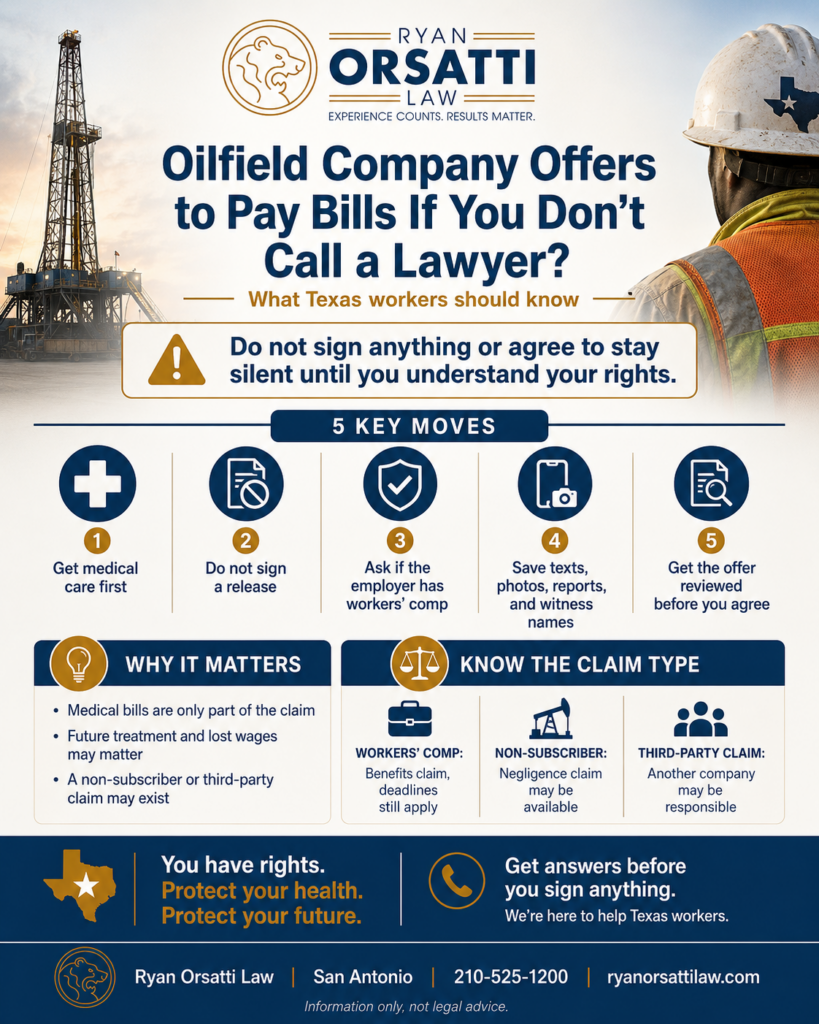
Is it legal for an oilfield company to offer to pay my bills if I do not call a lawyer?
An oilfield company may offer to pay bills, but tying payment to “do not call a lawyer” is a warning sign that you should slow down and review the paperwork first. The danger is not simply that they offered help. The danger is what they may ask for in return.
A company representative, safety manager, insurance adjuster, or third-party administrator may say:
- “We will take care of your bills.”
- “You do not need a lawyer.”
- “Do not make this bigger than it is.”
- “Use our doctor.”
- “Just sign this so payroll can process it.”
- “We need a statement before we can pay anything.”
Those statements can mean different things. Sometimes the company is trying to keep morale high and get medical bills moving. Other times, the company is trying to control the timeline, lock down a statement, avoid OSHA scrutiny, reduce a future claim, or get a broad release before the worker knows the diagnosis.
According to the Bureau of Labor Statistics, oil and gas extraction industries had 65 fatal work injuries nationally in 2024, and the broader mining, quarrying, and oil and gas extraction sector had a fatal injury rate of 13.8 per 100,000 full-time equivalent workers. Oilfield injury claims require careful handling because the work is high-risk, the equipment is complex, and multiple companies may be involved. (Bureau of Labor Statistics)
You can read more about oilfield injury rights on Ryan Orsatti Law’s page on oil field accidents in Texas and the firm’s guide on what to do immediately after an oilfield accident in Texas.
What should I do first if the company says it will pay my medical bills?
You should get medical care first, then document the offer before you agree to anything. A serious oilfield injury can change quickly after the first clinic visit, especially with head trauma, spine injuries, burns, crush injuries, hand injuries, chemical exposure, and internal injuries.
If the company offers to pay bills, ask for the offer in writing. The writing should say whether payment is through Texas workers’ compensation, a non-subscriber benefit plan, a private accident policy, general liability insurance, or a direct company payment.
After an oilfield company offers to pay bills if you do not call a lawyer, do these 7 things:
- Get emergency care or follow-up care based on your symptoms, not based on company pressure.
- Ask whether the employer has Texas workers’ compensation coverage.
- Ask for the name of every insurance company, claim number, adjuster, and third-party administrator.
- Do not sign a release, waiver, resignation, “full and final settlement,” arbitration document, or broad medical authorization without review.
- Save texts, emails, voicemails, incident reports, photos, witness names, job safety analysis forms, and supervisor names.
- Write down who told you not to call a lawyer, when they said it, and what they offered in exchange.
- Preserve evidence early, including equipment photos, vehicle information, rig location, contractor names, PPE, work orders, and safety meeting records.
OSHA states that employers must inform workers of their right to report work-related injuries and illnesses free from retaliation. OSHA also requires employers to report a work-related fatality within 8 hours and a work-related inpatient hospitalization, amputation, or loss of an eye within 24 hours. (OSHA)
Does it matter if the oilfield employer has Texas workers’ compensation?
Yes, workers’ compensation coverage changes the claim completely. If the employer has Texas workers’ compensation insurance, Texas Labor Code § 408.001 generally makes workers’ compensation benefits the exclusive remedy against the employer for a covered work-related injury. (Texas Statutes)
That does not mean you have no rights. It usually means your claim against the employer goes through the Texas workers’ compensation system, while separate claims may still exist against other negligent companies.
Texas workers’ compensation may pay medical benefits and income benefits, but disputes can arise over whether the injury is work-related, whether treatment is reasonable and necessary, whether you can return to work, and what impairment rating applies.
Texas injured employees generally must report the injury to the employer within 30 days, and Texas Labor Code § 409.003 generally requires filing a workers’ compensation claim with the Division of Workers’ Compensation within one year of the injury date. (Texas Department of Insurance)
What if the oilfield company is a Texas non-subscriber?
If the oilfield employer is a Texas non-subscriber, the company does not have Texas workers’ compensation coverage, and the injured worker may have a negligence claim against the employer. Texas is different from most states because private employers can choose whether to provide workers’ compensation coverage. The Texas Department of Insurance calls employers without workers’ compensation coverage “non-subscribers.” (Texas Department of Insurance)
A non-subscriber may still offer private benefits, wage continuation, clinic visits, or bill payment. That is not the same as Texas workers’ compensation.
Texas Labor Code § 406.033 limits certain defenses for non-subscriber employers. In a non-subscriber case, the injured worker still must prove negligence by the employer or by an agent or servant of the employer acting in the general scope of employment, but the employer loses some traditional defenses. (Justia Law)
A non-subscriber case can involve:
- Negligent training
- Unsafe work procedures
- Inadequate supervision
- Defective or poorly maintained equipment
- Lack of proper lockout or tagout procedures
- Pressure to rush the job
- Failure to provide proper personal protective equipment
- Unsafe transportation or loading practices
- Failure to follow job safety analysis procedures
If a non-subscriber says, “We will pay your bills, but do not call a lawyer,” the next question is whether the company wants a waiver. Texas Labor Code § 406.033 says a covered non-subscriber cause of action cannot be waived before the injury or death, and any pre-injury agreement waiving that cause of action or right is void and unenforceable. A post-injury waiver is also restricted and must satisfy statutory conditions. (Texas Department of Insurance)
Could I still have a claim against another oilfield company?
Yes, you may have a third-party claim even if your direct employer has workers’ compensation. A third-party claim is a claim against someone other than your employer, such as the lease operator, drilling contractor, service company, trucking company, equipment manufacturer, maintenance contractor, or property owner.
Oilfield worksites around the Eagle Ford Shale, Permian Basin, South Texas, and West Texas often involve layered contracts. One worker may be employed by a service company, supervised by another company’s field representative, transported by a trucking contractor, and injured by equipment owned or maintained by a different company.
That is why “we will pay your bills” may not answer the real question. The company offering to pay may not be the only party with responsibility. A third-party claim may allow recovery for damages not fully covered by workers’ compensation or a company benefit plan, depending on the facts.
Texas Civil Practice & Remedies Code § 33.001 uses proportionate responsibility, which means a claimant may not recover damages if his percentage of responsibility is greater than 50 percent in covered cases. In plain English, fault allocation can affect whether money is recovered and how much each responsible party may owe. (Texas Statutes)
What paperwork should I be careful about before accepting bill payment?
You should be careful with any document that uses words like “release,” “waiver,” “settlement,” “resignation,” “full satisfaction,” “indemnity,” “confidentiality,” “medical authorization,” or “statement.” Those papers can affect your claim far beyond one ER bill.
Here is how common documents can affect an oilfield injury claim:
| Document or Request | Why It Matters | What to Do Before Signing |
|---|---|---|
| Medical bill payment agreement | May define whether payment is a benefit, loan, settlement advance, or full settlement | Ask whether signing releases any claim |
| Full and final release | May end claims for future care, wage loss, and non-economic damages | Do not sign until diagnosis and future care are known |
| Medical authorization | May allow broad access to unrelated medical history | Limit scope and dates when possible |
| Recorded statement | May be used to blame you before investigation is complete | Request the questions in writing |
| Resignation or separation agreement | May affect wage loss, job rights, and benefits | Review before signing |
| Non-subscriber waiver | Texas law imposes specific post-injury requirements | Confirm timing, medical evaluation, and voluntariness |
| Private benefit plan forms | May include arbitration, offsets, repayment, or plan limits | Request the full plan document |
A release is a contract that gives up legal claims. Once signed, it may be difficult or impossible to undo. The problem is that oilfield injuries often worsen after the first few days. A worker with “back pain” may later need injections or surgery. A worker with a “minor burn” may later need graft care. A worker with “dizziness” may later be diagnosed with a traumatic brain injury.
Are medical bills the only thing the company may owe?
No, medical bills are only one part of the damages analysis. A serious Texas oilfield injury may involve past medical bills, future medical care, lost wages, loss of earning capacity, impairment, disfigurement, physical pain, mental anguish, and loss of household services.
The phrase “we will pay your bills” usually means past medical bills. It may not include:
- Future surgery
- Specialist visits
- Physical therapy
- Burn care
- Medication
- Lost overtime
- Per diem loss
- Job retraining
- Permanent restrictions
- Scarring
- Sleep disruption
- Depression or anxiety tied to injury
- Family care burdens
- Travel for medical care
- Reduced ability to work in the oilfield
In matters we have handled, the gap between “bills so far” and the real case value often appears after the worker sees the right doctor, gets imaging, receives work restrictions, and learns whether the injury will affect future earning capacity.
Attorney Insight: The first offer after an oilfield injury is often built around what the company can see immediately: the ER bill, clinic bill, and a few missed shifts. The claim may change once there is an MRI, burn evaluation, surgical consult, impairment rating, or permanent restriction. A worker should not trade unknown future rights for known early bills without understanding the full medical picture.
What about hospital liens, subrogation, ERISA plans, MedPay, UM/UIM, and letters of protection?
Medical payment issues can affect the net recovery, so you should identify every possible lien and reimbursement claim before settlement. Subrogation means a health plan or benefit payer claims a right to be repaid from injury settlement money. An ERISA plan is an employer-sponsored benefit plan governed by federal law, and some ERISA plans assert strong reimbursement rights.
Texas Property Code Chapter 55 gives hospitals a lien in certain accident cases when hospital services are provided for injuries caused by an accident attributed to another person’s negligence. For the hospital lien to attach, the person generally must be admitted to a hospital not later than 72 hours after the accident. (Texas Statutes)
A letter of protection is an agreement where a medical provider treats now and waits for payment from a later claim recovery. It can help when treatment is needed, but it also creates a balance that must be handled at settlement.
MedPay and UM/UIM usually matter when a motor vehicle crash is part of the oilfield event. MedPay means medical payments coverage. UM/UIM means uninsured or underinsured motorist coverage. These coverages may apply if the injury involved a company truck, third-party driver, oilfield traffic crash, or personal vehicle collision, but they do not apply to every rig, well-site, or plant injury.
How long do I have to decide whether to bring a Texas oilfield injury claim?
For many Texas personal injury claims, the lawsuit deadline is two years, but shorter workers’ compensation notice and claim deadlines may apply. Texas Civil Practice & Remedies Code § 16.003 generally requires personal injury and wrongful death lawsuits to be filed not later than two years after the claim accrues. (Texas Statutes)
Do not treat two years as a safe waiting period. Oilfield evidence can disappear fast. Trucks get repaired. Equipment gets returned to vendors. Contractors leave the site. Safety paperwork gets revised. Video may be overwritten. Witnesses move to other jobs. A spoliation letter is a written preservation demand that tells companies to keep evidence that may be relevant to a claim.
In San Antonio and Bexar County cases involving South Texas oilfield operations, early evidence work often focuses on identifying every company on site, every safety document, and every equipment owner before the file becomes a finger-pointing contest.
When should I call a lawyer after an oilfield company offers to pay bills?
You should call a lawyer before signing anything that limits your rights, gives broad access to your records, or conditions payment on silence. The point is not to turn every injury into a lawsuit. The point is to understand the coverage, deadlines, documents, and evidence before you make an irreversible decision.
A lawyer can help determine:
- Whether the employer has workers’ compensation coverage
- Whether the employer is a Texas non-subscriber
- Whether a third-party claim exists
- Whether the offer includes a release or waiver
- Whether the medical care plan is adequate
- Whether the company is trying to obtain a recorded statement too early
- Whether OSHA reporting or injury reporting issues exist
- Whether hospital liens, ERISA reimbursement, or subrogation claims may affect the net recovery
- Whether urgent evidence preservation is needed
Ryan Orsatti Law handles serious injury cases for workers and families in San Antonio, Bexar County, South Texas, and across Texas. The firm’s San Antonio personal injury law firm page explains the practice areas the firm handles, including oil field accidents, commercial vehicle accidents, catastrophic injuries, and wrongful death. For serious burn injuries, the firm also has a resource on San Antonio burn injury claims. Families facing fatal oilfield incidents can review the firm’s page on Texas wrongful death claims.
What should I say if the company pressures me not to call a lawyer?
You can keep the conversation calm and ask for everything in writing. A simple response is often enough:
“I appreciate the offer to help with medical bills. Please send me the offer, the insurance information, the claim number, and any paperwork you want me to sign. I am not agreeing to release any rights or give a recorded statement today.”
You do not have to argue with a supervisor or adjuster at the job site. You also do not have to accuse anyone of wrongdoing before the facts are known. Your immediate goals are medical care, documentation, and preservation.
If someone threatens your job, light duty, benefits, immigration status, references, or future work because you reported an injury or asked about legal rights, write down exactly what was said. OSHA states that workers can report safety concerns without being punished or treated unfairly. (OSHA)
FAQ
Can the oilfield company pay my bills and still be responsible for more later?
Yes, depending on the wording of the agreement and the type of claim. A company can pay bills without ending the claim, but a release or waiver may cut off future rights. Before accepting payment, confirm whether the money is a benefit, partial payment, settlement, loan, or full release.
Does accepting medical bill payment mean I cannot sue later?
Not always. Accepting payment does not automatically mean you released your claim, but signing a release, waiver, settlement agreement, or non-subscriber document may change that. The exact language matters. In Texas non-subscriber cases, post-injury waivers are subject to statutory requirements under Texas Labor Code § 406.033. (Texas Department of Insurance)
What if my supervisor told me not to report the injury?
Report the injury in writing anyway and keep proof. If the employer has Texas workers’ compensation coverage, Texas injured workers generally must report the injury within 30 days. If a supervisor discourages reporting, save texts, emails, call logs, and witness names because delayed reporting can become a claim dispute. (Texas Department of Insurance)
What if the company doctor says I am fine but I still hurt?
Follow up with appropriate medical care if symptoms continue. Company clinics often focus on work status and immediate restrictions, not always the full long-term diagnosis. Persistent pain, numbness, dizziness, burns, weakness, headaches, or worsening symptoms should be documented and evaluated by the right medical provider.
Can I call a lawyer if I already have workers’ compensation?
Yes. The Texas Department of Insurance says injured employees do not have to have an attorney, but they have the right to get help from one at any time. A lawyer may help with benefit disputes, medical care disputes, impairment issues, and possible third-party claims. (Texas Department of Insurance)
What if the oilfield accident involved a truck or company vehicle?
A truck or company vehicle can create additional insurance issues. Depending on the facts, the case may involve workers’ compensation, a non-subscriber claim, a commercial auto policy, MedPay, UM/UIM, negligent hiring, maintenance records, driver logs, and third-party contractor liability. Preserve vehicle photos, driver names, DOT numbers, and crash reports.
How fast should evidence be preserved after an oilfield injury?
Evidence should be preserved immediately. Rig sites, yards, lease roads, and service company equipment can change within hours. Key evidence may include incident reports, job safety analysis forms, maintenance logs, tool records, ELD data, dashcam video, inspection records, PPE, training records, and witness statements.
Should I sign a release if the company says it will pay everything?
Do not sign a release until you know what “everything” means. Past bills are not the same as future care, lost earning capacity, impairment, pain, disfigurement, or lien resolution. A fair review starts with the full medical diagnosis, coverage information, work restrictions, and all written terms of the proposed agreement.
Ryan Orsatti Law
4634 De Zavala Rd, San Antonio, TX 78249
Phone: 210-525-1200
ryanorsattilaw.com
This blog is for informational purposes only, not legal advice. Reading it does not create an attorney-client relationship. Past results do not guarantee future results.
Hurt in an accident in San Antonio? Learn how a San Antonio personal injury lawyer can help with your claim. Call 210-525-1200 or request a free consultation. There is no fee unless we win.
Related San Antonio legal resources
- San Antonio construction-accident representation
- Texas personal-injury services
- Contact Ryan Orsatti Law
Primary legal and public-data sources
- Texas Civil Practice and Remedies Code Chapter 16: limitations
- Texas Civil Practice and Remedies Code Chapter 33: proportionate responsibility
Ryan Orsatti Law
4634 De Zavala Road, San Antonio, TX 78249
Source links verified August 7, 2026.