
Quick Answer
- Ask for a written copy of the incident report from your spouse’s employer before the worksite shifts or changes.
- Collect every emergency room record, hospital bill, treatment note, and prescription from day one.
- Save pay stubs, the employment contract or offer letter, and any work-schedule documentation going back at least six months.
- Keep all communications from insurance adjusters in writing; do not let your spouse give a recorded statement before speaking with a lawyer.
Key Takeaways
- Texas law gives injured workers and their families generally two years from the date of injury to file a personal injury lawsuit under Tex. Civ. Prac. & Rem. Code § 16.003, but shorter windows apply when government contractors are involved.
- Texas is the only state where most private employers can legally opt out of workers’ compensation insurance. A non-subscriber employer means your family may have a full civil damages claim rather than a capped workers’ comp benefit.
- Multiple companies share a single oilfield site. Operators, drilling contractors, subcontractors, equipment manufacturers, and chemical suppliers can each carry independent liability and each controls different records.
- OSHA requires employers to report work-related fatalities within 8 hours and hospitalizations or amputations within 24 hours (29 C.F.R. § 1904.39). That report becomes a key document in your case.
- The documents gathered in the first two weeks usually carry more weight than anything pulled months later, because worksites change, contractors rotate off, and memories fade.
Why the Paper Trail Matters More in a Texas Oilfield Case
A single oilfield site in Texas can involve an operator, a drilling contractor, a well-servicing company, a frac crew, water and sand haulers, and multiple subcontractors, all on the same lease at the same time. When something goes wrong, each of those companies controls records that may prove what caused the accident. Their legal teams and insurance carriers move fast. In serious incidents, investigators are often on site within hours.
According to the NIOSH Fatalities in Oil and Gas Extraction Database, Texas recorded 219 oilfield worker deaths between 2018 and 2023, more than any other state in the country. Behind every number in that database is a family that faced insurance carriers, employer defense teams, and multi-company liability questions, often with little guidance on where to start.
The answer starts with documents. This checklist is written for the spouse or family member handling logistics while the worker recovers or while the family processes a catastrophic loss. You do not need to know the law to save the right records. You only need to know where to look and what to ask for.
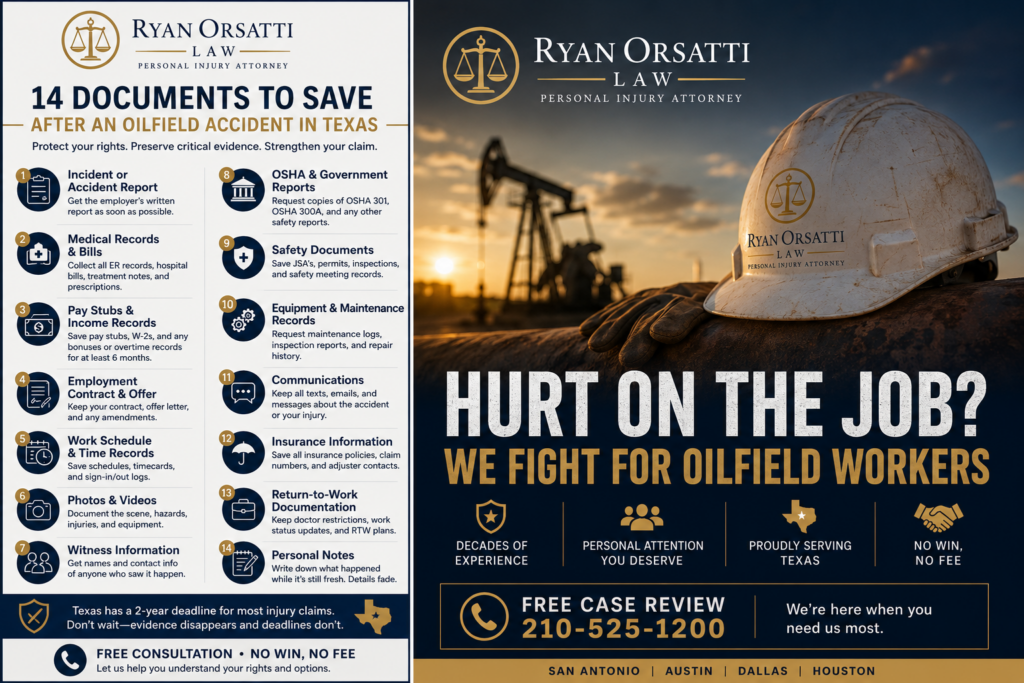
14 Documents to Start Saving Right Now After a Texas Oilfield Accident
- Written incident or accident report. Request this from the employer in writing as soon as possible. The employer controls the first written version of what happened. Getting a copy early, before anyone has had time to refine the account, lets a lawyer compare it against later statements and spot inconsistencies.
- OSHA Form 301 (Injury and Illness Incident Report). Employers covered by OSHA must complete this form within 7 days of learning about a recordable injury. Under 29 C.F.R. § 1904.35(b)(2), current and former employees and their authorized representatives have the right to request a copy of Form 301. The employer must provide it within four business hours of the request. Put your request in writing and keep a copy.
- Emergency room and hospital records. Request these at discharge or by written request shortly after. Ask specifically for intake notes, imaging results, physician notes, operative reports, and discharge instructions. These documents capture the nature and severity of the injury while it is closest in time to the event.
- All medical bills and Explanation of Benefits forms (EOBs). Save every invoice from every provider: ambulance services, emergency physicians, specialists, physical therapists, and pharmacies. Keep the EOBs (the forms from your health insurer showing what was billed, adjusted, and paid) alongside the bills. Together they establish both the total medical cost and what remains unpaid.
- Doctor’s notes, treatment plans, and work restrictions. Every time your spouse sees any provider, get the written note. Work-restriction documentation is particularly important. It ties the injury directly to lost income and establishes what your spouse cannot physically do, which is central to calculating damages.
- Prescription records. Keep a log of every prescription filled: the date, medication name, prescribing provider, pharmacy, and out-of-pocket cost. These are often overlooked but directly recoverable as economic damages.
- Pay stubs and employment records. Gather the last six months of pay stubs. Add the employment contract, offer letter, or any written job description. These documents establish your spouse’s wage rate, overtime patterns, job classification, and employee status, all of which affect how lost income is calculated in either a workers’ comp claim or a civil lawsuit.
- Workers’ compensation claim paperwork. If the employer subscribes to Texas workers’ comp, save every form, acknowledgment letter, and any denial. Under Tex. Lab. Code § 409.001, an injured worker must notify the employer of the injury within 30 days, and a formal claim must be filed with the Texas Division of Workers’ Compensation (Texas DWC) within one year of the injury. Missing either deadline can affect benefits, so document every step.
- All communications from the employer and insurance adjusters. Save every text, email, voicemail, and letter. Do not delete anything, even messages that seem routine. Adjuster communications can lock in admissions or inconsistencies that become useful later. If an adjuster calls, your spouse does not have to give a recorded statement. Politely decline and consult a lawyer first.
- Photographs of your spouse’s injuries. Take photos at the hospital and at regular intervals throughout recovery. Documenting the progression of burns, bruising, surgical incisions, or physical limitations over time creates a visual record that written descriptions alone cannot replicate. Timestamps matter.
- Witness contact information. If your spouse can identify coworkers or contractors who were present when the accident happened, write down their full names, cell phone numbers, and the company they work for. Oilfield workers rotate off sites quickly. Contact information gathered in the first week is often impossible to obtain a month later.
- Any company safety records or prior incident mentions your spouse recalls. If your spouse remembers hearing about a prior accident on the same site, seeing an OSHA citation posted, or receiving safety training records, note every detail. Prior violation history is available through formal channels and can be directly relevant to whether the company acted with gross negligence.
- A daily injury and symptoms journal. Start writing today. A short daily entry covering what symptoms your spouse experienced, what they could not do, how they slept, and how the injury affected your household is nearly impossible to reconstruct after the fact. This journal is one of the strongest tools available for documenting pain, suffering, and loss of daily life enjoyment.
- Household and out-of-pocket expense records. Save receipts for anything the injury has forced your family to spend: transportation to medical appointments, home health aides, rental equipment, prescription co-pays, childcare costs created by the injury, and any home modifications. These expenses are recoverable damages in a personal injury claim and are easy to document when tracked from the beginning.
Attorney Insight The incident report is the first document we request, and it is often the one families forget to ask for. In oilfield matters we handle, the employer’s written report and the worker’s account of events frequently do not match. By the time an employer has had a week to write up what happened, details can shift in ways that favor the company. Getting a copy of that report on day one, before anyone has refined it, is one of the single most important steps a family can take. If the employer says one is not available yet, put the request in writing with the date and follow up.
Which Documents You Control and Which Require a Request
| Document | Who Controls It | When to Request | Why It Matters |
|---|---|---|---|
| Written incident report | Employer | Same day or next day; request in writing | Captures the employer’s initial account before it is refined; key for spotting inconsistencies |
| OSHA Form 301 | Employer (OSHA-covered workplaces) | Within the first week; employer must provide within 4 business hours under 29 C.F.R. § 1904.35 | Official injury incident report; preserves facts documented by the employer under a federal regulatory obligation |
| Emergency room and hospital records | Hospital or clinic | Request in writing at discharge or shortly after | Documents severity and nature of injury at the earliest possible point in time |
| Medical bills and EOBs | Providers and health insurer | As they arrive by mail; request duplicates if missed | Establishes economic damages; shows total cost, insurance adjustments, and outstanding amounts |
| Pay stubs and employment records | Employer HR department | First week; request in writing before any HR changes | Required to calculate lost wages and confirm employee classification |
| Insurance adjuster communications | Insurance carrier | Save everything as received; do not delete voicemails | Adjuster statements can contain admissions about coverage or liability that become evidence |
| Daily injury journal | Your family | Start today; continue daily through recovery | Irreplaceable record of pain, functional limitations, and daily life impact; cannot be reconstructed later |
| Safety Data Sheets (SDS) for chemicals on site | Employer and chemical manufacturers | Request immediately if any chemical exposure is suspected | Required by OSHA’s Hazard Communication Standard; critical for exposure injuries involving H2S, produced water, silica, or industrial chemicals; records can disappear when contractors rotate |
Workers’ Comp Subscriber vs. Non-Subscriber: Why It Changes What You Need
Texas is the only state in the country that does not require most private employers to carry workers’ compensation insurance. That distinction matters immediately after an oilfield accident because it determines which legal path is available and what documents are most critical.
If the employer subscribes to Texas workers’ comp, an injured employee typically goes through the Texas DWC system. Benefits cover medical care and a portion of lost wages, but pain and suffering damages are generally not available, and the employee usually cannot sue the employer in civil court. To protect your family’s rights under that system, report the injury to the employer within 30 days under Tex. Lab. Code § 409.001 and file a formal claim with Texas DWC within one year of the injury.
If the employer is a non-subscriber, the injured worker keeps the full right to sue in civil court. Non-subscriber employers lose several standard defenses, and there is no cap on pain and suffering or future earning capacity damages. Non-subscriber cases require stronger documentation from the outset because no administrative claim process generates records on your behalf.
Even in a workers’ comp subscriber case, your spouse may have a separate third-party claim against another company on the site, such as an equipment manufacturer whose product failed or a subcontractor whose crew created the hazard. That third-party claim is an ordinary personal injury lawsuit and is not limited by workers’ comp rules.
The Filing Deadlines Texas Families Need to Know
In Texas, the general deadline to file a personal injury lawsuit is two years from the date of injury, under Tex. Civ. Prac. & Rem. Code § 16.003. A wrongful death action carries the same two-year window from the date of death. Missing that deadline almost always ends the claim permanently, regardless of how strong the evidence is.
Two circumstances shorten that window. First, if your spouse worked for a company contracting with a federal government entity, the Federal Tort Claims Act imposes a two-year limit on administrative claims, with pre-suit steps that take time to complete. Second, if any government entity or municipality was involved in the accident, the Texas Tort Claims Act may require written notice within 90 days of the incident.
Workers’ comp runs on a shorter timeline: notify the employer within 30 days of the injury under Tex. Lab. Code § 409.001, and file the formal claim with Texas DWC within one year. Missing the 30-day employer notice requirement can create problems with the workers’ comp claim even when the injury is undisputed.
Two years feels like a long time. In a serious oilfield case, it is not. Preservation letters must go out, witnesses must be located while they are still accessible, and a thorough investigation of every company on that site takes time to build.
Attorney Insight One category families almost always overlook in the first few days: chemical exposure records. If the injury involved hydrogen sulfide (H2S), produced water, silica dust from frac sand, benzene, or any industrial chemical on the site, the employer is required under OSHA’s Hazard Communication Standard (29 C.F.R. § 1910.1200) to maintain Safety Data Sheets for every substance workers are exposed to. Those records can be requested, but the window closes quickly when contractor rotations change who controls the site. If there is any chance of a chemical component to the injury, flag it for a lawyer immediately and request the SDS files in writing before the worksite changes hands.
What to Do With the Documents Once You Have Them
Keep originals somewhere safe and separate from anything given to you by the employer or insurer. Make digital backups and store them in a location only you control. Do not hand originals to an insurance adjuster or let anyone take the only copy.
When you bring these documents to a lawyer, the attorney is looking for several things: whether the incident report matches your spouse’s account, whether a third-party claim exists against a company other than the direct employer, whether OSHA violations or prior safety citations support a negligence or gross negligence theory, and whether the employment records correctly reflect your spouse’s actual duties, hours, and pay. The documents you gather are not just evidence of what happened. They are the map that shows every entity that may be responsible.
If the accident involved a commercial vehicle or oilfield truck, electronic data from vehicle systems often supplements the paper documents. The firm’s related article on preserving electronic vehicle data in Permian Basin oilfield truck cases covers that evidence trail in detail.
How a Texas Oilfield Injury Lawyer Reviews These Documents
When a family brings in a document file from the first weeks after a serious oilfield injury, the first question is: who else was on that site? In our experience representing injured Texans on oilfield cases, the direct employer is rarely the only party responsible. An equipment manufacturer with a defective pressure coupling, a contractor who failed to follow a lockout/tagout procedure, or a chemical supplier whose product lacked adequate warnings can each carry independent liability, and each controls different records that may not surface without a formal legal demand.
Ryan Orsatti Law handles catastrophic injury and wrongful death claims arising from Texas oilfield accidents, including cases involving Permian Basin operators, Eagle Ford Shale sites, and refinery-adjacent locations along the Gulf Coast. The firm works on a contingency fee basis: no attorney’s fee unless we recover for you. Consultations are free and available in English and Spanish. If you have questions about the documents you have already gathered or what options your family may have, reach out for a free consultation.
Frequently Asked Questions
How long does my spouse have to file an oilfield injury lawsuit in Texas?
The general deadline is two years from the date of injury under Tex. Civ. Prac. & Rem. Code § 16.003. Workers’ comp claims must be filed with Texas DWC within one year and the injury reported to the employer within 30 days. Cases involving government contractors may have shorter deadlines, and notice requirements apply when a government entity is involved. Two years passes faster than families expect when a serious investigation is needed. Talk to a lawyer as soon as the immediate medical situation allows.
What if my spouse’s employer does not have workers’ compensation?
Texas does not require most private employers to carry workers’ comp. If the employer is a non-subscriber, your spouse keeps the full right to file a civil personal injury lawsuit with no cap on pain and suffering or lost future earning capacity. The employer also loses several common defenses in that lawsuit. Identifying non-subscriber status early, before making claims statements or signing any paperwork, changes which legal route makes the most sense and how documents should be gathered.
Can I request the OSHA Form 301 from my spouse’s employer?
Yes. Under 29 C.F.R. § 1904.35, current and former employees and their authorized representatives have the right to receive a copy of the OSHA Form 301 (Injury and Illness Incident Report) for the injured employee. The employer must provide it within four business hours of a written request. Send the request in writing, keep a copy of the request and record the date you sent it, and follow up if you do not receive a response within the required window.
Should my spouse give a recorded statement to the insurance adjuster?
No. An adjuster representing the employer’s insurer or a third-party carrier is working to protect the company’s position, not your family’s. A recorded statement made without legal counsel can lock in details in ways that harm the claim. Your spouse has no legal obligation to give a recorded statement to a third-party adjuster. Declining politely and consulting a lawyer first protects the record and preserves options. This is one step that cannot be undone after the fact.
What if my spouse was partly responsible for the accident?
Texas uses proportionate responsibility (Tex. Civ. Prac. & Rem. Code § 33.001), meaning an injured person can still recover as long as their share of fault does not exceed 50 percent. If your spouse is found 25 percent responsible, total damages are reduced by 25 percent. Oilfield defendants routinely argue comparative fault to reduce what they owe. The documents you gather in the first weeks, particularly the incident report, OSHA records, and witness information, are the primary tools for countering those arguments with objective evidence.
What if multiple companies were on the site when the accident happened?
This is common in Texas oilfield cases, and it is one reason oilfield injury claims are more complex than most workplace accidents. An operator, drilling contractor, equipment manufacturer, and chemical supplier can each carry independent legal responsibility for their own negligence. A workers’ comp claim against a direct employer does not prevent a separate lawsuit against other parties on the site. Documenting each company’s role, which entity controlled which equipment, and who had safety oversight responsibility is critical to identifying every available claim.
Source Notes
This post relies on the following primary authorities:
- Tex. Civ. Prac. & Rem. Code § 16.003 (two-year limitations period for personal injury and wrongful death): statutes.capitol.texas.gov
- Tex. Civ. Prac. & Rem. Code § 33.001 (proportionate responsibility): statutes.capitol.texas.gov
- Tex. Lab. Code §§ 409.001-409.003 (workers’ comp injury reporting and claim filing deadlines): statutes.capitol.texas.gov
- 29 C.F.R. § 1904.39 (OSHA employer reporting of fatalities and severe injuries) and 29 C.F.R. § 1904.35 (employee access to OSHA injury records): osha.gov/recordkeeping
- 29 C.F.R. § 1910.1200 (OSHA Hazard Communication Standard; Safety Data Sheet obligations): osha.gov/hazcom
- NIOSH Fatalities in Oil and Gas Extraction (FOGD) Database (2018-2023), Texas fatality data: cdc.gov/niosh/topics/oilgas
Ryan Orsatti Law
4634 De Zavala Rd, San Antonio, TX 78249
Phone: 210-525-1200
ryanorsattilaw.com
This blog is for informational purposes only, not legal advice. Reading it does not create an attorney-client relationship. Past results do not guarantee future results.
Hurt in an accident in San Antonio? Learn how a San Antonio personal injury lawyer can help with your claim. Call 210-525-1200 or request a free consultation.
The firm works on a contingency fee. You pay nothing unless the firm recovers money for you, and that covers case expenses as well as the fee: if there is no recovery, you owe no attorney's fee and no case expenses. Ask for the fee agreement and read the fee and expense section before you sign anything.
Related San Antonio legal resources
- San Antonio construction-accident representation
- Texas personal-injury services
- Contact Ryan Orsatti Law
Primary legal and public-data sources
- Texas Civil Practice and Remedies Code Chapter 16: limitations
- Texas Civil Practice and Remedies Code Chapter 33: proportionate responsibility
Ryan Orsatti Law
4634 De Zavala Road, San Antonio, TX 78249
General reference links. Consult each source for its current text.