
Quick Answer
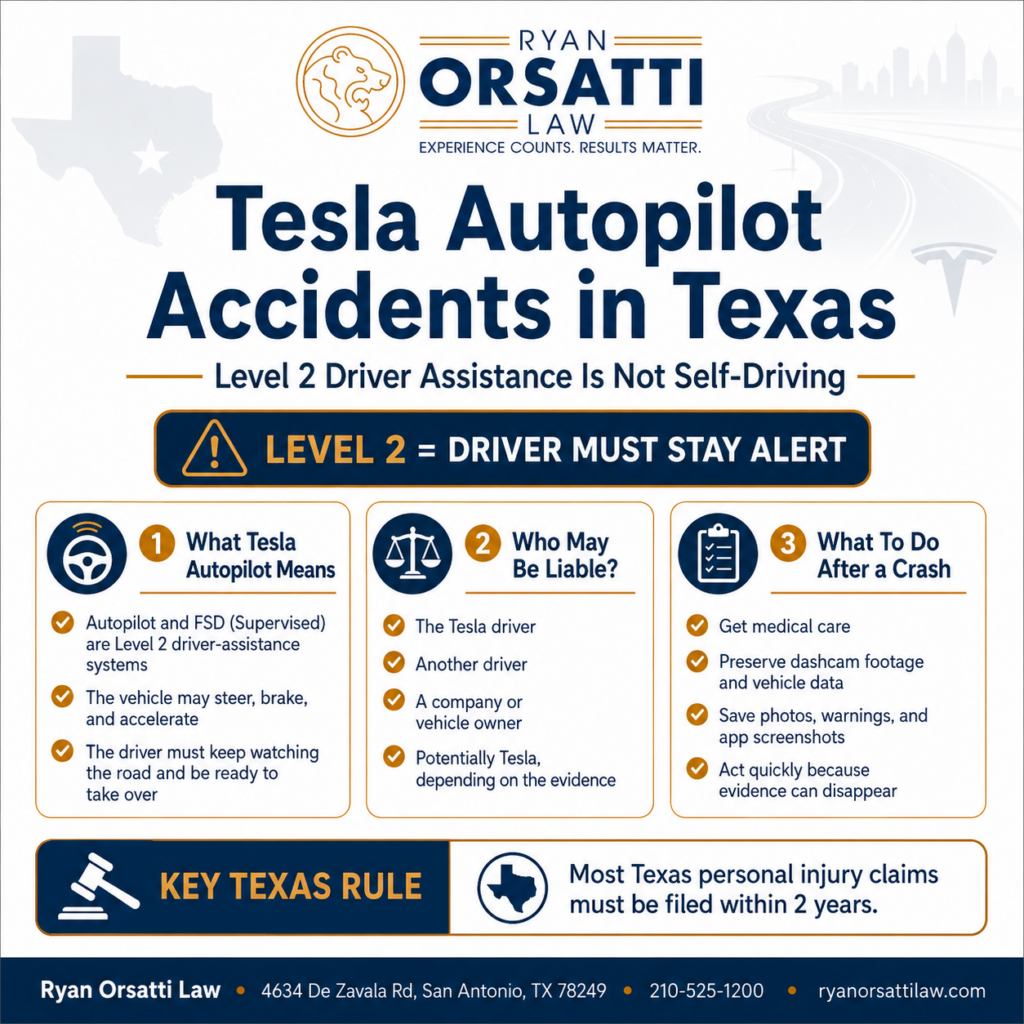
Tesla Autopilot and Full Self-Driving (Supervised) are driver-assistance systems, not autonomous driving. Under the Level 2 classification, the vehicle may control steering, acceleration, and braking, but the human driver must remain attentive and responsible for operating the vehicle. After a Texas crash, liability may involve the Tesla driver, another motorist, a company, or potentially Tesla, depending on the vehicle data and the cause of the collision.
Key Takeaways
- Tesla Autopilot and FSD (Supervised) do not turn the driver into a passenger.
- Autopilot activation does not automatically establish who caused the crash.
- Tesla vehicle data, camera footage, software information, and driver-monitoring records may be critical evidence.
- Texas can divide responsibility among several people or companies.
- A claimant who is more than 50 percent responsible generally cannot recover damages under Texas law.
- Most Texas personal injury lawsuits must be filed within two years, although exceptions and shorter notice requirements may apply.
Why Is Tesla Autopilot Level 2 Instead of Self-Driving?
Tesla Autopilot is considered Level 2 because it can assist with both steering and speed while requiring the driver to supervise continuously. The National Highway Traffic Safety Administration describes Level 2 as “You Drive, You Monitor,” meaning the human driver remains responsible for watching the road and responding immediately when necessary. Tesla likewise states that its driver-assistance features do not make its vehicles fully autonomous.
The distinction matters after a collision. A Tesla driver generally cannot avoid responsibility merely by saying the vehicle was steering or braking. At the same time, the Level 2 classification does not automatically eliminate a possible claim involving a software malfunction, inadequate warning, defective design, or other product issue.
| Automation level | What the system can do | Human driver’s role | Relevance to a Texas crash |
|---|---|---|---|
| Level 2 | Continuously assists with steering and acceleration or braking | Must remain attentive, supervise the system, and take control when needed | This is the category applicable to Tesla Autopilot and FSD (Supervised) |
| Level 3 | Performs the driving task under limited conditions | Must be available to take over when requested | Different from Tesla’s supervised consumer system |
| Level 4 | Performs all driving within defined conditions | A human driver may not be necessary in those conditions | Texas’s commercial automated-vehicle program addresses Level 4 and Level 5 vehicles |
| Level 5 | Performs all driving under all roadway conditions | Occupants are passengers | Fully autonomous consumer vehicles are not currently available for ordinary public purchase and use |
The classifications come from NHTSA’s automated-vehicle guidance. Texas’s current Automated Vehicles Regulatory Program is directed at commercial Level 4 and Level 5 vehicles operating without human drivers, not an ordinary motorist using Level 2 assistance.
Key takeaway: A person using Tesla Autopilot or FSD (Supervised) remains the vehicle’s driver and must continue monitoring the roadway.
Who Can Be Liable for a Tesla Autopilot Accident in Texas?
Liability may be divided among the Tesla driver, another driver, an employer or vehicle owner, and potentially a product manufacturer or seller. The correct answer depends on what each party did, whether the automated feature was engaged, what warnings appeared, and whether a human or technological failure actually caused the collision.
When Is the Tesla Driver Liable?
A Tesla driver may be liable when the driver fails to watch the road, ignores warnings, misuses the feature, drives too fast for conditions, or fails to intervene when a reasonably attentive driver would have done so. Tesla expressly warns that FSD (Supervised) requires active supervision and that the driver remains responsible for controlling the vehicle.
Examples may include:
- Looking at a phone while Autopilot is active
- Ignoring visual or audible driver-attention warnings
- Using the feature on an unsuitable roadway
- Failing to respond to construction, stopped traffic, debris, or an emergency vehicle
- Continuing to use the system in heavy fog, glare, dust, or other conditions that impair visibility
- Driving while fatigued, impaired, or otherwise unable to intervene safely
The feature’s name does not replace the driver’s duty to use reasonable care. An insurer may examine cabin-camera information, steering-wheel inputs, warning records, phone activity, witness testimony, and the driver’s own statements.
Can Tesla Be Liable for an Autopilot or FSD Crash?
Tesla may be liable only if the evidence supports a legally recognized product claim, such as a defective design, inadequate warning, manufacturing defect, or misrepresentation that caused the injury. A bad outcome alone does not prove that the vehicle was defective.
Under Texas Civil Practice and Remedies Code § 82.005, a design-defect claimant ordinarily must prove that a safer alternative design existed and that the alleged defect was a producing cause of the injury, meaning it actually contributed to causing the harm. Texas law defines product-liability actions broadly enough to include personal injury and property-damage claims based on defective products or inadequate warnings.
A potential product claim may require analysis of:
- The Tesla model and model year
- The exact software version installed
- Whether Autopilot or FSD (Supervised) was active
- The roadway and weather conditions
- System warnings before impact
- Driver-monitoring information
- Camera, radar, or sensor performance
- Whether the driver had enough time to recognize the danger and intervene
- Whether a reasonable alternative design or warning could have prevented the crash
These cases often require engineers, vehicle-data professionals, or accident reconstructionists. A lawyer should not assume a product claim exists merely because a Tesla was involved.
Can Another Driver or Company Share Fault?
Yes. Another driver, commercial carrier, employer, vehicle owner, roadway contractor, or other responsible entity may share fault even when Autopilot was active.
For example, a speeding driver may cut across the Tesla’s lane, a trucking company may place an unsafe commercial vehicle on the road, or a construction contractor may create an unreasonably dangerous traffic pattern. If a Tesla driver was working at the time, the driver’s employer may also become relevant under agency or employment principles.
The case should be investigated as a complete collision, not reduced to the question of whether Autopilot was on.
What Evidence Matters Most After a Tesla Autopilot Crash?
The most important evidence includes the Tesla’s electronic data, camera recordings, physical condition, software version, system warnings, driver inputs, and independent crash evidence. Preservation should begin before the vehicle is repaired, sold, reset, salvaged, or materially altered.
NHTSA’s Autopilot investigation demonstrates the importance of electronic evidence. The agency reviewed onboard video, event data recorder information, vehicle logs, and other records when examining hundreds of reported crashes. An event data recorder is the vehicle component commonly described as a “black box,” although Tesla systems may contain additional information beyond the traditional crash recorder.
What Should You Preserve After the Crash?
Take the following steps when they can be completed safely:
- Obtain medical care and report the collision.
Call 911 when appropriate and describe all symptoms accurately. Some injuries may become more noticeable after the initial shock wears off. - Protect the Tesla from unnecessary changes.
Do not authorize repairs, destruction, salvage disposal, or major software-related action until counsel determines whether an inspection or data download is needed. - Photograph the vehicle and interior displays.
Capture exterior damage, wheel positions, deployed restraints, dashboard messages, touchscreen warnings, road markings, weather, traffic controls, and surrounding sight lines. - Save video and account information.
Preserve Tesla dashcam or Sentry Mode footage, phone videos, photographs, app screenshots, subscription records, driver profiles, and any information showing which software version was installed. - Request available Tesla account data.
Tesla provides a privacy-request process through which an owner may seek a copy of account-related data for a specified period. The scope of available information varies, so the request should not replace a formal preservation demand. - Send preservation notices.
A preservation notice, sometimes called a spoliation letter, is a written demand that relevant evidence not be destroyed or altered. Notices may be appropriate for Tesla, an insurer, a repair facility, a towing company, another driver, or a commercial defendant. - Collect independent evidence.
Obtain the crash report, witness information, business surveillance footage, traffic-camera information when available, phone records, photographs, medical records, and towing or repair documents.
Attorney Insight: In a Level 2 crash, an insurer may try to force a false choice between human error and software error. Texas law can recognize shared responsibility. The stronger approach is to preserve the vehicle and electronic evidence first, then determine how the driver, system, roadway conditions, and other motorists interacted.
A San Antonio car accident lawyer can coordinate preservation demands, inspections, insurance communications, and requests for records before important evidence disappears.
What Do NHTSA’s Tesla Autopilot Investigations Mean for a Texas Claim?
NHTSA’s investigations show that Autopilot crashes require detailed, case-specific analysis, but an investigation does not prove that Tesla is liable in an individual lawsuit. Agency findings can identify system-wide safety concerns while the facts of a particular Texas collision still must establish causation, fault, and damages.
In its April 2024 report, NHTSA stated that it reviewed 956 crashes in which Autopilot was initially alleged to have been in use. That number does not mean Autopilot caused all 956 crashes. NHTSA placed approximately 489 reports into categories involving insufficient data, another vehicle’s fault, nonuse of Autopilot, or circumstances unrelated to the investigation. It then evaluated patterns in the remaining 467 crashes.
NHTSA reported concerns about a mismatch between the system’s capabilities and drivers’ expectations, along with controls that did not always ensure adequate attention. The agency identified crashes involving frontal impacts, road departures following system disengagement, and loss of control in low-traction conditions.
On July 2, 2026, NHTSA upgraded a separate investigation into FSD performance under reduced-visibility conditions to an engineering analysis. The agency identified nine known crashes involving conditions such as glare, fog, or airborne dust and is examining whether drivers received enough warning to intervene. The investigation remains an inquiry, not a final determination that a defect caused any specific Texas crash.
How Does Texas Proportionate Responsibility Apply to a Tesla Crash?
Texas can assign percentages of responsibility to every person or company whose conduct contributed to the collision. Proportionate responsibility means the claimant’s recovery may be reduced by the claimant’s own percentage of fault, and a claimant who is more than 50 percent responsible generally cannot recover damages.
Under Texas Civil Practice and Remedies Code § 33.001, recovery is barred when the claimant’s percentage of responsibility is greater than 50 percent. If the claimant is 50 percent responsible or less, Texas law generally reduces the recoverable damages by that percentage.
Consider a collision in which a Tesla driver failed to respond promptly to a system warning, but another driver made an unsafe lane change. A factfinder could divide responsibility between them. If evidence also establishes that a defective warning or system behavior contributed to the crash, a manufacturer could potentially be included in the allocation.
The percentages are driven by evidence, not by the vehicle’s brand or the name of the software.
What Insurance May Pay After a Tesla Autopilot Accident?
Payment may come from the at-fault driver’s liability coverage, the injured person’s own policy, a commercial policy, or another responsible entity’s insurance. Coverage depends on the policies, exclusions, vehicle use, household drivers, and the identities of all responsible parties.
Potential sources include:
- Bodily injury liability coverage
- Property damage liability coverage
- Personal injury protection, commonly called PIP
- Medical payments coverage
- Uninsured or underinsured motorist coverage
- An employer’s commercial automobile policy
- A vehicle owner’s policy
- Product-liability insurance
- Umbrella or excess coverage
A software-related allegation does not eliminate the need to investigate ordinary automobile coverage. Likewise, an insurer should not assume that the Tesla driver is solely responsible merely because Level 2 assistance was active.
Ryan Orsatti Law provides additional information about Texas car insurance requirements and payment of medical bills after a car accident.
How Long Do You Have to File a Tesla Accident Lawsuit in Texas?
Most Texas personal injury lawsuits arising from a vehicle collision must be filed within two years of the date of injury. Missing the applicable deadline can prevent recovery regardless of how strong the underlying evidence may have been.
The general two-year limitation appears in Texas Civil Practice and Remedies Code § 16.003. Wrongful death claims are also generally subject to a two-year limitations period, although the calculation and available exceptions can depend on the circumstances.
Do not treat two years as a safe period to postpone investigation. Tesla data, surveillance footage, witness memories, physical evidence, and damaged vehicle components may disappear much earlier. Claims involving governmental entities can also involve notice provisions that arise well before the ordinary filing deadline.
Read more about the Texas two-year statute of limitations and possible exceptions.
When Should You Contact a Tesla Autopilot Accident Lawyer in Texas?
You should contact a lawyer promptly when the crash caused a serious injury or death, fault is disputed, Autopilot or FSD may have been engaged, the vehicle may contain important electronic evidence, or a product-related issue is being considered. Early legal involvement can help prevent insurers, repair facilities, or other parties from disposing of evidence before it is evaluated.
Legal assistance may be particularly important when:
- The driver says the Tesla acted unexpectedly
- A warning appeared immediately before impact
- Autopilot disengaged shortly before the crash
- The collision occurred in fog, glare, dust, heavy rain, or a construction zone
- The Tesla struck a stopped vehicle, emergency vehicle, pedestrian, or roadway object
- An insurer blames the injured person for failing to intervene
- The Tesla has been declared a total loss
- A commercial vehicle, employer, or rideshare activity is involved
- Catastrophic injuries or wrongful death occurred
Ryan Orsatti Law helps injured people in San Antonio, Bexar County, and across Texas evaluate driver fault, available insurance, medical-bill issues, electronic evidence, and potential product claims. The firm’s service model emphasizes direct attorney involvement and personal attention rather than treating the matter as a routine vehicle claim.
You can contact Ryan Orsatti Law to discuss the facts and determine what evidence should be preserved.
Frequently Asked Questions
Is Tesla Autopilot legally considered self-driving in Texas?
No. Tesla Autopilot and FSD (Supervised) are Level 2 driver-assistance systems that require continuous human supervision. The system may assist with steering, acceleration, and braking, but the driver must remain attentive and ready to intervene. Texas’s commercial automated-vehicle framework instead addresses Level 4 and Level 5 vehicles capable of operating without a human driver.
Is the Tesla driver always liable if Autopilot was active?
No. Autopilot activation is one fact, not a complete liability determination. The Tesla driver may be responsible for failing to monitor the road, but another motorist, employer, vehicle owner, roadway contractor, or manufacturer could also share fault. Electronic records, physical evidence, witness statements, warnings, and system performance must be evaluated before responsibility can be assigned.
Can I sue Tesla after an Autopilot or FSD accident?
A claim against Tesla may be possible when evidence supports a product defect, inadequate warning, manufacturing problem, or other legally recognized theory that caused the injury. The fact that a crash occurred while Autopilot was active is not enough by itself. Texas design-defect claims ordinarily require proof of causation and a safer alternative design.
How can I prove that Autopilot or FSD was engaged?
Evidence may include vehicle logs, touchscreen messages, driver-account information, software records, camera footage, event data recorder information, driver-monitoring warnings, witness testimony, and Tesla account data. Preserve the vehicle before repairs or disposal, save all available videos and screenshots, and consider sending formal preservation notices to Tesla, insurers, repair facilities, and other involved parties.
What happens if I was partially at fault for the Tesla crash?
Texas may reduce your recovery by your percentage of responsibility. You generally remain eligible to recover when you are 50 percent responsible or less, subject to the other elements of the claim. If you are found more than 50 percent responsible, Texas Civil Practice and Remedies Code § 33.001 generally bars recovery.
How long do I have to sue after a Tesla Autopilot accident in Texas?
Most Texas personal injury lawsuits must be filed within two years of the injury under Texas Civil Practice and Remedies Code § 16.003. Certain exceptions or shorter governmental notice periods may apply. Evidence-preservation needs usually arise much sooner, so an injured person should not wait until the filing deadline approaches before investigating the vehicle and its data.
Ryan Orsatti Law
4634 De Zavala Rd, San Antonio, TX 78249
Phone: 210-525-1200
ryanorsattilaw.com
This blog is for informational purposes only, not legal advice. Reading it does not create an attorney-client relationship. Past results do not guarantee future results.
Hurt in an accident in San Antonio? Learn how a San Antonio car accident lawyer can help with your claim. Call 210-525-1200 or request a free consultation.
The firm works on a contingency fee. You pay nothing unless the firm recovers money for you, and that covers case expenses as well as the fee: if there is no recovery, you owe no attorney's fee and no case expenses. Ask for the fee agreement and read the fee and expense section before you sign anything.
Related San Antonio legal resources
Primary legal and public-data sources
- TxDOT: Texas crash reports, data, and statistics
- Texas Civil Practice and Remedies Code Chapter 33: proportionate responsibility
Ryan Orsatti Law
4634 De Zavala Road, San Antonio, TX 78249
General reference links. Consult each source for its current text.