
Quick Answer
The top safety tips for summer road trips in Texas are to inspect your tires, plan around weather and construction, buckle every passenger, secure children correctly, avoid texting and impaired driving, rest before long highway stretches, slow down in work zones, and know what to do if a crash happens. Texas roads remain dangerous: TxDOT reported 4,150 traffic deaths and 251,977 injuries in 2024, and distracted driving caused 86,384 crashes in Texas in 2025. Ryan Orsatti Law helps injured people in San Antonio and across Texas evaluate fault, insurance coverage, medical bills, and evidence after serious road-trip crashes. (TxDOT)
Key Takeaways
- Check tires, coolant, lights, wipers, brakes, battery, and emergency supplies before leaving.
- Summer Texas risks include heat, tire failure, drowsy driving, distracted driving, DUI crashes, sudden storms, work zones, and heavy traffic on I-10, I-35, Loop 1604, Loop 410, US-281, and rural highways.
- Texas law matters on road trips: seat belts, child safety seats, texting restrictions, Move Over or Slow Down rules, and crash reporting can all affect safety and claim evidence.
- If a crash happens, call 911 for injuries, photograph the scene, exchange information, identify witnesses, get medical care, and avoid giving a recorded statement before you understand your injuries.
- Texas personal injury claims are usually subject to a two-year filing deadline, and comparative responsibility can reduce or bar recovery if fault is disputed. (Texas Statutes)
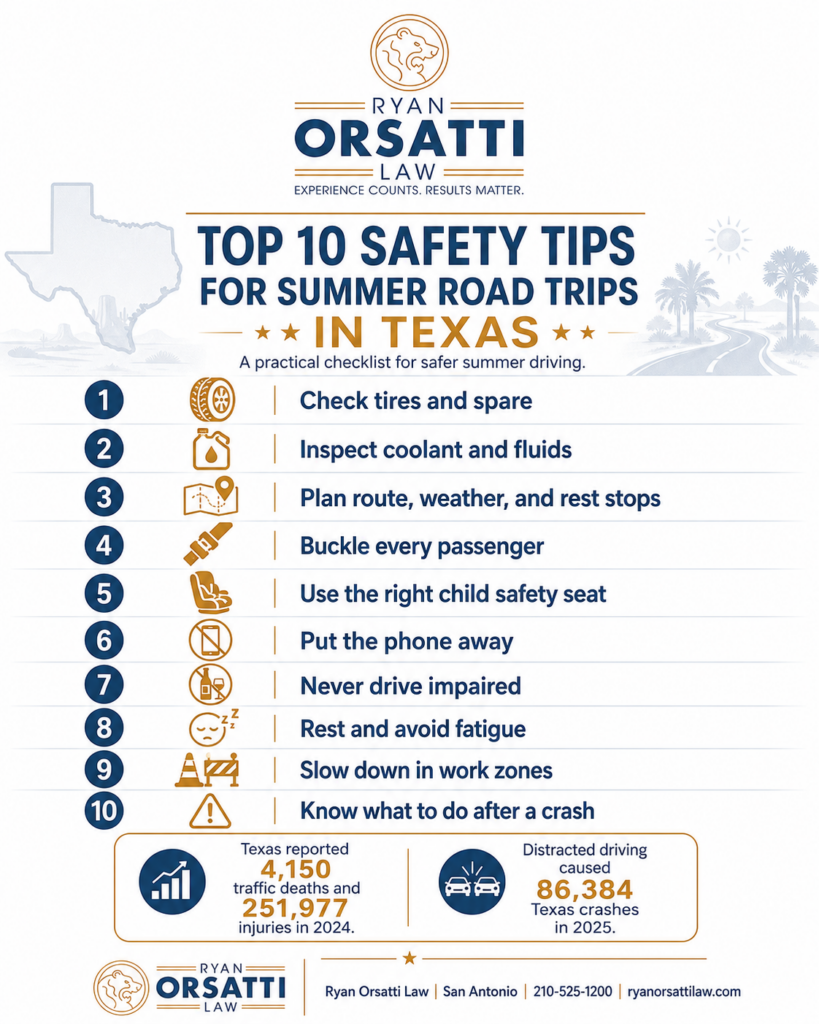
Why Do Summer Road Trips in Texas Require Extra Planning?
Summer road trips in Texas require extra planning because heat, long distances, high-speed highways, construction zones, holiday traffic, and impaired drivers can turn an ordinary drive into a serious crash risk. TxDOT’s 2024 crash facts reported that one reportable crash occurred every 57 seconds in Texas, and one person was injured every 2 minutes and 5 seconds. (TxDOT)
Texas trips often involve hours of driving between San Antonio, Austin, Dallas, Houston, Corpus Christi, the Hill Country, the Rio Grande Valley, and West Texas. That means drivers may face urban congestion, rural two-lane roads, construction barrels, sudden thunderstorms, and long stretches without easy access to medical help or repair services.
For San Antonio families, common summer routes include I-10 toward Boerne or Houston, I-35 toward New Braunfels and Austin, US-281 toward the Hill Country, and Loop 1604 or Loop 410 for local travel. Those roads can be safe when drivers plan ahead, but they can be unforgiving when a vehicle is overloaded, a tire is worn, or a driver is tired.
What Are the Top 10 Safety Tips for Summer Road Trips in Texas?
The top 10 summer road trip safety tips in Texas focus on preventing the most common avoidable crash causes: vehicle failure, distraction, fatigue, impaired driving, poor route planning, unsafe speeds, and missing evidence after a collision. Use this table as a practical pre-trip and on-the-road checklist for Texas highways.
| Safety tip | What to do before or during the trip | Why it matters in Texas |
|---|---|---|
| 1. Check every tire | Check cold tire pressure, tread depth, sidewall damage, spare tire, jack, and tire tools. | NHTSA says underinflation is the leading cause of tire failure, and heat makes tire problems worse. (NHTSA) |
| 2. Inspect fluids and cooling | Check coolant, oil, brake fluid, windshield washer fluid, belts, hoses, and battery. | Summer heat can expose weak cooling systems, old hoses, and battery problems before a long drive. (NHTSA) |
| 3. Plan the route | Check weather, traffic, road conditions, construction, and rest stops before leaving. | Texas drives are long, and rushing through traffic or construction increases crash risk. (NHTSA) |
| 4. Buckle every passenger | Require seat belts for every seat, every trip, every time. | TxDOT reported that 45.34% of people killed in vehicles where restraint use was known and applicable in 2024 were not restrained. (TxDOT) |
| 5. Secure children correctly | Use the correct child safety seat, booster, or seat belt for the child’s age and size. | Texas DSHS states that children under 8 must be in a child passenger safety seat unless taller than 4 feet 9 inches. (Texas Health Services) |
| 6. Put the phone away | Program navigation before leaving and pull off the road before texting. | TxDOT reported 86,384 distracted-driving crashes in Texas in 2025. (TxDOT) |
| 7. Do not drive impaired | Use a sober driver, rideshare, hotel, taxi, or public transportation after drinking. | TxDOT reported 273 deaths and 596 serious injuries in DUI-alcohol related crashes during summer 2024. (TxDOT) |
| 8. Manage fatigue | Sleep before leaving, rotate drivers, and stop before drowsiness becomes dangerous. | Long routes across Texas can cause highway hypnosis, delayed reactions, and lane departures. |
| 9. Slow down in work zones | Reduce speed, increase following distance, and expect sudden stops. | TxDOT reported more than 28,000 Texas work-zone crashes in 2025, with 203 deaths. (TxDOT) |
| 10. Know what to do after a crash | Call 911 when needed, take photos, identify witnesses, and get medical care. | Early documentation can affect fault, insurance coverage, and medical causation in a Texas injury claim. |
Key takeaway: A safe Texas road trip starts before the car leaves the driveway, because tires, route planning, restraints, driver attention, and evidence preservation often determine whether a close call becomes a serious injury claim.
How Should You Prepare Your Vehicle Before a Long Texas Drive?
You should prepare your vehicle at least several days before a long Texas drive so you have time to repair tire, coolant, brake, battery, light, or wiper problems before departure. NHTSA recommends checking tire inflation, tire damage, tread depth, coolant, fluid levels, batteries, lights, wiper blades, floor mats, and emergency supplies before summer travel. (NHTSA)
A rushed gas-station inspection the morning of the trip is not enough for a long drive to South Padre, Port Aransas, Dallas, Houston, Big Bend, or the Hill Country. Heat, speed, cargo weight, and stop-and-go traffic can expose problems that were not obvious during ordinary city driving.
What Should Be in a Texas Road Trip Emergency Kit?
A Texas road trip emergency kit should include communication, first aid, lighting, tire tools, water, food, medications, and basic repair supplies. NHTSA lists items such as a cell phone and charger, first aid kit, flashlight, flares or a white flag, jumper cables, tire pressure gauge, jack, gloves, tools, duct tape, water, nonperishable food, medicines, washer fluid, maps, towels, and blankets. (NHTSA)
For Texas summer driving, add extra drinking water, sunscreen, cooling towels, a paper insurance card, a written medication list, and a portable battery pack. If you are traveling with children, older adults, pets, or someone with a medical condition, plan stops more conservatively than your GPS suggests.
Pre-Trip Vehicle Checklist for Texas Summer Driving
Use this checklist 3 to 7 days before a summer road trip:
- Check cold tire pressure using the PSI listed inside the driver’s door or in the owner’s manual.
- Inspect tire tread and sidewalls for cuts, bulges, punctures, cracks, or uneven wear.
- Confirm the spare tire, jack, lug wrench, and wheel lock key are in the vehicle.
- Check coolant level and look for signs of leaks under the vehicle.
- Check oil, brake fluid, transmission or clutch fluid, power steering fluid, and windshield washer fluid.
- Test headlights, brake lights, turn signals, hazard lights, and trailer lights.
- Replace worn wiper blades before driving into summer storms.
- Make sure floor mats cannot interfere with the accelerator or brake pedal.
- Check for open recalls using the vehicle identification number.
- Pack water, food, medicines, phone chargers, first aid supplies, and emergency tools.
What Texas Laws Matter Most on a Summer Road Trip?
Texas road trip safety is not only about careful driving; several Texas traffic and insurance rules can also affect fault, crash documentation, and injury claims. The most important road-trip rules involve restraints, child safety seats, texting, Move Over or Slow Down duties, crash reports, insurance, filing deadlines, and comparative responsibility.
| Texas rule or issue | Practical meaning for drivers | Why it can matter after a crash |
|---|---|---|
| Child safety seats | A child under 8 must be in a child passenger safety seat unless taller than 4 feet 9 inches. (Texas Health Services) | Restraint use can affect injury severity, police reports, and insurance arguments. |
| Texting while driving | TxDOT says reading, writing, or sending a text while driving has been illegal in Texas since Sept. 1, 2017, with fines up to $200. (TxDOT) | Phone use may become key evidence in a distracted-driving claim. |
| Move Over or Slow Down | Drivers must move over or slow to 20 mph below the posted limit when approaching certain stopped vehicles with flashing lights. (TxDOT) | Violations can cause roadside crashes involving police, tow trucks, TxDOT vehicles, utility vehicles, and emergency responders. |
| Crash reports | A Texas officer who investigates a crash involving injury, death, or at least $1,000 apparent property damage must submit a written report to TxDOT within 10 days. (TxDOT) | The CR-3 crash report often becomes an important early document for insurance and liability review. |
| Liability insurance | Texas requires at least $30,000 per injured person, $60,000 per accident, and $25,000 for property damage, known as 30/60/25 coverage. (Texas Department of Insurance) | Minimum limits may be too low for serious injury crashes, multi-vehicle crashes, or totaled vehicles. |
| Two-year deadline | Texas Civil Practice & Remedies Code § 16.003 generally gives two years for personal injury and wrongful death lawsuits. (Texas Statutes) | Waiting too long can put the claim at risk even if fault seems clear. |
| Comparative responsibility | Texas Civil Practice & Remedies Code § 33.001 bars recovery if the claimant’s percentage of responsibility is greater than 50%. (Texas Statutes) | Fault disputes matter because insurance companies may try to shift blame. |
Key takeaway: Texas safety rules are not just ticket rules. They can become evidence rules, insurance rules, and fault arguments after a serious road-trip crash.
How Can You Reduce Distracted Driving During a Texas Road Trip?
You can reduce distracted driving by assigning one passenger to navigation, programming the route before leaving, silencing notifications, and pulling off the road completely before texting or calling. TxDOT defines distracted driving broadly, including texting, talking, glancing at a phone, eating, drinking, programming navigation, adjusting controls, or reaching into the back seat. (TxDOT)
The most dangerous distraction on a road trip is often not one dramatic mistake. It is a pattern: looking down at maps, handing snacks to kids, changing playlists, checking arrival time, and answering “quick” messages while moving at highway speed.
A good rule is simple. The driver drives. A passenger handles everything else. If no passenger can help, stop at a safe place before using the phone.
How Can You Avoid Impaired Driving During Summer Travel in Texas?
You can avoid impaired driving by deciding the sober-ride plan before the first drink, not after the event ends. TxDOT reported that during summer 2024, 273 people were killed and 596 were seriously injured in DUI-alcohol related crashes in Texas, and over Labor Day weekend alone there were 327 DUI-alcohol related crashes. (TxDOT)
Summer trips often include river floats, beach weekends, lake houses, festivals, weddings, cookouts, and late-night drives back to hotels or rentals. That is exactly why the sober-ride plan should be part of the itinerary.
Practical options include:
- A designated driver who drinks no alcohol.
- Rideshare or taxi planned before the event.
- A hotel or short-term rental close to the event.
- Staying overnight instead of driving late.
- Refusing to ride with anyone who has been drinking or using impairing substances.
How Should Families Handle Heat, Children, Pets, and Car Seats?
Families should treat heat and passenger safety as a core part of road-trip planning, not an afterthought. NHTSA warns never to leave children alone in a vehicle, says a child’s body temperature rises three to five times faster than an adult’s, and recommends checking the back seat before exiting the car. (NHTSA)
In Texas summer conditions, a short stop can become dangerous quickly. Build bathroom, water, snack, and shade breaks into the route. Do not leave a child, older adult, disabled passenger, or pet in a parked vehicle while paying for gas, checking into a hotel, buying food, or unloading bags.
For children, use the correct seat for the child’s age, height, weight, and the seat manufacturer’s instructions. A car seat that is legally required but loose, expired, incorrectly installed, or inappropriate for the child’s size may not protect the child as intended.
How Should You Drive Through Texas Work Zones and Roadside Emergencies?
You should drive through Texas work zones by slowing down, increasing following distance, putting the phone away, and expecting uneven pavement, narrow lanes, barriers, equipment, and sudden stops. TxDOT reported more than 28,000 Texas work-zone crashes in 2025, resulting in 203 deaths, and says rear-end collisions are the most common type of work-zone crash. (TxDOT)
Work zones are common in and around San Antonio, New Braunfels, Austin, Dallas, Houston, and along fast-growing Texas corridors. Drivers often make the mistake of treating work zones like ordinary highway lanes. They are not ordinary lanes.
For roadside emergencies, follow Texas Move Over or Slow Down rules. If you see flashing lights on the shoulder, change lanes when safe. If you cannot move over safely, slow to 20 mph below the posted limit, or to 5 mph where the posted limit is 25 mph or less. (TxDOT)
What Should You Do If a Crash Happens During a Texas Road Trip?
If a crash happens during a Texas road trip, first protect people from further harm, call 911 for injuries or danger, then preserve evidence before vehicles, witnesses, and debris disappear. A highway crash on I-10, I-35, US-281, Loop 1604, or a rural county road can become difficult to prove if photos, witness names, dashcam footage, and location details are not saved quickly.
Follow these steps:
- Move to a safe location if the vehicles can be moved and it is safe to do so.
- Call 911 if anyone is hurt, a driver may be impaired, traffic is blocked, a vehicle is disabled, or the crash involves serious damage.
- Photograph vehicle positions before moving them, if it is safe.
- Photograph damage, license plates, skid marks, debris, injuries, traffic signs, weather, road defects, and construction barrels.
- Exchange names, phone numbers, license plate numbers, driver’s license information, and insurance information.
- Get names and phone numbers for witnesses before they leave.
- Ask for the investigating agency, officer name, and crash report number.
- Get medical care, even if adrenaline makes the injury seem minor at first.
- Do not admit fault or guess about what happened.
- Notify your insurer, but avoid detailed recorded statements until you understand your injuries and rights.
Attorney Insight: In a road-trip crash, the evidence can disappear faster than the pain develops. Photos of lane markings, traffic signs, construction barrels, vehicle resting positions, and visible injuries often matter later because the insurance company may question speed, lane position, following distance, distraction, or whether the crash actually caused the injury. A simple photo taken safely at the scene can prevent weeks of argument later.
How Does Texas Insurance Affect a Summer Road Trip Crash Claim?
Texas insurance affects a summer road trip crash claim because the available coverage may control how medical bills, vehicle damage, rental car costs, and uninsured-driver problems are handled. Liability coverage means insurance that pays for damage and injuries a driver causes to others, and TDI states Texas minimum liability coverage is 30/60/25. (Texas Department of Insurance)
That minimum can be too low after a serious crash. One ER visit, imaging study, surgery recommendation, missed-work claim, or multi-vehicle collision can exceed minimum coverage.
Other coverages may matter:
- PIP: Personal injury protection can help pay medical bills and some lost wages. TDI states Texas auto policies include PIP unless rejected in writing. (Texas Department of Insurance)
- MedPay: Medical payments coverage can help pay medical bills, but it usually does not include wage-loss benefits.
- UM/UIM: Uninsured/underinsured motorist coverage can help when the at-fault driver has no insurance or not enough insurance.
- Collision: Collision coverage can help repair or replace your vehicle, usually subject to a deductible.
- Rental reimbursement: This can help pay for a rental vehicle if your policy includes it.
Subrogation means a health insurer or benefit plan may claim a right to be paid back from a settlement. A hospital lien is a legal claim a hospital may assert against part of a personal injury recovery. These issues can affect the net recovery after a Texas road-trip crash, especially when medical bills are high.
When Should You Call a Lawyer After a Summer Road Trip Crash in Texas?
You should consider calling a Texas personal injury lawyer after a summer road trip crash if anyone was injured, medical treatment is needed, fault is disputed, the at-fault driver has low limits, a commercial vehicle was involved, a child was injured, or the insurance company asks for a recorded statement. Ryan Orsatti Law helps people in San Antonio and across Texas evaluate these issues after serious car, truck, and commercial vehicle crashes.
Legal help matters most when the case involves more than a simple property-damage claim. Injury claims can involve medical causation, preexisting conditions, delayed symptoms, lost wages, future treatment, health insurance subrogation, hospital liens, recorded statements, crash reconstruction, and comparative responsibility.
Ryan Orsatti Law can review road-trip crashes involving passenger vehicles, rideshare vehicles, 18-wheelers, delivery vehicles, commercial vans, motorcycles, pedestrians, and serious injuries. Learn more about the firm’s work with San Antonio car accident cases, San Antonio truck accident cases, and commercial vehicle accident cases.
For serious injuries, attorney involvement should begin before evidence is lost and before the insurance company frames the claim. You can also review Ryan Orsatti Law’s personal injury services or contact the firm to discuss next steps.
FAQ
What are the most important summer road trip safety tips in Texas?
The most important Texas summer road trip safety tips are to check tires, coolant, fluids, lights, wipers, and emergency supplies before leaving; plan the route around weather and construction; buckle every passenger; secure children correctly; avoid texting and impaired driving; take fatigue seriously; and know what evidence to save if a crash happens.
How often should I check tire pressure before a Texas summer road trip?
Check tire pressure when the tires are cold, ideally at least three hours after driving, before a long Texas road trip. NHTSA says to use the manufacturer’s recommended pressure listed in the owner’s manual or driver’s door placard, not the maximum pressure printed on the tire. (NHTSA)
Are children required to use car seats during Texas road trips?
Yes. Texas DSHS states that a child younger than 8 must be secured in a child passenger safety seat while riding in a passenger vehicle unless the child is taller than 4 feet 9 inches. The seat should also match the child’s size and be used according to the manufacturer’s instructions. (Texas Health Services)
Is texting while driving illegal in Texas?
Yes. TxDOT states that since Sept. 1, 2017, it has been illegal in Texas to read, write, or send a text while driving, and violators can face a fine of up to $200. For safety, pull completely off the road before texting, calling, or reprogramming navigation. (TxDOT)
What should I do if I am injured in a crash while traveling outside San Antonio?
If you are injured in a crash outside San Antonio but still in Texas, call 911 when needed, get medical care, photograph the scene, exchange information, identify witnesses, and request the crash report information. A San Antonio-based Texas personal injury lawyer can still help evaluate fault, coverage, medical bills, and claim strategy.
How long do I have to file a Texas personal injury lawsuit after a road trip crash?
Texas Civil Practice & Remedies Code § 16.003 generally gives two years to file a personal injury lawsuit, and wrongful death claims also generally have a two-year deadline from the date of death. Shorter notice rules may apply in some government-vehicle or roadway-defect cases, so early review is important. (Texas Statutes)
What if the insurance company says I was partly at fault?
Texas uses comparative responsibility, which means fault can be divided by percentage. Under Texas Civil Practice & Remedies Code § 33.001, a claimant may not recover damages if the claimant’s responsibility is greater than 50%. If fault is disputed, preserve photos, witness names, crash reports, and vehicle data quickly. (Texas Statutes)
Should I give a recorded statement after a Texas road trip crash?
Be cautious before giving a recorded statement, especially if you are injured, medicated, still in pain, or unsure how the crash happened. Insurance adjusters may ask questions about speed, lookout, symptoms, prior injuries, and treatment gaps. A statement given too early can create problems later if injuries worsen or facts change.
Ryan Orsatti Law
4634 De Zavala Rd, San Antonio, TX 78249
Phone: 210-525-1200
ryanorsattilaw.com
This blog is for informational purposes only, not legal advice. Reading it does not create an attorney-client relationship. Past results do not guarantee future results.
Hurt in an accident in San Antonio? Learn how a San Antonio car accident lawyer can help with your claim. Call 210-525-1200 or request a free consultation.
The firm works on a contingency fee. You pay nothing unless the firm recovers money for you, and that covers case expenses as well as the fee: if there is no recovery, you owe no attorney's fee and no case expenses. Ask for the fee agreement and read the fee and expense section before you sign anything.
Related San Antonio legal resources
Primary legal and public-data sources
- TxDOT: Texas crash reports, data, and statistics
- Texas Civil Practice and Remedies Code Chapter 33: proportionate responsibility
Ryan Orsatti Law
4634 De Zavala Road, San Antonio, TX 78249
General reference links. Consult each source for its current text.