
Quick Answer
Texas personal injury deadlines and paperwork usually involve two tracks: the lawsuit filing deadline and the evidence needed to support the insurance claim. In most Texas personal injury and wrongful death cases, Texas Civil Practice & Remedies Code § 16.003 gives you two years to file suit, but claims involving a city, county, school district, or other governmental unit can require written notice much sooner. (Texas Legislature Online)
Start one organized claim file with the crash or incident report, photos, medical records, medical bills, insurance letters, wage records, and every document you receive from an adjuster. Ryan Orsatti Law helps injured people in San Antonio and across Texas identify deadlines, organize claim paperwork, and evaluate whether the insurance company has the information needed to fairly review the claim.
Key Takeaways
- Most Texas personal injury lawsuits must be filed within two years, but some notice deadlines are much shorter.
- Government claims require immediate attention because the Texas Tort Claims Act generally requires notice within six months, and some city charter rules may require notice within a permitted shorter period. (Texas Legislature Online)
- TxDOT reported that 251,977 people were injured in Texas motor vehicle traffic crashes in 2024, which means crash paperwork, medical documentation, and insurance records are not small details. They are often the foundation of the claim.
- Do not sign a broad release, settlement agreement, blanket medical authorization, or final check without understanding what rights you may be giving up.
- Medical records matter, but so do wage records, photos, witness information, repair estimates, lien notices, health insurance explanations of benefits, and your own insurance declarations page.
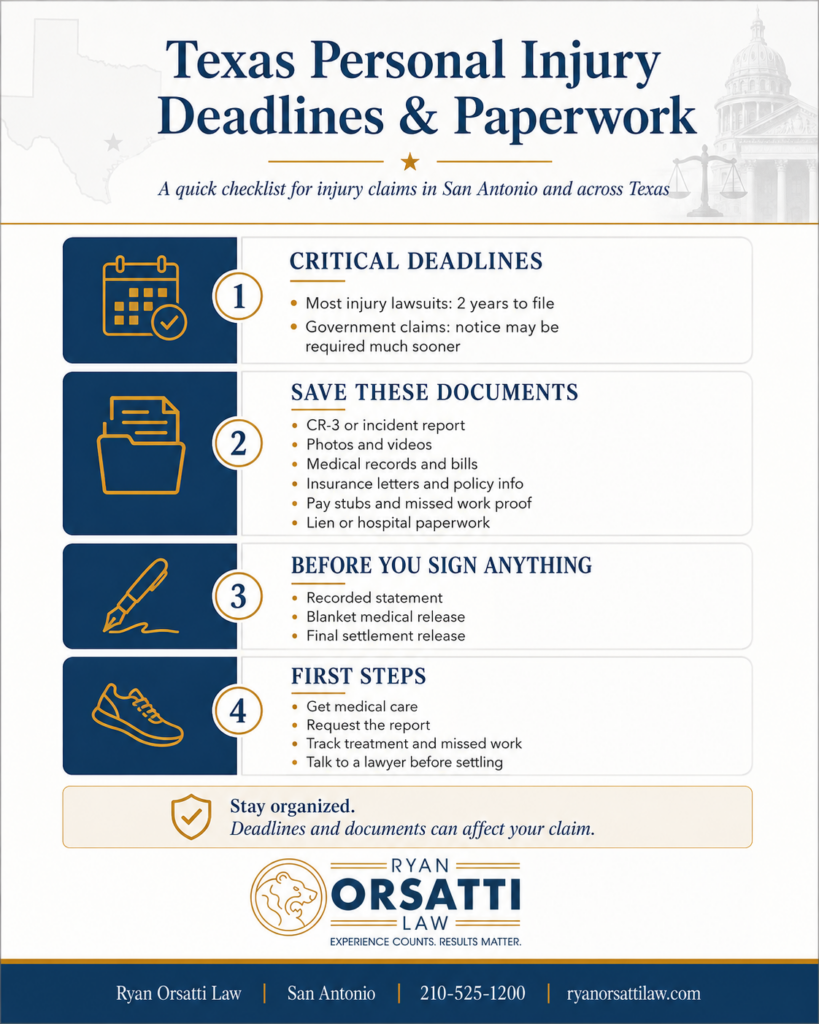
What Are the Most Important Texas Personal Injury Deadlines and Paperwork?
The most important Texas personal injury deadlines and paperwork are the lawsuit deadline, any government notice deadline, the incident report, medical records, bills, insurance documents, wage proof, lien paperwork, and settlement documents. A claim can be harmed by missing a legal deadline, but it can also be weakened by missing records, delayed treatment documentation, unclear wage proof, or an incomplete claim file.
In a San Antonio injury case, the paperwork often comes from several places: SAPD or another investigating agency, TxDOT, EMS, hospitals, clinics, imaging centers, health insurers, auto insurers, employers, and sometimes Bexar County lien records. The goal is to build a record that proves what happened, why the other party is responsible, what injuries were caused, and how the injury changed your finances and daily life.
| Deadline or paperwork | What to save or do | Why it matters |
|---|---|---|
| Texas lawsuit deadline | Calendar the two-year limitations period for most injury and wrongful death claims | Missing the filing deadline can end the claim before the facts are ever heard. |
| Government notice deadline | Send proper notice quickly if a city, county, school district, transit agency, or other governmental unit may be involved | Texas law generally requires notice not later than six months, and some city charter rules may be shorter. |
| Crash or incident report | Request the police report, TxDOT CR-3, store incident report, workplace report, or premises report | These documents often identify parties, witnesses, location, diagrams, and early liability facts. |
| Medical documentation | Keep discharge papers, treatment notes, imaging reports, bills, referrals, work restrictions, and therapy notes | Adjusters often evaluate injury claims through diagnosis, treatment consistency, objective findings, and medical billing proof. |
| Insurance documents | Save claim letters, policy declarations, PIP, MedPay, UM/UIM information, and all adjuster communications | Coverage paperwork can determine which insurance sources may apply. |
| Lien and reimbursement records | Track hospital liens, health insurance reimbursement claims, Medicare or Medicaid issues, and letters of protection | Settlement paperwork should not be finalized until repayment issues are identified and addressed. |
Key takeaway: A Texas personal injury claim is not just about one deadline. It is about preserving the documents that prove liability, damages, coverage, and repayment obligations before the case is evaluated or settled.
How Long Do I Have to File a Personal Injury Lawsuit in Texas?
In most Texas personal injury cases, you have two years from the date the claim accrues to file a lawsuit. Texas Civil Practice & Remedies Code § 16.003 applies to personal injury claims and also states that a death-injury claim must be brought not later than two years after the cause of action accrues. (Texas Legislature Online)
That two-year deadline is not the same thing as an insurance company deadline. An adjuster may ask for documents in 10 days, 30 days, or by the end of the month, but those requests do not replace the statute of limitations. At the same time, waiting until the end of the two-year period can create practical problems because witnesses disappear, video is overwritten, medical providers move, and evidence becomes harder to collect.
Texas has some rules that may affect limitations in narrow situations. For example, Texas Civil Practice & Remedies Code § 16.001 provides that a person younger than 18 or of unsound mind is under a legal disability, and time during that disability may not be included in the limitations period for certain personal actions. (Texas Legislature Online) These issues are fact-specific and should not be treated as a reason to wait.
What Deadline Applies if a Government Entity May Be Responsible?
If a Texas governmental unit may be responsible, you should treat the claim as urgent because the Texas Tort Claims Act generally requires written notice not later than six months after the incident. The notice must reasonably describe the damage or injury, the time and place of the incident, and the incident itself. (Texas Legislature Online)
This issue can come up in crashes involving city vehicles, VIA buses, school district vehicles, county vehicles, road defects, police vehicles, or public property. Texas Civil Practice & Remedies Code § 101.101 also recognizes certain city charter and ordinance notice provisions, and the notice requirement may not apply if the governmental unit has actual notice of the death, injury, or property damage. (Texas Legislature Online)
Do not assume that a police report or ambulance response automatically satisfies legal notice. A lawyer should review the entity involved, the correct notice recipient, the deadline, and the facts needed in the notice.
How Fast Should I Request a Texas Crash Report or Incident Report?
You should request the crash or incident report as soon as it becomes available, then use it as a roadmap for witnesses, insurance information, vehicle identification, and location details. TxDOT states that Texas Transportation Code § 550.062 requires an officer who investigates a crash involving injury, death, or apparent property damage of $1,000 or more to submit a written report to TxDOT not later than the tenth day after the crash. (Texas Department of Transportation)
For car wrecks in San Antonio, Bexar County, Comal County, Guadalupe County, and nearby areas, the Texas Peace Officer’s Crash Report is usually called the CR-3. It may include driver information, insurance information, roadway conditions, contributing factors, diagrams, citations, and injury information. If you were hurt in a wreck, Ryan Orsatti Law’s San Antonio car accident lawyer page explains more about how car accident claims are handled locally.
The crash report is not the whole evidence file. TxDOT explains that subpoena requests for dash cam videos, field notes, photographs, or other scene information should be submitted to the investigating agency because that information is not part of TxDOT’s crash report custodial files. (Texas Department of Transportation)
What Medical Paperwork Matters Most in a Texas Injury Claim?
The most important medical paperwork includes records that show diagnosis, causation, treatment plan, work restrictions, bills, and future care recommendations. In plain English, causation means the link between the accident and the injury. If the medical records do not clearly connect the injury to the incident, the insurance company may argue the condition was old, unrelated, exaggerated, or not supported.
Keep these records in one folder:
- ER discharge papers and hospital records.
- Ambulance and EMS records.
- Primary care, orthopedic, pain management, neurology, chiropractic, or physical therapy notes.
- Imaging reports, including X-rays, CT scans, and MRIs.
- Medical bills and itemized statements.
- Health insurance explanations of benefits.
- Prescription receipts.
- Work restriction notes.
- Referral slips and future treatment recommendations.
- A simple symptom diary that records pain levels, missed activities, sleep issues, and functional limits.
Delayed treatment is not always fatal to a claim, but it gives the adjuster something to question. If you waited to treat because you hoped the pain would resolve, lacked transportation, could not afford care, or did not understand the injury at first, tell your medical providers the truth so the records accurately reflect what happened.
What Insurance Paperwork Should I Save Before Talking to an Adjuster?
Before talking to an adjuster, save your own auto insurance declarations page, the other driver’s insurance information, claim numbers, adjuster letters, emails, text messages, and any request for a recorded statement or authorization. The declarations page matters because it identifies coverages such as liability, collision, personal injury protection, MedPay, and uninsured or underinsured motorist coverage.
The Texas Department of Insurance explains that PIP helps pay medical bills and may also pay costs such as lost wages, and that Texas auto policies include PIP unless rejected in writing. TDI also explains that insurers must offer uninsured or underinsured motorist coverage, and rejection must be in writing. (Texas Department of Insurance)
PIP means personal injury protection, which is first-party coverage through your own policy. UM/UIM means uninsured or underinsured motorist coverage, which may apply when the at-fault driver has no insurance or not enough insurance. MedPay means medical payments coverage, which may help with medical bills but often works differently from PIP.
What Paperwork Can Hurt a Personal Injury Claim if Handled Wrong?
The paperwork most likely to hurt a Texas personal injury claim includes broad medical authorizations, recorded statement transcripts, social media screenshots, inconsistent intake forms, settlement releases, lien letters, and final checks. A document that looks routine may give the insurance company access to unrelated medical history, preserve an incomplete statement, or close claims you did not mean to settle.
Be careful with:
- A recorded statement before you understand your injuries.
- A blanket medical authorization that reaches years of unrelated records.
- A release that says “all claims,” “known and unknown injuries,” or “full and final settlement.”
- A property damage release that also releases bodily injury claims.
- A settlement check with release language printed on it.
- Medical lien notices or reimbursement letters that are ignored.
- Gaps between what you told the adjuster and what you told your doctor.
Attorney Insight: Adjusters often look for inconsistency more than drama. A small mismatch between the crash report, ER history, recorded statement, and later medical records can become a liability or causation argument. The safest practice is simple: be accurate, do not guess, do not minimize symptoms to sound tough, and do not sign broad paperwork before it is reviewed.
What Are Hospital Liens, Subrogation, and Letters of Protection?
Hospital liens, subrogation claims, and letters of protection are repayment issues that can affect how settlement funds are distributed. A hospital lien is a legal claim a hospital may assert against part of a personal injury recovery, and Texas Property Code Chapter 55 gives hospitals lien rights in certain accident-related treatment situations. (Texas Statutes)
Subrogation means a health insurer, Medicare plan, Medicaid program, ERISA plan, or benefit provider may claim a right to be paid back from a settlement. A letter of protection, often called an LOP, is an agreement that a medical provider may wait to be paid from a future recovery instead of billing the patient immediately.
These documents should be reviewed before settlement. A settlement number can look acceptable until lien claims, health insurance reimbursement, unpaid providers, and case expenses are calculated. For more on claim timing, see Ryan Orsatti Law’s guide on how long a Texas personal injury case may take to settle.
What Should I Do First After an Injury to Protect Deadlines and Paperwork?
The first thing to do after an injury is create a simple evidence system and calendar every known deadline. You do not need a complicated legal file. You need a complete, accurate record that keeps the claim from becoming a pile of disconnected bills, emails, screenshots, and adjuster letters.
Follow this checklist:
- Get medical care and follow discharge instructions.
- Save all photos and videos in a cloud folder.
- Request the crash report, incident report, or workplace report.
- Write down witness names and phone numbers.
- Save your insurance declarations page.
- Keep all medical bills, records, and explanations of benefits.
- Track missed work, PTO used, and reduced hours.
- Save every adjuster letter, email, text, and voicemail.
- Do not sign a release or broad authorization without review.
- Contact a Texas personal injury lawyer if you were injured, fault is disputed, a government entity is involved, or medical bills are growing.
If a lawsuit becomes necessary, the case usually moves through pleadings, discovery, mediation, and trial preparation. Ryan Orsatti Law explains that process in more detail in its guide to how a personal injury lawsuit works.
When Should a Texas Personal Injury Lawyer Review the Paperwork?
A Texas personal injury lawyer should review the paperwork early if you were hurt, received medical treatment, missed work, have disputed fault, are being asked for a recorded statement, or received a settlement offer. The only situation where a lawyer may not be necessary is a true property-damage-only claim with no injury and no medical treatment.
Insurance is adversarial. The adjuster’s job is to evaluate and resolve the claim for the insurance company. Your job is to protect the record, understand your damages, and avoid signing away rights before the medical, lien, wage, and coverage issues are clear.
Ryan Orsatti Law helps injured people in San Antonio and across Texas evaluate deadlines, claim documents, medical proof, insurance coverage, and settlement paperwork. The firm’s about Ryan Orsatti Law page provides more information about the San Antonio-based practice, and you can contact Ryan Orsatti Law to discuss a potential injury claim.
FAQs
What is the deadline to file a personal injury lawsuit in Texas?
In most Texas personal injury cases, the lawsuit deadline is two years from the date the claim accrues. Texas Civil Practice & Remedies Code § 16.003 applies to personal injury claims and death-injury claims. Some claims have different rules, so do not wait until the deadline is close before getting legal advice. (Texas Legislature Online)
What paperwork do I need for a Texas personal injury claim?
The core paperwork includes the crash or incident report, photos, witness information, medical records, medical bills, insurance letters, wage loss proof, repair estimates, lien notices, and health insurance explanations of benefits. The goal is to prove liability, injury causation, medical expenses, lost income, and any repayment claims before settlement is discussed.
Do I need a police report for a Texas car accident injury claim?
A police report is not the only evidence, but it can be very important in a Texas car accident injury claim. TxDOT states that officers must submit a written crash report for investigated crashes involving injury, death, or apparent property damage of $1,000 or more not later than the tenth day after the crash. (Texas Department of Transportation)
What if a city vehicle, county vehicle, or school bus caused my injury?
If a governmental unit may be involved, act quickly because Texas law generally requires notice within six months, and some city charter provisions may be shorter if permitted by law. The notice must reasonably describe the injury or damage, the time and place, and the incident. This is separate from filing a lawsuit. (Texas Legislature Online)
Should I give the insurance company a recorded statement?
You should be careful before giving a recorded statement, especially if you are still treating, taking medication, unsure about the facts, or being blamed for the incident. A recorded statement can lock in incomplete answers. If you were injured, it is safer to have a Texas personal injury lawyer review the request first.
Should I sign medical authorization forms from the adjuster?
Do not sign a broad medical authorization without understanding its scope. Some authorizations allow the insurance company to collect years of unrelated medical history. The safer approach is to provide relevant records in an organized way after the proper treatment, billing, causation, and privacy issues are reviewed.
What paperwork should I review before accepting a settlement?
Before accepting a settlement, review the release, settlement check language, medical bills, lien notices, health insurance reimbursement claims, unpaid provider balances, case expenses, and whether future treatment is still expected. A settlement can be final even if you later discover more bills or worsening symptoms.
Ryan Orsatti Law
4634 De Zavala Rd, San Antonio, TX 78249
Phone: 210-525-1200
ryanorsattilaw.com
This blog is for informational purposes only, not legal advice. Reading it does not create an attorney-client relationship. Past results do not guarantee future results.
Hurt in an accident in San Antonio? Learn how a San Antonio car accident lawyer can help with your claim. Call 210-525-1200 or request a free consultation. There is no fee unless we win.