
Quick Answer: Most Texas personal injury cases do not end in a jury trial, but some go to court when fault, medical causation, injury severity, liens, or claim value remain disputed. Filing suit may also be necessary to protect the claim before Texas’s general two-year personal injury deadline, even if the case later settles. In 2025, Texas Office of Court Administration data reported 66,315 new motor vehicle injury or damage cases in Texas district and statutory county courts, but only 364 dispositions by jury verdict in that category. Ryan Orsatti Law helps injured people in San Antonio and across Texas evaluate settlement, litigation, and trial preparation based on the facts of the case. (Texas Legislature Online)
Key Takeaways
- A personal injury claim can settle before a lawsuit, after a lawsuit, during discovery, at mediation, or even close to trial.
- Filing a lawsuit is not the same thing as having a jury trial.
- Texas generally gives injured people two years to file a personal injury lawsuit, but claims against government entities can have much shorter notice deadlines.
- Cases are more likely to go to court when the insurer disputes fault, says the injuries were preexisting, challenges medical bills, or refuses to evaluate future damages.
- If your case is filed, expect pleadings, service, written discovery, depositions, possible mediation, pretrial deadlines, and trial preparation.
- Good documentation early can reduce surprises later.
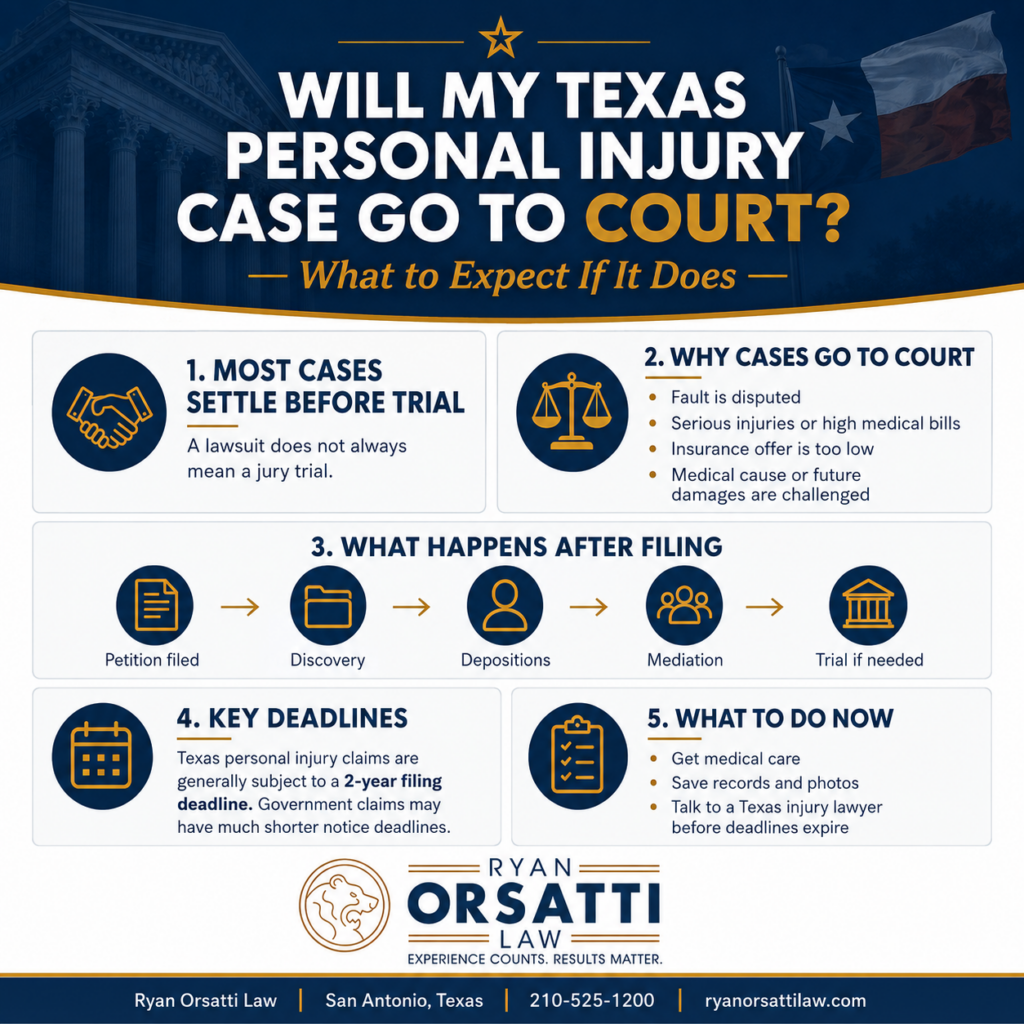
Will my Texas personal injury case go to court?
Your Texas personal injury case may go to court if the insurer or defendant will not reasonably resolve disputed fault, injury causation, medical damages, future care, liens, or insurance coverage. Going to court usually means a lawsuit has been filed, but it does not always mean your case will be tried to a jury.
Many injury cases settle before trial because both sides eventually have enough evidence to evaluate risk. The key question is not simply “Will this case go to court?” The better question is, “What facts would make litigation necessary or useful?”
In Texas, the pressure points usually include:
- Who caused the incident
- Whether the defendant broke a safety rule
- Whether the crash or incident caused the injury
- Whether the treatment was necessary and reasonable
- Whether future medical care or lost earning capacity is supported
- Whether health insurance, Medicare, Medicaid, ERISA plans, or hospital liens must be repaid
- Whether available insurance coverage is enough
The Texas Office of Court Administration’s FY 2025 statewide civil activity data shows why “going to court” and “going to trial” should not be treated as the same thing. For motor vehicle injury or damage cases in Texas district and statutory county courts, OCA reported 69,343 total dispositions, but only 364 final judgments by jury verdict. That means a jury trial was the final judgment event in only a small fraction of those reported disposed motor vehicle cases.
What is the difference between an injury claim, a lawsuit, and a trial?
An injury claim is the demand for compensation, a lawsuit is the formal court case, and a trial is the final courtroom presentation to a judge or jury. A claim can exist for months before a lawsuit is filed, and a lawsuit can still settle before trial.
| Stage | What it means | What you may have to do | How settlement fits |
|---|---|---|---|
| Insurance claim | Your lawyer or you present the claim to the insurer before suit | Medical treatment, records collection, bills, wage loss proof, crash evidence | Many cases settle here if liability, damages, and coverage are clear |
| Lawsuit filed | A petition is filed in court against the defendant | Review pleadings, help locate evidence, stay available for questions | Settlement talks can continue after filing |
| Discovery | Both sides exchange information and evidence | Answer written questions, produce documents, attend a deposition | Discovery often changes case value because both sides see strengths and weaknesses |
| Mediation | A neutral mediator helps both sides discuss settlement | Attend with your lawyer, evaluate offers, make decisions | Many filed cases resolve at or after mediation |
| Trial | Evidence is presented to a judge or jury | Testify if needed, attend trial, prepare with your lawyer | Settlement may still happen before or during trial, but it is not guaranteed |
| Post-trial | The court enters judgment, and post-trial motions or appeals may follow | Discuss collection, liens, judgment issues, or appeal risk | Resolution can still take time after a verdict |
Key takeaway: A filed lawsuit is a tool for moving a disputed case forward, while a jury trial is only one possible endpoint.
Why do Texas personal injury cases usually settle before trial?
Texas personal injury cases often settle before trial because litigation gives both sides more information about risk, proof, and likely trial issues. Once the medical records, bills, deposition testimony, liability evidence, and liens are clearer, both sides can make a more informed settlement decision.
Settlement does not mean the claim was weak. It often means both sides chose a negotiated resolution instead of the cost, delay, and uncertainty of trial.
Several things can make settlement more likely:
- The defendant’s fault is well documented.
- The medical records clearly connect the injury to the incident.
- The injured person followed a consistent treatment plan.
- Wage loss and out-of-pocket losses are documented.
- Hospital liens and health insurance repayment claims are identified.
- The insurance limits are known.
- Both sides understand the trial risk.
Subrogation means a health insurer may claim a right to be paid back from a settlement. A hospital lien is a legal claim a hospital may assert against part of a personal injury recovery. These issues can affect settlement because the gross settlement number is not the same thing as what the client may receive after fees, expenses, medical bills, and valid repayment claims are addressed.
What makes a Texas personal injury case more likely to go to court?
A Texas personal injury case is more likely to go to court when the insurer disputes fault, medical causation, damages, future treatment, policy coverage, or the value of the claim. Serious injuries, multiple defendants, disputed crash facts, and low settlement offers can also push a case toward litigation.
Common litigation triggers include:
- The defendant claims you caused or partly caused the incident.
- The insurer argues the injury came from a prior condition.
- The crash report is incomplete or disputed.
- The defendant was working, driving a commercial vehicle, or using a company vehicle.
- The injured person needs surgery, injections, long-term treatment, or future care.
- Medical bills are high compared to the available insurance limits.
- A government entity may be involved.
- A UM/UIM claim is needed because the at-fault driver has no insurance or not enough insurance.
Comparative responsibility means Texas can reduce your recovery by your percentage of fault. Texas law also bars recovery if the claimant’s percentage of responsibility is greater than 50 percent. That makes disputed fault a major reason some cases cannot be safely resolved without litigation pressure or further evidence. (Texas Statutes)
Attorney Insight: In real injury claims, adjusters often look for treatment gaps, conflicting medical histories, prior injury arguments, missing photos, unclear witness information, and social media posts that can be used against the claim. A case is more likely to need litigation when the insurer believes a Bexar County jury might assign shared fault or question whether the incident caused the claimed injury.
What happens after a personal injury lawsuit is filed in Texas?
After a Texas personal injury lawsuit is filed, the case usually moves through pleadings, service, an answer, required disclosures, written discovery, depositions, mediation, pretrial deadlines, and trial settings. The court process is structured, but the exact timeline depends on the county, court docket, complexity of the case, and whether the parties reach settlement.
Texas Rule of Civil Procedure 47 requires the original pleading to include a short statement of the cause of action and a statement about the category of monetary relief sought. It also requires the pleading to contain the relief requested from the court.
A typical Texas personal injury lawsuit may involve the following steps:
- Original petition filed. The plaintiff files a lawsuit stating the claim, parties, factual basis, and requested relief.
- Defendant served. The defendant receives formal notice of the lawsuit.
- Answer filed. The defendant responds and may deny fault or raise defenses.
- Required disclosures exchanged. The parties provide basic case information without waiting for a discovery request.
- Written discovery served. The parties may exchange interrogatories, requests for production, and requests for admission.
- Depositions taken. Witnesses answer questions under oath before trial.
- Records and testimony developed. Medical records, billing records, employment records, photographs, crash data, and witness testimony are organized.
- Mediation or settlement conference occurs. Many filed cases go to mediation before trial.
- Pretrial deadlines approach. The parties prepare exhibits, witness lists, motions, and trial filings.
- Trial occurs if the case does not resolve. A judge or jury hears evidence and decides disputed issues.
Ryan Orsatti Law’s guide to how a personal injury lawsuit works in Texas explains the lawsuit process in more detail for injured people who want a step-by-step overview.
What does discovery mean in a Texas personal injury lawsuit?
Discovery means both sides exchange information and evidence before trial. In Texas civil cases, the rules require a discovery control plan, and required disclosures are designed to provide basic information without waiting for a formal request.
For an injured person, discovery may include written answers, document production, medical record review, employment record review, expert reports, depositions, and updated medical information. Discovery can feel intrusive, but it is often where a disputed case becomes clearer.
What is mediation in a Texas personal injury case?
Mediation is a settlement meeting where a neutral mediator helps the parties evaluate risk and discuss resolution. Mediation is not a trial, and the mediator does not decide who wins.
In a San Antonio injury case, mediation may happen after key records, depositions, and medical evidence have been exchanged. The goal is to give both sides enough information to make a serious settlement decision. Some cases resolve at mediation, some resolve later, and some continue toward trial.
How long does it take if my Texas personal injury case goes to court?
A Texas personal injury lawsuit can take months or longer depending on the court docket, injury severity, number of parties, expert needs, discovery disputes, and settlement posture. Texas rules create some structure, but they do not guarantee a specific trial date or outcome.
Under Texas Rule of Civil Procedure 190, most cases are assigned a discovery control plan, and Level 2 discovery generally continues until the earlier of 30 days before trial or nine months after the first initial disclosures are due, unless a different plan applies.
Trial settings also require notice. Texas Rule of Civil Procedure 245 provides that the court may set contested cases for trial with reasonable notice of not less than 45 days for the first setting, unless the parties agree otherwise. Later resets require reasonable notice or agreement.
For more local timing context, Ryan Orsatti Law’s Bexar County personal injury timeline explains how filing, discovery, mediation, and trial preparation may unfold in San Antonio cases.
What should I expect if my Texas injury case actually goes to trial?
If your Texas injury case goes to trial, expect the focus to be on admissible evidence, witness credibility, medical proof, fault, and damages. Trial is not a conversation with the insurance adjuster. It is a formal court process where the judge applies evidence rules and the jury or judge decides disputed facts.
A Texas personal injury trial may include:
- Jury selection, called voir dire
- Opening statements
- Plaintiff witnesses
- Defendant witnesses
- Medical testimony
- Expert testimony, if needed
- Exhibits such as photos, records, bills, diagrams, and reports
- Closing arguments
- Jury instructions and verdict questions
- Judgment and possible post-trial issues
If a jury trial is requested, Texas Rule of Civil Procedure 216 requires a written jury demand within a reasonable time before trial, but not less than 30 days in advance.
In many Texas injury trials, the jury may not be told about liability insurance to prove negligence or wrongful conduct. Texas Rule of Evidence 411 says evidence that a person was or was not insured against liability is not admissible to prove whether the person acted negligently or wrongfully, although it may be admitted for other purposes such as bias, agency, ownership, or control.
Texas civil jury rules also differ by court. The Texas Judicial Branch explains that district court jury trials have 12 jurors, county-level civil juries generally have six, and civil verdicts may be reached by agreement of five-sixths of the jury. (Texas Courts)
Will filing a lawsuit hurt my chance of settling?
Filing a lawsuit does not automatically hurt your chance of settling. In many disputed Texas personal injury cases, filing suit creates the process needed to obtain evidence, take depositions, evaluate defenses, and put the case on a trial track.
Settlement talks can continue after filing. Texas Rule of Evidence 408 generally limits the use of settlement offers and settlement negotiation statements to prove or disprove the validity or amount of a disputed claim, though the rule includes exceptions.
The practical issue is whether filing suit helps the claim move forward. It may be necessary when:
- The statute of limitations is approaching.
- The insurer is delaying without enough explanation.
- Fault is disputed.
- The defendant will not provide key information.
- A company, rideshare entity, trucking company, property owner, or government entity is involved.
- The insurer’s offer does not account for the evidence.
- Medical causation or future care is contested.
Filing suit also carries tradeoffs. Litigation can take more time, require more client involvement, increase case expenses, and expose both sides to trial risk. A careful lawsuit decision should compare the current offer, available evidence, medical status, insurance coverage, liens, and trial issues.
What deadlines should I know before deciding whether to wait?
The main Texas personal injury deadline is usually two years from the date the cause of action accrues, but some claims have shorter notice deadlines. Texas Civil Practice & Remedies Code § 16.003 generally requires personal injury lawsuits to be filed not later than two years after the claim accrues. (Texas Legislature Online)
Shorter deadlines can apply when a government entity may be responsible. Under the Texas Tort Claims Act, a governmental unit is generally entitled to notice of a claim not later than six months after the incident, and the notice must reasonably describe the injury, time and place, and incident. The statute also preserves city charter notice requirements, and actual notice may affect the analysis. (Texas Legislature Online)
For the City of San Antonio, the city’s claim notice page states that written notice must be filed within 90 days after the death, injury, or destruction of property. The notice must state when, where, and how the incident occurred and describe the extent of injury or damages. (webapp1.sanantonio.gov)
Ryan Orsatti Law’s article on the Texas two-year personal injury deadline explains why waiting can create risk, especially when evidence is disappearing or government notice rules may apply.
How can Ryan Orsatti Law help if court becomes necessary?
Ryan Orsatti Law helps injured people in San Antonio, Bexar County, and across Texas evaluate whether a personal injury claim should remain in pre-suit negotiation, move into litigation, or be prepared for trial. The work usually starts with fault, insurance coverage, medical documentation, liens, deadlines, and the evidence needed to prove damages.
In a case that may go to court, legal work may include:
- Preserving crash, premises, vehicle, or company evidence
- Identifying all possible defendants and insurance policies
- Reviewing police reports, photos, videos, medical records, and bills
- Coordinating medical documentation with claim issues
- Evaluating hospital liens, health insurance liens, Medicare, Medicaid, or ERISA reimbursement claims
- Preparing the client for deposition
- Working with treating doctors or retained witnesses when appropriate
- Preparing mediation materials
- Building the case as if trial may be required
A San Antonio injury case may involve local roads such as Loop 1604, I-10, I-35, Loop 410, US-281, or local business premises. A Texas case may also involve nearby counties such as Comal, Guadalupe, Kendall, Wilson, Atascosa, or Medina. Local context matters, but the core question is still evidence: what can be proven, what is disputed, and what deadlines apply?
What should I do now if I think my case may go to court?
If you think your Texas personal injury case may go to court, focus on medical care, evidence preservation, documentation, deadlines, and avoiding statements that can be used out of context. You do not need to know whether the case will try to a jury on day one, but you should treat the claim as if the evidence may later matter in court.
Use this checklist:
- Get appropriate medical care and follow the treatment plan.
- Save photos and videos of the scene, vehicles, hazards, injuries, and repairs.
- Keep the crash report, incident report, claim numbers, and insurance letters.
- Do not guess in recorded statements.
- Avoid posting about the incident, injuries, activities, or settlement talks online.
- Track missed work, mileage, out-of-pocket expenses, and daily limitations.
- Save names and contact information for witnesses.
- Ask whether any government notice deadline may apply.
- Identify all health insurance, Medicare, Medicaid, VA, workers’ compensation, or ERISA plan issues.
- Speak with a Texas personal injury lawyer before the deadline becomes urgent.
For case-specific help, you can contact Ryan Orsatti Law to discuss whether your Texas injury claim is likely to resolve through settlement, litigation, or trial preparation.
FAQ
Do most Texas personal injury cases go to trial?
Most Texas personal injury cases do not end in a jury trial, but some require litigation before they resolve. In FY 2025, Texas OCA data for district and statutory county courts reported 69,343 disposed motor vehicle injury or damage cases and 364 final judgments by jury verdict in that category.
Can my Texas personal injury case settle after a lawsuit is filed?
Yes. A Texas personal injury case can settle after suit is filed, after discovery, at mediation, shortly before trial, or during trial. Filing a lawsuit often gives both sides access to formal discovery and depositions, which can make settlement evaluation more realistic. Settlement is never guaranteed and depends on the facts, proof, coverage, and risk.
How long do I have to file a personal injury lawsuit in Texas?
Texas Civil Practice & Remedies Code § 16.003 generally gives an injured person two years to file a personal injury lawsuit, measured from when the claim accrues. Some claims require shorter notice, especially claims involving governmental units. For example, the Texas Tort Claims Act generally uses a six-month notice rule, and San Antonio lists a 90-day written notice requirement for city claims. (Texas Legislature Online)
What happens at a deposition in a Texas personal injury case?
A deposition is sworn testimony taken before trial. The other lawyer asks questions, a court reporter records the answers, and the testimony can be used later in the case. In a personal injury case, deposition questions often cover the incident, injuries, medical history, work history, daily limitations, prior claims, and damages.
Will I have to testify if my Texas personal injury case goes to court?
You may have to testify if your Texas personal injury case goes to trial, and you may also have to testify earlier at a deposition. Many filed cases settle before trial, but trial preparation should assume testimony may be needed. Preparation usually focuses on accuracy, medical chronology, prior history, and avoiding guesses.
What if the other driver says I was partly at fault in Texas?
If the other driver says you were partly at fault, Texas proportionate responsibility rules may become central to the case. Texas can reduce damages by the claimant’s percentage of responsibility, and a claimant may not recover if found more than 50 percent responsible. Evidence such as photos, witness statements, crash reports, vehicle data, and medical records can matter. (Texas Statutes)
Do San Antonio injury claims against the city have shorter deadlines?
Yes. Claims involving the City of San Antonio may have a shorter notice deadline than the general two-year personal injury statute of limitations. The city’s claim notice page states that written notice must be filed within 90 days after the death, injury, or property destruction and must describe when, where, and how the incident occurred. (webapp1.sanantonio.gov)
Ryan Orsatti Law
4634 De Zavala Rd, San Antonio, TX 78249
Phone: 210-525-1200
ryanorsattilaw.com
This blog is for informational purposes only, not legal advice. Reading it does not create an attorney-client relationship. Past results do not guarantee future results.
Hurt in an accident in San Antonio? Learn how a San Antonio car accident lawyer can help with your claim. Call 210-525-1200 or request a free consultation.
The firm works on a contingency fee. You pay nothing unless the firm recovers money for you, and that covers case expenses as well as the fee: if there is no recovery, you owe no attorney's fee and no case expenses. Ask for the fee agreement and read the fee and expense section before you sign anything.
Related San Antonio legal resources
Primary legal and public-data sources
- TxDOT: Texas crash reports, data, and statistics
- Texas Civil Practice and Remedies Code Chapter 33: proportionate responsibility
Ryan Orsatti Law
4634 De Zavala Road, San Antonio, TX 78249
General reference links. Consult each source for its current text.