
Quick Answer
- Texas is not a no-fault state. The driver who causes a wreck is responsible for the damage, usually through liability insurance that must carry at least $30,000 per injured person.
- You do not file your own crash report with TxDOT. TxDOT no longer keeps driver-filed CR-2 reports, and the police officer’s CR-3 is the report that matters.
- The general deadline to file a Texas car accident lawsuit is two years, but a claim against the City of San Antonio needs written notice within 90 days.
- Texas uses a 51 percent bar. If you are more than 50 percent at fault, you recover nothing, and any smaller share of fault reduces what you can recover.
Key Takeaways
- AI chatbots learn from national content, so their answers about car wrecks can mix in rules from no-fault states, pure comparative fault states, or older Texas law.
- Personal injury protection (PIP) pays without regard to fault, which is why some answers wrongly call Texas a no-fault state.
- Texas drivers must immediately call police after a crash that injures someone or leaves a vehicle unable to be driven safely.
- Texas reduces your recovery by your share of fault and bars it completely once your share passes 50 percent.
- Crashes with government vehicles carry short notice deadlines: 90 days for the City of San Antonio and six months under the Texas Tort Claims Act.
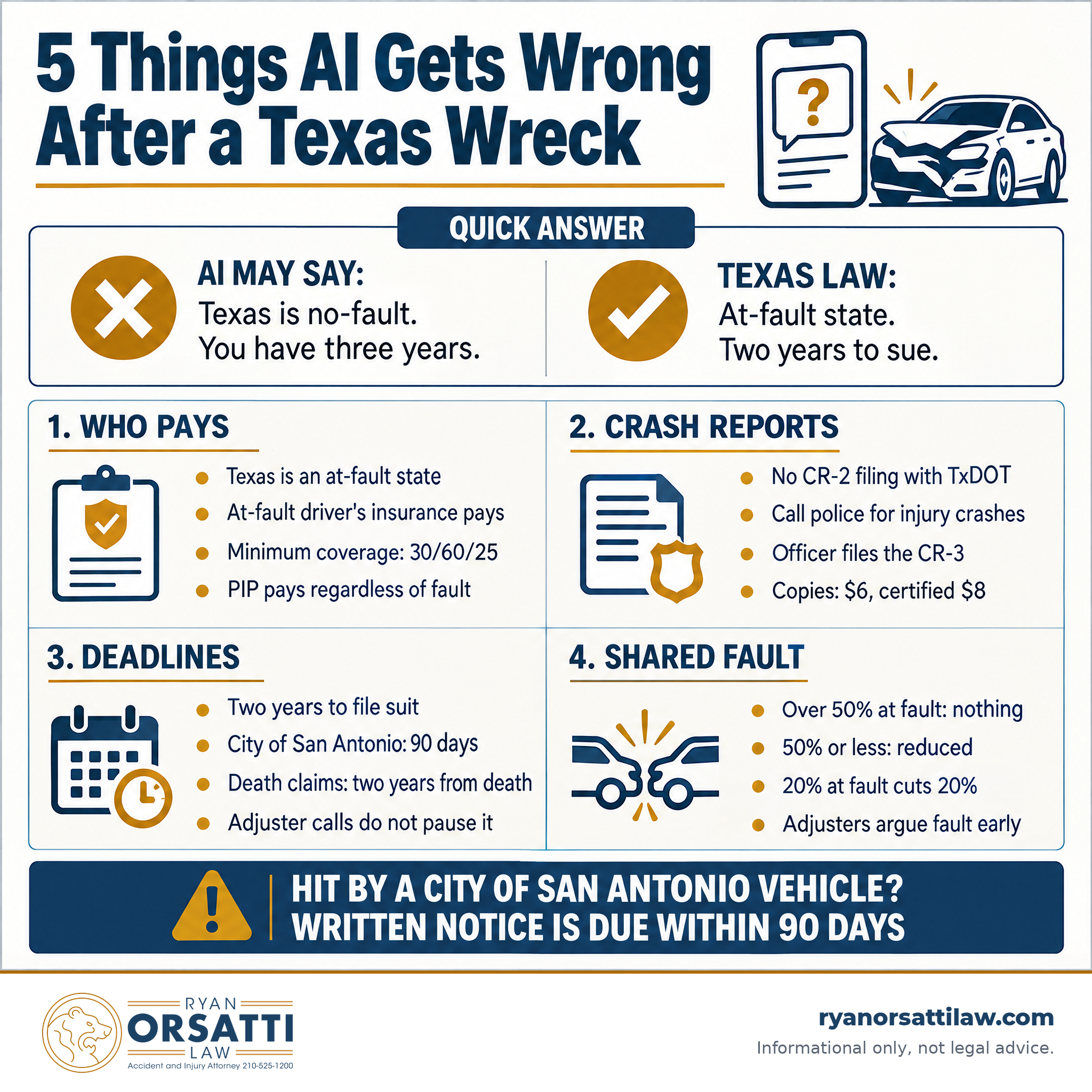
If you typed your wreck into ChatGPT, Gemini, or another chatbot, the answer probably sounded confident. Some of it may even be right. The problem is that Texas car accident laws differ from other states in ways that change who pays, how long you have, and whether you can recover at all, and a chatbot gives you no warning when it has blended in another state’s rule.
Below are five places where AI answers about Texas wrecks tend to go wrong, the actual Texas rule for each one, and the source you can open to check it yourself. If an answer has you unsure about a deadline or who pays, Ryan Orsatti Law, a San Antonio personal injury firm, offers a free consultation where your situation gets reviewed against Texas law itself, not a summary of it.
Why Do AI Chatbots Get Texas Car Accident Law Wrong?
AI chatbots get Texas car accident law wrong mostly because they are built from huge amounts of general writing, not from the Texas statutes. Most car accident content online is written for a national audience, and some states run no-fault insurance systems that work very differently from Texas. When a chatbot blends those sources, the result reads smoothly and can still be wrong for a crash on Loop 410.
Three other gaps show up again and again:
- Old pages. Texas changed its driver crash report rules in 2017, but older web pages still describe the old process.
- Local rules. Short notice deadlines for city claims live in city charters, not in the statewide statutes most answers summarize.
- Missing facts. A chatbot cannot see whether a city truck hit you, whether police came, or what your own policy says.
This matters because a lot of Texans end up asking these questions. TxDOT’s 2025 Crash Facts report one reportable crash every 59 seconds and 244,534 people injured on Texas roads that year, including 17,420 serious injuries.
Attorney Insight: A chatbot is fine for the busywork after a wreck: a list of receipts to save, a daily symptom journal, questions to bring to your doctor. Where it gets risky is anything with a number attached to it, like a deadline, a fault percentage, or a coverage limit. Those numbers come from a specific Texas statute or a specific policy, and the answer is only as good as the source behind it.
For a fuller breakdown of what a chatbot is good for after a wreck and where it can hurt your claim, see our guide on whether you should use ChatGPT after a car accident in Texas.
Mistake 1: Is Texas a No-Fault State? No.
Texas is not a no-fault state. It is an at-fault state, which means the driver who causes a crash is responsible for the harm. The Texas Department of Insurance describes the rule simply: Texas law makes drivers pay for the accidents they cause.
Every Texas driver must carry liability insurance (coverage that pays for damage you cause to other people) with minimums of $30,000 for injury to one person, $60,000 for injuries to two or more people, and $25,000 for property damage in one crash, under Texas Transportation Code Sec. 601.072. People call this 30/60/25 coverage.
Where the no-fault confusion comes from
The confusion usually comes from PIP. Personal injury protection is coverage on your own auto policy that pays some medical bills and lost income, and under Texas Insurance Code Sec. 1952.155, PIP benefits are payable without regard to who caused the crash. That one feature looks a lot like a no-fault system, so an AI answer trained on no-fault states can blur the two.
Texas insurers must include PIP in an auto liability policy unless a named insured rejects it in writing (Insurance Code Sec. 1952.152). The law does not require insurers to provide more than $2,500 per person (Sec. 1952.153), so check your declarations page for your actual amount.
What it means for you: if you have PIP, use it for early bills. It is a first step, not the whole claim. The at-fault driver’s liability coverage is where the rest of the injury claim goes, and if that coverage is thin, our guide on what to do when the at-fault driver in San Antonio has minimum coverage insurance walks through the next options.
Mistake 2: Do You Have to File a Crash Report With TxDOT?
No. Texas drivers no longer file their own crash report with TxDOT. After Senate Bill 312 from the 85th Texas Legislature, TxDOT stopped retaining the Driver’s Crash Report (Form CR-2) effective September 1, 2017, and the retention period for every CR-2 it held expired on January 1, 2019. TxDOT now says it has no driver crash reports in its records at all.
Answers built from older pages may still tell you to fill out a CR-2 and mail it in. Doing that does nothing for your claim.
What Texas actually requires after a crash
Texas Transportation Code Sec. 550.026 requires a driver to notify police immediately, by the quickest means available, after a crash that injures or kills someone or damages a vehicle so it cannot be normally and safely driven. Inside a city, that notice goes to the local police department.
When an officer investigates a crash involving injury, death, or apparent property damage of $1,000 or more to any one person, Sec. 550.062 requires the officer to write a report and file it electronically with TxDOT within 10 days. That report is the CR-3, the Texas Peace Officer’s Crash Report. TxDOT sells copies for $6 (regular) or $8 (certified). Our step-by-step guide explains how to obtain a crash report in San Antonio.
If no officer investigated, TxDOT’s guidance is to keep your own information for your records. That means photos, the other driver’s name and insurance, the plate number, witness contacts, and a short written note of what happened, made the same day.
Mistake 3: How Long Do You Have to File a Car Accident Claim in Texas?
In Texas, the general deadline to file a personal injury lawsuit after a car accident is two years from the day the claim accrues, which is usually the day of the crash, under Texas Civil Practice and Remedies Code Sec. 16.003. The same two-year period covers lawsuits over damage to your vehicle and other property.
AI answers miss this in a few ways. Some give a number borrowed from another state. Some skip the exceptions. The ones worth knowing:
- Wrongful death: the two years run from the date of death, not the date of the crash (Sec. 16.003(b)).
- Children: for a child’s own injury claim, time before the child turns 18 is not counted (Sec. 16.001). Evidence still fades, so families should not treat that as a reason to wait.
- Insurance talks do not stop the clock. Calls and emails with an adjuster do not pause the statute of limitations (the legal deadline to file suit). Only filing suit or resolving the claim protects it.
Attorney Insight: The AI answer that worries us most is not the obviously wrong one. It is the half-right one. “Two years” is correct often enough that people stop checking, and then a 90-day city notice deadline or an insurance policy’s own notice requirement slips by underneath it. Adjusters know every one of these dates. When we review a file, the first thing we build is a deadline list for that specific crash, because the statewide answer is only the outer limit.
Mistake 4: Can You Recover if You Were Partly at Fault in Texas?
Yes, as long as your share of fault is 50 percent or less. Texas follows a modified comparative fault system called proportionate responsibility, where each party is assigned a percentage of fault. Under Texas Civil Practice and Remedies Code Sec. 33.001, a person whose share of responsibility is greater than 50 percent recovers nothing. Under Sec. 33.012(a), anyone at or below that line has their damages reduced by their own percentage.
Some AI answers describe pure comparative fault instead, a system used in other states where a driver can recover even at 90 percent fault. That is not Texas law.
Here is the math on a hypothetical $10,000 in damages, for illustration only:
- 20 percent at fault: $10,000 x (1 – 0.20) = $8,000
- 50 percent at fault: $10,000 x (1 – 0.50) = $5,000
- 51 percent at fault: barred, $0
Fault percentages get argued long before any jury sees them. In claims we handle, adjusters often propose their own fault split early, and a casual comment like “I didn’t see him until the last second” can turn into an argument that you share the blame. Our post on combating false claims that you were partially at fault covers how that plays out.
Mistake 5: Hit by a City of San Antonio Vehicle? You May Have Only 90 Days
If a City of San Antonio vehicle hit you, written notice of your claim must reach the City Manager or the City Clerk within 90 days after the injury or damage, under Section 150 of the San Antonio City Charter. The notice must state when, where, and how the injury happened, the apparent extent of the injury, and the amount of damages.
The Texas Tort Claims Act (the state law that allows some injury claims against government bodies) sets a six-month notice deadline for claims against governmental units under Civil Practice and Remedies Code Sec. 101.101(a). Sec. 101.101(b) then ratifies city charter notice periods like San Antonio’s. That is how a 90-day local deadline can sit underneath a two-year statewide one.
A chatbot asked “how long do I have” will usually give the two-year answer and stop there. A few more points it tends to skip:
- Not every public vehicle belongs to the city. The city’s notice-of-claim page says claims involving CPS Energy, SAWS, or VIA Metropolitan Transit go to those entities, not the city.
- Other Texas cities have their own charters and their own notice rules, so the 90-day number is specific to San Antonio.
- Sec. 101.101(c) has an exception when the government already has actual notice of the injury, but whether it applies is a fact fight. Nobody should plan around it.
AI Answers vs. Texas Law: Side by Side
| Topic | What an AI answer may say | What Texas law says | Source |
|---|---|---|---|
| Who pays | Texas is no-fault, so your own insurer pays. | The driver who causes the crash pays. Minimum coverage is 30/60/25. | Transp. Code Sec. 601.072 |
| Crash report | File a CR-2 with TxDOT. | TxDOT no longer keeps CR-2s. Call police for injury crashes. The officer files the CR-3. | Transp. Code Secs. 550.026, 550.062 |
| Lawsuit deadline | Three years, or no rush. | Two years for injury and property damage claims. | CPRC Sec. 16.003 |
| Shared fault | You can recover even if mostly at fault. | Over 50 percent at fault bars recovery. Lower shares reduce it. | CPRC Secs. 33.001, 33.012 |
| City vehicle | Two years, like any other claim. | Written notice to the City of San Antonio within 90 days. | City Charter Sec. 150, CPRC Sec. 101.101 |
How to Fact-Check an AI Answer About Your Texas Car Accident
You can check most AI answers about a Texas wreck in a few minutes. Work through these steps before you rely on one:
- Ask which state’s law it is using. Then ask for the exact statute section. A vague answer is a warning sign.
- Open the statute yourself. Texas statutes are free at statutes.capitol.texas.gov. Look for the Civil Practice and Remedies Code, Transportation Code, or Insurance Code.
- Watch for four red-flag phrases: “no-fault,” “three years,” “pure comparative fault,” and “file a report with TxDOT.”
- Write down your two-year date. Count from the crash date and put it on your calendar now.
- Check who owned the other vehicle. A city truck, a utility truck, or a transit bus can bring a much shorter notice deadline.
- Pull your own policy. Look for PIP, MedPay, and uninsured or underinsured motorist coverage on the declarations page.
- Do not let a chatbot write anything you send to an insurer. Anything you send becomes part of the claim file.
- Have a Texas lawyer confirm any deadline before you count on it.
For the hour-by-hour steps right after a wreck, see our guide to the first 24 hours after a San Antonio car accident.
Why Injured Texans Have a Lawyer Check What AI Told Them
An AI answer can get the general rule right and still miss what controls your case: who owned the other vehicle, what your policy says, how fault will be split, and which deadline hits first. A lawyer reviewing a crash should start with the deadline list, then pull the CR-3, confirm every available policy, send preservation requests, and look at the fault argument before an adjuster frames it. Ryan Orsatti Law handles car accidents, truck accidents, motorcycle crashes, pedestrian collisions, and other serious injury cases for people across San Antonio and Texas, with offices in Austin, Dallas, and Houston. If you want help with a San Antonio car accident claim, the firm offers free consultations in English and Spanish, and you can call 210-525-1200 any time.
Frequently Asked Questions
Is Texas a no-fault state for car accidents?
No. Texas is an at-fault state, so the driver who causes a crash is responsible for the damage, usually through liability insurance. Texas requires at least $30,000 per injured person, $60,000 per crash for injuries, and $25,000 for property damage. PIP coverage on your own policy pays without regard to fault, which is why some people mistakenly call Texas a no-fault state.
Do I have to report a car accident to the police in Texas?
Yes, if the crash injures or kills someone or leaves a vehicle unable to be driven normally and safely. Texas Transportation Code Sec. 550.026 requires the driver to notify police immediately by the quickest means available. You do not file your own report with TxDOT anymore. The investigating officer files the CR-3 crash report with TxDOT within 10 days.
How long do I have to file a car accident claim in Texas?
The general deadline to file a car accident lawsuit in Texas is two years from the date the claim accrues, usually the crash date, under Civil Practice and Remedies Code Sec. 16.003. Shorter notice deadlines can apply, including 90 days for claims against the City of San Antonio. Talking with an insurance adjuster does not pause the two-year deadline.
Can I still recover if I was 50 percent at fault in Texas?
Yes, but your recovery is reduced by half. Texas bars recovery only when your share of fault is greater than 50 percent, under Civil Practice and Remedies Code Sec. 33.001. At 50 percent or less, your damages are reduced by your percentage of fault. Above 50 percent, you recover nothing from the other driver.
Can I trust ChatGPT for advice after a car accident in Texas?
You can use ChatGPT or another chatbot to organize your thoughts, but do not rely on it for Texas deadlines, fault rules, or insurance coverage. AI answers can blend rules from other states or rely on outdated pages, and they cannot see your policy or who owned the other vehicle. Check any legal answer against the Texas statute or a Texas lawyer.
Should I wait until I know my injuries before talking to a lawyer?
No. Medical care, evidence, and deadlines do not wait for your symptoms to settle. Some notice deadlines are as short as 90 days, video footage can get recorded over, and early statements to an insurer can shape the fault argument. A free consultation lets you learn your deadlines and options early, while you keep focusing on your treatment.
Source Notes
- Tex. Civ. Prac. & Rem. Code Sec. 16.003 (two-year limitations period) and Sec. 16.001 (effect of disability, including minors)
- Tex. Civ. Prac. & Rem. Code Sec. 33.001 (proportionate responsibility) and Sec. 33.012 (amount of recovery)
- Tex. Civ. Prac. & Rem. Code Sec. 101.101 (Texas Tort Claims Act notice)
- Tex. Transp. Code Sec. 550.026 (immediate report of collision) and Sec. 550.062 (officer’s collision report)
- Tex. Transp. Code Sec. 601.072 (minimum liability coverage)
- Tex. Ins. Code Sec. 1952.152 (PIP required unless rejected in writing), Sec. 1952.153 (maximum required PIP amount), and Sec. 1952.155 (PIP payable without regard to fault)
- City of San Antonio, Notice of Claim (City Charter Sec. 150)
- TxDOT, Crash Reports and Records (CR-2 retention and CR-3 copy fees)
- TxDOT, 2025 Texas Motor Vehicle Traffic Crash Facts
- Texas Department of Insurance, Auto Insurance
Ryan Orsatti Law
4634 De Zavala Rd, San Antonio, TX 78249
Phone: 210-525-1200
ryanorsattilaw.com
This blog is for informational purposes only, not legal advice. Reading it does not create an attorney-client relationship. Past results do not guarantee future results.
Hurt in an accident in San Antonio? Learn how a San Antonio personal injury lawyer can help with your claim. Call 210-525-1200 or request a free consultation.
The firm works on a contingency fee. You pay nothing unless the firm recovers money for you, and that covers case expenses as well as the fee: if there is no recovery, you owe no attorney's fee and no case expenses. Ask for the fee agreement and read the fee and expense section before you sign anything.
Related San Antonio legal resources
Primary legal and public-data sources
- TxDOT: Texas crash reports, data, and statistics
- Texas Civil Practice and Remedies Code Chapter 33: proportionate responsibility
Ryan Orsatti Law
4634 De Zavala Road, San Antonio, TX 78249
General reference links. Consult each source for its current text.