
Quick Answer
- ChatGPT after a car accident in Texas can help with blank checklists, general questions, and organizing tasks.
- Keep private medical records, lawyer communications, and detailed crash accounts out of a consumer chatbot unless your lawyer has approved the tool and the use.
- Do not rely on AI alone to diagnose injuries, decide fault, calculate a filing deadline, or value a claim.
- If you already used AI, preserve the conversation and any drafts you sent. Using a chatbot does not automatically ruin a claim.
Key Takeaways
- A blank symptom-log template is useful. An AI-generated description of symptoms you never reported is a problem.
- A private account does not, by itself, create attorney-client privilege.
- The deadline to sue and a government notice deadline are different clocks.
- Keep your original notes and documents so an AI summary never becomes the only account of what happened.
Ryan Orsatti Law helps injured Texans review insurance requests, preserve crash evidence, and identify deadlines. Our San Antonio car accident resource explains the broader claim process.
What should I do before asking ChatGPT about a Texas wreck?
Get needed medical care, save the original evidence, and identify urgent deadlines before spending time on prompts. A chatbot conversation can wait while you address those needs.
The Texas Civil Practice and Remedies Code generally gives a person two years after a personal-injury claim accrues to file suit under Section 16.003(a). Accrual means the point when the legal claim arises. Exceptions can change the analysis.
A government vehicle can create an earlier notice issue. Section 101.101 generally requires notice to a governmental unit within six months and recognizes qualifying city notice provisions. San Antonio’s Charter Section 150 states a 90-day written-notice requirement to the City Manager or City Clerk. Applicability and actual-notice exceptions require individual review. A police report is not a safe substitute for confirming that a claim-notice requirement has been satisfied.
For a wreck on I-10, I-35, or Loop 1604, identify the actual vehicle owner and employer. A City truck, private delivery van, and VIA bus may involve different entities and rules. Do not let AI turn a general deadline into a calendar date for your specific case.
What is ChatGPT useful for after a car accident?
ChatGPT is useful for creating a structure you fill in yourself. Begin with an empty form rather than uploading a police report, hospital chart, or insurance file.
| Use level | Example | Practical limit |
|---|---|---|
| Green: blank organization | Receipt tracker, appointment checklist, symptom-log template | Fill it in privately. Check every entry against the original. |
| Green: general learning | Questions to ask a lawyer, or an explanation of an insurance term | Verify the answer before acting. Leave out identifying facts. |
| Yellow: summaries | Summarizing your crash notes or claim correspondence | Get approval before uploading private material. Preserve originals and uncertainty. |
| Red: claim statements | Writing an account for an adjuster or a fault admission | Have a lawyer review the facts and purpose before sending. |
| Red: decisions | Diagnosis, claim value, filing date, release approval | Use medical care and individualized legal review. |
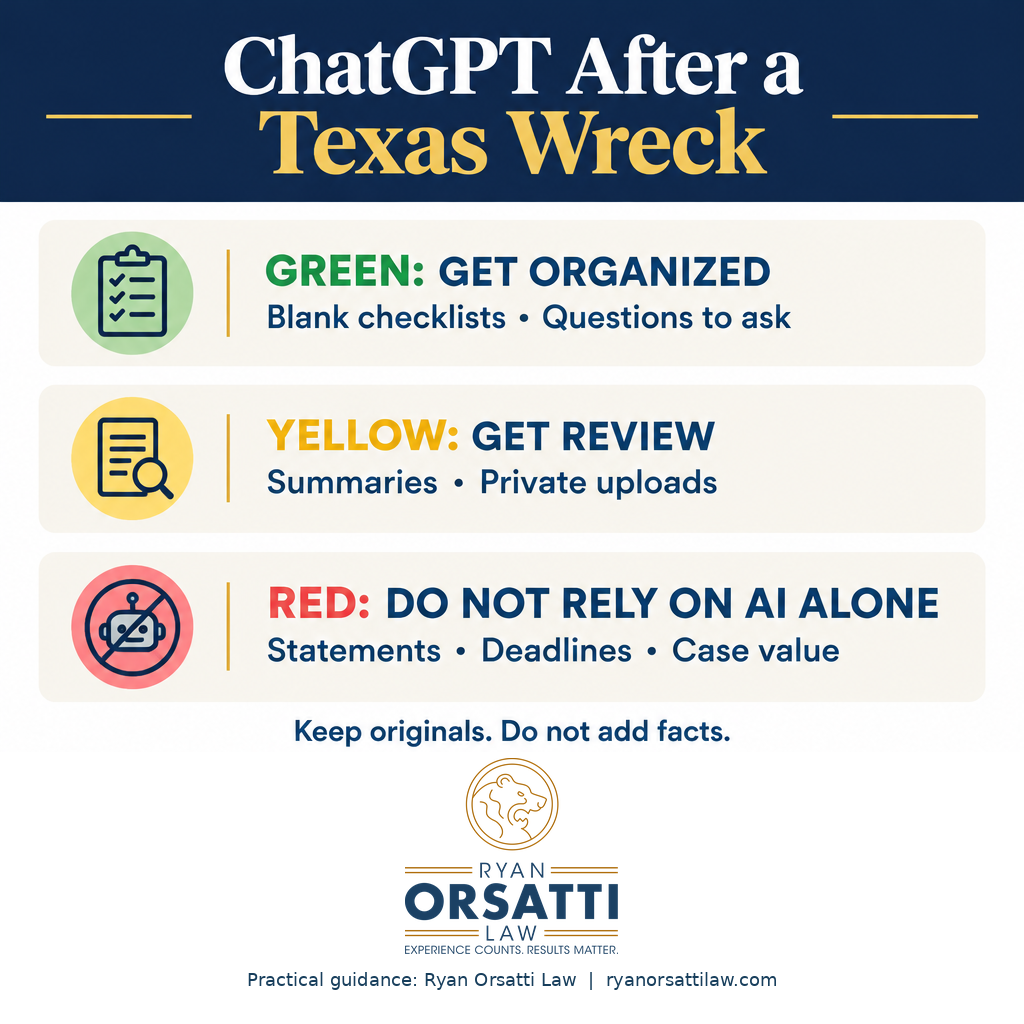
These labels describe practical risk. A green task is not a promise of accuracy, and a yellow task is not automatically forbidden. What you share, what the tool changes, and what you do with the answer all matter.
For example, ask for receipt columns covering date, expense type, amount, payment status, and original filename. Enter the actual information in a private spreadsheet. The total should be checked against the receipts, including refunds and duplicate charges.
Are my ChatGPT conversations protected by attorney-client privilege?
Do not assume a conversation with ChatGPT has attorney-client privilege, the legal protection for certain confidential lawyer-client communications. Texas Rule of Evidence 503 protects qualifying communications made to obtain legal services. A consumer chatbot is not your lawyer.
Texas Rule of Evidence 511 also addresses waiver, meaning loss of a privilege through voluntary disclosure. Pasting your lawyer’s advice into an outside tool can create a waiver dispute. A label such as “confidential” does not settle that issue.
There is a separate protection called work product for certain material prepared in anticipation of litigation. Texas Rule of Civil Procedure 192.5 includes qualifying work by or for a party, so lack of a lawyer’s direction alone does not end every Texas work-product claim. Protection depends on the facts, applicable law, and exceptions.
What does the Heppner AI decision actually say?
The federal court in United States v. Heppner rejected privilege and work-product claims over a criminal defendant’s self-directed Claude exchanges. The written memorandum was filed February 17, 2026. The court considered the lack of counsel’s direction and the platform’s privacy terms, among other facts. The materials were seized under a search warrant, rather than obtained through ordinary civil discovery.
That Southern District of New York criminal ruling does not bind Texas state courts or decide every ChatGPT scenario. Its practical warning is narrower: do not assume an outside AI conversation becomes protected just because it discusses legal strategy or is later forwarded to counsel.
Can the insurance company get my AI chats?
An insurer does not automatically gain access to your account because you open a claim. In a Texas lawsuit, relevant, nonprivileged electronic material may be requested in discovery, the process for exchanging case information. Rules 192.3 and 192.4 govern scope and limits. Discoverability does not make every document admissible at trial.
The strongest defense argument is that a chat may show an earlier account of the wreck, when symptoms were first described, or whether a later statement came from the injured person or the software. An unrelated conversation does not become relevant simply because it is in the same account. A lawyer can evaluate proper requests and objections.
Attorney Insight: Keep a clear line between what you remember and what a tool supplied. If your note says, “I did not see the signal before impact,” an AI rewrite saying, “I entered on a green light,” adds a fact. A polished sentence cannot replace a missing memory.
Should I upload my medical records or police report?
Keep those documents out of a consumer chat unless your lawyer has reviewed the proposed use and safeguards. Removing your name alone may leave enough details to identify you or someone else.
HHS explains that HIPAA generally does not protect health information you enter into an app for personal use unless the app is provided by a covered entity or its business associate. Your doctor’s privacy duties do not automatically follow a record into every app you choose.
Review the service’s current retention, training, sharing, and connected-app settings. Product controls vary and change. Treat those controls as separate from the legal question of privilege. Do not paste lawyer emails, strategy notes, Social Security numbers, insurance identifiers, or another person’s medical information into a general-purpose prompt.
If you need a plain-language explanation of a medical term, ask about the term without uploading the chart. Bring questions about your diagnosis, treatment, or changing symptoms to your medical provider.
Can ChatGPT write my statement to the insurance adjuster?
ChatGPT can produce a draft, but sending an unchecked draft can turn guesses into your claimed facts. Review who is asking, what information is needed, and whether the request concerns your own policy or the other driver’s insurer.
TDI explains that you do not have a contract with the other driver’s insurer. Your own insurer is different: the Office of Public Insurance Counsel advises policyholders to cooperate with their company and keep claim records. Do not ignore your own insurer or let AI tell you that all requests are optional.
For detailed interviews, see our guide to recorded statements after a Texas car accident.
Before using any draft, check each sentence against a source or your actual memory. Delete invented facts from an unsent draft while keeping its original version. Do not use AI to rehearse an account that makes you sound more certain than you are.
If an AI-written statement was already sent, save what you sent and tell your lawyer which parts came from the tool. Review how to correct a material error deliberately, rather than sending a second long account in a hurry.
Attorney Insight: Tell the reviewing lawyer whether a draft stayed on your device, was uploaded to an insurer’s portal, or was sent to an adjuster. Bring the exact version and the transmission record. The next step depends on what actually left your hands, not just what appears in the latest draft.
What prompts can I use without sharing my case?
Ask for empty templates or general questions that require no private facts. These examples give you a starting point:
- “Create a blank expense tracker for someone recovering from a car accident. Include a column for the original receipt filename. Do not estimate expenses.”
- “Create a blank daily symptom log with fields for date, my own description, activities affected, and medical appointments. Do not suggest symptoms or diagnoses.”
- “List questions to ask a Texas personal injury lawyer about insurance, evidence, and deadlines. Do not calculate a deadline or estimate a settlement.”
Write symptom entries yourself, close to when you notice them, using ordinary words. If an entry is made later, identify when you wrote it and when the event occurred. An honest gap is preferable to a reconstructed history presented as a daily record.
What should I do during the first week after a wreck?
Use the first week to get care, preserve originals, and obtain answers to urgent claim questions. This checklist is a practical sequence, not a waiting period or legal deadline.
- Address medical needs. Get appropriate care and follow discharge instructions. Do not wait for a chatbot to confirm whether a symptom matters.
- Save original evidence. Keep photographs, video, texts, witness details, and available report information. Use our Texas car accident evidence checklist in English and Spanish.
- Report the claim promptly. Identify your insurer, policy, and claim number. Ask for unfamiliar requests in writing.
- Keep your own records. Save bills, receipts, missed-work information, and factual notes without embellishment.
- Flag unusual facts immediately. Government vehicles, serious injuries, disputed fault, and a driver working for a business may require different steps.
- Preserve any existing AI material. Keep the conversation, uploads, outputs, and versions of statements you sent. Ask your lawyer about preservation before changing relevant retention or deletion settings.
How can Ryan Orsatti Law help with an AI-assisted claim?
Ryan Orsatti Law can review the original crash evidence alongside any AI-assisted statement or summary. That review helps separate firsthand facts from added language and identify coverage, preservation, and deadline issues. Based in San Antonio, the firm represents injured people in car accidents and other personal injury matters across Texas. You can request a free consultation in English or Spanish without first building a complete file or asking AI to value the claim.
Frequently Asked Questions
Can I use ChatGPT to help with my car accident claim?
Yes, for limited tasks such as making blank checklists and preparing questions. Keep private case information out of the prompt, verify the output, and keep original documents. Do not treat a chatbot’s explanation as a decision about your medical needs, legal deadline, insurance duties, or settlement.
Can ChatGPT tell me what my Texas accident case is worth?
A chatbot’s estimate should not guide a settlement decision. A useful evaluation requires the actual evidence, available coverage, disputed fault, documented losses, and unresolved medical questions. A tool that has not reviewed those materials cannot reliably account for them. Avoid using an AI number as an anchor for accepting or rejecting an offer.
Does sending my AI conversation to my lawyer make it privileged?
Forwarding an existing conversation to a lawyer does not automatically protect the original material. The communication with your lawyer may raise a separate privilege question. Preserve the full conversation and explain how it was created. Let your lawyer assess the relevant protections before you share it with anyone else.
Should I delete my ChatGPT history after a car accident?
Do not delete relevant chats to prevent someone from finding them. Keep the original exchange, uploads, and outputs, including errors, and ask your lawyer about preservation. If material is missing, explain what happened honestly. Do not recreate a chat or edit an export to make it appear to be the original.
Did I hurt my claim by already using ChatGPT?
Using ChatGPT does not automatically harm a claim. The important questions are what you shared, what the tool changed, and whether you sent or relied on the result. Save the material and tell your lawyer about it. A factual review is more useful than assuming the claim is lost or trying to hide the chat.
Should I wait for an AI answer before getting care or calling a lawyer?
No. Medical needs, disappearing evidence, and legal deadlines deserve prompt attention. You can seek care and ask about your legal options before the police report arrives or the insurer makes an offer. Bring what you have, including any AI drafts, and identify what is still missing rather than waiting for a complete package.
Source Notes
The authorities below support the legal and privacy points in this article. The task examples and use-level table are practical recommendations, not rules declaring every AI use protected or discoverable.
- Tex. Civ. Prac. & Rem. Code § 16.003(a): general personal-injury limitations period.
- Tex. Civ. Prac. & Rem. Code § 101.101: governmental claim notice and exceptions.
- City of San Antonio, Notice of Claim, Charter § 150: the City’s written-notice provision.
- Tex. R. Evid. 503 and 511: lawyer-client privilege and voluntary disclosure.
- Tex. R. Civ. P. 192.3, 192.4 and 192.5: discovery scope, limits, and work product.
- United States v. Heppner, No. 25 Cr. 503 (JSR), slip op. at 5-12 (S.D.N.Y. Feb. 17, 2026): the federal criminal AI ruling discussed above.
- HHS, Protecting the Privacy and Security of Your Health Information When Using Your Personal Cell Phone or Tablet: limits of HIPAA protection for personal app use.
- TDI, Dealing with the other driver’s insurance, and OPIC, Information on First-Party Claims: insurer distinctions and recordkeeping.
Ryan Orsatti Law
4634 De Zavala Rd, San Antonio, TX 78249
Phone: 210-525-1200
ryanorsattilaw.com
This blog is for informational purposes only, not legal advice. Reading it does not create an attorney-client relationship. Past results do not guarantee future results.
Hurt in an accident in San Antonio? Learn how a San Antonio personal injury lawyer can help with your claim. Call 210-525-1200 or request a free consultation.
The firm works on a contingency fee. You pay nothing unless the firm recovers money for you, and that covers case expenses as well as the fee: if there is no recovery, you owe no attorney's fee and no case expenses. Ask for the fee agreement and read the fee and expense section before you sign anything.
Related San Antonio legal resources
Primary legal and public-data sources
- TxDOT: Texas crash reports, data, and statistics
- Texas Civil Practice and Remedies Code Chapter 33: proportionate responsibility
Ryan Orsatti Law
4634 De Zavala Road, San Antonio, TX 78249
General reference links. Consult each source for its current text.