
Quick Answer: After a tragic wrong-way collision in South Bexar County, injured people and eligible families may have civil claims for personal injury, wrongful death, and survival damages, separate from any criminal investigation. In Texas, most injury and wrongful death lawsuits must be filed within two years, and wrongful death claims are generally brought for the surviving spouse, children, and parents. Ryan Orsatti Law helps San Antonio and Texas families evaluate fault, insurance coverage, crash evidence, and deadlines after serious highway collisions. (Texas Statutes)
Key Takeaways
- A wrong-way crash can create personal injury, wrongful death, and survival claims under Texas law, depending on who was hurt, who died, and what losses occurred. (Texas Statutes)
- Texas generally gives injury victims and families two years to file suit, but crash evidence can disappear much sooner. (Texas Statutes)
- TxDOT reported 617 deaths in head-on crashes in Texas in 2024, and 1,053 traffic deaths involved a driver under the influence of alcohol. (Texas Department of Transportation)
- Insurance may include liability coverage, uninsured/underinsured motorist coverage, PIP, MedPay, commercial coverage, or umbrella coverage.
- Families should not assume the criminal case will protect their civil claim. The civil case requires separate proof, separate deadlines, and separate damages evidence.
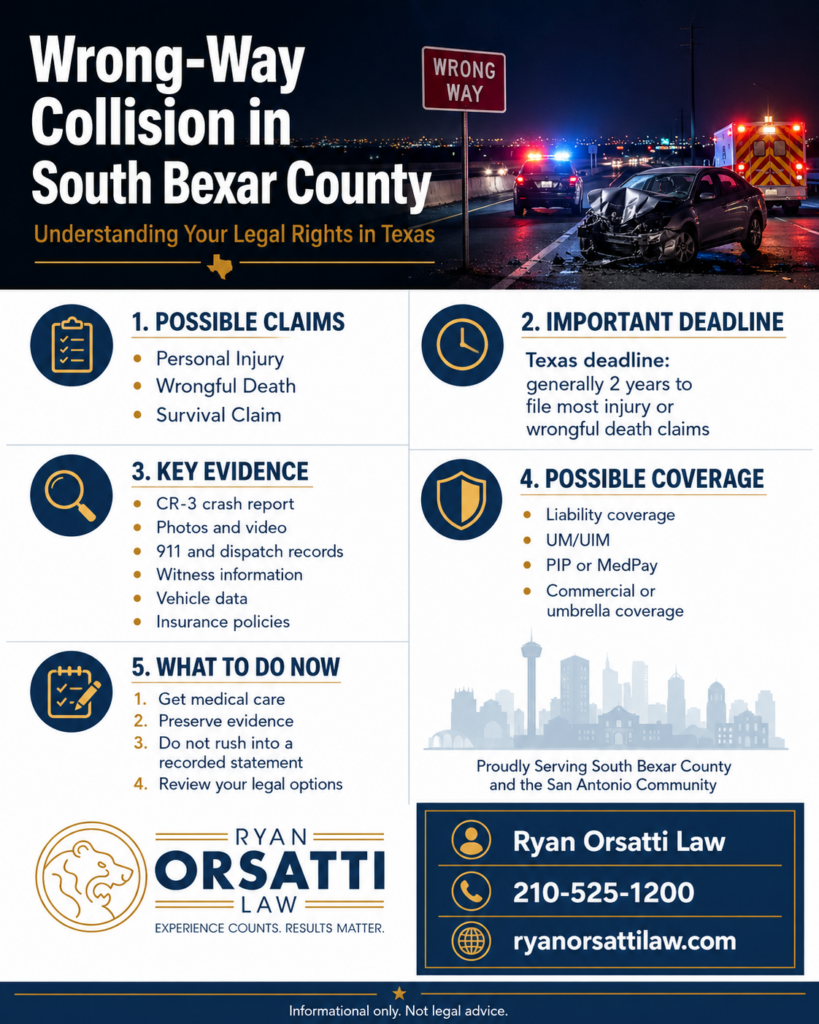
What legal rights do families have after a wrong-way collision in South Bexar County?
Families may have the right to bring a Texas wrongful death claim, a survival claim, or both after a fatal wrong-way collision in South Bexar County. A wrongful death claim belongs to certain family members for their own losses, while a survival claim preserves the injured person’s own claim through the estate. (Texas Statutes)
A wrongful death claim is a civil claim for the losses suffered by eligible family members after a person dies because of another party’s wrongful act, neglect, carelessness, unskillfulness, or default. Texas law identifies the surviving spouse, children, and parents as the core wrongful death beneficiaries. (Texas Statutes)
A survival action is different. It is the claim the injured person could have brought if they had survived, including damages tied to the injury before death. Texas Civil Practice and Remedies Code § 71.021 states that a personal injury action survives to and in favor of the heirs, legal representatives, and estate of the injured person. (Texas Statutes)
For families trying to understand the difference, Ryan Orsatti Law has additional resources on fatal car accident claims in South Texas and what is needed to prove wrongful death in Texas.
Why are wrong-way collisions often so serious?
Wrong-way collisions are often catastrophic because they commonly involve vehicles moving directly toward each other at highway speeds. The National Transportation Safety Board defines wrong-way driving as movement opposite the legal traffic flow on high-speed divided highways or access ramps, and it has noted that wrong-way crashes are far more likely to involve fatal or serious injuries than many other highway crashes. (NTSB)
In South Bexar County, wrong-way crash risk can involve high-speed corridors, entrance ramps, frontage roads, rural stretches, low-light conditions, and late-night driving. Roads such as I-37, Loop 1604, Highway 16, US-281 South, I-35, I-10, and Loop 410 can all raise different evidence questions, depending on where the wrong-way movement began.
Texas crash data shows why these cases require careful investigation. TxDOT reported 617 deaths in head-on crashes in 2024, and Texas recorded 1,053 traffic deaths in crashes where a driver was under the influence of alcohol. TxDOT also reported that DUI-alcohol crashes were more frequent between 2:00 a.m. and 2:59 a.m. than any other hour. (Texas Department of Transportation)
Who can file a wrongful death claim in Texas?
In Texas, a wrongful death claim is generally brought for the surviving spouse, children, and parents of the person who died. These claims focus on the family’s losses, which may include loss of companionship, mental anguish, lost financial support, funeral expenses, and related damages allowed by Texas law. (Texas Statutes)
The estate may also have a survival claim if the person lived for any period of time after the crash, even briefly. That claim can include damages the injured person suffered before death, such as conscious pain, medical expenses, and other losses supported by the evidence. (Texas Statutes)
Texas also uses comparative responsibility, which means fault can be divided by percentage. Under Texas Civil Practice and Remedies Code Chapter 33, a claimant generally cannot recover damages if that claimant’s percentage of responsibility is greater than 50%. In serious wrong-way cases, insurers may still look for ways to dispute speed, lighting, seat belt use, evasive action, or other facts. (Texas Statutes)
For more on timing, see Ryan Orsatti Law’s guide to the Texas wrongful death statute of limitations.
What evidence should be preserved after a South Bexar County wrong-way crash?
The most important evidence after a wrong-way crash includes the crash report, vehicle evidence, scene photographs, video, 911 and dispatch records, toxicology evidence, witness information, roadway signage, and insurance documents. Families should act quickly because some video, vehicle data, and business records may be overwritten or lost before the civil claim is ready. (Texas Department of Transportation)
Texas officers investigating crashes involving injury, death, or at least $1,000 in property damage must submit a written crash report to TxDOT not later than the 10th day after the crash. TxDOT is the custodian of Texas crash reports, but dash camera video, photographs, field notes, and other scene materials usually must be requested from the investigating agency. (Texas Department of Transportation)
Evidence checklist after a wrong-way collision
The right evidence plan depends on the road, vehicles, police agency, injuries, and available insurance. A serious South Bexar County wrong-way collision should usually trigger a fast preservation plan.
- Identify the investigating agency, crash number, and exact crash location.
- Request the Texas CR-3 crash report when it becomes available.
- Preserve all vehicles before repair, sale, salvage, or inspection by another party.
- Photograph the vehicles, roadway, signs, debris, skid marks, gouge marks, and lighting conditions.
- Look for nearby business, residential, dash camera, rideshare, fleet, or surveillance video.
- Request 911 audio, dispatch records, body camera video, dash camera video, and officer photographs from the proper agency.
- Preserve phone records, vehicle event data, and navigation data when relevant.
- Track hospital bills, EMS records, funeral expenses, wage loss documents, and family impact evidence.
- Avoid signing any release until all claims, insurance layers, and liens have been reviewed.
Key takeaway: In a wrong-way crash, the evidence that proves where the wrong-way movement began may be more valuable than the final point of impact.
Attorney Insight: In serious wrong-way crashes, the first insurance answer is rarely the full coverage picture. A plaintiff’s lawyer should not stop at the at-fault driver’s declarations page. The investigation should look for employer use, household policies, UM/UIM coverage, umbrella coverage, alcohol-service evidence, vehicle ownership, and fast-disappearing video near ramps, gas stations, and nearby businesses.
How does insurance work after a fatal or serious wrong-way crash?
Insurance after a wrong-way crash may include the at-fault driver’s liability coverage, the victim’s uninsured/underinsured motorist coverage, PIP, MedPay, commercial coverage, or excess coverage. Texas minimum auto liability limits are $30,000 per injured person, $60,000 per accident, and $25,000 for property damage, which can be far too low for a fatal or catastrophic crash. (Texas Department of Insurance)
Uninsured/underinsured motorist coverage, often called UM/UIM, can help when the at-fault driver has no insurance or not enough insurance. Texas insurers must offer UM/UIM coverage, and the policyholder must reject it in writing if they do not want it. (Texas Department of Insurance)
PIP, or personal injury protection, can pay certain medical expenses and lost income regardless of fault. Texas auto policies include PIP unless the insured rejected it in writing. MedPay is another optional coverage that may help pay medical bills, depending on the policy language. (Texas Department of Insurance)
| Coverage or source | What it may cover | What to check after a wrong-way crash |
|---|---|---|
| At-fault driver liability | Injury damages, wrongful death damages, property damage | Policy limits, exclusions, permissive use, vehicle ownership |
| UM/UIM | Damages when the at-fault driver has no insurance or too little insurance | Victim’s policy, household policies, rejection forms, stacking issues |
| PIP | Medical expenses and certain lost income regardless of fault | Whether PIP was rejected in writing, available limits, covered expenses |
| MedPay | Medical bills, depending on the policy | Limits, reimbursement rights, coordination with health insurance |
| Commercial or employer coverage | Higher limits if the driver was working or using a company vehicle | Scope of employment, dispatch records, vehicle purpose, employer policies |
| Umbrella or excess coverage | Additional insurance above primary limits | Whether the driver, household, business, or vehicle owner had extra coverage |
Key takeaway: A fatal wrong-way crash should not be evaluated only through the at-fault driver’s minimum policy because other coverage may exist.
Could a bar, restaurant, employer, or vehicle owner share responsibility?
A third party may share responsibility for a wrong-way crash if the evidence supports a legal basis beyond the wrong-way driver’s conduct. Potential examples include an alcohol provider, an employer, a vehicle owner, a commercial vehicle company, or another party whose conduct contributed to the crash.
A dram shop claim is a claim against an alcohol provider for unlawfully serving alcohol. Texas Alcoholic Beverage Code § 2.02 allows this type of claim only under specific facts, including evidence that the person was obviously intoxicated to the extent that they presented a clear danger to themselves and others, and that the intoxication caused the damages. (Texas Statutes)
Alcohol-service claims are fact intensive. Businesses may raise training and compliance defenses, so evidence such as receipts, tabs, surveillance video, witness statements, server information, ride-share records, and phone location data may matter. The Texas Alcoholic Beverage Commission recognizes seller-server training and related safe harbor issues under Texas alcohol law. (Texas Alcoholic Beverage Commission)
An employer may also be relevant if the wrong-way driver was working, driving a company vehicle, making a delivery, transporting passengers, or operating a commercial vehicle. A vehicle owner may matter if there is evidence of negligent entrustment, which means allowing someone to use a vehicle despite known safety concerns, licensing problems, impairment issues, or a dangerous driving history.
How long do you have to act after a wrong-way crash in Texas?
In Texas, most personal injury and wrongful death lawsuits must be filed within two years, but families should not wait that long to start the investigation. The legal deadline is important, but practical evidence deadlines can be much shorter because video, vehicle data, and witness memory can disappear quickly. (Texas Statutes)
The two-year deadline is not the only timing issue. TxDOT crash reports have their own process, police agencies may have separate records procedures, vehicles may be moved to storage or salvage, and insurance companies may request recorded statements before the family understands the full claim. (Texas Department of Transportation)
Spoliation means the loss, destruction, or failure to preserve relevant evidence when litigation is reasonably anticipated. In a serious wrong-way collision, a lawyer may send preservation letters to vehicle owners, insurers, employers, bars, restaurants, towing yards, nearby businesses, and public agencies when the facts support those requests.
What mistakes should families avoid after a South Bexar County wrong-way crash?
Families should avoid giving recorded statements, signing releases, assuming the criminal case handles everything, delaying evidence preservation, or discussing the crash online. These mistakes can affect fault, insurance coverage, medical bill issues, and the value of a civil claim.
Common mistakes include:
- Giving a recorded statement to another driver’s insurer before understanding the claim.
- Signing a property damage release that also affects injury or death claims.
- Waiting for the criminal case to end before preserving civil evidence.
- Assuming the at-fault driver’s policy is the only available insurance.
- Posting crash details, grief updates, or medical information on social media.
- Letting the vehicle be destroyed before it is inspected.
- Ignoring health insurance subrogation, hospital liens, or funeral expense documentation.
Subrogation means a health insurer may claim a right to be paid back from a settlement. A hospital lien is a legal claim a hospital may assert against part of a personal injury recovery. These issues can affect the final amount a family receives, even when liability seems clear.
How can Ryan Orsatti Law help after a wrong-way collision in Bexar County?
Ryan Orsatti Law helps injured people and families in San Antonio and across Texas evaluate fault, insurance coverage, medical bill issues, evidence preservation, and legal deadlines after serious crashes. In a South Bexar County wrong-way collision, early work often focuses on identifying where the wrong-way movement began, what coverage exists, and what evidence must be preserved.
A legal review may include:
- Reviewing the CR-3 crash report and investigating agency records.
- Sending preservation letters for video, vehicle data, dispatch records, and business records.
- Identifying all available liability, UM/UIM, PIP, MedPay, commercial, and excess coverage.
- Evaluating wrongful death and survival claims.
- Coordinating medical bill, health insurance, subrogation, and hospital lien issues.
- Preparing the claim for negotiation or litigation if needed.
Families can also review Ryan Orsatti Law’s resources on South Side San Antonio crash evidence and Texas wrongful death claims. To speak with the firm, use the Ryan Orsatti Law contact page.
FAQ
Can I bring a wrongful death claim if my loved one died in a wrong-way crash in Texas?
Yes, if you are an eligible beneficiary under Texas law. Texas wrongful death claims are generally brought for the surviving spouse, children, and parents of the person who died. The claim is separate from any criminal case and focuses on civil damages caused by the death. (Texas Statutes)
Is a criminal DWI case the same as a civil wrongful death claim?
No. A criminal DWI case is brought by the government and focuses on punishment or public safety. A civil wrongful death claim is brought by eligible family members or the estate and focuses on damages. Families should not rely on the criminal case alone to preserve insurance evidence, video, vehicle data, or civil deadlines.
What if the wrong-way driver also died in the crash?
A civil claim may still be possible even if the wrong-way driver died. The investigation may involve the driver’s estate, auto liability insurance, the victim’s UM/UIM coverage, household policies, commercial coverage, or third-party responsibility. UM/UIM coverage can help when the at-fault driver has no insurance or not enough insurance. (Texas Department of Insurance)
How do I get the crash report after a South Bexar County collision?
Texas crash reports are usually obtained through TxDOT’s crash report process or the investigating agency. TxDOT states that officers must submit qualifying crash reports not later than the 10th day after the crash, and reports are confidential but available to people with a proper legal interest. (Texas Department of Transportation)
Could a bar or restaurant be liable if the wrong-way driver was drunk?
Possibly, but only under specific evidence. Texas dram shop law may allow a claim if an alcohol provider served the person when it was apparent the person was obviously intoxicated to the extent they presented a clear danger, and that intoxication caused the damages. These claims require fast evidence preservation. (Texas Statutes)
How long do families have to file a lawsuit after a fatal Texas wrong-way crash?
Most Texas personal injury and wrongful death lawsuits must be filed within two years. Families should treat that as the outer deadline, not the investigation timeline. Video, vehicle data, witness information, and insurance evidence can be lost long before the lawsuit deadline arrives. (Texas Statutes)
Ryan Orsatti Law
4634 De Zavala Rd, San Antonio, TX 78249
Phone: 210-525-1200
ryanorsattilaw.com
This blog is for informational purposes only, not legal advice. Reading it does not create an attorney-client relationship. Past results do not guarantee future results.
Hurt in an accident in San Antonio? Learn how a San Antonio car accident lawyer can help with your claim. Call 210-525-1200 or request a free consultation.
The firm works on a contingency fee. You pay nothing unless the firm recovers money for you, and that covers case expenses as well as the fee: if there is no recovery, you owe no attorney's fee and no case expenses. Ask for the fee agreement and read the fee and expense section before you sign anything.
Related San Antonio legal resources
Primary legal and public-data sources
- TxDOT: Texas crash reports, data, and statistics
- Texas Civil Practice and Remedies Code Chapter 33: proportionate responsibility
Ryan Orsatti Law
4634 De Zavala Road, San Antonio, TX 78249
General reference links. Consult each source for its current text.