
Quick Answer
Fault for a wide right turn truck accident in Texas depends on how the turn was made, who had the lane, and whether another driver tried to pass on the right. A truck driver or trucking company may be responsible if the truck swung wide, failed to signal, left the right side open, or moved into another lane when it was not safe. Texas also uses proportionate responsibility, meaning fault can be divided between drivers, and a claimant generally cannot recover damages if found more than 50% responsible. (Texas Statutes)
Ryan Orsatti Law helps injured people in San Antonio and across Texas evaluate fault, insurance coverage, medical bills, and trucking evidence after serious truck crashes.
Key Takeaways
- A wide right turn crash often happens when an 18-wheeler swings left before turning right and traps a smaller vehicle on the right side.
- Texas law requires turns, lane movements, and passing maneuvers to be made safely, not just technically within a lane.
- The truck driver may be at fault if the turn was unsafe, poorly signaled, too wide, or inconsistent with commercial driving safety practices.
- The passenger vehicle may share fault if it tried to squeeze past the truck on the right when it was unsafe.
- Evidence matters quickly, including the TxDOT crash report, photos, witness statements, dashcam footage, business cameras, ELD data, and truck maintenance records.
- In TxDOT’s 2024 commercial motor vehicle report, Texas recorded 39,393 commercial motor vehicle involved crashes, including 546 fatal crashes and 1,261 suspected serious injury crashes. (TxDOT)
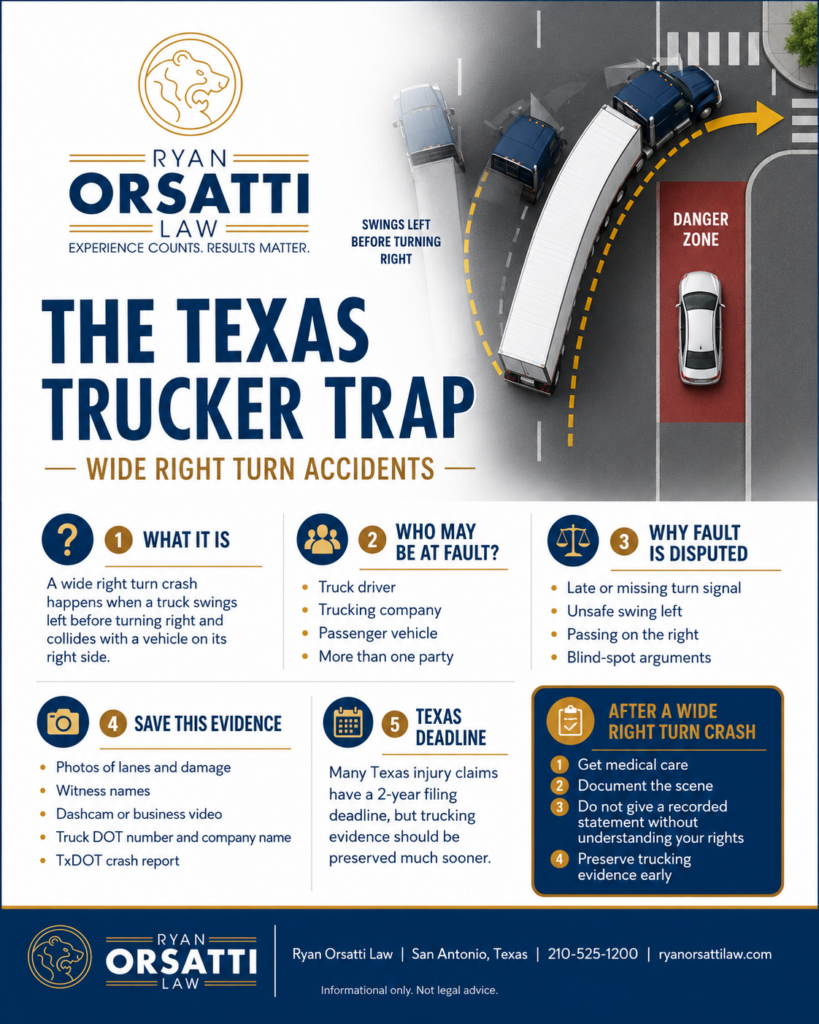
What Is a Wide Right Turn Truck Accident?
A wide right turn truck accident happens when a large truck moves left before turning right, then collides with a vehicle, cyclist, pedestrian, or motorcyclist near the truck’s right side. These crashes are common with tractor-trailers because the rear wheels do not follow the same path as the cab. The danger zone is often the area beside the trailer, where a smaller vehicle may be hidden from the truck driver’s view.
In plain English, this is the “squeeze” problem. The truck driver needs space to clear the curb or corner, but the maneuver can create an opening on the right that looks like a usable lane. If the truck then turns right across that space, the smaller vehicle can be crushed, sideswiped, or forced off the road.
In San Antonio, this can happen near intersections, loading docks, frontage roads, construction entrances, truck stops, industrial areas, and tight turns along Loop 410, Loop 1604, I-35, I-10, and US-281. The same issue appears across Texas wherever commercial trucks mix with commuter traffic.
Why Are Wide Right Turns Called the Texas Trucker Trap?
Wide right turns can become a trap because both drivers may think they are using the road correctly until the truck closes the space. The truck driver may believe the swing is necessary, while the smaller vehicle may believe the truck is changing lanes or turning left. The crash often turns on timing, signals, lane position, road design, and whether either driver acted reasonably.
Texas commercial driving materials warn that large vehicles need extra curb clearance during right turns. The Texas Commercial Motor Vehicle Driver Handbook explains that tractor-trailers and long-wheelbase vehicles may need to swing left, but they should not swing so far left that a driver is invited to pass on the right.
That is why these cases are rarely as simple as “the car was in the blind spot” or “the truck was too wide.” The real question is whether the truck driver planned and executed the turn safely under the actual road conditions.
Who Is Usually at Fault for a Wide Right Turn Truck Accident in Texas?
The at-fault party in a Texas wide right turn truck accident is the party whose unsafe driving caused or contributed to the crash. That may be the truck driver, the trucking company, the driver of the smaller vehicle, another driver, or more than one party. Texas proportionate responsibility means each party can be assigned a percentage of fault.
Comparative responsibility means Texas can reduce a claimant’s recovery by the claimant’s percentage of fault. Under Texas Civil Practice & Remedies Code Chapter 33, a claimant generally cannot recover damages if the claimant’s percentage of responsibility is greater than 50%. (Texas Statutes)
For example, a jury or insurer may examine whether the truck signaled for at least the last 100 feet before the turn, whether the truck moved from its lane safely, whether the smaller vehicle tried to pass on the right, and whether the truck driver left a dangerous gap.
When Can the Truck Driver or Trucking Company Be at Fault?
The truck driver or trucking company can be at fault when the turn was unsafe, poorly planned, poorly signaled, or inconsistent with safe commercial driving practices. A truck driver is not excused from safety rules just because an 18-wheeler needs extra room. The driver still must use reasonable care before changing lanes, swinging wide, or turning across another lane.
Truck fault may be supported by evidence that the driver:
- Failed to signal before the turn
- Signaled too late
- Swung left so far that the right side looked open
- Turned from the wrong lane without adequate warning
- Failed to check mirrors before turning
- Moved right when another vehicle was already beside the trailer
- Drove too fast for the turn
- Misjudged the trailer’s off-tracking
- Entered a turn that could not be made safely
A trucking company may also be responsible if company policies, training, route planning, maintenance, hiring, or driver supervision contributed to the crash. These cases often require more than the police report because the most important evidence may be controlled by the trucking company.
Can the Passenger Vehicle Be Blamed for Passing on the Right?
Yes, the passenger vehicle can be blamed if it tried to pass on the right when conditions did not permit safe passing. Texas law allows passing on the right only in limited situations and only if conditions permit safely passing on the right. That rule matters when a smaller vehicle moves into the space beside a truck that is preparing to turn. (Texas Legislature Online)
This does not automatically excuse the truck driver. The key question is what a reasonable driver would have understood from the truck’s position, turn signal, speed, lane movement, and surrounding traffic. If the truck drifted left with no signal and left an apparent open lane, fault may still point heavily toward the truck driver.
What If Both Drivers Made Mistakes?
If both drivers made mistakes, Texas law can divide fault by percentage. For example, an insurer might argue the truck driver was 70% responsible for an unsafe wide turn and the passenger vehicle was 30% responsible for attempting to pass. That percentage matters because Texas proportionate responsibility can reduce or block recovery depending on the final fault allocation. (Texas Statutes)
This is one reason early evidence preservation matters. If the truck’s camera, dashcam, mirrors, lane position, signal timing, or electronic data is lost, the insurance company may try to frame the crash as a simple blind-spot mistake by the smaller vehicle.
What Texas Laws Matter in a Wide Right Turn Truck Crash?
Several Texas traffic laws can matter in a wide right turn crash, especially rules on right turns, safe turning, lane movement, signaling, and passing on the right. These laws do not decide every case by themselves, but they give insurers, lawyers, and juries a framework for evaluating unsafe conduct. The facts still matter.
| Texas rule or source | What it says in plain English | Why it matters in a wide right turn crash |
|---|---|---|
| Texas Transportation Code § 545.101 | A right turn should be made as closely as practicable to the right-hand curb or edge of the roadway. | A truck may need extra space, but the driver still must justify why the turn was made from that position. |
| Texas Transportation Code § 545.103 | A driver may not turn or move right or left unless the movement can be made safely. | A wide turn is not safe just because the truck driver needed room. |
| Texas Transportation Code § 545.104 | A driver intending to turn must signal continuously for at least the last 100 feet before the turn. | Late or missing signals can change how fault is evaluated. |
| Texas Transportation Code § 545.060 | A driver should stay within one lane as nearly as practical and should not move from the lane unless the movement can be made safely. | Swinging wide or drifting across lanes may support a negligence argument. |
| Texas Transportation Code § 545.057 | Passing on the right is allowed only when conditions permit it safely and other statutory conditions apply. | A smaller vehicle may share fault if it tried to squeeze past the truck on the right. |
| Texas DPS Commercial Motor Vehicle Driver Handbook | Large vehicles need curb clearance, but drivers should not swing so far left that another driver is invited to pass on the right. | This is often a central safety issue in wide right turn truck cases. |
Key takeaway: A wide right turn case usually depends on safety, not labels, so the strongest evidence is often the proof showing exactly how the truck moved before impact. (Texas Legislature Online)
What Evidence Should You Save After a Wide Right Turn Truck Accident?
You should save evidence that shows lane position, signal timing, truck movement, impact location, and what the drivers could see before the crash. The police report is important, but it may not capture the full turn path or the truck’s electronic data. TxDOT explains that Texas crash data comes from Texas Peace Officer’s Crash Reports, also called CR-3 reports, processed through the state crash system. (TxDOT)
Use this evidence checklist if you were hit by a truck making a wide right turn:
- Get medical care first. Your health comes before claim documentation, and medical records also help connect your injuries to the crash.
- Photograph the scene. Capture lane markings, curbs, signs, traffic lights, skid marks, gouges, debris, and final vehicle positions.
- Photograph the truck. Get the company name, DOT number, license plate, trailer number, cab number, and any visible camera equipment.
- Photograph vehicle damage. The point of impact can help show whether the truck crossed into your path or squeezed your vehicle.
- Identify witnesses. Get names, phone numbers, and short notes about what they saw.
- Look for cameras. Nearby businesses, buses, dashcams, apartments, warehouses, and traffic-adjacent cameras may have useful footage.
- Request the crash report. The CR-3 may list contributing factors, location, insurance information, and witness details.
- Preserve phone and dashcam data. Do not delete photos, video, GPS information, or call records from the crash window.
- Save insurance documents. Keep your declarations page, PIP, MedPay, UM/UIM information, and claim letters.
- Ask about trucking evidence early. ELD data, driver logs, dispatch records, maintenance records, dashcam video, and driver qualification files can be important.
Spoliation means evidence was destroyed or lost when a party had reason to preserve it for a legal claim. Federal rules require motor carriers to retain certain driver records of duty status and supporting documents for at least six months, which is one reason trucking evidence should be requested quickly. (eCFR)
Attorney Insight: In wide right turn cases, adjusters often argue that the injured driver “slipped into the blind spot.” The better question is usually whether the truck driver created the blind-spot danger by swinging left too far, signaling too late, or turning across a space that looked open. Photos, camera footage, lane markings, and the exact damage pattern can make or break that dispute.
How Do Insurance Companies Evaluate a Wide Right Turn Truck Accident?
Insurance companies evaluate wide right turn truck accidents by looking for facts that shift fault away from the truck driver. They may focus on whether the smaller vehicle was passing on the right, whether the truck’s signal was on, whether the truck was already turning, and whether the smaller vehicle should have stayed back. That does not mean the insurer’s first fault decision is correct.
A trucking insurer may request a recorded statement early. A recorded statement is an audio or video statement the insurer can later compare against medical records, crash evidence, and deposition testimony. Before giving one, injured people should understand that small wording errors can be used to argue speed, awareness, lane position, or delay in reporting pain.
Commercial truck cases can also involve multiple insurance layers. Potential sources may include the driver’s policy, the motor carrier’s commercial liability coverage, a trailer policy, a shipper or broker dispute, an employer policy, or your own PIP, MedPay, or UM/UIM coverage. UM/UIM means uninsured or underinsured motorist coverage from your own policy if the at-fault coverage is missing or not enough.
What Medical Bill Issues Come Up After a Truck Turn Crash?
Medical bill issues after a truck turn crash often involve health insurance, hospital liens, letters of protection, and reimbursement claims. Subrogation means a health insurer may claim a right to be paid back from a settlement. A hospital lien is a legal claim a hospital may assert against part of a personal injury recovery.
These issues can affect the net recovery, not just the headline settlement number. A serious truck crash may involve ambulance care, emergency treatment, imaging, orthopedic care, pain management, surgery consultations, physical therapy, lost wages, and future medical needs. The claim should be built around documented injuries, treatment history, medical necessity, and lien resolution.
Ryan Orsatti Law helps injured people in San Antonio and across Texas evaluate how medical bills, health insurance, liens, and trucking insurance interact after serious commercial vehicle crashes.
How Long Do You Have to File a Wide Right Turn Truck Accident Claim in Texas?
In many Texas personal injury cases, the lawsuit deadline is two years from the date the injury claim accrues. Texas Civil Practice & Remedies Code § 16.003 sets a two-year limitations period for many personal injury claims, and wrongful death claims generally have a two-year deadline from the date of death. (Texas Statutes)
Do not treat two years as a safe waiting period. Camera footage may be erased in days or weeks, witness memory fades, commercial records may be overwritten, and vehicle damage may be repaired. If a government vehicle or public entity is involved, separate notice rules may apply and can be much shorter.
The safer practical step is to investigate early, preserve evidence, and identify all responsible parties before the claim is reduced to a debate over memory and paperwork.
When Should You Contact a Texas Truck Accident Lawyer?
You should contact a Texas truck accident lawyer soon after a wide right turn crash if you were injured, fault is disputed, a commercial truck was involved, or the insurer is blaming you. These cases often require fast evidence preservation and a detailed review of trucking records. Waiting can make it harder to prove how the turn happened.
Legal help may matter more if:
- The truck insurer says you were in the blind spot
- The crash involved an 18-wheeler, box truck, dump truck, tanker, delivery truck, or construction vehicle
- You were taken by ambulance or later needed imaging
- You missed work
- The police report is incomplete or wrong
- There were cameras nearby
- The trucking company contacted you quickly
- You are being asked for a recorded statement
- You received lien notices or medical bills you do not understand
Ryan Orsatti Law represents injured people in San Antonio, Bexar County, and across Texas in truck and commercial vehicle accident claims. The firm can review the crash facts, identify insurance coverage, send preservation letters, evaluate fault arguments, and help determine what steps make sense for your situation. For more information, see our pages on San Antonio truck accident claims, commercial vehicle accident cases, or contact Ryan Orsatti Law.
FAQ
Can a truck driver be at fault if I was on the right side of the truck?
Yes, a truck driver can still be at fault even if your vehicle was on the right side of the truck. The key issue is whether the truck driver signaled properly, checked mirrors, controlled the turn, and avoided creating a dangerous opening. Texas law focuses on whether the turn and lane movement could be made safely.
Is passing a truck on the right always illegal in Texas?
No, passing on the right is not always illegal in Texas, but it is allowed only when conditions permit safe passing and the statutory conditions are met. In a wide right turn crash, the insurer may argue the smaller vehicle passed unsafely. The response often depends on the truck’s signal, lane position, speed, and turn path.
What if the truck had a “wide turns” warning sticker?
A “wide turns” warning sticker does not automatically decide fault. It may help show that a truck needs extra room, but the truck driver still must turn safely, signal properly, and avoid unsafe lane movement. A warning sticker is not a license to turn across a vehicle that the driver should have seen.
Do I need the TxDOT crash report after a wide right turn accident?
Yes, the TxDOT crash report can be important because it may identify drivers, insurance, location, vehicle information, contributing factors, and witnesses. It may not include everything, so it should be treated as a starting point. Photos, video, truck data, witness statements, and medical records may be just as important.
What if the police report blames me for the truck accident?
A police report can matter, but it does not always end the fault dispute. Officers often arrive after the crash and may not have camera footage, truck data, or complete witness statements. If the report is incomplete or wrong, a lawyer may review whether supplemental evidence can clarify how the wide right turn happened.
What evidence can prove the truck made an unsafe wide right turn?
Useful evidence may include scene photos, lane markings, impact damage, dashcam video, business surveillance, witness statements, the truck’s ELD data, driver logs, dispatch records, and vehicle inspection records. The turn path is often critical. Evidence showing when the signal came on and how far the truck swung left can be especially important.
Can Ryan Orsatti Law help with a wide right turn truck crash in San Antonio?
Yes, Ryan Orsatti Law helps injured people in San Antonio and across Texas with truck and commercial vehicle crash claims, including disputed wide right turn accidents. The firm can evaluate fault, insurance coverage, medical bill issues, and evidence preservation. Every case depends on its specific facts, injuries, documents, and available proof.
Ryan Orsatti Law
4634 De Zavala Rd, San Antonio, TX 78249
Phone: 210-525-1200
ryanorsattilaw.com
This blog is for informational purposes only, not legal advice. Reading it does not create an attorney-client relationship. Past results do not guarantee future results.
Hurt in an accident in San Antonio? Learn how a San Antonio car accident lawyer can help with your claim. Call 210-525-1200 or request a free consultation.
The firm works on a contingency fee. You pay nothing unless the firm recovers money for you, and that covers case expenses as well as the fee: if there is no recovery, you owe no attorney's fee and no case expenses. Ask for the fee agreement and read the fee and expense section before you sign anything.
Related San Antonio legal resources
Primary legal and public-data sources
Ryan Orsatti Law
4634 De Zavala Road, San Antonio, TX 78249
General reference links. Consult each source for its current text.