
Quick Answer
If your motorcycle suddenly wobbles, accelerates, loses braking, shuts down, or otherwise feels like it “has a mind of its own,” treat the crash as a potential evidence case, not just a rider-error claim. In Texas, the responsible party may be another driver, a repair shop, a dealership, a parts seller, or a manufacturer, but Texas Civil Practice & Remedies Code § 16.003 generally gives injured people two years to file a personal injury lawsuit. (Texas Statutes) Preserve the motorcycle exactly as it is, photograph the scene and parts, check the VIN for NHTSA recalls, and speak with a Texas motorcycle accident lawyer before anyone repairs, sells, or disposes of the bike. Ryan Orsatti Law helps injured riders in San Antonio and across Texas evaluate fault, insurance coverage, defect evidence, and claim timing after serious motorcycle crashes.
Key Takeaways
- A motorcycle malfunction crash in Texas may involve product liability, negligent repair, another driver’s negligence, poor maintenance allegations, or a combination of causes.
- Do not authorize repairs, teardown, salvage, or disposal until the motorcycle and failed components have been inspected and documented.
- TxDOT reported that in 2025, nearly 9,000 motorcycle crashes in Texas killed 557 motorcyclists and seriously injured 2,468 riders. (Texas Department of Transportation)
- Texas product-defect cases often turn on physical evidence, maintenance records, recall data, photos, and technical inspection, not just the rider’s memory of what happened.
- Texas comparative responsibility can reduce or bar a claim if the rider is blamed for speed, maintenance, lane position, gear, or loss of control.
- First-party coverage such as PIP, MedPay, collision, and UM/UIM may matter when the crash involves a single motorcycle, a hit-and-run, or a driver with too little insurance.
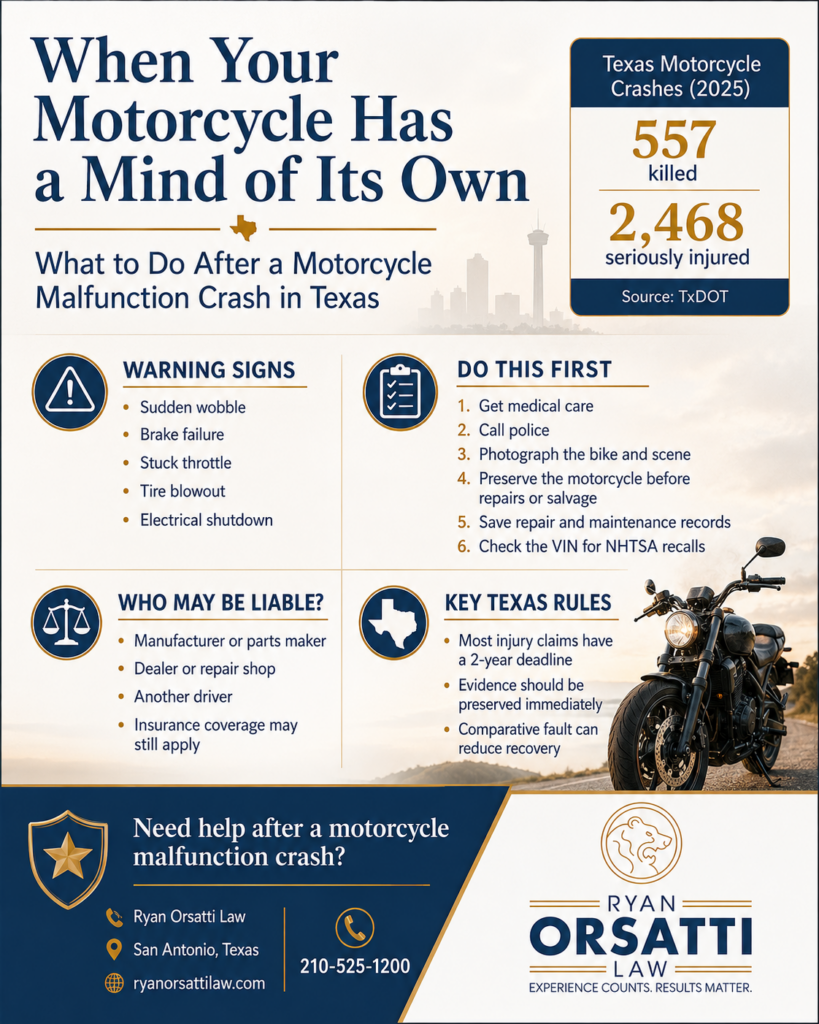
What does it mean when your motorcycle has a mind of its own?
A motorcycle has a “mind of its own” when it suddenly behaves in a way the rider did not command and cannot safely control. That can include a violent wobble, brake failure, tire failure, stuck throttle, electrical shutdown, steering problem, suspension issue, chain failure, clutch problem, or loss of traction tied to a mechanical or product issue.
This phrase is not a legal category by itself. In a Texas injury claim, the legal question is what caused the loss of control and whether a person or company is legally responsible for it. The answer may involve a manufacturer, parts supplier, dealership, repair shop, another driver, road condition, or the rider’s own maintenance history.
Common examples include:
- The front end begins shaking at highway speed on I-10 or Loop 1604.
- The throttle sticks open after recent service.
- The brakes fade, lock, or fail to engage.
- A tire separates, blows out, or loses pressure without warning.
- A chain, belt, clutch, or sprocket failure causes a sudden loss of drive.
- The motorcycle stalls in traffic on I-35, US-281, or Loop 410.
- A recent repair appears connected to the part that failed.
TxDOT’s motorcycle safety campaign notes that motorcyclists have far less physical protection than people inside vehicles and that even a relatively minor collision can cause serious harm. That reality matters in defect and malfunction claims because the injury severity may be high even when the disputed mechanical issue seems small. (Texas Department of Transportation)
What should you do first after a motorcycle malfunction crash in Texas?
After a motorcycle malfunction crash in Texas, your first steps are to get medical help, report the crash when required, and preserve the motorcycle before anyone changes the evidence. A malfunction case can be damaged quickly if the bike is repaired, totaled, released to salvage, washed, moved without photos, or inspected only by the insurance company.
TDI advises crash victims to take pictures, gather witness information, write down location and weather details, report the claim, and keep medical records and bills. TxDOT also allows people to obtain a Texas Peace Officer’s Crash Report, commonly called a CR-3, through its crash report system. (Texas Department of Insurance)
- Get medical care right away, even if adrenaline masks symptoms.
- Call police if anyone is injured, a driver leaves, or the motorcycle cannot be safely operated.
- Photograph the motorcycle from every angle before it is moved.
- Photograph the tires, brakes, chain, throttle, handlebars, forks, fluid leaks, broken parts, odometer, VIN plate, and aftermarket accessories.
- Photograph the road surface, skid marks, scrape marks, gouges, debris field, traffic controls, lighting, and weather conditions.
- Get witness names, phone numbers, and any nearby business or dashcam video sources.
- Tell the tow yard in writing not to repair, alter, sell, dismantle, or dispose of the motorcycle.
- Save repair orders, maintenance receipts, inspection records, owner’s manuals, texts with the shop, and dealership communications.
- Check the VIN through NHTSA’s recall lookup tool and save screenshots.
- Avoid guessing in recorded statements about speed, maintenance, or what part failed until the evidence has been reviewed.
Should you repair the motorcycle before the claim is reviewed?
You should not repair the motorcycle before a serious malfunction claim is reviewed because the motorcycle itself may be the main evidence. A repair, teardown, or total-loss salvage transfer can destroy proof of a defective part, negligent repair, improper installation, or crash-related failure sequence.
If the insurer needs to inspect the bike, ask for the inspection to be documented and request advance notice before any destructive testing. If a dealership, shop, or manufacturer wants to inspect it, keep a written record of who will attend, what will be touched, what photos will be taken, and whether any parts will be removed.
Attorney Insight: In motorcycle malfunction cases, the first real fight is often not about money. It is about control of the evidence. Adjusters may frame the claim as “rider lost control” before anyone has inspected the tire, throttle, brake system, service history, or recall status. A rider who preserves the bike, the failed part, the tow records, and the repair history gives the claim a stronger factual foundation than a rider who lets the motorcycle disappear into salvage.
Who may be responsible if a motorcycle malfunction caused the crash?
The responsible party depends on what failed, why it failed, and who had control over the motorcycle or part before the crash. In Texas, a malfunction may point to a manufacturer, component maker, seller, dealership, repair shop, installer, another driver, or sometimes multiple parties at the same time.
“Products liability” means a claim against a manufacturer or seller for injury, death, or property damage allegedly caused by a defective product. Texas Civil Practice & Remedies Code Chapter 82 defines product-liability actions and includes specific rules for manufacturers and sellers. (Texas Statutes)
| What the evidence suggests | Possible responsible party | Evidence to preserve |
|---|---|---|
| Brake, tire, chain, throttle, or steering part failed without warning | Manufacturer, component maker, seller, or installer | Failed part, VIN, part number, DOT tire code, photos, owner’s manual, recall search |
| Problem began after service or customization | Dealership, repair shop, mobile mechanic, or parts installer | Repair order, invoice, texts, mileage, old parts, shop photos, technician notes |
| Motorcycle had an open safety recall | Manufacturer, dealer, or recall-remedy provider depending on facts | NHTSA recall screenshot, notice letter, dealer records, appointment history |
| Another driver caused a sudden evasive maneuver | Driver, vehicle owner, employer, or UM/UIM insurer if uninsured | CR-3, witness names, video, photos, insurance information |
| Insurer blames rider maintenance | Rider, prior owner, repair shop, or seller depending on proof | Maintenance logs, inspection records, purchase documents, service receipts |
| Road surface contributed to loss of control | Government entity or contractor in limited cases | Scene photos, location data, construction signs, prior complaint evidence |
Key takeaway: A motorcycle malfunction crash should be investigated as a cause-and-evidence problem, not automatically accepted as rider error.
Is a motorcycle malfunction claim different from a normal motorcycle accident claim?
A motorcycle malfunction claim is different because the key proof may be mechanical, technical, and physical rather than limited to driver conduct. In an ordinary motorcycle crash, the main dispute may be whether a driver failed to yield, changed lanes, followed too closely, or misjudged the rider’s speed. In a malfunction case, the bike, failed part, repair history, and recall history may matter just as much.
Texas design-defect claims have a specific statutory burden. Under Texas Civil Practice & Remedies Code § 82.005, a claimant alleging a design defect must prove a safer alternative design and that the defect was a producing cause of the injury, property damage, or death. (Texas Statutes)
That does not mean every malfunction case is a design-defect case. Some cases involve a manufacturing defect, inadequate warning, negligent repair, negligent installation, negligent inspection, or another driver’s negligence. The early investigation should avoid locking into one theory too soon.
Does an NHTSA recall prove the claim by itself?
An NHTSA recall does not automatically prove a Texas injury claim by itself, but it can be important evidence. A recall may show that a vehicle, tire, or equipment item created an unreasonable safety risk or failed to meet minimum safety standards.
NHTSA explains that a recall is issued when a manufacturer or NHTSA determines that a vehicle, equipment, car seat, or tire creates an unreasonable safety risk or fails to meet minimum safety standards. Manufacturers are required to remedy recalled problems by repair, replacement, refund, or in rare cases repurchase. (NHTSA)
A recall search should be part of the investigation, but it is not the whole case. The issue is whether the recalled condition existed on that motorcycle, whether it was repaired, whether the failed part was related, and whether that condition caused or contributed to the crash.
What evidence proves a motorcycle defect or mechanical failure?
The strongest evidence in a motorcycle defect or mechanical failure case is usually the motorcycle itself, the failed component, the maintenance history, the recall history, and scene documentation. A rider’s statement that “something felt wrong” matters, but technical evidence often decides whether the claim can be proven.
NHTSA allows consumers to file safety-defect complaints and makes complaints searchable. NHTSA also states there is no set number of complaints required before it opens an investigation because the agency reviews complaints and other data to determine whether a safety-defect trend may exist. (NHTSA)
Important evidence may include:
- The motorcycle in unrepaired condition
- Failed tire, brake, throttle, chain, belt, fork, handlebar, suspension, or steering parts
- VIN, model year, mileage, and purchase documents
- Recall search results
- Manufacturer communications or technical service bulletins
- Repair invoices and maintenance logs
- Photos from the crash scene
- Tow yard and storage records
- Helmet, gloves, jacket, boots, and damaged riding gear
- Diagnostic fault codes, if available
- Witness statements and video from vehicles or nearby businesses
- Medical records tying the injury pattern to the crash
What if the insurance company wants to total the motorcycle?
If the insurance company wants to total the motorcycle, do not release the bike to salvage until evidence preservation has been addressed. A total-loss payment can be helpful for property damage, but it can also create risk if the motorcycle is sold, crushed, parted out, or repaired before the defect issue is documented.
Ask where the motorcycle is located, who has access, whether storage fees are accruing, whether the insurer has photographed it, and whether any parts have been removed. If a defect, negligent repair, or product claim is possible, the property-damage process should be coordinated with the injury investigation.
How do insurance companies handle motorcycle malfunction crashes?
Insurance companies often handle motorcycle malfunction crashes by looking for rider fault, maintenance issues, speed allegations, and gaps in medical treatment. That does not mean those defenses are correct, but it means the claim should be documented before the adjuster’s theory becomes the only story in the file.
Comparative responsibility means Texas can reduce a claimant’s recovery by the claimant’s percentage of fault. Under Texas Civil Practice & Remedies Code § 33.001, a claimant may not recover damages if the claimant’s percentage of responsibility is greater than 50 percent, and § 33.012 reduces recoverable damages by the claimant’s percentage of responsibility if the claim is not barred. (Texas Statutes)
Common insurer arguments include:
- The rider was speeding.
- The rider overcorrected.
- The rider failed to maintain the motorcycle.
- The rider used aftermarket parts.
- The rider ignored warning signs before the crash.
- The rider delayed medical treatment.
- The failed part broke because of the crash, not before it.
- The motorcycle had prior damage.
- The rider cannot identify a specific defect.
A recorded statement can make those disputes worse if the rider guesses. It is usually safer to report the claim, provide basic facts, and avoid technical speculation until the bike, records, and scene evidence have been reviewed.
What Texas deadlines apply to motorcycle malfunction and defect claims?
The main Texas deadline for most motorcycle injury claims is the two-year personal injury statute of limitations, but product cases may also involve a separate statute of repose. A statute of limitations is a filing deadline based on when a claim accrues. A statute of repose can cut off certain product claims based on the age or sale date of the product, even if the injury happened later.
For product cases, Texas Civil Practice & Remedies Code § 16.012 generally requires a products-liability action against a manufacturer or seller to be brought before the end of 15 years after the date of sale by that defendant, subject to statutory exceptions. (Texas Statutes)
| Issue | General Texas rule or practical deadline | Why it matters |
|---|---|---|
| Personal injury lawsuit | Generally two years under § 16.003 | Missing the filing deadline can end the injury claim |
| Wrongful death lawsuit | Generally two years from death under § 16.003 | The date may differ from the crash date |
| Product-liability repose | Generally 15 years from sale by the defendant under § 16.012 | Older motorcycles and older parts need early review |
| Insurance notice | Policy-specific and often prompt | Late notice can create coverage disputes |
| Physical evidence | Immediate practical deadline | Repairs, salvage, towing, weather, and missing parts can weaken proof |
| Recall and complaint research | As soon as possible | Recall data, owner notices, and complaint trends may shape the investigation |
Key takeaway: The legal filing deadline may be two years, but the evidence deadline in a motorcycle malfunction crash can be days or even hours.
Can PIP, MedPay, UM/UIM, or health insurance help after a motorcycle malfunction crash?
Yes, first-party insurance may help after a motorcycle malfunction crash, especially if no other driver clearly caused the wreck. PIP means personal injury protection, a no-fault auto coverage that can pay certain medical bills and lost income. UM/UIM means uninsured or underinsured motorist coverage, which may apply if another driver caused the crash and had no insurance or too little insurance.
TDI states that all Texas auto policies include PIP unless the insured rejects it in writing, and insurers must offer UM/UIM unless the insured rejects it in writing. TDI also explains that Texas minimum liability coverage is 30/60/25, meaning $30,000 per injured person, $60,000 per accident, and $25,000 for property damage. (Texas Department of Insurance)
Coverage questions to review include:
- Does your policy cover the motorcycle involved?
- Do you have PIP or MedPay?
- Was PIP rejected in writing?
- Do you have UM/UIM coverage?
- Was another driver involved or did a driver force an evasive maneuver?
- Do you have collision coverage for motorcycle property damage?
- Do you have health insurance, ERISA coverage, Medicare, Medicaid, Tricare, or VA benefits?
- Are there hospital liens or subrogation claims?
Subrogation means a health insurer may claim a right to be paid back from a settlement. A hospital lien is a legal claim a hospital may assert against part of a personal injury recovery. These issues affect the net recovery, so they should be reviewed before resolving a serious motorcycle claim.
How can Ryan Orsatti Law help after a motorcycle malfunction crash in San Antonio?
Ryan Orsatti Law can help by evaluating the crash facts, preserving the motorcycle, reviewing insurance coverage, identifying potential defendants, and building a Texas-specific evidence plan. A serious malfunction crash in San Antonio may involve local scene evidence from Bexar County roads, technical motorcycle issues, first-party insurance, product-liability deadlines, and medical documentation.
The firm handles motorcycle accident matters for riders in San Antonio and across Texas. Helpful related resources include the firm’s San Antonio motorcycle accident lawyer page, its guide on whether to get a lawyer after a motorcycle accident, its Texas UM/UIM coverage guide, and its contact page.
In a malfunction case, the first legal decision is often not whether to file a lawsuit. It is whether the evidence is being protected, whether the right parties are being placed on notice, and whether the insurer is being allowed to define the crash before the facts are developed.
FAQ
Can I sue if my motorcycle malfunctioned but no other vehicle hit me?
Yes, a claim may still exist if a motorcycle malfunction caused a crash without another vehicle hitting you. The possible claim may involve a defective product, negligent repair, negligent installation, unsafe maintenance work, or first-party insurance coverage. The key issue is proof. Preserve the motorcycle, failed parts, repair records, recall search results, photos, and medical documentation before the evidence changes.
What if the motorcycle problem started after dealership or repair shop work?
If the problem began after dealership or repair shop work, the repair history becomes central evidence. Save invoices, estimates, texts, emails, inspection forms, warranty documents, mileage records, and any replaced parts. The claim may involve negligent repair or installation rather than a product defect. Do not let the same shop alter the motorcycle again until evidence preservation has been addressed.
Does an NHTSA recall automatically prove a motorcycle defect case in Texas?
No, an NHTSA recall does not automatically prove a Texas motorcycle injury claim. It can be important evidence, but the rider still needs to connect the recalled condition to the motorcycle, the failed part, and the crash. Recall status, repair completion, dealer records, VIN history, component inspection, and causation all matter in a serious defect claim.
How long do I have to file a motorcycle malfunction lawsuit in Texas?
Most Texas personal injury lawsuits must be filed within two years under Texas Civil Practice & Remedies Code § 16.003. Product-liability cases may also face the 15-year statute of repose in § 16.012, measured from sale by the defendant and subject to exceptions. Evidence can disappear much faster, so preservation should begin immediately.
Should I give a recorded statement after a motorcycle malfunction crash?
You should be careful with recorded statements because malfunction cases often involve technical facts the rider cannot safely diagnose from memory. You may need to cooperate with your own insurer, but do not guess about speed, maintenance, mechanical cause, or whether the bike failed before or during impact. Basic facts are safer than speculation.
Can UM/UIM help if another driver caused me to lay down the bike and left?
UM/UIM may help if another driver caused the crash, had no insurance, had too little insurance, or fled the scene, depending on the policy and proof. TDI says UM/UIM pays for certain losses when the other driver lacks enough coverage and that insurers must offer it unless rejected in writing. Prompt reporting and evidence of the other driver are critical.
What if the insurance company says I failed to maintain the motorcycle?
If the insurer says poor maintenance caused the crash, respond with records, not argument. Maintenance receipts, inspection records, prior repair orders, tire age, mileage, photos, and witness statements can help separate a true maintenance issue from an unsupported blame theory. Texas comparative responsibility makes this important because rider fault allegations can reduce or bar recovery.
Do I need a lawyer for a motorcycle malfunction crash in Texas?
A lawyer is often worth considering when the crash caused serious injuries, the motorcycle is totaled, a product defect is possible, a repair shop may be involved, or the insurer is blaming the rider. These claims are evidence-sensitive. A Texas personal injury lawyer can help preserve the motorcycle, review coverage, place parties on notice, and evaluate deadlines.
Ryan Orsatti Law
4634 De Zavala Rd, San Antonio, TX 78249
Phone: 210-525-1200
ryanorsattilaw.com
This blog is for informational purposes only, not legal advice. Reading it does not create an attorney-client relationship. Past results do not guarantee future results.
Hurt in an accident in San Antonio? Learn how a San Antonio car accident lawyer can help with your claim. Call 210-525-1200 or request a free consultation.
The firm works on a contingency fee. You pay nothing unless the firm recovers money for you, and that covers case expenses as well as the fee: if there is no recovery, you owe no attorney's fee and no case expenses. Ask for the fee agreement and read the fee and expense section before you sign anything.
Related San Antonio legal resources
- San Antonio motorcycle-accident representation
- Texas personal-injury services
- Contact Ryan Orsatti Law
Primary legal and public-data sources
- Texas Transportation Code Chapter 661: motorcycle protective headgear
- Texas Civil Practice and Remedies Code Chapter 33: proportionate responsibility
Ryan Orsatti Law
4634 De Zavala Road, San Antonio, TX 78249
General reference links. Consult each source for its current text.