
Quick Answer
The 100 Deadliest Days in Texas refers to the summer driving period between Memorial Day and Labor Day, when fatal crashes involving teen drivers increase. AAA reports that more than 30% of deaths in crashes involving teen drivers from 2019 to 2023 happened during this period, and San Antonio officials have specifically warned local families about the same risk. (newsroom.aaa.com) (San Antonio)
For an injured person, the term matters because summer crashes often involve teen drivers, extra passengers, distracted driving, speeding, night driving, borrowed vehicles, and family insurance policies. Those facts can change fault, available coverage, and the evidence that needs to be preserved.
Key Takeaways
- The 100 Deadliest Days are most often discussed as a teen-driver safety period between Memorial Day and Labor Day.
- In San Antonio, summer crash risks often overlap with I-10, I-35, Loop 410, Loop 1604, US-281, Fiesta-season traffic patterns, vacation travel, and late-night teen driving.
- Texas provisional drivers under 18 face limits on passengers, night driving, and wireless device use. (Texas Department of Public Safety)
- Texas personal injury cases generally have a two-year filing deadline under Texas Civil Practice and Remedies Code § 16.003, but shorter notice deadlines can apply when a governmental entity is involved. (Texas Statutes)
- Insurance coverage matters early because Texas minimum liability coverage is only 30/60/25, which may be too low for a serious crash. (Texas Department of Insurance)
- After a summer crash, preserve photos, vehicle data, witness information, medical records, insurance pages, and anything showing phone use, speeding, passengers, or impairment.
Why Do the 100 Deadliest Days in Texas Matter After a Crash?
The 100 Deadliest Days in Texas matter because they describe a predictable summer risk pattern, not a separate legal claim. If you are injured during this period, your case is still built on the same Texas negligence rules, insurance coverage rules, medical proof, and deadline requirements that apply to other car accident cases.
Negligence means a driver failed to use reasonable care. In plain English, it means someone did something unsafe, such as speeding, texting, following too closely, running a red light, driving impaired, or allowing distractions in the vehicle.
AAA’s 2025 review of National Highway Traffic Safety Administration crash data found that 13,135 people were killed in crashes involving a teen driver between 2019 and 2023, and more than 30% of those deaths occurred during the 100 Deadliest Days. AAA also reported that 860 of the 2,897 deaths in crashes involving a teen driver in 2023 happened during this summer window. (newsroom.aaa.com)
San Antonio has treated the issue as a local safety concern too. In 2025, the San Antonio Municipal Court warned that the period between Memorial Day and Labor Day brings increased fatal crash risk for teens, and reported that SAPD issued more than 15,000 citations the prior summer for violations including speeding, seat belt violations, and cell phone use. (San Antonio)
Is the 100 Deadliest Days a Legal Term in Texas?
The 100 Deadliest Days is not a Texas legal cause of action. It is a traffic safety term used by AAA, NHTSA-related safety campaigns, local courts, and public safety groups to describe a higher-risk summer driving period involving teen drivers. (newsroom.aaa.com)
That distinction matters. You do not sue someone because the crash happened during the 100 Deadliest Days. You pursue a claim because a driver, vehicle owner, company, or other responsible party caused injury through negligent conduct.
In a Texas car accident case, the key legal questions are usually:
- Who had a duty to drive safely?
- How was that duty breached?
- Did the breach cause the crash?
- What injuries, medical bills, lost income, and life disruption resulted?
- What insurance coverage is available?
- Is there evidence that must be preserved quickly?
If you were hurt in San Antonio, Bexar County, Comal County, Guadalupe County, Kendall County, Wilson County, Atascosa County, or Medina County, the same basic Texas injury rules apply. Venue, insurance handling, medical providers, and available evidence may vary by location.
What Makes Summer Teen-Driver Crashes Different?
Summer teen-driver crashes are often different because the facts involve less supervised driving, more passengers, later driving hours, and more phone-related distractions. Those facts can matter when an adjuster, defense lawyer, or jury evaluates responsibility.
Texas Department of Public Safety materials explain that provisional license holders under 18 may not drive with more than one passenger under 21 unless the passenger is family, may not drive between midnight and 5:00 a.m. except for work, school, or emergencies, and may not use wireless communication devices while driving. (Texas Department of Public Safety)
Those restrictions do not automatically prove a civil case by themselves. But they can become important evidence if the crash involved a 16-year-old or 17-year-old driver with several friends in the car, a late-night trip, or phone use.
| Issue in a Summer Teen Crash | Why It Matters in a Texas Injury Claim | Evidence to Preserve |
|---|---|---|
| Teen driver with multiple passengers | May show distraction, peer pressure, or violation of provisional license rules | Passenger names, photos, police report, witness statements |
| Phone use or social media activity | May show distracted driving or timing of messages | Phone records, screenshots, app posts, crash time data |
| Night driving | May affect visibility, fatigue, speed, and provisional license restrictions | Crash time, lighting photos, nearby cameras |
| Speeding | May support negligence and explain crash severity | Vehicle damage photos, event data recorder, skid marks, witness statements |
| No seat belt use | May affect injury causation disputes and comparative fault arguments | EMS records, police report, vehicle photos |
| Borrowed family vehicle | May open coverage questions involving the owner’s policy | Insurance declarations page, permission facts, household driver list |
| Hit and run | May shift focus to uninsured motorist coverage | Police report, plate information, camera footage |
How Does Texas Fault Law Apply During the 100 Deadliest Days?
Texas fault law applies the same during the 100 Deadliest Days as it does during the rest of the year. Texas Civil Practice and Remedies Code Chapter 33 uses proportionate responsibility, which means fault can be divided among multiple people or entities.
Under Texas Civil Practice and Remedies Code § 33.001, a claimant may not recover damages if that person’s percentage of responsibility is greater than 50%. This is often called the Texas 51% bar rule. (Texas Statutes)
That rule matters in summer crashes because insurance companies may look for ways to shift blame. They may argue that the injured driver was speeding, distracted, failed to keep a proper lookout, failed to brake, was not wearing a seat belt, or contributed to the crash.
A 100 Deadliest Days crash in Bexar County should be investigated like any serious injury case: road conditions, lighting, traffic signal timing, vehicle movement, phone distraction, witness statements, and medical causation all matter. The phrase “teen driver crash” is not enough. The evidence must show what happened, why it happened, and how it caused injury.
What Insurance Coverage Matters After a 100 Deadliest Days Crash?
The most important coverages after a 100 Deadliest Days crash are liability coverage, uninsured motorist coverage, underinsured motorist coverage, personal injury protection, MedPay, collision coverage, and health insurance. Each coverage pays for different losses.
Liability coverage means the at-fault driver’s insurance that pays other people for injuries and property damage caused by that driver. The Texas Department of Insurance states that Texas requires at least $30,000 per injured person, $60,000 per accident, and $25,000 for property damage, commonly called 30/60/25 coverage. (Texas Department of Insurance)
Uninsured motorist coverage (UM) applies when the at-fault driver has no insurance or cannot be identified, such as in some hit-and-run cases. Underinsured motorist coverage (UIM) applies when the at-fault driver has insurance, but not enough to cover the injury claim. Texas Insurance Code § 1952.101 addresses uninsured and underinsured motorist coverage. (Texas Statutes)
Personal injury protection (PIP) can pay medical bills, lost wages, and certain nonmedical costs regardless of fault. MedPay, short for medical payments coverage, can help pay medical bills, but does not work exactly like PIP. TDI explains that Texas auto policies include PIP unless the policyholder rejects it in writing, and insurers must offer UM/UIM unless it is rejected in writing. (Texas Department of Insurance)
If the crash involves a hit and run, review Ryan Orsatti Law’s guide on who pays for injuries after a hit-and-run accident. If the at-fault driver has no insurance, review the firm’s guide on what happens when an at-fault driver is uninsured in Texas.
What Medical and Billing Issues Come Up After a Summer Crash?
Medical and billing issues can become as important as fault because the value of a Texas injury claim depends on proving the injury, the treatment, the bills, and the long-term impact. Summer crashes often involve ER visits, urgent care, imaging, chiropractic care, orthopedic referrals, physical therapy, and missed work.
Subrogation means a health insurer, PIP carrier, MedPay carrier, Medicare plan, Medicaid program, or other payer may claim a right to be reimbursed from a settlement. An ERISA plan is an employer-sponsored health plan governed by federal law, and some ERISA reimbursement claims can be more difficult to reduce than ordinary health insurance liens.
A hospital lien is a claim a hospital may assert against a personal injury recovery when it provides treatment after an accident and meets Texas lien requirements. A letter of protection, often called an LOP, is an agreement where a medical provider treats now and waits to be paid from a future settlement or recovery.
The practical issue is net recovery. Net recovery means what the client receives after fees, expenses, medical bills, and valid liens are resolved. A large settlement number can still be disappointing if medical bills, liens, and insurance reimbursement claims are not handled carefully.
What Should You Do After a Crash During the 100 Deadliest Days?
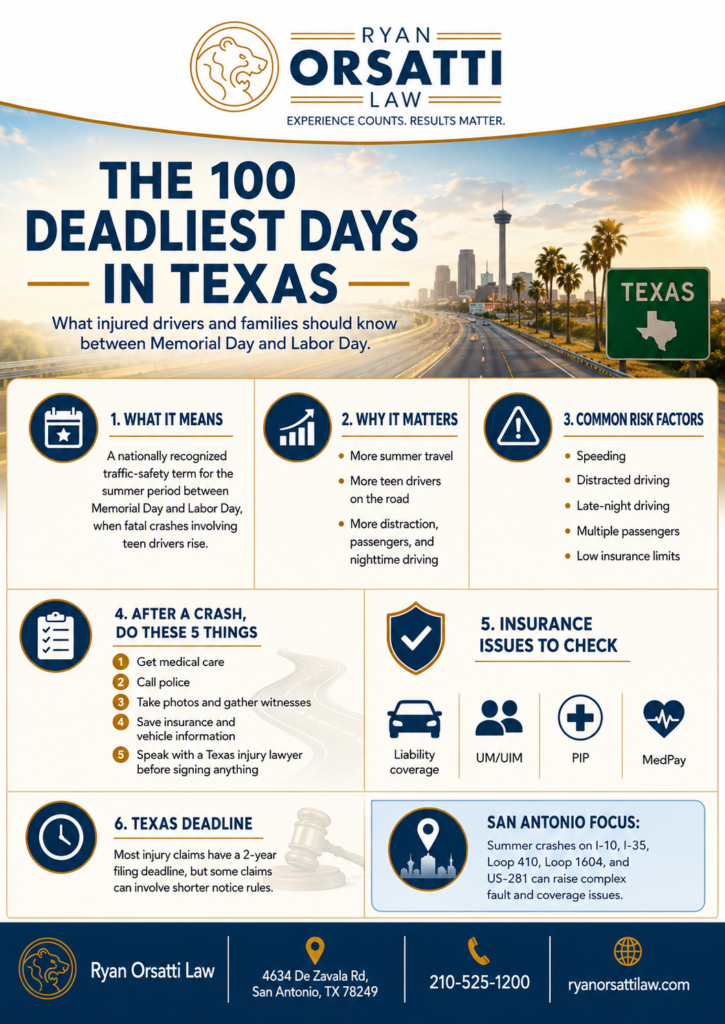
After a crash during the 100 Deadliest Days, protect your health first, then preserve evidence before it disappears. Summer crash evidence can disappear quickly because families travel, teen passengers scatter, vehicles are repaired, and phone data may not be preserved unless requested.
- Call 911 if anyone is hurt, the crash blocks traffic, a driver seems impaired, or the other driver leaves.
- Get medical care the same day or as soon as symptoms appear. Delayed care gives insurers room to dispute causation.
- Photograph all vehicles, license plates, skid marks, debris, traffic signs, airbags, seat belts, and visible injuries.
- Get names and phone numbers for drivers, passengers, witnesses, and responding officers.
- Ask where the vehicle will be towed and take photos before repairs or salvage.
- Save dashcam footage, doorbell footage, business-camera information, and nearby intersection details.
- Preserve your own phone data, texts, rideshare records, photos, and timeline. Do not delete posts about the crash.
- Get the insurance declarations pages for every household policy that may apply.
- Do not give a recorded statement without understanding which insurer is calling and whose interests it serves.
- Speak with a Texas personal injury attorney before signing a release, especially if injuries, liens, UM/UIM, or a teen driver are involved.
For a broader local overview, visit Ryan Orsatti Law’s San Antonio car accident lawyer page.
How Long Do You Have to File a Texas Injury Claim?
In most Texas personal injury cases, a person must file suit within two years of the date the claim accrues under Texas Civil Practice and Remedies Code § 16.003. For a typical car crash injury claim, that usually means two years from the crash date, but deadline analysis can be fact-specific. (Texas Statutes)
Do not treat the two-year rule as the only deadline. If a city, county, school district, police unit, public transit vehicle, or other governmental entity may be involved, shorter notice rules may apply. Those notice rules are separate from the lawsuit filing deadline and should be checked immediately.
The safest approach is to calendar every possible deadline early: insurance notice, PIP or MedPay deadlines, UM/UIM notice, preservation requests, governmental notice, and the lawsuit filing deadline. Waiting until the end of the limitations period can weaken a case even if suit is technically filed on time.
Attorney Insight
In summer crash cases, the fact that changes the file is often not “teen driver” by itself. It is the combination of a provisional driver, multiple passengers, late-night driving, phone distraction, and a family insurance policy with low limits. We want the declarations pages, passenger names, vehicle photos, phone-use timeline, and medical chronology early, because those facts shape both liability and coverage before an adjuster frames the case against the injured person.
When Should You Talk to a Lawyer After a 100 Deadliest Days Crash?
You should talk to a lawyer quickly if anyone was injured, fault is disputed, the at-fault driver was a teen, there were multiple passengers, the crash involved texting or impairment, a driver fled, insurance limits may be low, or medical bills are already piling up.
Not every crash requires representation. A minor property-damage-only claim may be handled directly with insurance. But when there are injuries, ER bills, missed work, possible UM/UIM coverage, or liens, early legal review can prevent mistakes that are hard to fix later.
Ryan Orsatti Law handles car accident cases in San Antonio and throughout Texas. The firm also explains its statewide work on its page about handling cases outside San Antonio and provides additional background on the Ryan Orsatti Law about page.
FAQ
What does the 100 Deadliest Days mean in Texas?
The 100 Deadliest Days refers to the period between Memorial Day and Labor Day, when fatal crashes involving teen drivers increase. In Texas, the phrase is most useful as a safety warning and evidence-preservation reminder. It is not a separate lawsuit, but the facts common in summer crashes can affect fault and insurance coverage. (newsroom.aaa.com)
Are teen drivers automatically at fault during the 100 Deadliest Days?
No. A teen driver is not automatically at fault just because a crash happened during the 100 Deadliest Days. Fault depends on evidence such as speed, phone use, lookout, right of way, passenger distraction, intoxication, road conditions, and witness statements. Texas proportionate responsibility rules can also assign fault to more than one person. (Texas Statutes)
What are the Texas passenger rules for teen drivers?
Texas DPS states that provisional license holders under 18 may not drive with more than one passenger under 21 unless the passenger is family. They also may not drive between midnight and 5:00 a.m. except for work, school, or emergencies, and they may not use wireless communication devices while driving. (Texas Department of Public Safety)
What if the teen driver was using a phone before the crash?
Phone use can be important evidence in a Texas crash claim. TxDOT reports that distracted driving caused 86,384 crashes on Texas roads in 2025, with 2,437 serious injuries and 299 deaths. TxDOT also notes that reading, writing, or sending a text while driving has been illegal in Texas since September 1, 2017. (TxDOT)
What insurance pays if a teen driver causes a crash?
The teen driver’s household auto policy may provide liability coverage if the teen had permission and was not excluded. If that coverage is missing or too low, your own UM/UIM, PIP, MedPay, collision, and health insurance may matter. Texas minimum liability coverage is 30/60/25, which can be insufficient for serious injuries. (Texas Department of Insurance)
How long do I have to sue after a summer car crash in Texas?
Most Texas personal injury lawsuits must be filed within two years under Texas Civil Practice and Remedies Code § 16.003. That said, claims involving governmental entities, minors, wrongful death, UM/UIM disputes, or unusual facts require separate deadline analysis. Do not wait until the two-year mark to investigate evidence or coverage. (Texas Statutes)
Do I need a lawyer if the insurance company already accepted fault?
Maybe. Accepted fault does not resolve injury causation, medical bills, future care, liens, lost wages, pain and suffering, policy limits, UM/UIM coverage, or net recovery. A lawyer may be helpful when injuries are more than minor, treatment is ongoing, medical bills are high, or the insurer asks for a broad release.
Why does San Antonio local evidence matter in a summer crash?
San Antonio local evidence matters because crash scenes, tow yards, witnesses, traffic cameras, nearby businesses, and medical providers are often local. A crash on Loop 410, Loop 1604, I-10, I-35, or US-281 may involve different traffic patterns and evidence sources than a rural county crash. Fast preservation helps prevent avoidable proof problems.
Ryan Orsatti Law
4634 De Zavala Rd, San Antonio, TX 78249
Phone: 210-525-1200
ryanorsattilaw.com
This blog is for informational purposes only, not legal advice. Reading it does not create an attorney-client relationship. Past results do not guarantee future results.
Hurt in an accident in San Antonio? Learn how a San Antonio personal injury lawyer can help with your claim. Call 210-525-1200 or request a free consultation.
The firm works on a contingency fee. You pay nothing unless the firm recovers money for you, and that covers case expenses as well as the fee: if there is no recovery, you owe no attorney's fee and no case expenses. Ask for the fee agreement and read the fee and expense section before you sign anything.
Related San Antonio legal resources
Primary legal and public-data sources
- Texas Civil Practice and Remedies Code Chapter 16: limitations
- Texas Civil Practice and Remedies Code Chapter 33: proportionate responsibility
Ryan Orsatti Law
4634 De Zavala Road, San Antonio, TX 78249
General reference links. Consult each source for its current text.