
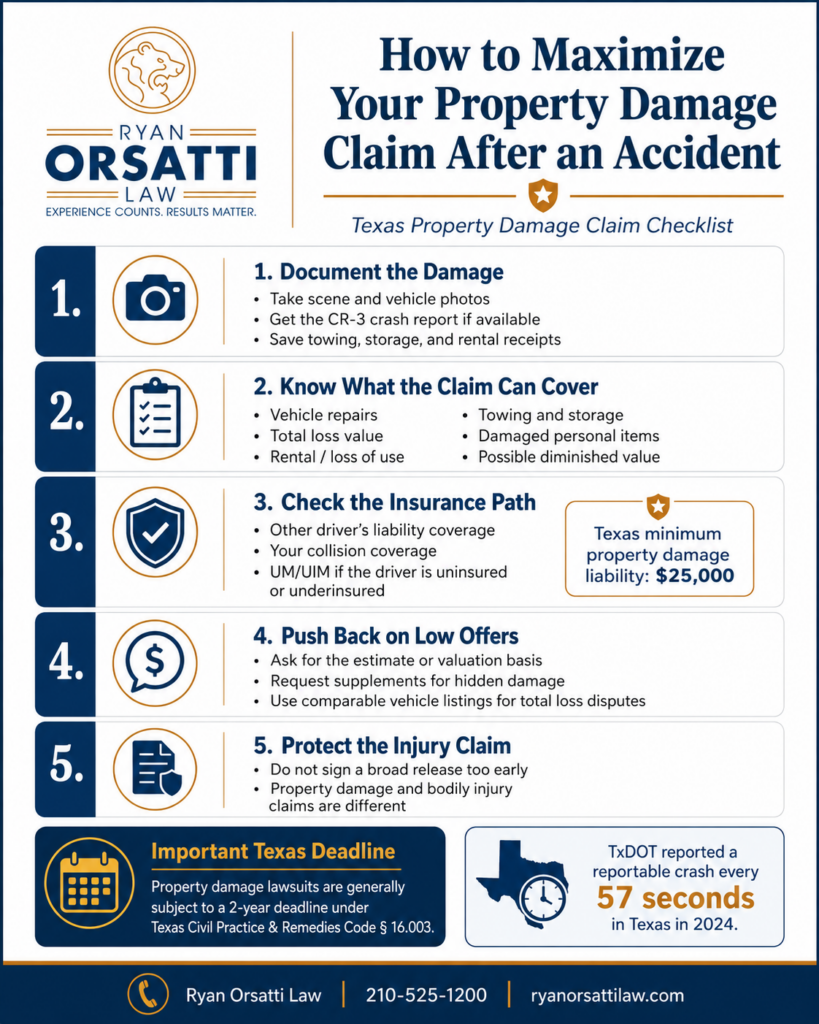
Quick Answer: To maximize your property damage claim after a car accident in Texas, document the vehicle damage immediately, get the Texas Peace Officer’s Crash Report if one was made, compare the insurer’s estimate against real repair or market evidence, and do not sign a release that accidentally settles injury claims. Texas insurers generally pay vehicle repair or replacement only up to actual cash value, and Texas minimum liability coverage includes only $25,000 for property damage. (Texas Department of Insurance) Ryan Orsatti Law helps injured Texans separate the property damage claim from the bodily injury claim so a fast vehicle settlement does not create a larger legal problem.
Key Takeaways
- A Texas property damage claim can include repair costs, total loss value, rental or loss-of-use issues, towing, storage, damaged personal items, and sometimes diminished value.
- Texas minimum auto liability coverage includes only $25,000 for property damage, which may not be enough for a newer vehicle, a luxury vehicle, or a multi-car crash. (Texas Department of Insurance)
- TxDOT reported that one reportable crash occurred every 57 seconds in Texas in 2024, which is why clear documentation matters from day one.
- Your own insurer has Texas claim-handling deadlines, but those prompt-payment deadlines generally do not apply to the other driver’s insurance company. (Texas Department of Insurance)
- Do not sign a general release if you were injured or still receiving medical care. A property damage settlement should not accidentally settle your bodily injury claim.
What Counts as a Property Damage Claim After a Texas Car Accident?
A property damage claim after a Texas car accident usually covers the financial loss tied to your vehicle and other damaged property, not your medical bills or pain. The claim may involve the at-fault driver’s liability insurance, your own collision coverage, uninsured or underinsured motorist coverage, or rental reimbursement coverage, depending on fault and policy language.
The Texas Department of Insurance explains that liability insurance pays to repair or replace the other driver’s car or other damaged property when the insured driver is at fault. Collision coverage pays to repair or replace your own car after an accident, and uninsured or underinsured motorist coverage may apply when the at-fault driver has no insurance or not enough insurance. (Texas Department of Insurance)
| Property damage item | What it means | Proof that helps |
|---|---|---|
| Vehicle repairs | Labor, parts, paint, calibration, diagnostics, and supplements | Photos, repair estimate, supplement requests, shop invoice |
| Total loss value | Actual cash value if repair cost is close to the car’s current value | Comparable vehicle listings, mileage, trim package, maintenance records |
| Rental or loss of use | Transportation while your car is being repaired or replaced | Rental invoices, rideshare receipts, repair timeline |
| Towing and storage | Cost to move and store a disabled vehicle | Tow bill, storage invoice, release documents |
| Personal property | Phones, child seats, tools, glasses, or other items damaged in the crash | Photos, receipts, replacement quotes |
| Diminished value | Potential loss in market value after repairs because the vehicle now has crash history | Diminished value appraisal, vehicle history report, pre-crash and post-repair market data |
Key takeaway: A stronger property damage claim is built item by item, so do not let the adjuster treat the claim as only “bumper repair” if the crash caused towing, rental, storage, personal property, or post-repair value issues.
What Should You Do First to Protect Your Property Damage Claim?
You should protect your property damage claim by preserving proof before the vehicle is moved, repaired, sold for salvage, or overwritten by later events. In San Antonio and Bexar County crashes on Loop 1604, I-10, I-35, Loop 410, or US-281, the most useful proof is often gathered in the first few hours after the collision.
If law enforcement investigates the crash, the Texas Peace Officer’s Crash Report, known as a CR-3, may become an important property damage document. TxDOT allows people directly concerned in a crash, including vehicle owners and insurers, to request the report through its crash report system. (TxDOT)
- Take wide photos of the crash scene before vehicles are moved, if it is safe.
- Photograph all vehicle angles, license plates, debris, skid marks, traffic lights, lane markings, and road signs.
- Take close photos of impact points, airbags, seat belt marks, broken parts, tire damage, and fluid leaks.
- Get the other driver’s license, insurance card, license plate, and phone number.
- Identify witnesses and save their names, numbers, and short statements.
- Ask for the officer’s name, badge number, agency, and report number.
- Move the vehicle out of storage as soon as reasonably possible after confirming where it should go.
- Keep every towing, rental, repair, rideshare, storage, and replacement receipt.
- Do not authorize major repairs before the vehicle is photographed and inspected.
- Read every release before signing, especially if you were hurt.
How Do You Maximize a Property Damage Claim After a Texas Car Accident?
You maximize a property damage claim by proving the full economic loss with documents, not by relying on the adjuster’s first estimate. The adjuster’s first number may be based on photographs, visible damage, standard labor times, or incomplete teardown information, so supplements and market proof often matter.
The Texas Department of Insurance says the insurer will base its payment on the adjuster’s estimate, but if the damage turns out to be worse, you or the repair shop can talk to the adjuster about raising the estimate. TDI also notes that some insurers may ask you to get your own estimates and provide them to the company. (Texas Department of Insurance)
A practical property damage package should include:
- The crash report or report number
- Scene and vehicle photos
- Repair estimate and supplement requests
- Comparable vehicle listings if the car is totaled
- Trim, package, mileage, and condition proof
- Receipts for towing, storage, rental, rideshare, and damaged personal items
- Written proof of any delay caused by parts, teardown, shop scheduling, or insurer review
- A separate written note that any property damage resolution does not settle bodily injury claims, if injuries exist
Attorney Insight: Adjusters often move quickly on property damage because it is easier to price than injuries. That speed can help you get transportation restored, but it can also create risk if the release is too broad. A clean property damage release should identify the vehicle damage being resolved and should not release medical, wage loss, pain, impairment, or future injury claims unless that is truly intended.
How Do Texas Insurance Coverages Affect a Property Damage Claim?
Texas insurance coverage affects your property damage claim because the available policy, the deductible, and the fault dispute determine who pays first. Texas minimum liability coverage is 30/60/25, meaning $30,000 for injury per person, $60,000 per accident, and $25,000 for property damage. (Texas Department of Insurance)
That $25,000 property damage limit can be too low when a newer truck, SUV, commercial vehicle, or multiple vehicles are damaged. If the other driver’s limits are not high enough, TDI says you may file with your own insurer under collision or uninsured or underinsured motorist coverage, though a deductible may apply. (Texas Department of Insurance)
| Coverage route | When it may apply | Main issue to watch |
|---|---|---|
| Other driver’s liability coverage | The other driver caused the crash and has valid insurance | Policy limits, fault disputes, slow third-party adjustment |
| Your collision coverage | You have collision coverage and want your own insurer to handle repairs | Deductible, possible subrogation, policy limits |
| UM/UIM property coverage | The at-fault driver has no insurance, not enough insurance, or fled the scene | Policy language, police report requirements, deductible |
| Rental reimbursement | Your policy includes rental coverage | Daily limit and total policy limit |
| Towing and labor coverage | Your policy includes towing or roadside coverage | Whether the tow and storage charges are reasonable and covered |
Key takeaway: The fastest route is not always the route that pays every dollar, so compare liability, collision, UM/UIM, rental, and deductible issues before accepting the first claim path.
Should I file with the other driver’s insurance or my own?
You should usually compare both options before deciding whether to file with the other driver’s insurer or your own. A third-party claim may avoid your deductible, but your own collision coverage may move faster when the other insurer disputes fault, cannot reach its insured, or has low property damage limits.
Subrogation means your insurer may try to recover what it paid from the at-fault driver’s insurer. TDI explains that if the other driver’s company will not pay, you may file with your own company if you have collision coverage, and your company will probably try to collect from the other driver’s company. (Texas Department of Insurance)
How Do You Challenge a Low Repair Estimate or Total Loss Offer?
You challenge a low repair estimate or total loss offer by asking for the valuation basis, correcting missing vehicle details, and submitting written proof. For repairs, that usually means a supplement from the shop; for total loss, it means comparable vehicles with similar year, make, model, trim, mileage, condition, and local market pricing.
TDI says insurers pay repairs or replacement only up to actual cash value, which means replacement cost minus depreciation. TDI also says a company might raise a total loss offer if you show the car would sell for a higher price, including written quotes for similar cars from used car dealers. (Texas Department of Insurance)
Watch for these valuation issues:
- Wrong trim level or package
- Missing optional equipment
- Incorrect mileage
- Incorrect pre-crash condition
- Ignored recent maintenance
- Low comparable vehicles from outside your local market
- Salvage deduction if you want to keep the vehicle
- Rental cutoff shortly after a total loss notice
TDI also says insurers may give a list of preferred repair shops, but they cannot require you to use a shop on that list. The insurer is generally required to pay for parts of like kind and quality, but not necessarily original manufacturer parts. (Texas Department of Insurance)
What if my repaired car is worth less after the crash?
If your repaired car is worth less because of crash history, you may need to evaluate a diminished value claim separately from the repair claim. Diminished value means a vehicle may have lower market value after repairs because buyers, dealers, or vehicle-history reports treat an accident history as negative.
Diminished value is not automatic. It usually requires market proof, a reasoned appraisal, photographs, repair records, and evidence that the loss is tied to the crash rather than normal depreciation. Ryan Orsatti Law has a separate guide on diminished value versus depreciation after an auto accident in Texas.
What if the Insurance Company Delays, Underpays, or Denies the Claim?
If the insurance company delays, underpays, or denies the claim, your next step depends on whether the claim is against your own insurer or the other driver’s insurer. Texas claim-handling deadlines apply to your own insurer, but TDI states the prompt payment law does not apply when another driver’s insurance company is paying the claim. (Texas Department of Insurance)
For first-party claims, TDI explains that an insurer must tell you it got your claim within 15 days, accept or reject the claim within 15 business days after getting the information it needs, and send payment within five business days after agreeing to pay. The company may take 45 more days to decide if it tells you why more time is needed. (Texas Department of Insurance)
If the dispute is with your own insurer, you may be able to use appraisal if the policy allows it. TDI explains that appraisal is for disputes about the amount of your claim, and it applies only to disputes with your own insurance company, not another person’s insurance company. (Texas Department of Insurance)
If the dispute is with the other driver’s insurer, the practical options may include continued negotiation, using your own coverage, filing a TDI complaint for claim-handling concerns, or filing suit before the statute of limitations expires. TDI cautions that it cannot decide who was at fault or determine damage amounts. (Texas Department of Insurance)
How Can a Property Damage Settlement Hurt an Injury Claim?
A property damage settlement can hurt an injury claim if the release settles more than vehicle damage. If you were hurt, still treating, missing work, or unsure whether symptoms will develop, read the release carefully before signing anything from the insurance company.
A bodily injury claim is different from a property damage claim. Bodily injury includes medical bills, future care, lost income, impairment, pain, and other injury-related losses. A property damage claim should address vehicle repair, total loss, rental, towing, storage, and damaged personal items. Ryan Orsatti Law explains this risk in more detail in its guide on property-damage-only settlements while injuries are still developing.
Texas law also uses proportionate responsibility, which means fault can affect recovery. Under Texas Civil Practice and Remedies Code § 33.001, a claimant may not recover damages if the claimant’s percentage of responsibility is greater than 50 percent. (Texas Statutes) That rule can matter in both injury and property damage disputes.
How Long Do You Have to File a Texas Property Damage Lawsuit?
You generally have two years to file a Texas lawsuit for damage to personal property after a car accident. Texas Civil Practice and Remedies Code § 16.003 sets a two-year limitations period for certain injury-to-property claims, but insurance policies may require much faster notice. (Texas Statutes)
Do not treat the two-year lawsuit deadline as a safe waiting period. Vehicle damage evidence can disappear quickly, repair shops may discard parts, storage bills can grow, and crash video from nearby businesses may be overwritten. In San Antonio, early preservation is especially important near commercial corridors, apartment exits, gas stations, rideshare pickup areas, and highway frontage roads.
When Should You Call Ryan Orsatti Law About a Property Damage Claim?
You should consider calling a Texas personal injury lawyer about property damage when the crash also caused injuries, the release is broad, fault is disputed, coverage is denied, the at-fault driver is uninsured, the vehicle is high-value, or the total loss offer seems unsupported. Not every property damage-only claim requires a lawyer, but property damage becomes more serious when it can affect the injury claim.
Ryan Orsatti Law helps injured people in San Antonio, Bexar County, and across Texas evaluate crash claims involving vehicle damage, bodily injury, insurance coverage, disputed fault, and release language. The firm’s San Antonio car accident lawyer page explains the broader injury-claim process, and its guide on what to do when the at-fault driver’s insurance will not cover full vehicle repair costs addresses common repair-limit problems.
A legal review is especially useful if:
- You were injured and the insurer is asking for a release.
- The vehicle was totaled but the offer does not match the local market.
- The repair shop found hidden damage after teardown.
- The other driver had only minimum insurance.
- The insurer is blaming you for part of the crash.
- The crash involved a commercial vehicle, 18-wheeler, rideshare driver, or company vehicle.
- You need to evaluate UM/UIM, collision, rental, and deductible options.
- You are dealing with a coverage lapse or denial, including issues discussed in Ryan Orsatti Law’s guide to San Antonio accident claims when the defendant’s insurance coverage has lapsed.
For help reviewing a claim, release, or property damage issue after a Texas car accident, you can contact Ryan Orsatti Law.
FAQs About Texas Property Damage Claims After Car Accidents
How long do I have to file a property damage claim after a car accident in Texas?
Texas generally gives you two years to file a lawsuit for vehicle or other personal property damage, but your insurance policy may require notice much sooner. Texas Civil Practice and Remedies Code § 16.003 is the key limitations statute for many property damage lawsuits. (Texas Statutes) Report the claim quickly so evidence, estimates, and coverage rights are preserved.
Can I choose my own repair shop after a Texas car accident?
Yes. TDI says an insurance company may give you a list of preferred repair shops, but it cannot require you to use a shop on that list. (Texas Department of Insurance) The insurer still usually disputes only what it considers reasonable repair cost, so keep the estimate, supplement requests, photos, invoices, and written repair explanations.
What if the at-fault driver only has $25,000 in property damage coverage?
If the at-fault driver only has Texas minimum coverage, the property damage limit may be $25,000. TDI warns that minimum limits may be too low if a multi-vehicle accident happens or a vehicle is totaled. (Texas Department of Insurance) You may need to evaluate your own collision or UM/UIM coverage, subject to deductibles and policy terms.
Do I have to accept the insurance company’s total loss value?
No. You can dispute a total loss value if the offer does not reflect the vehicle’s actual cash value before the crash. TDI says a company may raise its offer if you show your car would sell for more, including written price quotes for similar used vehicles. (Texas Department of Insurance) Use comparable listings that match trim, mileage, condition, and location.
Will the insurance company pay for a rental car after a Texas crash?
A rental may be covered if another driver caused the crash, or under your own policy if you have applicable coverage. TDI says the other driver’s insurer will pay for a rental for the time it believes is reasonable for repairs, and it may stop rental payments a few days after telling you the car is totaled. (Texas Department of Insurance)
Can a property damage release affect my personal injury claim?
Yes. A property damage release can affect your injury claim if it broadly releases “all claims” from the crash. If you were hurt, still treating, or unsure about future medical care, do not assume a vehicle settlement is harmless. Ask for written clarification that the settlement resolves only property damage before signing.
Can I recover diminished value after a Texas car accident?
Possibly. Diminished value is the claimed loss in market value after a vehicle is repaired but carries accident history. It is not automatic and usually requires proof such as an appraisal, repair records, photographs, and comparable market data. The analysis can change depending on fault, policy language, vehicle age, mileage, repair quality, and whether the claim is first-party or third-party.
Ryan Orsatti Law
4634 De Zavala Rd, San Antonio, TX 78249
Phone: 210-525-1200
ryanorsattilaw.com
This blog is for informational purposes only, not legal advice. Reading it does not create an attorney-client relationship. Past results do not guarantee future results.
Hurt in an accident in San Antonio? Learn how a San Antonio car accident lawyer can help with your claim. Call 210-525-1200 or request a free consultation.
The firm works on a contingency fee. You pay nothing unless the firm recovers money for you, and that covers case expenses as well as the fee: if there is no recovery, you owe no attorney's fee and no case expenses. Ask for the fee agreement and read the fee and expense section before you sign anything.
Related San Antonio legal resources
Primary legal and public-data sources
- TxDOT: Texas crash reports, data, and statistics
- Texas Civil Practice and Remedies Code Chapter 33: proportionate responsibility
Ryan Orsatti Law
4634 De Zavala Road, San Antonio, TX 78249
General reference links. Consult each source for its current text.