
Quick Answer: Texas rainstorm driving safety means slowing down before standing water, turning on headlights, turning off cruise control, leaving extra distance, and never driving into floodwater. Texas law requires drivers to operate at a speed that is reasonable and prudent for current conditions, including weather and highway conditions, and the Texas Department of Insurance says rain accounts for more than 85% of weather-related roadway crashes in Texas. If a wet-road crash causes injury, document the weather, water, vehicles, witnesses, medical care, and insurance issues before giving detailed recorded statements. Ryan Orsatti Law helps injured people in San Antonio and across Texas evaluate fault, coverage, and evidence after serious rainstorm crashes. (Texas Statutes)
Key Takeaways
- Hydroplaning is not always a simple “bad weather” excuse. Fault often depends on speed, following distance, tire condition, lane position, visibility, and whether the driver ignored standing water.
- Texas Transportation Code § 545.351 requires drivers to adjust speed to the circumstances, including weather and highway conditions. (Texas Statutes)
- Texas Transportation Code § 547.302 requires required vehicle lights when light is insufficient or atmospheric conditions make people or vehicles not clearly visible at 1,000 feet ahead. (Texas Statutes)
- The National Weather Service warns that 12 inches of rushing water can carry away most cars, and 2 feet can carry away SUVs and trucks. (Weather.gov)
- After an injury crash, preserve evidence quickly because rain, water depth, skid marks, debris, traffic-camera footage, dashcam video, and witness memories can disappear fast.
- Most Texas personal injury claims must be filed within two years under Texas Civil Practice & Remedies Code § 16.003, but claims involving a governmental unit can involve shorter notice issues. (Texas Statutes)
What Does Texas Rainstorm Driving Safety Mean in Real Life?
Texas rainstorm driving safety means driving for the road you actually have, not the posted speed limit you wish you had. A driver going the speed limit can still be driving too fast if heavy rain, standing water, reduced visibility, or traffic congestion makes that speed unsafe under Texas Transportation Code § 545.351. (Texas Statutes)
In San Antonio, that matters on Loop 1604, I-10, I-35, Loop 410, US-281, Bandera Road, Culebra Road, and low-water areas throughout Bexar County. Rain can turn ordinary traffic into a liability dispute because every driver is expected to adjust to visibility, traction, traffic, and roadway conditions.
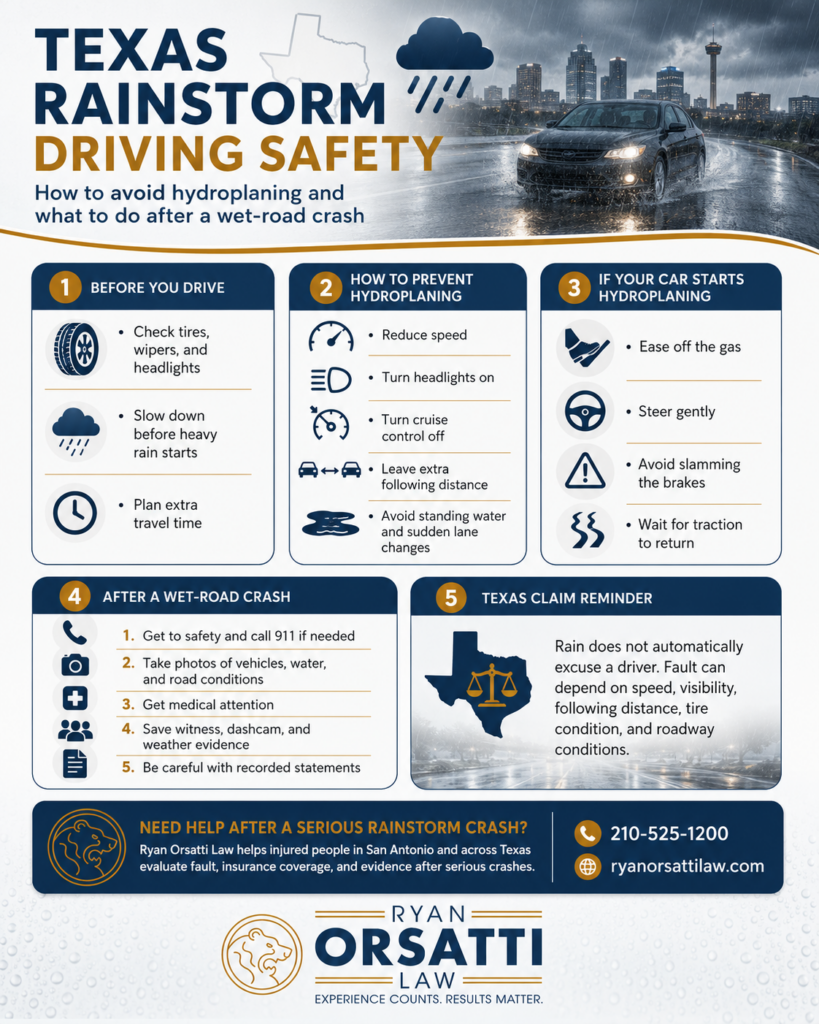
Rainstorm driving safety usually comes down to a few practical choices:
- Reduce speed before you reach standing water.
- Avoid sudden braking, sudden steering, and hard acceleration.
- Turn headlights on so other drivers can see you.
- Increase following distance.
- Stay out of low-lying lanes where water pools.
- Avoid cruise control.
- Do not drive around barricades or through floodwater.
- Pull over safely if visibility drops too far.
The Texas Department of Insurance’s bad-weather driving guidance recommends turning off cruise control, avoiding hard braking, avoiding sharp turns, and never driving beyond the limits of visibility. Those same facts also matter after a crash because insurers often ask whether the driver adjusted to the storm. (Texas Department of Insurance)
Why Is Rain Such a Serious Crash Risk in Texas?
Rain is a serious Texas crash risk because it reduces traction, shortens visibility, increases stopping distance, and can cause hydroplaning. The Texas Department of Insurance states that rain accounts for more than 85% of weather-related roadway crashes in Texas, and the Federal Highway Administration reports that nationally, 75% of weather-related vehicle crashes occur on wet pavement and 47% happen during rainfall. (Texas Department of Insurance)
Hydroplaning happens when water builds in front of the tires faster than the vehicle’s weight can push it away. The tire rides on a thin layer of water instead of gripping the pavement. The driver may suddenly lose steering, braking, and lane control.
Wet roads are especially dangerous after a dry spell. Oil, rubber, dirt, and road grime collect on the pavement. The first rain can lift that residue and make intersections, curves, ramps, and bridge approaches slick.
For injury claims, the key question is not simply “Was it raining?” The key question is whether a driver acted reasonably for the rain that was actually present.
How Do You Avoid Hydroplaning on San Antonio Highways?
You avoid hydroplaning by reducing speed before the water, keeping steady control inputs, maintaining tire tread, avoiding pooled lanes, and increasing space around other vehicles. TDI identifies speed, water depth, and tire tread depth as the three main causes of hydroplaning risk. (Texas Department of Insurance)
On San Antonio highways, water often gathers near lane edges, construction areas, underpasses, frontage roads, and worn pavement sections. TDI recommends driving in middle lanes when possible because rainwater tends to pool along the outside edges of the road. (Texas Department of Insurance)
Practical wet-road habits include:
- Slow down before curves, ramps, and standing water.
- Avoid following 18-wheelers, buses, and large trucks too closely because tire spray can block visibility.
- Keep both hands on the wheel.
- Turn off cruise control so you can adjust speed smoothly.
- Avoid sudden lane changes.
- Do not assume all-wheel drive prevents hydroplaning.
- Replace worn tires before storm season.
What Should You Do if Your Car Starts Hydroplaning?
If your car starts hydroplaning, ease off the accelerator, avoid panic braking, steer gently in the direction of the skid, and wait for the tires to reconnect with the road. TDI’s hydroplaning guidance says to step off the accelerator, turn in the direction of the skid, wait for traction to return, and brake gently as needed. (Texas Department of Insurance)
Do not jerk the wheel. Do not slam the brakes unless a collision is otherwise unavoidable. Hard braking or overcorrecting can turn a slide into a spin, rollover, median impact, or multi-vehicle collision.
If you regain control, move to a safe location when possible. Check yourself and passengers for injury. If a crash happened, call 911, photograph the roadway, and document the weather while conditions are still visible.
What Texas Traffic Rules Matter Most in a Rainstorm?
The Texas rainstorm rules that matter most are the duty to drive at a reasonable speed for conditions, the duty to use lights when visibility is poor, and the duty to avoid dangerous conduct around floodwater or standing water. These rules can matter both for safety and for proving fault after a crash.
| Rainstorm issue | Texas rule or official guidance | Why it matters in an injury claim |
|---|---|---|
| Speed in rain | Texas Transportation Code § 545.351 says a driver may not drive faster than reasonable and prudent under existing circumstances, including weather or highway conditions. (Texas Statutes) | A driver may be found negligent even if they were below the posted speed limit if the rain made that speed unsafe. |
| Headlights and visibility | Texas Transportation Code § 547.302 requires required lights when light is insufficient or atmospheric conditions make people or vehicles not clearly visible at 1,000 feet. (Texas Statutes) | Headlight use can affect whether another driver, pedestrian, cyclist, or witness could see the vehicle. |
| Cruise control | TDI recommends turning cruise control off in bad weather because drivers need control to make necessary adjustments. (Texas Department of Insurance) | Cruise control can become an issue if the vehicle accelerated or failed to respond smoothly on wet pavement. |
| Floodwater | The National Weather Service says it is never safe to drive or walk into floodwaters and warns that rushing water can carry vehicles away. (Weather.gov) | Ignoring floodwater, barricades, or low-water crossings can become strong evidence in a liability dispute. |
| Following distance | TDI recommends giving other vehicles plenty of room and not following trucks or buses closely because water spray reduces visibility. (Texas Department of Insurance) | Rear-end crashes in rain often turn on whether the following driver left enough space for wet-road stopping distance. |
Key takeaway: In a Texas rainstorm crash, the legal question is usually not whether the weather was bad, but whether each driver adjusted speed, visibility, spacing, and control to match the weather.
Who May Be at Fault After a Hydroplaning Crash in Texas?
Fault after a hydroplaning crash depends on whether one or more people failed to act reasonably under the conditions. Bad weather can explain why a crash happened, but it does not automatically excuse speeding for conditions, following too closely, driving with unsafe tires, failing to use headlights, or driving into standing water.
Potentially responsible parties may include:
- A driver who was going too fast for the rain.
- A driver who followed too closely and could not stop.
- A driver who changed lanes suddenly on wet pavement.
- A commercial driver or company if the crash involved unsafe operation, maintenance, routing, or training.
- A vehicle owner if unsafe tires, brakes, or lights contributed.
- A governmental unit in limited cases involving road design, maintenance, missing warnings, or dangerous road conditions, subject to special notice and immunity rules.
- Multiple drivers if each contributed to the crash.
Can Bad Weather Excuse the Driver Who Hit Me?
Bad weather does not automatically excuse the driver who hit you in Texas. Texas law requires drivers to use reasonable care under existing circumstances, and § 545.351 specifically ties speed decisions to actual and potential hazards, including weather or highway conditions. (Texas Statutes)
For example, an adjuster may claim the crash was unavoidable because it was raining. The stronger question is whether the driver slowed down, left enough space, used headlights, avoided standing water, maintained tires, and reacted reasonably.
That is why photos, dashcam video, witness statements, weather data, and vehicle condition evidence matter.
What if I Also Lost Control or Hydroplaned?
If you also lost control, Texas comparative responsibility rules may still allow a claim if your percentage of responsibility is not greater than 50%. Comparative responsibility means Texas can reduce a person’s recovery by that person’s percentage of fault, and the 51% bar is shorthand for the rule that a claimant cannot recover if their responsibility is greater than 50%. (Texas Statutes)
This issue comes up often in rainstorm crashes. One driver may have hydroplaned first, while another was following too closely. One driver may have stopped suddenly, while another failed to account for wet pavement. The final fault analysis depends on the evidence.
What Should You Do After a Wet-Road Crash in San Antonio?
After a wet-road crash in San Antonio, protect safety first, call 911 if anyone is hurt, document the rain and roadway conditions, get medical attention, and avoid giving detailed fault opinions at the scene. The Texas Peace Officer’s Crash Report, also called a CR-3, is an important document law enforcement uses to collect crash data in Texas. (TxDOT)
Use this checklist if you are physically able:
- Move to safety if you can do so without creating more danger. Turn on hazards and get away from active traffic if possible.
- Call 911 if anyone is injured, a vehicle cannot be driven, lanes are blocked, or floodwater creates a hazard.
- Photograph the road before conditions change. Capture standing water, puddles, lane markings, underpasses, curves, traffic signals, construction zones, signs, barricades, and visibility.
- Photograph all vehicles from multiple angles. Include close-ups and wide shots showing where the vehicles came to rest.
- Save weather proof. Take screenshots of radar, weather alerts, rain intensity, and the time.
- Get witness names and numbers. Nearby drivers, passengers, pedestrians, and business employees may remember speed, lights, spray, and lane position.
- Preserve dashcam, Tesla camera, rideshare app, delivery app, and cell phone data.
- Get checked by a medical provider. Pain, concussion symptoms, neck injuries, and back injuries may become clearer after adrenaline wears off.
- Report the claim, but be careful with recorded statements. Give basic facts, but avoid guessing about speed, fault, or injury severity.
- Talk with a Texas personal injury lawyer if you were injured or fault is disputed. Early legal review can help preserve evidence before rainstorm conditions disappear.
For road closures and hazardous weather notices, TxDOT recommends checking DriveTexas or calling 800-452-9292. (TxDOT)
What Evidence Matters Most in a Texas Rainstorm Injury Claim?
The most important evidence in a Texas rainstorm injury claim is proof of what the road, weather, vehicles, and drivers were doing at the time of the crash. Rain conditions change quickly, so evidence gathered within hours often carries more weight than memories gathered weeks later.
Key evidence includes:
- Scene photos showing standing water and lane conditions.
- Vehicle photos showing impact angles.
- Tire tread photos.
- Headlight and taillight condition.
- Windshield wiper condition.
- Dashcam or security footage.
- Nearby business video.
- 911 call records.
- Police body camera when available.
- CR-3 crash report.
- Weather reports and radar screenshots.
- Medical records connecting symptoms to the crash.
- Repair estimates and total-loss documents.
- Phone records if distracted driving is suspected.
- Commercial vehicle records if a truck, delivery vehicle, or company vehicle was involved.
Attorney Insight: In rainstorm crashes, insurance adjusters often focus on the word “hydroplaned” because it sounds like no one was responsible. The better analysis is more specific: speed for conditions, tire condition, following distance, lane choice, visibility, braking pattern, and whether the driver had enough time to react. A wet-road crash should be investigated as a negligence case, not dismissed as bad luck.
What Insurance Coverage Can Apply After a Hydroplaning Crash?
Several insurance coverages can apply after a hydroplaning crash, depending on who caused the crash and what coverage exists. Liability coverage may apply if another driver was at fault, collision coverage may apply to your own vehicle damage, PIP may help with medical bills and lost income if not rejected, and UM/UIM may apply if the responsible driver has no insurance or not enough insurance. (Texas Department of Insurance)
Important coverage terms:
- Liability coverage means the at-fault driver’s insurance may pay covered losses caused by that driver.
- Collision coverage means your own policy may pay to repair or replace your car after a crash, subject to the policy and deductible.
- Comprehensive coverage may apply to non-collision damage such as flood damage, depending on policy terms.
- Personal Injury Protection, or PIP, is coverage that can pay medical bills and certain lost income or nonmedical costs. TDI states all Texas auto policies include PIP unless rejected in writing. (Texas Department of Insurance)
- Uninsured/underinsured motorist coverage, or UM/UIM, may apply when the responsible driver has no insurance, lacks enough coverage, or flees the scene. TDI states insurers must offer UM/UIM, and rejection must be in writing. (Texas Department of Insurance)
Ryan Orsatti Law provides more detail on UM/UIM coverage in Texas wrecks and San Antonio hit-and-run claims.
When Should You Call a Lawyer After a Texas Rainstorm Crash?
You should call a lawyer after a Texas rainstorm crash if you were injured, fault is disputed, the other driver blames hydroplaning, a commercial vehicle was involved, an insurer asks for a recorded statement, or medical bills are building. A lawyer can help preserve evidence, evaluate fault, identify coverage, and prevent avoidable claim mistakes.
Legal help is especially important when:
- The crash caused emergency care, imaging, injections, surgery, concussion symptoms, or ongoing therapy.
- The other driver says “I hydroplaned” and denies responsibility.
- The crash happened on I-10, I-35, Loop 1604, Loop 410, US-281, or another high-speed corridor.
- A truck, rideshare vehicle, delivery vehicle, or company vehicle was involved.
- The insurer is asking broad medical questions.
- You are being blamed for speed, braking, or lane position.
- A road defect, flooded underpass, missing barricade, or drainage issue may be involved.
- You are unsure whether PIP, MedPay, UM/UIM, collision, or liability coverage applies.
Ryan Orsatti Law helps injured people in San Antonio, Bexar County, and across Texas evaluate car accident claims involving fault disputes, medical documentation, insurance coverage, and litigation decisions. You can learn more about the firm’s San Antonio car accident practice or read about whether you can sue after a Texas car accident.
What Deadlines Apply After a Texas Wet-Road Injury Crash?
Most Texas personal injury lawsuits must be filed within two years from the date the cause of action accrues under Texas Civil Practice & Remedies Code § 16.003. That deadline is not the same as an insurance reporting deadline, a medical treatment deadline, or a governmental notice deadline. (Texas Statutes)
Some deadlines can be shorter. If a governmental unit may be involved, Texas Civil Practice & Remedies Code § 101.101 gives a governmental unit the right to receive notice of a claim not later than six months after the incident, unless actual notice applies. City charter or ordinance issues can also matter. (Texas Statutes)
Insurance policies may also require prompt notice. Waiting too long can create disputes over whether the crash caused the injury, whether evidence still exists, and whether policy conditions were met.
FAQs About Texas Rainstorm Driving Safety and Wet-Road Crashes
Is hydroplaning automatically the driver’s fault in Texas?
Hydroplaning is not automatically the driver’s fault, but it is not an automatic excuse either. In Texas, fault depends on whether the driver acted reasonably for the rain, water depth, visibility, traffic, speed, tire condition, and roadway conditions. A driver who fails to slow down, follows too closely, or ignores standing water may still be responsible.
Should I use cruise control while driving in heavy rain in Texas?
You should not use cruise control in heavy rain. The Texas Department of Insurance recommends turning cruise control off in bad weather because drivers need to remain in control and make quick adjustments. Cruise control can make it harder to respond smoothly when the vehicle hits standing water, loses traction, or begins to hydroplane. (Texas Department of Insurance)
Do I need headlights during daytime rain in Texas?
You should use headlights in daytime rain, and Texas law requires required lights when atmospheric conditions make people or vehicles not clearly visible at 1,000 feet ahead. Headlights help other drivers see your vehicle through spray, mist, and low visibility. TDI also recommends using headlights in rain, even during daylight. (Texas Statutes)
What should I photograph after a wet-road crash?
Photograph the water, roadway, lane markings, impact points, vehicle positions, tire tread, traffic signs, construction areas, underpasses, traffic signals, and visible weather. Also take screenshots of radar and weather alerts showing the time. In rainstorm claims, the road may look completely different an hour later, so early photos can be important evidence.
Can I recover if both drivers slid on wet pavement?
You may still be able to recover if both drivers slid, depending on the percentages of fault. Texas proportionate responsibility rules generally bar recovery only if the claimant’s responsibility is greater than 50%. If your percentage is 50% or less, any recovery can be reduced by your share of responsibility. (Texas Statutes)
How long do I have to file a Texas injury claim after a rainstorm crash?
Most Texas personal injury claims must be filed within two years under Texas Civil Practice & Remedies Code § 16.003. Do not wait until the deadline is close. Evidence from rainstorm crashes can disappear quickly, and insurance policies, governmental claims, or other special facts may create earlier notice problems. (Texas Statutes)
What if flooded roads or bad drainage helped cause the crash?
If a flooded road, missing warning, road defect, or drainage issue helped cause the crash, the claim may involve a governmental entity or road contractor. These cases need early investigation because notice requirements, immunity defenses, maintenance records, prior complaints, and inspection history can matter. Do not assume the ordinary two-year deadline is the only time limit.
Talk With Ryan Orsatti Law After a Texas Rainstorm Crash
A serious wet-road crash should be evaluated quickly, especially if the insurance company blames rain, hydroplaning, or “unavoidable conditions.” Ryan Orsatti Law helps injured people in San Antonio and across Texas review fault, coverage, medical documentation, and next steps after rainstorm crashes.
For help with a San Antonio or Texas car accident claim, contact Ryan Orsatti Law.
Ryan Orsatti Law
4634 De Zavala Rd, San Antonio, TX 78249
Phone: 210-525-1200
ryanorsattilaw.com
This blog is for informational purposes only, not legal advice. Reading it does not create an attorney-client relationship. Past results do not guarantee future results.
Hurt in an accident in San Antonio? Learn how a San Antonio car accident lawyer can help with your claim. Call 210-525-1200 or request a free consultation.
The firm works on a contingency fee. You pay nothing unless the firm recovers money for you, and that covers case expenses as well as the fee: if there is no recovery, you owe no attorney's fee and no case expenses. Ask for the fee agreement and read the fee and expense section before you sign anything.
Related San Antonio legal resources
Primary legal and public-data sources
- TxDOT: Texas crash reports, data, and statistics
- Texas Civil Practice and Remedies Code Chapter 33: proportionate responsibility
Ryan Orsatti Law
4634 De Zavala Road, San Antonio, TX 78249
General reference links. Consult each source for its current text.