
Quick Answer
Fatal vs. regular car accidents in Texas differ because a fatal crash may create wrongful-death and survival claims, while a regular nonfatal crash usually belongs to the injured person. Texas law generally gives two years to file personal injury and injury-resulting-in-death lawsuits, but fatal cases add beneficiary, estate, probate, insurance, and evidence issues that should be reviewed early. TxDOT reported 3,769 motor vehicle traffic deaths in Texas in 2025, based on reportable crash data processed as of April 7, 2026. (Texas Statutes)
Key Takeaways
- A “regular” accident usually means a nonfatal personal injury claim brought by the injured person.
- A fatal Texas accident may involve two different civil claims: a wrongful-death claim for eligible family members and a survival claim for the estate.
- Texas wrongful-death claims are for the benefit of the surviving spouse, children, and parents of the deceased. (Texas Statutes)
- Texas generally applies a two-year lawsuit deadline to personal injury claims and injury-resulting-in-death claims. (Texas Statutes)
- Fault still matters. Under Texas proportionate responsibility, a claimant may not recover damages if that claimant’s responsibility is greater than 50 percent. (Texas Statutes)
- In fatal accidents, minimum auto liability coverage can become a major issue because Texas requires only 30/60/25 coverage for basic auto liability policies. (Texas Department of Insurance)
What Are the Legal Differences Between Fatal vs. Regular Car Accidents in Texas?
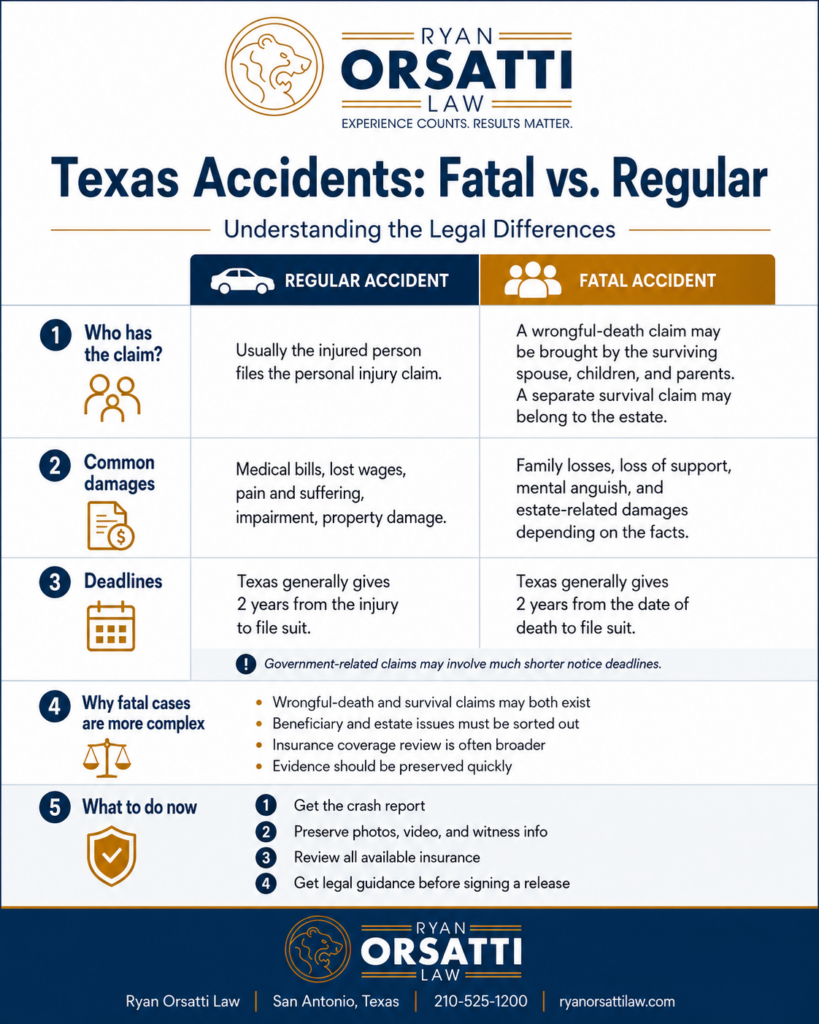
The biggest legal difference is who owns the claim. In a regular nonfatal Texas car accident, the injured person usually brings the personal injury claim. In a fatal crash, Texas law may allow certain family members to bring a wrongful-death claim, and the estate may have a separate survival claim for damages the deceased person could have pursued if they had lived. (Texas Statutes)
A regular accident claim focuses on the living injured person’s medical care, lost income, pain, impairment, property damage, and future needs. A fatal accident claim focuses on the family’s loss, the estate’s surviving claim, the circumstances of death, available insurance, and whether the right person has legal authority to act.
For San Antonio families, this often means gathering the TxDOT CR-3 crash report, law enforcement records, photos, witness statements, insurance information, medical records, death certificate, and any medical examiner or autopsy materials if they exist. TxDOT states that Texas Peace Officer’s Crash Reports are CR-3 reports and can be obtained through its crash report system. (Texas Department of Transportation)
Who Has the Legal Claim After a Fatal Accident in Texas?
In a fatal Texas accident, the claim may belong to more than one legal group. The wrongful-death claim belongs to eligible surviving family members, while the survival claim belongs to the estate, heirs, or legal representatives of the deceased person. That split is one reason fatal accident cases are more procedurally sensitive than ordinary injury claims. (Texas Statutes)
Who Can Bring a Texas Wrongful-Death Claim?
Texas wrongful-death claims are for the exclusive benefit of the surviving spouse, children, and parents of the deceased. One or more of those people may bring the claim for the benefit of all eligible beneficiaries, but siblings, grandparents, unmarried partners, and close friends are not listed in the Texas wrongful-death statute. (Texas Statutes)
This rule can surprise families after a fatal crash on I-35, Loop 410, Loop 1604, US-281, or another Texas road. The person who handled the deceased person’s affairs in life may not be the person Texas law allows to bring the wrongful-death claim. Ryan Orsatti Law helps families in San Antonio and across Texas evaluate who has standing before the claim is presented to an insurance company.
What Is a Survival Claim in Texas?
A survival claim is the injury claim the deceased person would have had if they had survived. Texas Civil Practice and Remedies Code § 71.021 says a personal injury cause of action does not abate because of death and survives in favor of the heirs, legal representatives, and estate. (Texas Statutes)
A survival claim can include damages tied to the deceased person’s injury before death, such as medical expenses and conscious pain before death, depending on the facts and proof. This is different from wrongful-death damages, which focus on the losses suffered by eligible family members.
How Do Deadlines Differ in Fatal vs. Regular Texas Accident Cases?
The basic Texas lawsuit deadline is often two years, but fatal cases can involve extra clocks. A regular personal injury case is generally subject to a two-year limitations period from the injury, while an injury-resulting-in-death action generally accrues on the date of death under Texas Civil Practice and Remedies Code § 16.003. (Texas Statutes)
That two-year rule should not be treated as permission to wait. Fatal crashes often require early preservation of video, vehicle data, commercial driver records, 911 audio, body camera footage, toxicology evidence, and witness statements. Some evidence may disappear long before the lawsuit deadline.
| Issue | Regular Nonfatal Accident | Fatal Accident |
|---|---|---|
| Main civil claim | Personal injury claim by the injured person | Wrongful-death claim and possible survival claim |
| Common lawsuit deadline | Generally two years from injury | Generally two years from death for injury resulting in death |
| Who usually controls the claim | Injured person or legal guardian if a minor or incapacitated | Eligible beneficiaries, estate representative, heirs, or legal representatives depending on claim type |
| Key documents | CR-3, medical records, bills, wage proof, photos | CR-3, death certificate, medical records, estate/probate documents, beneficiary information, medical examiner records if available |
| Insurance pressure point | Bodily injury limits, PIP, MedPay, UM/UIM | All available liability policies, UM/UIM, umbrella, employer, commercial, rideshare, or governmental coverage |
| Early risk | Recorded statements, delayed treatment, low settlement offers | Wrong claimant, missed notice deadline, incomplete beneficiary list, release signed before all claims are understood |
Key takeaway: Fatal Texas accident cases are not just larger injury claims. They often require a separate beneficiary and estate analysis before anyone signs a release or gives a binding statement.
What If a City, County, or Government Vehicle Was Involved?
If a Texas governmental unit may be responsible, notice deadlines can be much shorter than the normal two-year lawsuit deadline. The Texas Tort Claims Act generally requires notice of a claim against a governmental unit not later than six months after the incident, and the City of San Antonio’s notice form references a 90-day written notice requirement for death, injury, or property damage claims. (Texas Legislature Online)
This can matter after crashes involving city vehicles, public buses, police units, road defects, construction zones, or government employees acting within the scope of work. A family should not assume the crash report, a police investigation, or a phone call to the city automatically satisfies every notice requirement.
Ryan Orsatti Law has a Texas-focused injury practice and can help evaluate whether a crash may involve governmental notice issues. For more on these claims, see the firm’s article on suing government entities in Texas.
How Do Damages Change When an Accident Is Fatal?
Damages change because Texas law shifts part of the claim from the injured person to the surviving family and estate. In a regular injury case, damages usually focus on the living claimant’s medical expenses, lost wages, pain, impairment, and future care. In a fatal accident, the claim may include family losses, estate damages, and proof of what the deceased person experienced before death.
Wrongful-death damages are not just medical bills. They often require evidence about financial support, household services, family relationships, companionship, mental anguish, and the long-term impact of the death on eligible beneficiaries. Survival damages focus on the deceased person’s own claim that survived death.
This is also where documentation matters. Pay records, tax returns, family photographs, medical timelines, funeral invoices, counseling records, school records for minor children, and testimony from family members can all become important depending on the claim.
How Does Insurance Change After a Fatal Texas Accident?
Insurance becomes more important in fatal Texas accident cases because the losses often exceed basic liability limits. The Texas Department of Insurance says Texas law requires at least $30,000 for injuries per person, $60,000 total per accident, and $25,000 for property damage, commonly called 30/60/25 coverage. (Texas Department of Insurance)
A fatal crash can quickly exceed those limits. That does not mean the analysis ends with the at-fault driver’s personal policy. Depending on the facts, a lawyer may need to look for employer coverage, commercial auto coverage, umbrella policies, rideshare coverage, trucking coverage, negligent entrustment facts, dram shop issues, defective vehicle evidence, or uninsured/underinsured motorist coverage.
For families dealing with a fatal crash, Ryan Orsatti Law can review policy layers, coverage letters, releases, and beneficiary issues before a settlement is accepted. The firm also handles San Antonio wrongful death claims and Texas wrongful death proof issues.
Does a Fatal Accident Automatically Become a Criminal Case?
A fatal accident does not automatically become a criminal case, but it may trigger a more serious law enforcement investigation. A civil wrongful-death claim is separate from any criminal case, and the family’s civil rights do not depend entirely on whether prosecutors file charges. Texas Penal Code § 49.08 addresses intoxication manslaughter, and Texas Penal Code § 19.04 addresses manslaughter. (Texas Statutes)
This distinction matters because families sometimes wait on the criminal process before seeking civil advice. That can be risky. A criminal case may focus on punishment, while the civil case focuses on liability, insurance, damages, and compensation issues allowed under Texas law.
Civil lawyers often need evidence from the criminal investigation, but they also need to act independently. Waiting for a criminal case to finish can create problems with civil deadlines, video retention, vehicle inspections, and insurance communications.
How Does Fault Work in Fatal vs. Regular Texas Accidents?
Fault matters in both fatal and regular Texas accident cases. Texas proportionate responsibility means a claimant may not recover damages if that claimant’s percentage of responsibility is greater than 50 percent, and Texas law also provides for damages to be reduced by responsibility percentages when recovery is not barred. (Texas Statutes)
Comparative responsibility means Texas can reduce a recovery by the claimant’s percentage of fault. In a fatal case, insurers may still argue the deceased person caused or contributed to the crash, even when the other driver was cited or charged.
This is why early evidence matters. Skid marks, vehicle positions, dashcam video, event data recorder information, phone records, toxicology reports, sight lines, lighting, road design, and witness accounts can affect fault decisions. In serious San Antonio crashes, evidence from nearby businesses, roadway cameras, 911 records, and responding agencies should be evaluated quickly.
What Evidence Should Families Save After a Fatal Texas Accident?
Families should save every crash-related document, photo, communication, medical record, bill, and insurance letter. Fatal accident evidence is often scattered across law enforcement, hospitals, medical examiners, insurers, employers, towing yards, vehicle storage lots, phone providers, and witnesses. The earlier it is organized, the easier it is to protect the claim.
- Get the crash report number and request the TxDOT CR-3 when available.
- Save photos, videos, dashcam footage, vehicle photos, and scene photos.
- Write down witness names, phone numbers, and what each person saw.
- Preserve all insurance letters, policy numbers, claim numbers, and adjuster names.
- Collect medical records, hospital bills, EMS records, and death-related documents.
- Save funeral, burial, and related expense records.
- Gather proof of income, employment, household services, and family dependency.
- Identify all surviving spouse, children, and parents.
- Check whether probate or estate authority may be needed.
- Avoid signing a release until all wrongful-death, survival, insurance, and lien issues are understood.
Attorney Insight: In fatal crash cases, adjusters often move quickly to identify every possible fault argument and every possible coverage limit. Families should be careful with early recorded statements because a small wording mistake about speed, visibility, seat belts, medical history, or family relationships can affect liability, damages, or who is included in a release.
When Should You Contact a Texas Personal Injury Lawyer?
You should contact a Texas personal injury lawyer as soon as practical after a fatal crash or serious nonfatal accident. Early legal review can help identify the correct claimants, preserve evidence, check deadlines, evaluate insurance coverage, and prevent a release from accidentally giving up claims that were not fully understood.
This is especially important in crashes involving commercial trucks, rideshare drivers, government vehicles, hit-and-run drivers, uninsured drivers, alcohol, defective vehicles, construction zones, pedestrians, motorcycles, or multiple vehicles. These cases can involve more than one defendant and more than one insurance policy.
Ryan Orsatti Law helps injured people and grieving families in San Antonio, Bexar County, and across Texas evaluate fault, coverage, deadlines, medical documentation, and wrongful-death issues. You can also review the firm’s resources for San Antonio car accident claims, Texas wrongful death deadlines, and San Antonio truck accident claims.
FAQ
What is a regular accident claim in Texas?
A regular accident claim usually means a nonfatal personal injury claim brought by the injured person. The claim may involve medical expenses, lost income, pain, impairment, property damage, and future care needs. Texas generally applies a two-year deadline to personal injury lawsuits, but evidence and insurance issues should be handled much earlier. (Texas Statutes)
Is a fatal accident the same as a wrongful-death claim?
A fatal accident may create a wrongful-death claim, but the words are not identical. The accident is the event. The wrongful-death claim is the civil legal action Texas allows when death is caused by another party’s wrongful act, neglect, carelessness, unskillfulness, or default. The estate may also have a separate survival claim. (Texas Statutes)
Who can file a fatal car accident lawsuit in Texas?
Texas wrongful-death claims are for the surviving spouse, children, and parents of the deceased. One or more of those eligible people may bring the claim for the benefit of all eligible beneficiaries. A survival claim is different because it belongs to the estate, heirs, or legal representatives under Texas survival law. (Texas Statutes)
How long does a family have to file a fatal accident claim in Texas?
Texas generally requires an action for injury resulting in death to be filed not later than two years after the cause of action accrues, and the statute says the cause of action accrues on the death of the injured person. Governmental claims may require much earlier written notice, including six months under the Texas Tort Claims Act. (Texas Statutes)
Can a Texas case have both wrongful-death and survival claims?
Yes. A Texas fatal accident case can include both wrongful-death and survival claims. The wrongful-death claim focuses on losses suffered by eligible family members. The survival claim is the claim the deceased person could have pursued if they had lived, and it survives in favor of the heirs, legal representatives, and estate. (Texas Statutes)
What if the at-fault driver only has minimum insurance?
If the at-fault driver only has Texas minimum insurance, the available bodily injury coverage may be limited to $30,000 per person and $60,000 per accident. In fatal cases, a lawyer should check for other possible coverage, including UM/UIM, commercial policies, employer coverage, umbrella policies, rideshare coverage, or other responsible parties. (Texas Department of Insurance)
Does a criminal case replace a Texas wrongful-death claim?
No. A criminal case does not replace a Texas wrongful-death claim. Criminal charges are handled by the government and focus on punishment. A civil wrongful-death claim is brought by eligible family members and focuses on civil liability and damages. A family should not wait on the criminal case before checking civil deadlines and evidence preservation.
Ryan Orsatti Law
4634 De Zavala Rd, San Antonio, TX 78249
Phone: 210-525-1200
ryanorsattilaw.com
This blog is for informational purposes only, not legal advice. Reading it does not create an attorney-client relationship. Past results do not guarantee future results.
Hurt in an accident in San Antonio? Learn how a San Antonio car accident lawyer can help with your claim. Call 210-525-1200 or request a free consultation.
The firm works on a contingency fee. You pay nothing unless the firm recovers money for you, and that covers case expenses as well as the fee: if there is no recovery, you owe no attorney's fee and no case expenses. Ask for the fee agreement and read the fee and expense section before you sign anything.
Related San Antonio legal resources
Primary legal and public-data sources
- TxDOT: Texas crash reports, data, and statistics
- Texas Civil Practice and Remedies Code Chapter 33: proportionate responsibility
Ryan Orsatti Law
4634 De Zavala Road, San Antonio, TX 78249
General reference links. Consult each source for its current text.