
Quick Answer: Texas negligence law helps injured accident victims by giving them a legal path to hold a careless person, company, or property owner financially responsible for harm they caused. To recover in a Texas negligence claim, you generally must prove duty, breach, proximate cause, and damages, and your recovery can be reduced or barred under Texas proportionate responsibility rules. In motor vehicle cases, TxDOT reported 251,977 people injured in Texas crashes in 2024, which shows why evidence preservation after an accident matters. Ryan Orsatti Law helps injured people in San Antonio and across Texas evaluate fault, insurance coverage, medical documentation, and deadlines after serious accidents.
Key Takeaways
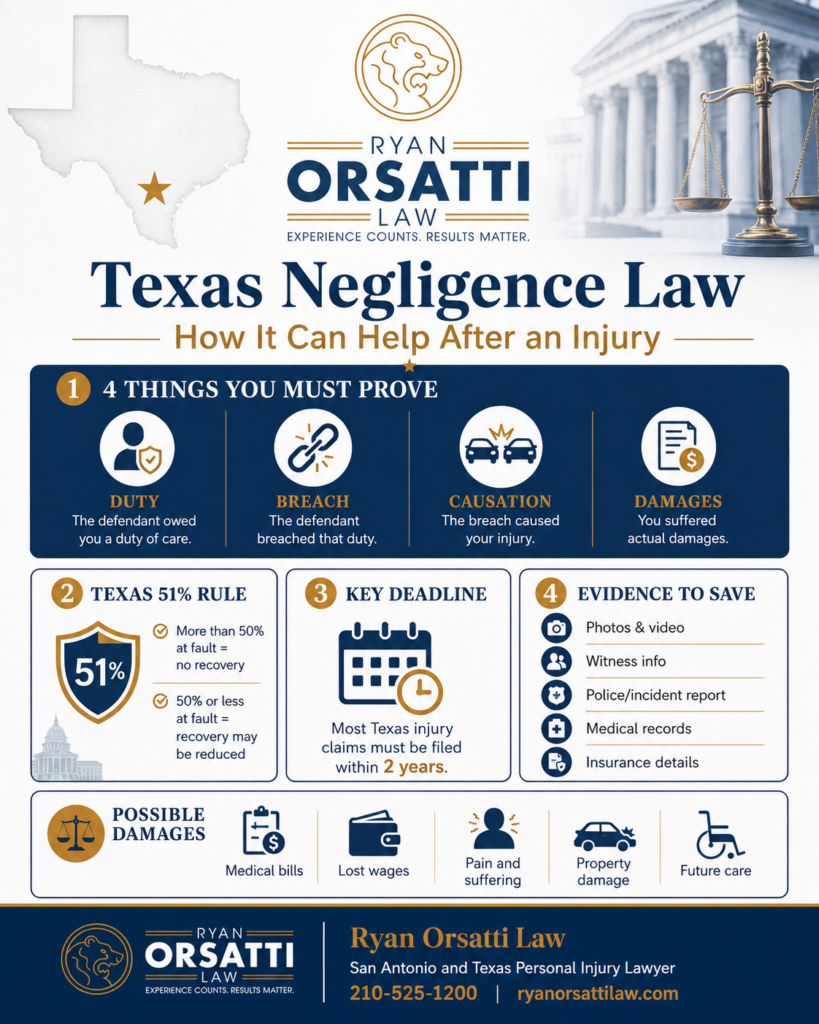
- Texas negligence law usually requires proof of four things: duty, breach, causation, and damages.
- Under Texas Civil Practice & Remedies Code § 33.001, a claimant may not recover damages if their percentage of responsibility is greater than 50 percent. (Texas Statutes)
- If you are 50 percent or less responsible, your damages are generally reduced by your percentage of responsibility under Texas law. (Texas Statutes)
- Most Texas personal injury lawsuits must be filed within two years, but claims involving government entities can involve shorter notice requirements. (Texas Statutes)
- Strong evidence includes photos, witness information, incident reports, medical records, wage records, and proof that the defendant’s conduct actually caused your injuries.
- Legal help becomes more important when fault is disputed, injuries are serious, insurance limits are low, medical liens exist, or multiple parties may share responsibility.
What Is Texas Negligence Law in a Personal Injury Claim?
Texas negligence law is the legal framework used to decide whether someone’s careless conduct makes them responsible for another person’s injuries. In a Texas personal injury case, negligence generally means a person or company owed a legal duty, failed to use reasonable care, and caused damages as a result. The Texas Supreme Court has described negligence elements as duty, breach, causation, and damages. (Texas Courts)
Negligence can apply to many injury scenarios: car crashes, 18-wheeler wrecks, unsafe property conditions, workplace third-party claims, pedestrian injuries, motorcycle crashes, and wrongful death cases. For example, a driver may be negligent for running a red light, a trucking company may be negligent for unsafe maintenance practices, and a store may be negligent for failing to address a dangerous condition it knew or should have known about.
Negligence does not mean every accident creates a valid claim. Texas law still requires evidence. The injured person must connect the defendant’s conduct to the injury, medical treatment, lost income, pain, impairment, or other damages.
How Does Texas Negligence Law Help Injured Accident Victims?
Texas negligence law helps injured accident victims by converting a careless act into a civil claim for damages. It gives the injured person a way to prove fault, identify legally responsible parties, calculate losses, and seek payment through insurance negotiations or a lawsuit. It also gives defendants and insurers a framework to dispute fault, causation, damages, or responsibility percentages.
This is why the details matter. A Texas negligence claim is not only about what happened. It is about what can be proven through records, witness testimony, medical documentation, photographs, video, crash reports, inspection records, and the timeline of treatment.
Ryan Orsatti Law’s Texas personal injury work often involves sorting out these issues early, especially in cases involving San Antonio car accidents, commercial truck crashes, traumatic brain injuries, and wrongful death claims. The goal is to understand liability, insurance, medical proof, and deadlines before an insurance company frames the claim against the injured person.
What Are the Four Elements of Negligence in Texas?
The four basic elements of negligence in Texas are duty, breach, causation, and damages. Duty means the defendant had a legal obligation to use reasonable care. Breach means the defendant failed to meet that obligation. Causation means the breach caused the injury. Damages means the injured person suffered legally recognized losses. (Texas Courts)
| Element | Plain-English Meaning | Common Evidence |
|---|---|---|
| Duty | The defendant had a legal responsibility to act with reasonable care. | Traffic laws, safety rules, policies, industry standards, property control facts |
| Breach | The defendant failed to act as a reasonably careful person or company would under similar circumstances. | Photos, video, witness statements, inspection records, phone records, maintenance records |
| Causation | The defendant’s breach actually caused or substantially contributed to the injury. | Medical records, crash reconstruction, incident timeline, treating doctor opinions |
| Damages | The injured person suffered losses Texas law recognizes. | Medical bills, wage records, impairment records, pain notes, repair estimates, family impact details |
Key takeaway: A Texas negligence claim is strongest when each element is supported by documents, testimony, and a clear timeline instead of assumptions.
What Does Proximate Cause Mean in Texas?
Proximate cause means the defendant’s conduct must be legally connected to the injury, not just part of the background story. In recent Texas Supreme Court analysis, proximate cause required more than “but for” causation. The negligent conduct had to be a substantial factor in causing the injury. (Texas Courts)
This matters because insurance companies often argue that the accident happened, but the defendant’s conduct did not really cause the injury claimed. They may point to prior medical records, delayed treatment, low property damage, intervening events, or unrelated conditions. A well-documented claim addresses causation directly with medical records, mechanism-of-injury evidence, and a consistent treatment timeline.
What Is Texas Proportionate Responsibility and the 51 Percent Rule?
Texas proportionate responsibility is the system Texas uses to divide fault among people or entities that caused or contributed to an injury. Under Texas Civil Practice & Remedies Code § 33.001, a claimant may not recover damages if their percentage of responsibility is greater than 50 percent. (Texas Statutes)
A jury or factfinder can assign responsibility percentages to claimants, defendants, settling persons, and responsible third parties in certain cases. Texas Civil Practice & Remedies Code § 33.003 addresses the factfinder’s determination of responsibility percentages, and § 33.012 generally reduces a claimant’s damages by their percentage of responsibility if they are not barred from recovery. (Justia Law)
| Fault Finding | General Texas Effect | Practical Meaning |
|---|---|---|
| Injured person 0% at fault | No reduction based on claimant fault | Full damages finding is not reduced for claimant responsibility |
| Injured person 20% at fault | Damages reduced by 20% | A $100,000 damages finding becomes $80,000 before other legal adjustments |
| Injured person 50% at fault | Damages reduced by 50% | Recovery may still be possible, but reduced substantially |
| Injured person 51% at fault | Recovery barred under § 33.001 | The claimant may recover nothing from that claim |
| Multiple defendants involved | Responsibility may be divided | Evidence must identify who did what and why it mattered |
Key takeaway: In Texas, small changes in fault allocation can change the entire claim, so early evidence preservation can be just as important as medical billing records.
How Long Do I Have to Bring a Texas Negligence Claim?
Most Texas negligence-based personal injury lawsuits must be filed within two years of the date the claim accrues. Texas Civil Practice & Remedies Code § 16.003 sets a two-year limitations period for personal injury and wrongful death actions. (Texas Statutes)
That two-year deadline is not the only deadline that can matter. If the potential defendant is a governmental unit, Texas Civil Practice & Remedies Code § 101.101 generally entitles the governmental unit to notice of a claim not later than six months after the incident, and the notice must reasonably describe the injury, time and place, and incident. (Texas Legislature Online) Some cities may also have charter notice provisions, so claims involving public buses, city vehicles, dangerous public property, or public employees should be reviewed promptly.
The deadline also affects evidence. Video may be overwritten, vehicles may be repaired, witnesses may move, and medical records may become harder to connect to the event if treatment is delayed. Waiting can give the insurer more room to argue that the injuries came from something else.
What Evidence Helps Prove Negligence in Texas?
Evidence that helps prove negligence in Texas includes scene documentation, witness information, official reports, medical records, wage proof, insurance documents, and anything showing what the defendant knew or should have done. The best evidence is gathered early, before vehicles are repaired, camera footage is deleted, or the hazard is cleaned up.
In motor vehicle cases, TxDOT’s 2024 crash facts show the scale of the problem: 251,977 people were injured in Texas motor vehicle traffic crashes, and one reportable crash occurred every 57 seconds. For San Antonio and Bexar County crashes on I-10, I-35, Loop 410, Loop 1604, US-281, and nearby corridors, fast documentation can make the difference between a clean liability presentation and a disputed claim.
What Should I Do After an Accident to Protect a Negligence Claim?
You should protect a Texas negligence claim by documenting the incident, getting medical care, preserving evidence, and avoiding statements that can be used out of context. These steps do not guarantee a result, but they help preserve facts before an insurance company or defendant starts building defenses.
- Get medical attention quickly. Follow the treatment plan and tell providers exactly how the injury happened.
- Report the incident. Call law enforcement after a crash or notify the property owner after a premises injury.
- Take photos and videos. Capture vehicles, hazards, injuries, lighting, weather, warning signs, skid marks, debris, and the surrounding area.
- Get witness information. Names, phone numbers, and short written notes can be valuable later.
- Save documents. Keep medical bills, discharge papers, prescriptions, wage records, repair estimates, and insurance letters.
- Do not guess about fault. Stick to facts. Avoid saying “I’m fine” or “it was my fault” when you do not know the full picture.
- Talk to a Texas personal injury lawyer before giving a recorded statement. Recorded statements can lock you into incomplete facts before you know the diagnosis, prognosis, or evidence.
Attorney Insight: Insurance adjusters often evaluate negligence claims in two tracks at the same time: fault and damages. A strong medical file will not fix weak liability evidence, and strong liability evidence will not fix unexplained treatment gaps. The safest approach is to document both tracks early: what the defendant did wrong, and how the injury changed your health, work, and daily life.
What Damages Can Texas Negligence Law Allow?
Texas negligence law can allow recovery for economic and non-economic damages when the evidence supports them. Economic damages are financial losses such as medical expenses, lost wages, reduced earning capacity, and property damage. Non-economic damages are human losses such as pain, mental anguish, physical impairment, disfigurement, and loss of enjoyment of life.
Medical damages require careful handling. Texas law limits recovery of medical or health care expenses incurred to the amount actually paid or incurred by or on behalf of the claimant under Texas Civil Practice & Remedies Code § 41.0105. (Texas Statutes) That means health insurance adjustments, letters of protection, unpaid balances, and billing affidavits must be reviewed carefully.
Exemplary damages, sometimes called punitive damages, are different from ordinary compensatory damages. They are not available in every negligence case. Under Texas Civil Practice & Remedies Code § 41.003, exemplary damages generally require clear and convincing evidence that the harm resulted from fraud, malice, or gross negligence. (FindLaw)
How Does Insurance Affect a Texas Negligence Claim?
Insurance affects a Texas negligence claim because the available coverage often controls how a claim is investigated, negotiated, and resolved. In auto cases, the Texas Department of Insurance explains that Texas law requires minimum liability coverage of $30,000 per injured person, $60,000 per accident, and $25,000 for property damage, often called 30/60/25 coverage. (Texas Department of Insurance)
Minimum coverage may be inadequate in serious injury cases. A surgery, traumatic brain injury, spinal injury, extended physical therapy course, or wrongful death claim can exceed minimum bodily injury limits quickly. That is why lawyers often look for additional coverage, such as commercial policies, umbrella policies, employer liability, negligent entrustment facts, UM/UIM coverage, PIP, MedPay, and possible third-party liability.
Subrogation means a health insurer may claim a right to be paid back from a settlement. A hospital lien is a legal claim a hospital may assert against part of a personal injury recovery. These repayment issues can affect the client’s net recovery and should be evaluated before settlement, not after the release is signed.
When Should I Talk to a Texas Personal Injury Lawyer About Negligence?
You should talk to a Texas personal injury lawyer when fault is disputed, your injuries are more than minor, an insurer wants a recorded statement, evidence may disappear, or multiple parties may share responsibility. Legal help is also important when the case involves a commercial vehicle, government entity, serious medical treatment, lost income, a child, a death, or a long-term impairment.
Ryan Orsatti Law helps injured people in San Antonio, Bexar County, and across Texas evaluate negligence claims involving crashes, unsafe property, serious injuries, commercial vehicles, and wrongful death. The firm’s role is to investigate the facts, preserve evidence, review insurance coverage, organize medical documentation, address liens, and help the client make informed decisions.
For broader process questions, see Ryan Orsatti Law’s guide on how a personal injury lawsuit works. To discuss a specific accident, use the firm’s contact page or call the number listed below.
Frequently Asked Questions About Texas Negligence Law
What is negligence in Texas personal injury law?
Negligence in Texas personal injury law generally means a person or company failed to use reasonable care and caused injury as a result. The injured person usually must prove duty, breach, causation, and damages. Texas courts treat causation seriously, so evidence must connect the careless conduct to the injury, not just show that an accident happened. (Texas Courts)
What is the 51 percent rule in Texas negligence cases?
The 51 percent rule means a Texas claimant generally cannot recover damages if their percentage of responsibility is greater than 50 percent. If the claimant is 50 percent or less responsible, the damages are generally reduced by that percentage. This is why photos, witnesses, video, and prompt investigation can matter so much in disputed-fault cases. (Texas Statutes)
How do I prove someone else was negligent in Texas?
You prove negligence in Texas with evidence showing duty, breach, causation, and damages. Useful proof may include incident reports, photos, surveillance video, witness statements, medical records, repair estimates, phone records, maintenance documents, safety policies, and wage records. The strongest claims explain what the defendant did wrong and how that conduct caused a specific injury.
Can I still recover if I was partly at fault for an accident in Texas?
You may still recover if you were partly at fault in Texas, but only if your responsibility is not greater than 50 percent under the applicable proportionate responsibility rules. Your recovery can be reduced by your percentage of responsibility. If fault is disputed, avoid guessing, preserve evidence, and get legal advice before giving a recorded statement. (Texas Statutes)
How long do I have to file a negligence lawsuit in Texas?
Most Texas personal injury negligence lawsuits must be filed within two years under Texas Civil Practice & Remedies Code § 16.003. Some claims involve shorter notice requirements, especially claims against governmental units under § 101.101. Because deadlines can depend on the defendant and facts, it is safer to review the claim quickly instead of waiting. (Texas Statutes)
What damages can I claim in a Texas negligence case?
A Texas negligence claim may include economic damages such as medical expenses, lost income, reduced earning capacity, and property damage, plus non-economic damages such as pain, mental anguish, impairment, and disfigurement. Medical expense recovery has special limits under Texas law, so bills, payments, adjustments, liens, and health insurance repayment claims should be reviewed carefully. (Texas Statutes)
Do I need a lawyer for a Texas negligence claim?
You may not need a lawyer for every minor claim, but legal help is often important when injuries are serious, fault is disputed, insurance limits are low, medical treatment is ongoing, or multiple parties may be responsible. A Texas personal injury lawyer can investigate liability, protect deadlines, communicate with insurers, and evaluate settlement paperwork before rights are released.
Ryan Orsatti Law
4634 De Zavala Rd, San Antonio, TX 78249
Phone: 210-525-1200
ryanorsattilaw.com
This blog is for informational purposes only, not legal advice. Reading it does not create an attorney-client relationship. Past results do not guarantee future results.
Hurt in an accident in San Antonio? Learn how a San Antonio car accident lawyer can help with your claim. Call 210-525-1200 or request a free consultation.
The firm works on a contingency fee. You pay nothing unless the firm recovers money for you, and that covers case expenses as well as the fee: if there is no recovery, you owe no attorney's fee and no case expenses. Ask for the fee agreement and read the fee and expense section before you sign anything.
Related San Antonio legal resources
Primary legal and public-data sources
- TxDOT: Texas crash reports, data, and statistics
- Texas Civil Practice and Remedies Code Chapter 33: proportionate responsibility
Ryan Orsatti Law
4634 De Zavala Road, San Antonio, TX 78249
General reference links. Consult each source for its current text.