
Quick Answer: In a Texas personal injury case, the number of jurors depends on the court. A district court jury usually has 12 jurors, and the same 10 must agree on every answer in the verdict; a county court jury usually has 6 jurors, and the same 5 must agree. Texas civil verdicts generally do not require unanimity, but exemplary damages require a unanimous jury finding. (Texas Judicial Branch)
Key Takeaways
- Texas district court civil injury trials usually start with 12 jurors.
- Texas county court civil injury trials usually start with 6 jurors.
- Most Texas civil injury verdicts require 10 of 12 or 5 of 6 jurors, not unanimity.
- The same jurors must agree on every answer in the court’s charge.
- Exemplary damages, sometimes called punitive damages, require unanimous jury findings in Texas.
- Jury risk matters long before trial because it affects settlement strategy, mediation, evidence presentation, and case valuation.
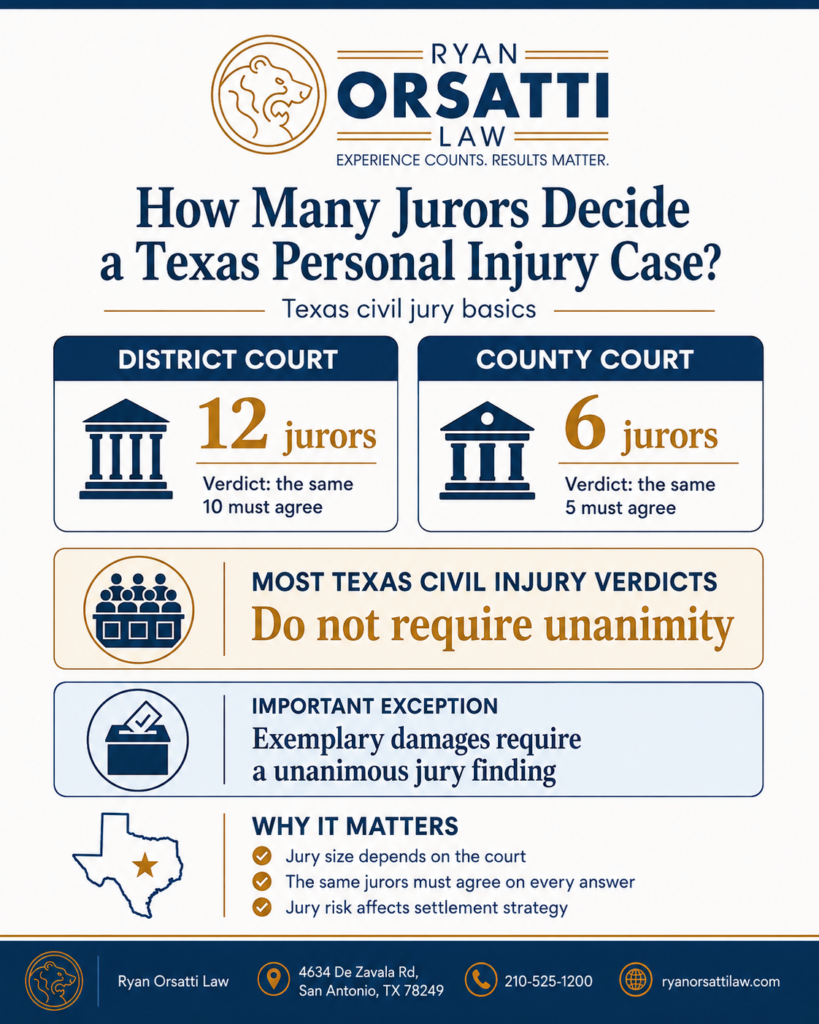
How Many Jurors Decide a Texas Personal Injury Case?
A Texas personal injury case is usually decided by 12 jurors in district court or 6 jurors in county court. The Texas Judicial Branch explains that district court jury trials consist of 12 jurors, while county courts, probate courts, justice courts, and municipal courts use 6 jurors. (Texas Judicial Branch)
That distinction matters because serious car crash, truck crash, wrongful death, catastrophic injury, and premises liability lawsuits are often filed in district court, especially when the damages are significant. Smaller civil cases may be filed in county court or another court with a 6-person jury, depending on the amount in controversy, parties, venue, and case type.
| Court type | Typical Texas civil jury size | Number usually needed for verdict | What it means in an injury case |
|---|---|---|---|
| District court | 12 jurors | Same 10 jurors | Common forum for serious personal injury and wrongful death lawsuits |
| County court | 6 jurors | Same 5 jurors | May apply in smaller civil injury cases or county-court-at-law cases |
| Texas federal court | 6 to 12 jurors | Usually unanimous unless stipulated otherwise | May apply in diversity cases, federal-question cases, or removed cases |
Key takeaway: In most Texas state personal injury trials, the real decision threshold is not “all jurors agree”; it is usually the same 10 of 12 in district court or the same 5 of 6 in county court.
Does a Texas Civil Injury Jury Have to Be Unanimous?
A Texas civil injury jury usually does not have to be unanimous to decide ordinary negligence, fault, and compensatory damages. Texas Rule of Civil Procedure 292 allows a verdict by the same 10 or more members of an original 12-person jury, or the same 5 or more members of an original 6-person jury.
This surprises many injured people because criminal cases are different. The Texas Judicial Branch states that criminal verdicts require unanimity, while civil trials require agreement of five-sixths of the jurors. (Texas Judicial Branch)
In a Texas injury case, that means a plaintiff may win even if two district-court jurors disagree. It also means a defendant may defeat or reduce a claim without persuading every juror.
What Does “Same 10 Jurors” Mean in Texas?
“Same 10 jurors” means the same group of 10 jurors must agree on every answer needed for the verdict. A Texas civil jury cannot have one group of 10 agree on negligence, a different group of 10 agree on damages, and another group agree on fault percentages.
This is why the jury charge is so important. The “charge” is the written set of questions, definitions, and instructions the judge gives the jury. In personal injury cases, those questions can decide negligence, proximate cause, percentage of responsibility, past medical expenses, future medical expenses, lost earning capacity, pain, impairment, disfigurement, and other damages.
What Questions Does a Texas Personal Injury Jury Answer?
A Texas personal injury jury usually answers questions about negligence, causation, percentage of responsibility, and damages. Texas Rule of Civil Procedure 277 says the court should submit broad-form questions when feasible and, when loss must be apportioned, ask what percentage of negligence or causation is attributable to each responsible person.
For an injured plaintiff, the verdict is not just one question. A jury may have to decide whether the defendant was negligent, whether that negligence caused the injury, whether the plaintiff was also partly at fault, and how much money fairly compensates the proven damages.
Common jury questions in a Texas injury case include:
- Did the defendant’s negligence proximately cause the occurrence or injury?
- Did the plaintiff’s negligence also proximately cause the occurrence or injury?
- What percentage of responsibility should be assigned to each person?
- What amount would fairly compensate the plaintiff for proven damages?
- Were future damages proven with enough evidence?
- In rare cases, were exemplary damages proven by clear and convincing evidence?
Comparative responsibility means Texas can reduce a plaintiff’s recovery by the plaintiff’s percentage of fault. Under Texas Civil Practice & Remedies Code § 33.001, a claimant may not recover damages if their percentage of responsibility is greater than 50 percent. (Texas Statutes)
Why Can 10 Jurors Control the Outcome of a Serious Injury Case?
In Texas district court, 10 jurors can control the outcome because civil verdicts usually require five-sixths agreement, not unanimity. That makes each juror important, but it also means two holdout jurors usually cannot block a verdict in an ordinary negligence case.
For plaintiffs, this cuts both ways. A strong case may survive disagreement from one or two skeptical jurors. But a defense verdict or reduced damages finding can also stand if the defense persuades the same 10 jurors on the key questions.
That is why trial preparation starts well before the courthouse. Medical records, crash reports, photos, witness statements, deposition testimony, treating doctor opinions, lost-wage proof, and daily-life impact evidence all matter because jurors decide facts based on admissible evidence, not insurance claim paperwork.
Attorney Insight: In injury cases, jurors often look for consistency. They compare what the plaintiff said at the scene, what appears in the medical records, what was said in deposition, and what is argued at trial. Gaps in treatment, vague pain descriptions, missing photos, and unclear wage proof give the defense room to argue that the evidence does not support the damages number.
How Often Do Texas Civil Cases Actually Reach a Jury?
Most Texas civil cases do not end with a jury verdict. In fiscal year 2025, Texas district and statutory county courts reported 905 final judgments by jury verdict out of 458,794 total civil case dispositions, which is roughly 0.2 percent; the same report listed 1,391 cases in which a jury was selected. (Texas Judicial Branch)
That statistic does not mean jury trial preparation is unimportant. It means the possibility of a jury often shapes the case even when the case resolves before verdict. Insurance adjusters, defense lawyers, mediators, and plaintiffs’ lawyers all evaluate what a Bexar County or Texas jury might do with the evidence.
For an injured person in San Antonio, the question is not only “Will my case go to trial?” The better question is “How would a jury likely view fault, treatment, credibility, damages, and responsibility if the case does not settle?”
Ryan Orsatti Law helps injured people in San Antonio and across Texas evaluate those trial risks in car wrecks, 18-wheeler crashes, wrongful death claims, premises cases, and other serious injury matters. You can learn more about the firm’s injury focus on its Texas personal injury law overview and About Ryan Orsatti Law pages.
What Happens During Jury Selection in a Texas Injury Case?
Jury selection, called voir dire, is the process where lawyers and the court question potential jurors before the final jury is seated. In a Texas civil district court case, each party generally receives 6 peremptory challenges, and in county court, each party generally receives 3.
A peremptory challenge is a strike a lawyer may use to remove a potential juror without stating a reason, subject to constitutional limits. A challenge for cause is different. It asks the judge to remove a potential juror because the person cannot follow the law, cannot be fair, has a disqualifying bias, or is otherwise legally unfit to serve.
Jury selection matters because personal injury cases often involve strong opinions about lawsuits, insurance claims, medical treatment, pain, personal responsibility, corporations, trucking companies, damages, and attorney advertising. The goal is not to find jurors who already favor one side. The goal is to seat a fair jury that can follow the court’s instructions and decide the case on evidence.
Can a Texas Jury Award Punitive Damages Without Everyone Agreeing?
No. Texas exemplary damages require unanimity. Texas Rule of Civil Procedure 292 states that a verdict awarding exemplary damages may be rendered only if the jury was unanimous in finding liability for and the amount of exemplary damages, and Texas Civil Practice & Remedies Code § 41.003 contains the same unanimity requirement.
Exemplary damages are damages meant to punish or deter, not compensate for medical bills or pain. They are not available in every injury case. In Texas, they generally require proof by clear and convincing evidence of fraud, malice, or gross negligence.
For example, an ordinary rear-end crash may involve negligence but not exemplary damages. A drunk driving death, a trucking company knowingly violating safety rules, or a company consciously disregarding a serious known danger may raise different questions, depending on the evidence.
What Should Injured Texans Do If Their Case May Go Before a Jury?
If your injury case may be decided by a Texas jury, protect the evidence early and make sure the legal deadlines are not missed. Texas Rule of Civil Procedure 216 requires a written jury request a reasonable time before trial, but not less than 30 days in advance, and most Texas personal injury lawsuits have a two-year filing deadline under Texas Civil Practice & Remedies Code § 16.003.
Use this practical checklist after a serious injury:
- Get medical care and follow the treatment plan. Jurors often compare claimed injuries against medical records.
- Save crash photos, scene photos, vehicle photos, and injury photos. Visual evidence helps jurors understand what happened.
- Do not rely only on the insurance claim number. A claim is not the same thing as a filed lawsuit.
- Preserve names and numbers for witnesses. Witnesses may move, forget details, or become hard to locate.
- Keep wage-loss documents. Pay stubs, tax records, employer letters, and missed-work notes matter.
- Avoid recorded statements without understanding the risk. Insurance questions can affect fault and damages disputes.
- Track daily limitations. Notes about sleep, work, childcare, driving, lifting, and hobbies can support human damages.
- Talk to a Texas injury lawyer before the deadline gets close. Trial strategy, jury demand timing, evidence preservation, and settlement posture all take time.
For fatal injury cases, the jury issues can become more complex because wrongful death beneficiaries, survival claims, estate issues, and causation evidence may all affect the verdict. Ryan Orsatti Law has a separate guide on what is needed to prove wrongful death in Texas.
Why Does Jury Risk Affect Settlement Value?
Jury risk affects settlement value because both sides are estimating what real jurors might do with disputed facts. A case with clear liability, consistent treatment, strong medical proof, and credible damages usually presents different risk than a case with delayed care, disputed fault, prior injuries, or uncertain future medical needs.
Insurance companies do not evaluate injury claims in a vacuum. They look at venue, witnesses, medical documentation, causation arguments, policy limits, plaintiff credibility, defense themes, and what a jury might award. In San Antonio and Bexar County cases, local facts can matter, including where the crash happened, how the police report reads, which witnesses are available, and whether the medical story is clear.
Ryan Orsatti Law helps injured people evaluate these issues before mediation, before filing suit, and before trial. The firm’s role is to organize the evidence, identify weaknesses, prepare the client, and present the claim in a way a Texas jury can understand. To ask about a specific injury claim, use the firm’s contact page.
FAQ: Texas Personal Injury Juries
How many jurors are on a Texas personal injury jury?
A Texas personal injury jury usually has 12 jurors in district court and 6 jurors in county court. Serious injury and wrongful death cases are often filed in district court, but the correct court depends on the claim, damages, parties, and venue. The court type determines the starting jury size and the verdict threshold.
Do all 12 jurors have to agree in a Texas personal injury case?
No. In most Texas district court civil injury cases, the same 10 of 12 jurors must agree on every answer in the charge. The jury does not usually have to be unanimous for ordinary negligence and compensatory damages. A different rule applies to exemplary damages, which require unanimous findings.
What does the jury decide in a Texas injury lawsuit?
A Texas injury jury usually decides whether the defendant was negligent, whether that negligence caused the injury, what percentage of responsibility belongs to each person, and what damages were proven. The judge gives the legal instructions, but the jury decides disputed facts based on admitted evidence and the written court charge.
What happens if the jury says I was partly at fault?
If a Texas jury finds you partly at fault, your recovery may be reduced by your percentage of responsibility. If the jury finds you more than 50 percent responsible, Texas Civil Practice & Remedies Code § 33.001 generally bars recovery. That is why fault evidence, witness testimony, photos, and crash reconstruction can matter.
Can one juror block a Texas personal injury verdict?
Usually, one juror cannot block a Texas personal injury verdict in state civil court. In district court, the same 10 of 12 jurors can usually render a verdict. In county court, the same 5 of 6 can usually render a verdict. Federal civil cases may require unanimity unless the parties stipulate otherwise.
Is jury selection important if most injury cases settle?
Yes. Jury selection matters even if the case settles because settlement value often reflects what the parties believe a jury might do. Strong trial preparation can affect mediation, negotiation, and claim evaluation. Lawyers prepare for jurors by testing fault themes, damages proof, medical causation, credibility issues, and likely defense arguments.
Does the jury hear about insurance in a Texas personal injury case?
Usually, the jury does not hear liability insurance evidence to prove negligence. Texas Rule of Evidence 411 says evidence that a person was or was not insured against liability is not admissible to prove whether the person acted negligently or wrongfully, though it may be admitted for certain other purposes.
When should I talk to a lawyer if my case may go to trial?
You should talk to a Texas personal injury lawyer early if fault is disputed, injuries are serious, medical bills are significant, the insurance company requests a recorded statement, or a lawsuit deadline is approaching. Jury issues begin long before trial because evidence preservation, medical documentation, witness statements, and pleadings affect how the case is presented.
Ryan Orsatti Law
4634 De Zavala Rd, San Antonio, TX 78249
Phone: 210-525-1200
ryanorsattilaw.com
This blog is for informational purposes only, not legal advice. Reading it does not create an attorney-client relationship. Past results do not guarantee future results.
Hurt in an accident in San Antonio? Learn how a San Antonio personal injury lawyer can help with your claim. Call 210-525-1200 or request a free consultation.
The firm works on a contingency fee. You pay nothing unless the firm recovers money for you, and that covers case expenses as well as the fee: if there is no recovery, you owe no attorney's fee and no case expenses. Ask for the fee agreement and read the fee and expense section before you sign anything.
Related San Antonio legal resources
Primary legal and public-data sources
- Texas Civil Practice and Remedies Code Chapter 16: limitations
- Texas Civil Practice and Remedies Code Chapter 33: proportionate responsibility
Ryan Orsatti Law
4634 De Zavala Road, San Antonio, TX 78249
General reference links. Consult each source for its current text.