
Quick Answer: After an accident with a stolen vehicle in Texas, the thief is usually the main at-fault driver, but that person may have no usable insurance or assets. Your best recovery options may include your own UM/UIM coverage, PIP, MedPay, collision coverage, or a claim against another party whose negligence made the theft or crash foreseeable. Texas generally gives injured people two years to file most personal injury lawsuits, but government-entity claims can have shorter notice deadlines. Ryan Orsatti Law helps injured people in San Antonio and across Texas evaluate fault, coverage, medical bills, and evidence after stolen-vehicle crashes. (Texas Statutes)
Key Takeaways
- Do not assume the stolen vehicle owner’s insurance will pay. A thief usually is not a permitted driver.
- Check your own policy for UM/UIM, PIP, MedPay, collision, rental, and health-insurance coordination.
- Texas law treats unauthorized use of a vehicle as operating another person’s motor vehicle without effective consent. (Justia Law)
- Vehicle-owner liability depends on facts such as keys left in the vehicle, business practices, prior thefts, pursuit, and foreseeability.
- Call police, get medical care, preserve video quickly, and request the crash report.
- If a police chase or government vehicle is involved, Texas Tort Claims Act notice issues may apply.
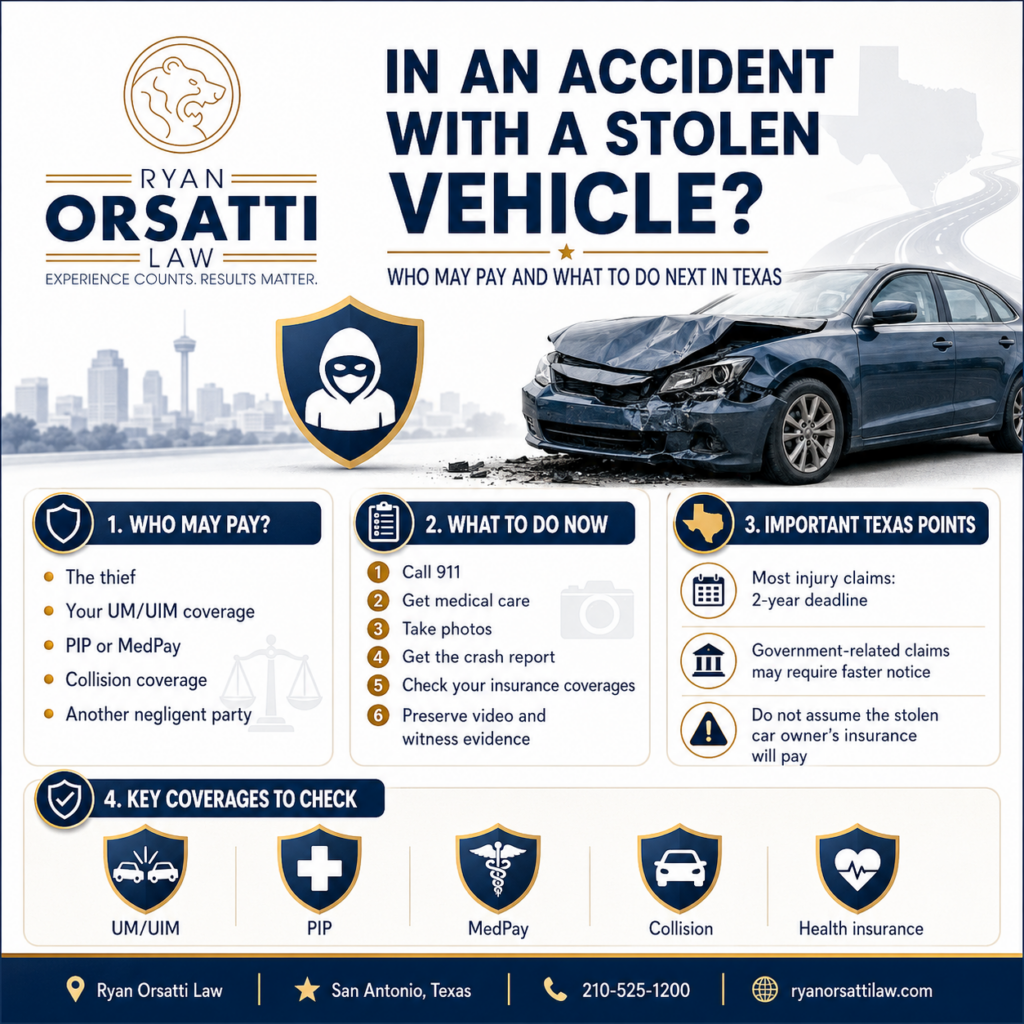
Who Pays After an Accident With a Stolen Vehicle in Texas?
Payment after an accident with a stolen vehicle usually comes from insurance coverage, not from the thief personally. The thief may be legally responsible, but the practical question is whether any collectible insurance, business liability, government liability, crime-victim assistance, or first-party coverage applies.
Texas sees stolen-vehicle issues often. The Texas Department of Motor Vehicles says more than 65,000 cars and trucks are stolen in Texas each year, and TxDOT reported that Texas had 251,977 people injured in motor vehicle traffic crashes in 2024. Those two realities overlap when a stolen vehicle becomes a crash claim. (TxDMV)
| Possible payment source | What it may cover | What to verify quickly |
|---|---|---|
| The thief personally | Injury damages, property damage, restitution | Identity, arrest status, assets, criminal case, collectability |
| Your UM/UIM coverage | Injuries and sometimes property damage caused by an uninsured, underinsured, or hit-and-run driver | Declarations page, policy limits, signed rejection, deductible |
| PIP or MedPay | Medical bills and, for PIP, some lost income or related costs depending on policy terms | Whether coverage exists and whether it was rejected in writing |
| Collision coverage | Repairs or total-loss payment for your vehicle | Deductible, rental coverage, subrogation |
| Stolen vehicle owner or custodian | Possible liability if their own negligence made the theft or reckless escape foreseeable | Permission, keys, prior thefts, business lot procedures, video, witness statements |
| Government entity | Possible claim if a police vehicle, road condition, or government conduct legally contributed | Texas Tort Claims Act notice, city notice rules, immunity issues |
| Crime Victims’ Compensation | Possible help for eligible crime-related costs | Eligibility, police report, other available insurance, OAG application rules |
Key takeaway: In stolen-vehicle crashes, the first insurance denial is not always the end of the claim. The important step is to identify every policy and every party whose conduct may have contributed to the crash.
Is the Stolen Vehicle’s Owner Automatically Liable in Texas?
The stolen vehicle’s owner is not automatically liable in Texas just because their vehicle hit you. A stolen car usually means the driver lacked permission, so the owner’s liability carrier may deny coverage, but the owner or custodian can still be investigated for independent negligence if the theft and dangerous driving were foreseeable.
Texas courts have treated stolen-vehicle liability as a fact-specific question. In Amaya v. Potter, the court considered facts involving unattended running vehicles, a dealership lot, a pursuit, and a crash shortly after the theft; the court found fact issues on foreseeability under those circumstances. (FindLaw)
Negligent entrustment means someone allowed another person to use a vehicle when they knew or should have known that person was unlicensed, incompetent, or reckless. The Texas Supreme Court has described the elements of negligent entrustment in motor-vehicle cases, including entrustment, knowledge, negligent driving, and proximate cause. (Justia Law)
For more on how Texas analyzes owner and driver responsibility, see Ryan Orsatti Law’s guide on owner or driver liability after a Texas car accident.
What Facts Can Make an Owner, Business, or Custodian Part of the Claim?
An owner, business, dealership, repair shop, valet company, employer, or property operator may become part of the claim if their conduct created a foreseeable risk of theft and injury. The key question is not simply “Who owned the car?” It is “Did someone’s conduct make this crash reasonably predictable?”
Facts that may matter include:
- Whether the vehicle was left running or unlocked
- Whether keys were left inside
- Whether the vehicle was on a dealership, repair, valet, tow, apartment, hotel, or commercial lot
- Whether the business had prior thefts or security complaints
- Whether employees saw suspicious conduct and failed to act reasonably
- Whether anyone chased the stolen vehicle and increased the danger
- Whether the crash happened minutes after the theft and close to the theft location
- Whether video, dispatch logs, GPS data, or witness statements support foreseeability
Texas proportionate responsibility means a jury can assign percentages of fault among responsible parties. Under Texas Civil Practice & Remedies Code § 33.001, a claimant may not recover damages if the claimant’s own percentage of responsibility is greater than 50 percent. (Texas Statutes)
Will My UM/UIM Coverage Pay If a Stolen Car Hits Me?
Your UM/UIM coverage may be one of the most important options after a stolen-vehicle crash because the thief may have no insurance and the stolen vehicle’s insurer may deny permissive-use coverage. UM/UIM means uninsured or underinsured motorist coverage, which is first-party coverage through your own auto policy.
The Texas Department of Insurance explains that UM/UIM coverage can pay for car repairs, property inside the car, rental expenses, medical bills, pain and suffering, and diminished value, and that it also applies to hit-and-run crashes when the other driver cannot be found. TDI also states that insurers must offer UM/UIM coverage and that rejection must be in writing. (Texas Department of Insurance)
A stolen-vehicle crash is not always a classic hit-and-run. Sometimes police identify the thief. Sometimes the thief flees and is never found. Sometimes the stolen vehicle is recovered at the scene, but the driver runs. Those differences can affect how the insurer classifies the claim, but they do not eliminate the need to review UM/UIM coverage.
For a deeper Texas coverage explanation, see Ryan Orsatti Law’s guide to Texas UM/UIM coverage.
What If I Do Not Have UM/UIM Coverage?
If you do not have UM/UIM coverage, you should still check PIP, MedPay, health insurance, collision coverage, rental coverage, possible business liability, and possible crime-victim assistance. PIP means personal injury protection, a first-party auto coverage that can help with medical expenses and certain lost-income issues depending on the policy.
The Texas Department of Insurance states that PIP and UM/UIM must be offered unless rejected in writing, and TDI’s auto insurance guide explains that collision covers vehicle repairs after a crash while comprehensive coverage covers theft and other non-collision losses. (Texas Department of Insurance)
Subrogation means a health insurer may claim a right to be paid back from a settlement. A hospital lien is a legal claim a hospital may assert against part of a personal injury recovery. These issues matter because the “source of payment” and the “final net recovery” can be very different.
The Texas Attorney General’s Crime Victims’ Compensation Program may help eligible victims with crime-related costs such as medical bills, counseling, and lost wages after a qualifying violent crime. A stolen vehicle alone is a property crime, but an injury crash may involve additional criminal conduct, so ask law enforcement, a victim liaison, or counsel whether the program may apply. (Texas Attorney General)
What Should I Do Immediately After a Stolen-Vehicle Crash in San Antonio?
After a stolen-vehicle crash in San Antonio, call 911, get medical care, document the scene, and preserve evidence before video disappears. Texas law requires immediate notice to law enforcement for crashes involving injury, death, or vehicle damage that prevents normal and safe driving.
In Bexar County and nearby counties such as Comal, Guadalupe, Kendall, Wilson, Atascosa, and Medina, stolen-vehicle crashes can involve multiple agencies. The crash may happen on Loop 410, Loop 1604, I-10, I-35, US-281, a neighborhood street, an apartment complex, or a commercial parking lot. Each location changes what evidence may exist.
- Call 911 and report injuries. Tell dispatch if you heard the vehicle may be stolen, if the driver fled, or if there was a chase.
- Get medical care the same day if you are hurt. Delayed treatment gives insurers an argument that the crash did not cause the injury.
- Photograph vehicles, plates, debris, roadway marks, traffic lights, and the surrounding area.
- Ask officers for the report number and agency name. San Antonio Police, Bexar County Sheriff, DPS, or another agency may investigate depending on location.
- Identify cameras. Look for gas stations, apartment gates, traffic-facing businesses, doorbell cameras, tow yards, and dealership cameras.
- Notify your insurer, but avoid broad recorded statements until you understand the coverage issues.
- Request your declarations page. This shows UM/UIM, PIP, MedPay, collision, comprehensive, and rental coverages.
- Do not rely only on the criminal case. A criminal case may help identify the driver, but your injury claim still needs insurance, medical, and damages evidence.
A law enforcement officer who investigates a qualifying Texas collision must submit a written collision report when the crash involves injury, death, or at least $1,000 in apparent property damage to any one person. TxDOT is the state custodian of crash records and receives Texas Peace Officer’s Crash Reports.
What Evidence Matters Most in a Stolen-Vehicle Accident Claim?
The most important evidence in a stolen-vehicle accident claim is evidence that proves fault, confirms the stolen status, identifies coverage, and connects the crash to your injuries. A police report helps, but it is not enough by itself to resolve liability, insurance, medical causation, liens, or damages.
Evidence to preserve includes:
- CR-3 crash report and incident report
- Theft report and vehicle-recovery records
- 911 audio, CAD logs, dispatch notes, and body-camera footage where available
- Business, traffic, apartment, gas station, and doorbell camera video
- Vehicle plate, VIN, tow-yard, and impound records
- Photos of impact points, skid marks, debris, airbags, and seatbelts
- Witness names, phone numbers, and statements
- Medical records, imaging, prescriptions, referrals, and work restrictions
- Insurance declarations pages and rejection forms for UM/UIM and PIP
- Proof of lost wages, mileage, rental expense, and out-of-pocket costs
Spoliation means the loss, destruction, or failure to preserve important evidence after someone knows a claim is likely. In stolen-vehicle crashes, time-sensitive evidence often includes video, tow-yard photographs, GPS data, impound records, and business security records.
Attorney Insight: In stolen-vehicle crashes, adjusters often focus less on “who caused the impact” and more on “who has collectible coverage.” A police report that says “stolen vehicle” helps, but it is only the start. The stronger file usually ties the crash to medical records, scene photographs, camera locations, dispatch logs, VIN or plate confirmation, and proof of every available policy, including UM/UIM and PIP.
Ryan Orsatti Law helps injured people evaluate these issues as part of a broader San Antonio car accident lawyerinvestigation.
How Long Do I Have to File a Texas Claim After a Stolen-Vehicle Crash?
Texas generally gives injured people two years to file most personal injury and property-damage lawsuits after a stolen-vehicle crash. Wrongful death claims also generally must be filed within two years after the death, but government claims, insurance deadlines, and evidence-preservation deadlines can arise much sooner. (Texas Statutes)
| Issue | Typical timing | Why it matters |
|---|---|---|
| Call 911 for qualifying crash | Immediately | Texas requires immediate notice for injury, death, or a vehicle that cannot be safely driven |
| Officer crash report | Not later than the 10th day after the crash for qualifying investigated crashes | Helps document drivers, vehicles, injuries, insurers, and crash factors |
| Insurance notice | As soon as reasonably possible under your policy | Late notice can create avoidable coverage disputes |
| Video preservation | Often within days | Many businesses overwrite footage quickly |
| Texas personal injury lawsuit | Usually two years | Missing the limitation deadline can bar the claim |
| Government-entity notice | Not later than six months under Texas CPRC § 101.101, and sometimes shorter by local rule | Police chase, road, or public-vehicle facts can create special notice issues |
Key takeaway: The lawsuit deadline may be two years, but stolen-vehicle evidence and insurance coverage opportunities can weaken within days.
If a police chase, public vehicle, road defect, or government employee may have contributed to the crash, the Texas Tort Claims Act notice rule should be reviewed quickly. Texas Civil Practice & Remedies Code § 101.101 gives governmental units notice rights not later than six months after the incident, and city charter or ordinance provisions may matter. (Texas Legislature Online)
How Does Ryan Orsatti Law Help After an Accident With a Stolen Vehicle?
Ryan Orsatti Law helps injured people in San Antonio and across Texas identify fault, coverage, evidence, medical-documentation issues, and insurer defenses after stolen-vehicle crashes. These cases often require more than a standard car accident claim because the owner’s insurer, the thief, your own insurer, and possible third parties may all point fingers.
The firm’s work may include:
- Reviewing the crash report, theft report, and criminal-case status
- Identifying all available auto policies and rejection forms
- Evaluating UM/UIM, PIP, MedPay, collision, and health-insurance coordination
- Sending preservation letters to businesses, apartment complexes, tow yards, and vehicle custodians
- Investigating whether a business, vehicle custodian, or pursuit increased the danger
- Organizing medical records, bills, work restrictions, and future-care documentation
- Addressing hospital liens, subrogation claims, and net-to-client issues
- Communicating with insurers so the injured person is not pushed into an incomplete early statement
If the driver fled or was never identified, Ryan Orsatti Law’s San Antonio hit-and-run accident lawyer page may also be useful. If the crash caused a death, families can review the firm’s San Antonio wrongful death lawyer information.
FAQs About Accidents With Stolen Vehicles in Texas
These FAQs answer common questions Texans ask after a stolen car, truck, or SUV causes a crash.
Can I Sue the Person Who Stole the Car and Hit Me in Texas?
Yes, you can sue the person who stole the car if that person caused your injuries, but collectability may be a serious problem. A civil judgment is only useful if there is insurance, assets, wages, restitution, or another practical recovery path. That is why UM/UIM, PIP, collision coverage, and third-party liability should be reviewed early.
Does the Stolen Car Owner’s Insurance Have to Pay for My Injuries?
Not automatically. A stolen vehicle usually means the driver did not have permission, and the owner’s insurer may deny liability coverage on that basis. The owner or custodian can still be investigated if their own conduct made the theft and crash foreseeable, such as leaving a running vehicle unattended in a high-risk commercial setting.
Is a Stolen-Vehicle Crash the Same as a Hit-and-Run Claim?
Sometimes, but not always. A stolen-vehicle crash becomes similar to a hit-and-run claim if the driver flees and cannot be identified or insured. If police identify the thief, the claim may still function like an uninsured-driver case because the thief may have no usable liability coverage or assets.
What Insurance Should I Check After Being Hit by a Stolen Vehicle in Texas?
Check UM/UIM, PIP, MedPay, collision, rental reimbursement, and health insurance. Also ask for your declarations page and any signed rejection forms for UM/UIM or PIP. TDI explains that UM/UIM can apply to hit-and-run and uninsured-driver situations, and Texas insurers must offer UM/UIM unless it is rejected in writing. (Texas Department of Insurance)
What If the Stolen Vehicle Crash Happened During a Police Chase in San Antonio?
A police-chase crash requires immediate review because government-entity rules may apply. These cases can involve sovereign immunity, emergency-response defenses, body-camera footage, dash-camera footage, dispatch logs, pursuit policy, and Texas Tort Claims Act notice. The general Texas notice period can be no later than six months, but local notice provisions may also matter. (Texas Legislature Online)
What If My Own Car Was Stolen and Then Used in a Crash?
If your car was stolen and used in a crash, report the theft immediately, cooperate with law enforcement, notify your insurer, and preserve proof that you did not give permission. Your comprehensive coverage may help with your vehicle theft or damage, but liability claims from injured third parties will depend on permission, policy language, and any alleged negligence by you.
How Soon Should I Talk to a Texas Personal Injury Lawyer After a Stolen-Vehicle Accident?
You should talk to a Texas personal injury lawyer as soon as serious injury, disputed coverage, missing video, a police chase, a commercial lot, or UM/UIM issues appear. Stolen-vehicle cases can turn on evidence that disappears quickly, including camera footage, dispatch logs, tow records, and proof of insurance rejection forms.
Ryan Orsatti Law
4634 De Zavala Rd, San Antonio, TX 78249
Phone: 210-525-1200
ryanorsattilaw.com
This blog is for informational purposes only, not legal advice. Reading it does not create an attorney-client relationship. Past results do not guarantee future results.
Hurt in an accident in San Antonio? Learn how a San Antonio car accident lawyer can help with your claim. Call 210-525-1200 or request a free consultation.
The firm works on a contingency fee. You pay nothing unless the firm recovers money for you, and that covers case expenses as well as the fee: if there is no recovery, you owe no attorney's fee and no case expenses. Ask for the fee agreement and read the fee and expense section before you sign anything.
Related San Antonio legal resources
Primary legal and public-data sources
- TxDOT: Texas crash reports, data, and statistics
- Texas Civil Practice and Remedies Code Chapter 33: proportionate responsibility
Ryan Orsatti Law
4634 De Zavala Road, San Antonio, TX 78249
General reference links. Consult each source for its current text.