
If you were the middle vehicle in a 3-car pileup in San Antonio or elsewhere in Texas, fault is not automatic just because your car also struck the vehicle in front.
Quick Answer
In Texas, the middle driver is often not at fault if the rear vehicle hit them first and pushed them into the car ahead. Texas drivers have a duty to maintain an assured clear distance, and Texas law also allows fault to be divided among multiple people when more than one driver contributed to the crash. (Texas Statutes)
But the middle driver can still share fault if the evidence shows they were following too closely, distracted, changed lanes unsafely, or hit the front vehicle before the rear impact happened. Texas uses proportionate responsibility: if you are more than 50% responsible, you generally cannot recover damages; if you are not barred from recovery, your damages are reduced under the statute. (Texas Statutes)
In other words, the real question is usually impact sequence:
- Did the rear driver start the chain reaction?
- Did the middle car independently cause a front-end impact before being hit from behind?
- Is there evidence that more than one driver contributed? (Texas Statutes)
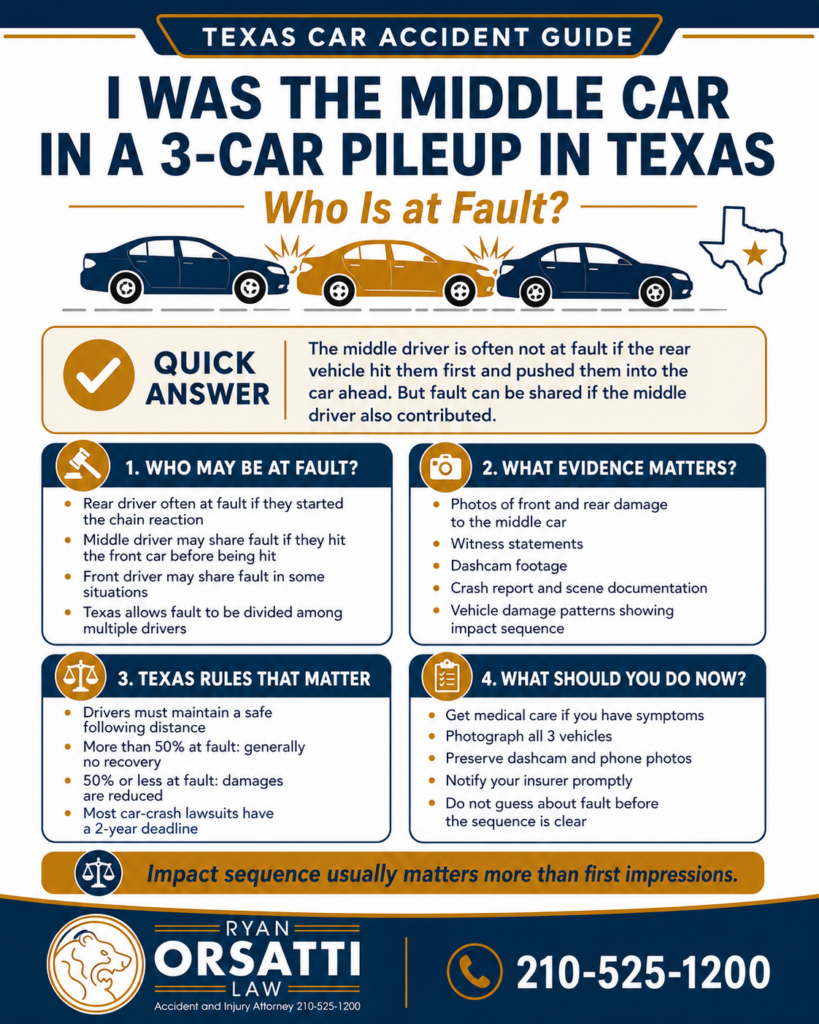
How fault is usually analyzed in a 3-car pileup
Texas law looks at what each driver did or failed to do. A driver following another vehicle must leave enough distance to stop safely, and Texas law allows a judge or jury to assign percentages of fault among the people who caused or contributed to the crash. (Texas Statutes)
| Scenario | Likely fault picture | Why it matters |
|---|---|---|
| Rear driver hits the middle car, and the middle car is shoved into the front car | Rear driver may bear most or all fault | The middle car may have hit the front vehicle only because of the rear impact |
| Middle car hits the front car before the rear impact | Middle driver may share fault or carry fault for some damage | This can create two separate impacts instead of one chain reaction |
| Rear driver and middle driver were both too close | Fault may be split | Texas allows fault allocation among multiple drivers |
| Front driver made an unsafe sudden move and the other drivers could not react reasonably | Front driver may also share fault if the evidence supports it | Texas fault allocation is evidence-driven, not automatic |
| The facts are disputed and each insurer tells a different story | Fault may stay contested until vehicle damage, witness statements, photos, and other evidence are reviewed | In pileup cases, timing usually matters more than first impressions |
That framework comes from Texas’s following-distance rule and its proportionate-responsibility statutes. (Texas Statutes)
Is the middle car automatically at fault because it hit the front car?
No.
That is one of the most common misunderstandings in chain-reaction crashes. The fact that your front bumper hit the car ahead does not automatically mean you caused that impact. If the rear vehicle forced your car forward, the rear driver may be the one who caused both collisions. On the other hand, if you had already rear-ended the front vehicle before the third car ever touched you, then the analysis changes. (Texas Statutes)
What evidence usually decides the middle-car issue?
In a 3-car crash, the best evidence usually answers one question: what happened first?
Useful evidence often includes:
- Photos showing damage to the front and rear of the middle vehicle
- The spacing and damage to all three vehicles
- Witness statements about which impact happened first
- Dashcam footage
- 911 audio and scene documentation
- Vehicle data, when available
- Repair estimates and damage patterns that help show whether the middle vehicle was pushed forward or made an independent impact first
Attorney Insight
In real pileup cases, insurers sometimes try to simplify the crash into “the middle car hit the front car, so the middle car must be at fault.” That shortcut misses the real issue. The key question is usually whether the middle vehicle made an independent impact or whether it was propelled forward by the rear driver. The damage pattern, timing, and witness accounts often matter more than a rushed roadside statement.
Can all three drivers share fault in Texas?
Yes.
Texas law specifically allows fault to be divided among multiple participants whose conduct caused or contributed to the harm. That means a 3-car pileup can involve fault percentages for the middle driver, the rear driver, the front driver, or some combination of them if the evidence supports it. (Texas Statutes)
That matters because settlement value and lawsuit strategy can change significantly when more than one driver is blamed.
Can I still make a claim if I was the middle car?
Usually, yes.
If another driver caused all or part of the chain-reaction crash, you may still have claims for:
- Medical expenses
- Lost income
- Vehicle damage
- Physical pain and impairment
- Other accident-related losses, depending on the facts
Even when liability is disputed, the middle driver may still pursue a claim. The main issue is whether the evidence shows the middle driver caused the front-end impact independently, or was pushed into it.
How insurance usually works in a Texas 3-car pileup
Insurance in a pileup can get messy fast because there may be multiple claim numbers, multiple adjusters, and limited policy money.
Texas requires minimum liability coverage of 30/60/25, and the Texas Department of Insurance specifically warns that minimum limits may be too low in a multi-vehicle crash. Texas also requires insurers to include PIP coverage unless it was rejected in writing; TDI explains that PIP can help with medical bills, lost wages, and some nonmedical costs, while MedPay can help with medical bills, and UM/UIM coverage can matter if the at-fault driver had no insurance or not enough insurance. (Texas Department of Insurance)
A practical way to think about it is this:
| Coverage | What it may help with | Why it matters in a 3-car pileup |
|---|---|---|
| At-fault driver’s liability coverage | Your bodily injury and property damage claims | This is the usual starting point if another driver caused the crash |
| Your collision coverage | Repairing your vehicle, subject to your policy terms and deductible | It may get your car handled faster while fault is still disputed |
| Your PIP coverage | Medical bills, lost wages, and some nonmedical costs | It can help regardless of fault if you have it |
| Your MedPay coverage | Medical bills | It may help with immediate treatment expenses |
| Your UM/UIM coverage | Losses caused by an uninsured or underinsured driver | Important when minimum limits are not enough |
What should I do right after a 3-car pileup?
If you are the middle driver, do these things as early as possible:
- Get checked medically, even if symptoms seem delayed
- Call law enforcement and make sure the crash is documented
- Take photos of all three vehicles, not just your own
- Photograph the front and rear damage to your car
- Get witness names and contact information
- Preserve dashcam footage and phone photos immediately
- Notify your own insurance company promptly
- Avoid guessing about fault before you understand the impact sequence
- Do not let your vehicle get repaired before the damage is fully documented
If you are making a claim on your own Texas auto policy, TDI says the insurer generally must acknowledge the claim within 15 days, decide within 15 business days after getting what it needs, and pay within 5 business days after approval, subject to limited extensions. (Texas Department of Insurance)
Common mistakes middle drivers make
Some of the most damaging mistakes happen in the first few days:
- Saying “I hit the car in front, so I must be at fault” before the sequence is understood
- Taking only rear-damage photos and forgetting front-end damage
- Failing to identify independent witnesses
- Repairing the vehicle before preserving evidence
- Treating the case like a simple rear-end claim when there may be multiple liable parties
- Waiting too long to address injuries or document symptoms
What does representation usually look like in a disputed 3-car case?
A disputed middle-car case usually involves more investigation than a straightforward 2-car rear-end crash.
That often means:
- Gathering the crash report, photos, witness information, and insurance details
- Pinning down the impact sequence
- Reviewing vehicle damage and repair records
- Identifying all available insurance coverages
- Separating property-damage issues from injury issues
- Presenting the claim only after the liability picture is clear enough to do it properly
In more serious cases, it may also mean preserving additional evidence early, especially when the insurers start pointing fingers at each other.
How long do I have to file a lawsuit in Texas?
In most Texas car-crash cases, the general limitations period is two years from the date of the injury. Missing that deadline can seriously damage or eliminate your claim. (Texas Statutes)
Because pileup cases can involve multiple insurers and shifting blame, it is usually better to investigate early rather than wait until the deadline is close.
FAQs
Is the rear driver always at fault in a 3-car pileup?
Not always, but rear drivers are often blamed because Texas requires drivers to maintain a safe following distance. Fault can still be divided if the evidence shows the middle or front driver also contributed. (Texas Statutes)
If I was pushed into the car in front of me, can I still recover?
Often, yes. If you did not independently cause the front-end impact, the rear driver may be responsible for pushing you into the front vehicle. Texas also allows fault to be divided rather than treated as all-or-nothing. (Texas Statutes)
What if the other insurer says I was following too closely?
That does not end the case. It means the insurer is trying to assign part of the fault to you. The outcome usually turns on evidence about timing, speed, distance, and whether you were pushed forward by the rear impact. (Texas Statutes)
What if the at-fault driver only has minimum coverage?
That is a real problem in multi-vehicle crashes. TDI warns that minimum Texas liability limits may be too low in a multi-vehicle accident, which is why your own PIP, collision, MedPay, or UM/UIM coverage may become important. (Texas Department of Insurance)
Do I have PIP in Texas?
Usually yes, unless it was rejected in writing. Texas law requires PIP to be provided unless a named insured rejects it in writing, and TDI explains that PIP can help with medical bills, lost wages, and certain nonmedical costs. (Texas Statutes)
Relevant Texas Sources
- Texas Transportation Code § 545.062 (following distance) (Texas Statutes)
- Texas Civil Practice and Remedies Code §§ 33.001, 33.003, 33.012 (fault allocation and recovery rules) (Texas Statutes)
- Texas Civil Practice and Remedies Code § 16.003 (general two-year limitations period) (Texas Statutes)
- Texas Department of Insurance auto insurance guide and Consumer Bill of Rights (minimum limits, PIP, MedPay, UM/UIM, and certain claim deadlines) (Texas Department of Insurance)
When to talk to a lawyer
If you were the middle car and any of these are true, it is worth getting the case reviewed:
- You have injury symptoms beyond a few days
- The insurers disagree about who caused what
- The crash involved significant front and rear damage
- You are being blamed for hitting the front car
- Multiple vehicles or multiple insurance policies are involved
- Available insurance may be limited
A pileup claim can look simple at first and still become complicated once the adjusters start allocating blame.
Ryan Orsatti Law
4634 De Zavala Rd, San Antonio, TX 78249
Phone: 210-525-1200
This blog is for informational purposes only, not legal advice. Reading it does not create an attorney-client relationship. Past results do not guarantee future results.
Hurt in an accident in San Antonio? Learn how a San Antonio car accident lawyer can help with your claim. Call 210-525-1200 or request a free consultation.
The firm works on a contingency fee. You pay nothing unless the firm recovers money for you, and that covers case expenses as well as the fee: if there is no recovery, you owe no attorney's fee and no case expenses. Ask for the fee agreement and read the fee and expense section before you sign anything.
Related San Antonio legal resources
Primary legal and public-data sources
- TxDOT: Texas crash reports, data, and statistics
- Texas Civil Practice and Remedies Code Chapter 33: proportionate responsibility
Ryan Orsatti Law
4634 De Zavala Road, San Antonio, TX 78249
General reference links. Consult each source for its current text.