
Quick Answer: You should consider hiring a lawyer after a minor car accident in San Antonio if you have pain, delayed symptoms, a fault dispute, an early settlement offer, a missing police report, or any issue with insurance coverage. Texas generally gives injured people two years to file a personal injury lawsuit under Texas Civil Practice & Remedies Code § 16.003, but evidence and some notice deadlines can move much faster. Ryan Orsatti Law helps injured people in San Antonio and across Texas evaluate fault, coverage, medical documentation, and settlement timing before rights are affected. (Texas Statutes)
Key Takeaways
- A “minor” crash can still create a real injury claim if symptoms appear later or the insurance company disputes causation.
- Texas fault rules matter. If you are found more than 50% responsible, you may be barred from recovery under Texas proportionate responsibility law.
- A true property-damage-only claim with clear fault and fair payment may not require a lawyer.
- Do not settle an injury claim until you understand your diagnosis, treatment plan, liens, insurance coverage, and lost-income issues.
- In San Antonio, crash evidence can disappear quickly, including dashcam footage, business surveillance video, witness memory, and vehicle damage evidence.
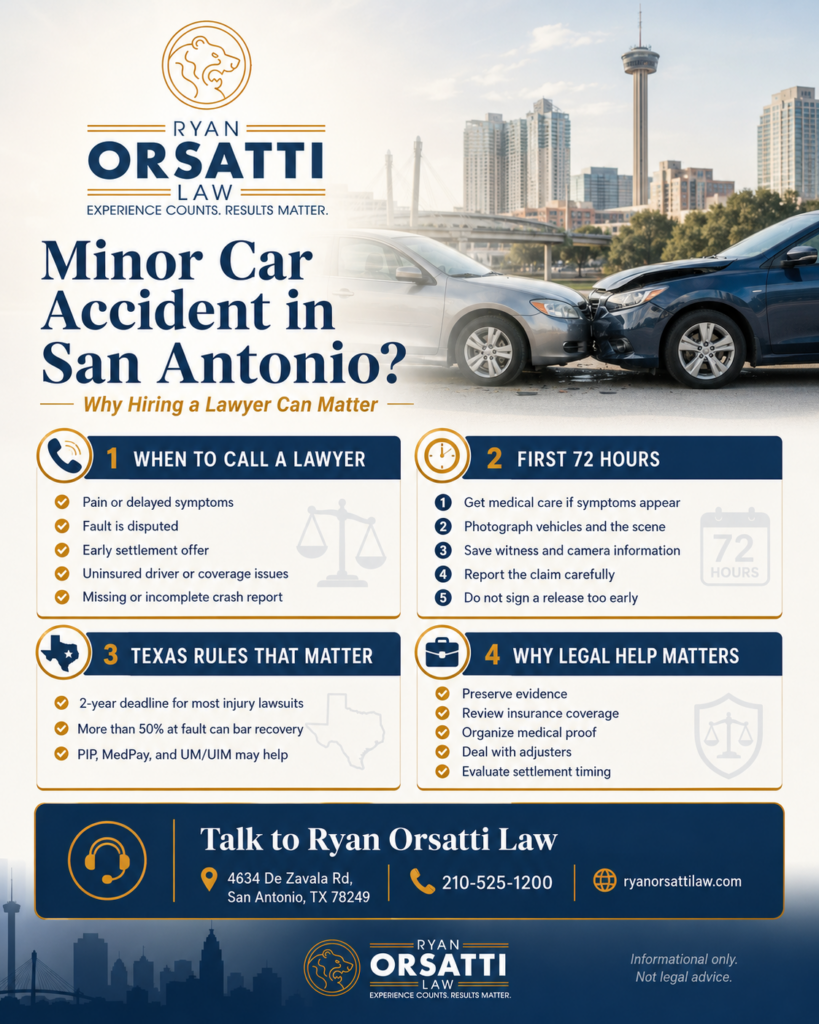
What counts as a minor car accident in San Antonio?
A minor car accident in San Antonio usually means the vehicle damage looks modest, traffic continues moving, and no one appears to have a life-threatening injury at the scene. That label can be misleading because TxDOT reported 39,805 reportable crashes in San Antonio in 2024, including 6,089 suspected minor-injury crashes and 5,286 possible-injury crashes, based on CR-3 reports processed as of April 9, 2025. (Texas Department of Transportation)
Insurance companies do not evaluate a claim only by the word “minor.” They look at fault, medical records, treatment timing, repair documentation, prior conditions, coverage limits, and whether your symptoms are connected to the wreck.
In real San Antonio claims, a low-speed rear-end crash on Loop 410, I-10, US-281, I-35, or Loop 1604 can still become contested if the other driver changes the story, the police report is incomplete, or pain becomes worse after the first day.
Why should I hire a lawyer after a minor car accident in San Antonio?
You should hire a lawyer after a minor car accident in San Antonio when the crash creates legal, medical, or insurance issues that are hard to evaluate alone. A lawyer can review fault, preserve evidence, identify available insurance coverage, help organize medical proof, and evaluate whether a settlement offer accounts for the full claim.
A lawyer is not necessary for every fender-bender. If there are no injuries, liability is accepted, the property damage is paid fairly, and no coverage issue exists, you may be able to handle the claim yourself.
A lawyer becomes more important when the insurance company says the impact was “too small” to cause injury, asks for a broad recorded statement, delays payment, disputes treatment, blames you, or offers money before your medical condition is clear.
When is a minor crash no longer simple?
A minor crash is no longer simple when there is an injury, a fault dispute, a commercial vehicle, a rideshare driver, an uninsured driver, a city or county vehicle, or a settlement offer that requires you to release future claims. In Texas, comparative responsibility means your recovery can be reduced by your percentage of fault, and a claimant may be barred if found more than 50% responsible. (Texas Statutes)
Watch for these warning signs:
- Neck, back, shoulder, wrist, knee, or head pain after the crash
- Pain that worsens after the first 24 to 72 hours
- The other driver denies fault after initially apologizing
- The police report is missing, delayed, or incomplete
- The adjuster asks for a recorded statement before you know your diagnosis
- The repair estimate is higher than expected
- The insurer offers a quick settlement before treatment is finished
- You missed work or may need follow-up care
When can you probably handle a minor car accident without a lawyer?
You can probably handle a minor car accident without a lawyer when it is truly property-damage-only, liability is clear, the insurer accepts responsibility, the repair or total-loss payment is reasonable, and you have no pain or lost income. Even then, do not sign a bodily injury release if you are unsure whether you are hurt.
| Situation after the crash | Lawyer review is usually more important if… | Practical next step |
|---|---|---|
| No injury and only cosmetic vehicle damage | The insurer accepts fault and pays repairs fairly | Keep photos, estimates, and payment records |
| Mild pain after the crash | Symptoms last more than a day or affect work, sleep, or daily activity | Get medical evaluation and document symptoms |
| Fault seems obvious | The other driver later changes the story or the report is incomplete | Preserve photos, witnesses, dashcam, and repair evidence |
| No police report | There is injury, disputed fault, or the vehicle was not safely drivable | Check whether a CR-3 exists through TxDOT |
| Early settlement offer | You have not finished treatment or do not know your diagnosis | Do not sign a release until the claim is evaluated |
| Government vehicle involved | A city, county, school district, or state employee may be involved | Check notice deadlines immediately |
Key takeaway: The issue is not whether the crash looked minor at the scene. The issue is whether injury, fault, coverage, or deadline problems could affect your rights.
What Texas laws affect a minor car accident claim?
Texas law affects minor car accident claims through filing deadlines, fault allocation, crash-report rules, insurance coverage, and medical-bill repayment issues. The main rules to know are the two-year limitations period for most personal injury claims, Texas proportionate responsibility under Chapter 33, and TxDOT crash-report rules for investigated crashes. (Texas Statutes)
Texas Civil Practice & Remedies Code § 16.003 generally requires a personal injury lawsuit to be filed within two years. This is not the same as an insurance claim deadline, and it does not mean you should wait two years to investigate.
Texas Civil Practice & Remedies Code § 33.001 says a claimant may not recover damages if the claimant’s percentage of responsibility is greater than 50%. Section 33.012 also provides that damages are reduced by the claimant’s percentage of responsibility if the claimant is not barred from recovery. (Texas Statutes)
TxDOT is the custodian of Texas crash records. Law enforcement must submit a written crash report to TxDOT not later than the tenth day after a crash if the investigated crash resulted in injury, death, or apparent property damage of $1,000 or more to any one person’s property. (Texas Department of Transportation)
If the crash involves a governmental unit, the timeline can be shorter. Texas Civil Practice & Remedies Code § 101.101 generally gives a governmental unit the right to notice of a claim not later than six months after the incident, and city charter or ordinance provisions may impose specific notice rules. (Texas Legislature Online)
What should you do in the first 72 hours after a minor car accident?
The first 72 hours after a minor car accident should be used to protect your health, document the scene, identify insurance coverage, and avoid statements that could be used out of context. This window matters because physical symptoms, vehicle repairs, surveillance footage, and witness memory can all change quickly.
- Get medical attention if you have pain, dizziness, numbness, headaches, or any worsening symptom. Tell the provider exactly when the crash happened and what symptoms started afterward.
- Photograph both vehicles before repairs. Include wide shots, close-ups, license plates, airbags, car seats, debris, skid marks, and the full roadway.
- Save the other driver’s information. Keep the driver’s license, insurance card, plate number, vehicle photos, and any employer or company markings.
- Look for witnesses and cameras. Nearby businesses, homes, rideshare vehicles, dashcams, and parking-lot cameras may have useful footage.
- Request the crash report if law enforcement responded. TxDOT allows eligible people to obtain a Texas Peace Officer’s Crash Report, also called a CR-3, through its crash report system. (Texas Department of Transportation)
- Notify your own insurance company. Report the crash, but avoid guessing about injuries or fault.
- Do not sign a release too early. A release can end your claim before you know your diagnosis, future treatment needs, lost wages, or lien issues.
- Talk to a lawyer if any injury, dispute, or coverage issue appears. Early review is often more useful than trying to fix a damaged claim later.
Should you give a recorded statement after a minor crash?
You should be cautious about giving a recorded statement to the other driver’s insurance company after a minor crash. You can report basic facts, but recorded answers about speed, pain level, prior injuries, fault, or whether you are “fine” may be used later if symptoms develop.
Your own insurance policy may require cooperation with your insurer, but the other driver’s insurer does not represent you. Before giving a recorded statement, it is reasonable to understand the police report, your symptoms, available coverage, and whether liability is being disputed.
What evidence matters when the damage looks small?
The evidence that matters most in a minor-damage crash is the evidence that proves fault, injury timing, vehicle movement, and how the crash affected your daily life. Insurance companies often compare photos, repair estimates, medical records, and statements to decide whether they believe the injury is related to the collision.
Helpful evidence includes:
- Scene photos from multiple angles
- Vehicle photos before repairs
- Body-shop estimates and supplement records
- Airbag, sensor, or diagnostic information when available
- Dashcam or surveillance footage
- Witness names and phone numbers
- CR-3 crash report
- ER, urgent care, primary care, chiropractic, orthopedic, imaging, or therapy records
- Work notes, missed-shift records, and wage documentation
- A short symptom diary showing pain levels, sleep disruption, and activity limits
- Receipts for prescriptions, braces, mileage, towing, rental, rideshare, or out-of-pocket costs
TxDOT no longer retains Driver’s Crash Reports, previously called CR-2 forms, and does not provide copies of them. If a minor crash was not investigated by law enforcement, your own photos, notes, witness information, and claim records become more important. (Texas Department of Transportation)
How do insurance companies evaluate minor car accident claims?
Insurance companies evaluate minor car accident claims by looking for proof of fault, proof of injury, treatment timing, consistency, prior medical history, and coverage limits. A claim with clear liability and consistent medical documentation is usually evaluated differently from a claim with delayed treatment, conflicting statements, or disputed crash mechanics.
The Texas Department of Insurance explains that minimum Texas liability coverage is 30/60/25, meaning at least $30,000 for injuries per person, $60,000 total per accident, and $25,000 for property damage. TDI also explains that Texas auto policies include personal injury protection unless rejected in writing, and insurers must offer uninsured/underinsured motorist coverage unless rejected in writing. (Texas Department of Insurance)
Attorney Insight: In minor-damage cases, the adjuster often tries to turn the claim into a “mechanism of injury” argument: not enough damage to cause injury. The response is not hype. It is documentation. Clear photos, repair estimates, early medical evaluation, consistent symptom notes, and a timeline explaining delayed pain often matter more than a broad argument about how bad the wreck felt.
How do medical bills get paid after a minor car accident?
Medical bills after a minor car accident may be paid through health insurance, PIP, MedPay, the at-fault driver’s liability coverage, UM/UIM coverage, or a letter of protection. The right order matters because liens, deductibles, reimbursement rights, and settlement terms can affect the net result.
PIP, or personal injury protection, can pay medical bills and some lost income after a crash if available. MedPay usually pays medical bills only. UM/UIM coverage may apply when the at-fault driver has no insurance or not enough insurance. TDI explains that PIP is included in Texas auto policies unless rejected in writing, and UM/UIM must be offered unless rejected in writing. (Texas Department of Insurance)
Subrogation means an insurer may claim a right to repayment from another insurer or from a settlement after paying benefits related to the crash. TDI defines subrogation as the legal right of insurance companies to pursue another person’s insurance company to recover money paid on a claim. (Texas Department of Insurance)
A hospital lien is a legal claim a hospital may assert against part of a personal injury recovery. Under Texas Property Code § 55.002, a hospital may have a lien on a claim for accident-related hospital services when the injury is attributed to another person’s negligence and the statutory requirements are met. (Texas Statutes)
How long does a minor car accident claim take in San Antonio?
A minor car accident claim can take weeks, months, or longer depending on injury recovery, treatment length, fault disputes, insurance coverage, and whether a lawsuit becomes necessary. A property-damage-only claim may move faster, while an injury claim should usually wait until the medical picture is stable enough to evaluate.
For first-party claims with your own insurer, TDI says an insurance company must acknowledge the claim within 15 days after notice, accept or reject the claim within 15 business days after receiving all required information, may take 45 more days if it gives a reason, and must send payment within five business days after agreeing to pay. TDI also notes that the prompt payment law does not apply when the other driver’s insurance company is paying the claim. (Texas Department of Insurance)
That is why third-party injury claims often turn on documentation rather than speed. Before settlement, you generally want to understand diagnosis, treatment plan, lost income, future care, liens, subrogation, available coverage, and whether any comparative responsibility argument exists.
For more on settlement stages, see Ryan Orsatti Law’s guide on how car accident settlements work.
What can Ryan Orsatti Law do after a minor car accident in San Antonio?
Ryan Orsatti Law can review whether a minor San Antonio crash is truly simple or whether injury, fault, insurance, or evidence issues need legal attention. The firm helps injured people evaluate the crash facts, available coverage, medical documentation, repair records, liens, and settlement timing before major claim decisions are made.
A lawyer’s work in a minor crash may include:
- Reviewing the CR-3 crash report and correcting claim misunderstandings
- Preserving dashcam, surveillance, vehicle, and witness evidence
- Evaluating comparative responsibility arguments
- Identifying liability, PIP, MedPay, UM/UIM, and commercial coverage
- Organizing medical records, bills, lost wages, and out-of-pocket losses
- Reviewing liens and subrogation issues before settlement
- Communicating with insurance adjusters
- Preparing the claim for settlement review or litigation if needed
If your “minor” crash is becoming complicated, Ryan Orsatti Law can help you decide whether legal representation makes practical sense. You can also review the firm’s San Antonio car accident lawyer page, the guide on whether you can sue after a car accident in Texas, and the article on signs a simple car accident case is more complicated than it seems.
FAQs About Hiring a Lawyer After a Minor Car Accident in San Antonio
Do I always need a lawyer after a minor car accident in San Antonio?
No. You may not need a lawyer if there is no injury, no lost income, no fault dispute, and the insurer fairly pays the property damage. You should consider a lawyer if you have pain, delayed symptoms, a disputed police report, an early injury settlement offer, uninsured driver issues, or concerns about medical bills.
Can a minor car accident still cause a real injury claim in Texas?
Yes. A crash with modest vehicle damage can still create an injury claim if medical evidence connects your symptoms to the collision. The key issue is not whether the bumper looked bad. The key issue is whether liability, causation, medical treatment, and damages can be documented clearly enough to support the claim.
What if there is no police report for my minor San Antonio crash?
A missing police report does not automatically end a claim, but it makes your own documentation more important. TxDOT no longer retains CR-2 driver crash reports, so keep photos, videos, witness names, insurance messages, repair estimates, medical records, and a written timeline of what happened. (Texas Department of Transportation)
Can I recover money if I was partly at fault for the crash?
Possibly. Texas proportionate responsibility law can reduce your recovery by your percentage of fault if you are not barred from recovery. If your percentage of responsibility is greater than 50%, Texas Civil Practice & Remedies Code § 33.001 bars recovery, which is why fault evidence matters early. (Texas Statutes)
Should I use PIP or MedPay after a minor car accident?
You may be able to use PIP or MedPay if those coverages are available under your policy. PIP can help with medical bills and lost income, while MedPay generally pays medical expenses. TDI states that Texas auto policies include PIP unless rejected in writing, so check your declarations page. (Texas Department of Insurance)
Should I accept a quick settlement offer after a minor accident?
Do not accept a quick injury settlement until you understand your diagnosis, treatment plan, medical bills, liens, lost income, and whether symptoms may require follow-up care. Once you sign a release, the claim is usually over. A legal review can help identify what the offer does and does not cover.
How soon should I contact a lawyer after a minor crash?
You should contact a lawyer as soon as injury, fault, insurance, or deadline issues appear. Early review is useful because video footage can disappear, vehicles may be repaired, witness memory can fade, and recorded statements may be taken before you know your medical condition. This does not mean every claim requires a lawsuit.
Ryan Orsatti Law
4634 De Zavala Rd, San Antonio, TX 78249
Phone: 210-525-1200
ryanorsattilaw.com
This blog is for informational purposes only, not legal advice. Reading it does not create an attorney-client relationship. Past results do not guarantee future results.
Hurt in an accident in San Antonio? Learn how a San Antonio car accident lawyer can help with your claim. Call 210-525-1200 or request a free consultation.
The firm works on a contingency fee. You pay nothing unless the firm recovers money for you, and that covers case expenses as well as the fee: if there is no recovery, you owe no attorney's fee and no case expenses. Ask for the fee agreement and read the fee and expense section before you sign anything.
Related San Antonio legal resources
Primary legal and public-data sources
- TxDOT: Texas crash reports, data, and statistics
- Texas Civil Practice and Remedies Code Chapter 33: proportionate responsibility
Ryan Orsatti Law
4634 De Zavala Road, San Antonio, TX 78249
General reference links. Consult each source for its current text.