
Quick Answer: A contingency fee in a Texas personal injury case means the attorney’s fee is paid from the recovery only if money is recovered, instead of the client paying hourly fees up front. Ryan Orsatti Law takes most personal injury cases on contingency, and in a Ryan Orsatti Law contingency-fee matter, the client does not write a personal check to the attorney for attorney fees from the client’s own account. Texas Disciplinary Rule 1.04 requires contingent fee agreements to be in writing and to explain the percentages, case expenses, and whether expenses are deducted before or after the fee is calculated.
Key Takeaways
- Ryan Orsatti Law takes most personal injury cases on a contingency fee.
- In a contingency-fee matter with Ryan Orsatti Law, attorney fees are paid from the recovery, if there is one, not by the client writing a personal check from the client’s own account.
- A contingency fee is controlled by the written agreement, not by a single fixed Texas percentage.
- Many Texas personal injury fee agreements use about one-third before litigation and a higher percentage if suit is filed, but you should compare contracts before signing.
- Case costs, medical bills, hospital liens, Medicare claims, and health insurance reimbursement claims can affect the final net recovery.
- If a lawyer quotes 35% or 37.5% before litigation, or 45% after litigation begins, slow down, ask questions, and consider comparing other fee agreements.
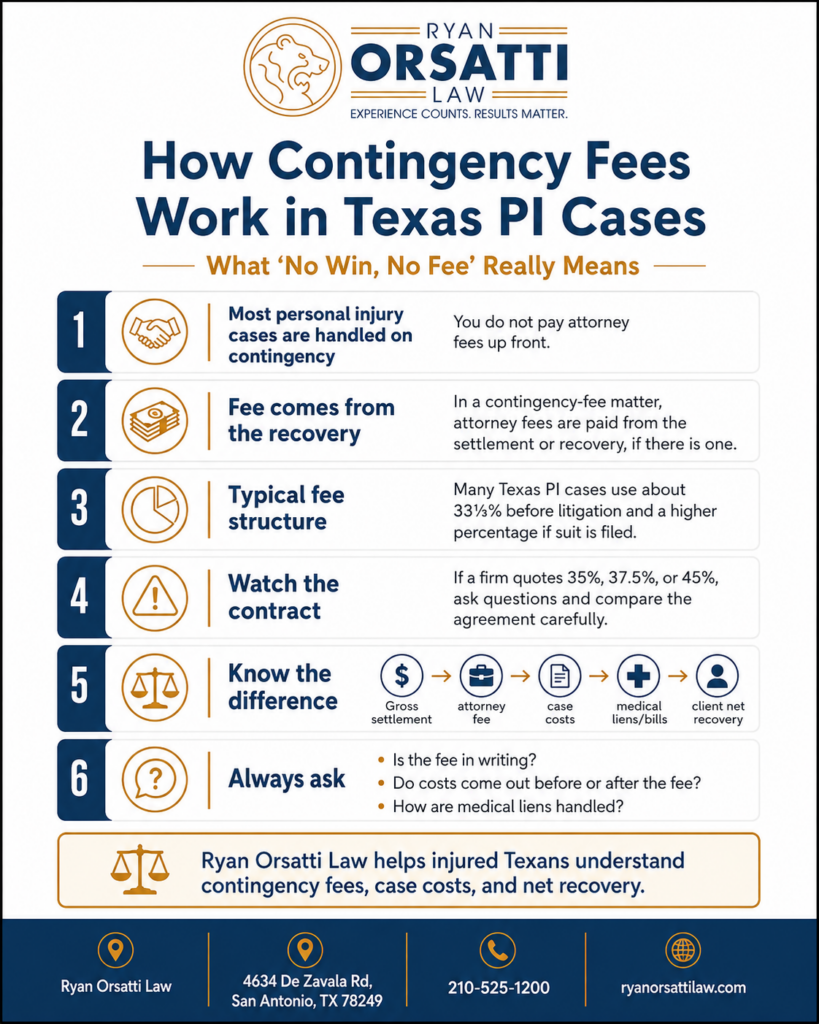
What is a contingency fee in a Texas personal injury case?
A contingency fee in a Texas personal injury case is a pay-from-the-recovery fee model. The lawyer’s fee depends on whether money is recovered through settlement, judgment, or another recovery. Texas Disciplinary Rule 1.04 says a contingent fee agreement must be in writing and must state how the fee will be calculated.
This fee structure is common in injury cases because injured people often need help before they have the money to pay a lawyer by the hour. TxDOT reported that 251,977 people were injured in Texas motor vehicle traffic crashes in 2024, including 18,218 people who sustained a serious injury. For many of those people, paying hourly legal bills while also paying medical bills would not be realistic. (Texas Department of Transportation)
Ryan Orsatti Law takes most personal injury cases on contingency. That means the written fee agreement explains the percentage, how case costs work, and when the fee is paid. The firm also explains contingency fees in its guide on how much a personal injury lawyer costs in San Antonio. (Ryan Orsatti Law)
What does “no win, no fee” really mean?
“No win, no fee” usually means no attorney’s fee is owed unless the case produces a financial recovery. At Ryan Orsatti Law, in a contingency-fee matter, the client does not write a personal check to the attorney for attorney fees from the client’s own bank account. The attorney fee is paid from the settlement or recovery, if there is one.
That is a major practical benefit for injured clients. It allows someone to get legal help while dealing with medical treatment, missed work, vehicle damage, and insurance pressure. The written agreement still matters because case expenses, medical balances, liens, and reimbursement claims may affect the final settlement distribution.
In many accepted contingency-fee injury cases, the goal is to address accident-related medical bills and also produce a net recovery for the client after fees, costs, and valid reimbursement claims are handled. No lawyer can promise that result in every case. The outcome depends on liability, available insurance, medical evidence, liens, treatment history, case costs, and whether litigation becomes necessary.
For more on the basic concept, Ryan Orsatti Law has a separate guide on no fee unless we win in personal injury cases.
What percentage do Texas personal injury lawyers usually charge?
Many Texas personal injury lawyers charge a contingency fee around one-third before litigation and a higher percentage if a lawsuit, trial, or appeal becomes necessary. The exact percentage is not set by one universal Texas statute. It comes from the written fee agreement, and Texas Rule 1.04 requires the contract to state the percentage for settlement, trial, or appeal if the percentage changes by stage.
Pre-litigation means the claim is being handled before a lawsuit is filed. Litigation means suit has been filed and the case may involve pleadings, discovery, depositions, mediation, hearings, retained witness work, and trial preparation.
| Case stage | Common fee issue to review | Why it matters |
|---|---|---|
| Pre-litigation | Often about one-third | This is the claim stage before a lawsuit is filed |
| After lawsuit is filed | Often higher, sometimes around 40% | Litigation usually requires more work, deadlines, and expense |
| Trial or appeal | Contract-specific | Trial and appeal work can change the fee percentage |
| High-fee quote | 35%, 37.5%, or 45% should be questioned | A higher fee may reduce the client’s net recovery |
Key takeaway: The fee percentage matters, but the better question is how the fee, costs, liens, and medical bills affect the client’s net recovery.
Should I be cautious if a large firm quotes a higher contingency fee?
Yes. If any personal injury firm, including a large high-volume firm, quotes 35% or 37.5% before litigation, or 45% after litigation begins, you should slow down and compare the agreement before signing. A higher fee is not automatically improper, but it should be clearly explained and justified by the work, risk, and case needs.
The biggest mistake is assuming every contingency fee agreement is basically the same. It is not. Two contracts can both say “no win, no fee” while producing very different net recoveries for the client.
Ask the lawyer to show you sample settlement math using round numbers. If the lawyer cannot explain when the fee increases, whether costs come out before or after the fee, and how liens are handled, it is reasonable to keep looking before you sign.
What are case costs in a Texas personal injury case?
Case costs are the out-of-pocket expenses needed to investigate, document, negotiate, or litigate the claim. Attorney fees pay the lawyer for legal work. Case costs pay third parties for records, reports, filing fees, depositions, mediation, and other case-building expenses.
Common case costs include:
- Medical records and billing records
- TxDOT crash reports
- Filing fees if suit is filed
- Service of process fees
- Deposition transcripts
- Court reporter fees
- Mediation fees
- Retained witness fees
- Accident investigation expenses
- Medical chronology or billing review expenses
Texas Rule 1.04 requires a contingency fee agreement to state the litigation and other expenses to be deducted from the recovery and whether those expenses are deducted before or after the contingent fee is calculated. It also requires a written statement at the end of the case showing the recovery, the client’s remittance, and how that amount was determined.
Why does it matter whether costs come out before or after the fee?
It matters because the order of deductions can change the client’s net recovery. If the fee is calculated before case costs are deducted, the math may be different than if case costs are deducted first. Texas requires the written agreement to explain this issue so the client is not left guessing.
Here is a simple example. This is only math, not a prediction of any case value.
| Settlement item | Example amount | What it means |
|---|---|---|
| Gross settlement | $100,000 | Total settlement before deductions |
| Attorney fee at 33⅓% | $33,333 | Fee if the written agreement uses one-third |
| Case costs | $3,000 | Records, filing, investigation, or litigation expenses |
| Medical liens or balances | $15,000 | Amount used to resolve valid medical or reimbursement claims |
| Estimated client net | $48,667 | Amount remaining after listed deductions |
Key takeaway: The gross settlement is not the number that matters most. The client’s net recovery after fees, costs, and valid medical claims is the number to focus on.
How do medical bills and liens come out of a settlement?
Medical bills, liens, and reimbursement claims are usually reviewed before settlement funds are disbursed to the client. A lien is a legal claim against part of the recovery. Subrogation means a health insurer or benefit plan may claim a right to be paid back from the settlement for accident-related bills it paid.
In Texas personal injury cases, the settlement may need to account for:
- Hospital liens
- Emergency medical services balances
- Medicare conditional payments
- Medicaid reimbursement claims
- Health insurance subrogation
- ERISA plan reimbursement claims
- Workers’ compensation liens
- Letters of protection
- Unpaid provider balances
A hospital lien is a legal claim a hospital may assert against part of a personal injury recovery. Texas Property Code Chapter 55 gives a hospital a lien on a claim of a person who receives hospital services for accident injuries caused by another person’s negligence. (Texas Statutes)
Medicare cases also require careful handling. CMS explains that a Medicare conditional payment is a payment Medicare makes for services where another payer may be responsible, and it must be repaid when a settlement, judgment, award, or other payment is made. (Centers for Medicare & Medicaid Services)
Attorney Insight: A settlement should not be evaluated only by the gross number. The real question is the client’s net recovery after attorney fees, case costs, hospital liens, Medicare claims, health insurance reimbursement, and unpaid medical balances are handled. In many injury files, lien work starts early because settlement can be delayed if reimbursement issues are discovered only after the insurance company sends the release.
What should be in your written contingency fee agreement?
Your written contingency fee agreement should clearly explain the percentage, when the percentage changes, how expenses are deducted, and what happens if there is no recovery. Texas Rule 1.04 requires contingent fee agreements to be in writing, and it requires the agreement to state how the fee is determined.
Before signing, review these items:
- The exact attorney fee percentage.
- Whether the percentage changes after a lawsuit is filed.
- Whether the percentage changes again for trial or appeal.
- Whether case costs are deducted before or after attorney fees.
- Whether case costs are owed if there is no recovery.
- Whether another lawyer or firm may be associated.
- How medical bills, liens, and reimbursement claims are handled.
- Whether you will receive a written settlement statement before disbursement.
- Who communicates settlement offers to you.
- Who has authority to accept or reject a settlement.
If lawyers from different firms divide a fee, Texas Rule 1.04 has written-consent requirements. The client must consent in writing to the fee-sharing arrangement, including the identity of participating lawyers or firms and how the fee will be divided.
When does hiring a personal injury lawyer on contingency make sense?
Hiring a personal injury lawyer on contingency usually makes sense when there is an injury, medical treatment, disputed fault, serious damages, missed work, commercial insurance, UM/UIM coverage, or medical lien issues. If the claim is only vehicle property damage with no injury and no medical treatment, a personal injury contingency fee may not add enough value to justify the fee.
Injury claims are different from property damage claims. Injury claims require proof of negligence, causation, medical damages, future care, lost income, pain, impairment, and often reimbursement issues. Comparative responsibility means Texas can reduce a recovery by the injured person’s percentage of fault, and a person found more than 50% responsible generally cannot recover damages under Texas proportionate responsibility law.
Deadlines also matter. Texas Civil Practice & Remedies Code § 16.003 generally gives a person two years to bring a personal injury lawsuit, although shorter notice rules and exceptions can apply depending on the defendant and facts. (Texas Statutes)
Ryan Orsatti Law helps injured people in San Antonio and across Texas evaluate whether legal representation makes practical financial sense. The firm handles many injury matters, including San Antonio car accident claims, serious crash cases, truck accident claims, and other plaintiff-side personal injury cases.
What should I ask before signing with a contingency fee lawyer?
You should ask direct questions about the fee percentage, litigation increase, costs, liens, communication, and the expected settlement distribution process. A clear fee conversation protects the client from surprises later.
Use this checklist before signing:
- What percentage do you charge before suit is filed?
- What percentage do you charge after suit is filed?
- Do you ever charge 35%, 37.5%, or 45%?
- What exact event causes the fee to increase?
- Are costs deducted before or after the attorney fee?
- Will I ever write a personal check to the attorney for attorney fees in a contingency-fee matter?
- Who pays case costs as the case moves forward?
- How are hospital liens, Medicare claims, and health insurance reimbursement handled?
- Will I see a settlement statement before funds are disbursed?
- Who will be my main point of contact?
A fair fee discussion should be simple enough for the client to understand before signing. If the explanation is confusing, rushed, or focused only on the gross settlement number, keep asking questions.
How does Ryan Orsatti Law explain contingency fees to injury clients?
Ryan Orsatti Law explains contingency fees in writing and takes most personal injury cases on contingency. In a Ryan Orsatti Law contingency-fee matter, the client does not write a personal check to the attorney for attorney fees from the client’s own account. The fee is paid from the recovery, if there is one.
This structure matters because injured clients are often dealing with medical appointments, lost wages, vehicle damage, and pressure from insurance adjusters. The contingency fee model lets the client get legal help without paying hourly attorney bills during the claim.
Ryan Orsatti Law also focuses on the net recovery issue. That means looking at the gross settlement, the attorney fee, case costs, medical balances, liens, and reimbursement claims together before the case is resolved. You can read more in the firm’s earlier guide to contingency fees in personal injury cases or contact the firm through the Ryan Orsatti Law contact page.
FAQs About Contingency Fees in Texas Personal Injury Cases
Do I pay Ryan Orsatti Law out of pocket in a contingency-fee personal injury case?
In a Ryan Orsatti Law contingency-fee personal injury matter, the client does not write a personal check to the attorney for attorney fees from the client’s own account. Attorney fees are paid from the recovery, if there is one. The written fee agreement explains the fee percentage, costs, and disbursement process.
Is one-third a normal contingency fee in Texas personal injury cases?
One-third is common in many Texas personal injury cases before litigation, but there is no single universal percentage set by statute. The written agreement controls the percentage. If the percentage increases after suit, trial, or appeal, Texas Rule 1.04 requires those percentages to be stated in the contingent fee agreement.
Should I sign if a firm charges 35% or 37.5% before litigation?
You should slow down and ask questions before signing a pre-litigation fee of 35% or 37.5%. A higher fee is not automatically improper, but it can reduce your net recovery. Ask when the fee increases, what work is included, whether costs are deducted before or after fees, and whether another agreement is more client-friendly.
Is a 45% litigation contingency fee high?
A 45% litigation fee is high enough that you should ask for a clear explanation and compare your options before signing. Litigation can require more work and expense, but the fee still affects your net recovery. Ask the lawyer to show sample settlement math before you agree to that percentage.
Are case costs the same as attorney fees?
No. Attorney fees pay the lawyer for legal work, while case costs pay third parties for items like medical records, filing fees, deposition transcripts, mediation, and retained witness expenses. Texas Rule 1.04 requires the written contingency agreement to explain expenses and whether they are deducted before or after the contingent fee is calculated.
Will my medical bills be paid from my personal injury settlement?
Medical bills, liens, and reimbursement claims are often paid or resolved from a personal injury settlement before the client receives the final net amount. The exact result depends on the medical providers, insurance coverage, lien law, health plan language, settlement amount, and case facts. No lawyer should promise that every bill will be eliminated.
What is the difference between gross settlement and net recovery?
Gross settlement is the total amount paid before deductions. Net recovery is the amount the client receives after attorney fees, case costs, medical liens, reimbursement claims, and unpaid balances are resolved. In personal injury cases, the net recovery is usually the number that matters most to the client.
Do I need a lawyer if my case is only property damage?
If your case is only vehicle property damage, with no injury and no medical treatment, you may not need a personal injury lawyer on contingency. If you have pain, treatment, missed work, disputed fault, an early release, uninsured driver issues, or medical bills, it is usually worth getting legal advice before settling.
Ryan Orsatti Law
4634 De Zavala Rd, San Antonio, TX 78249
Phone: 210-525-1200
ryanorsattilaw.com
This blog is for informational purposes only, not legal advice. Reading it does not create an attorney-client relationship. Past results do not guarantee future results.
Hurt in an accident in San Antonio? Learn how a San Antonio car accident lawyer can help with your claim. Call 210-525-1200 or request a free consultation.
The firm works on a contingency fee. You pay nothing unless the firm recovers money for you, and that covers case expenses as well as the fee: if there is no recovery, you owe no attorney's fee and no case expenses. Ask for the fee agreement and read the fee and expense section before you sign anything.
Related San Antonio legal resources
Primary legal and public-data sources
- Texas Civil Practice and Remedies Code Chapter 71: wrongful death
- Texas Civil Practice and Remedies Code Chapter 16: limitations
Ryan Orsatti Law
4634 De Zavala Road, San Antonio, TX 78249
General reference links. Consult each source for its current text.