
Quick Answer
W.W. White Road is one of San Antonio’s busiest north-south corridors on the East Side, running through Highland Hills, Kirby, and connecting major highways including I-10, I-410, and Hwy 87 (Rigsby Avenue). Crashes here frequently involve high-speed merges, commercial traffic, and congested intersections at highway access points.
If you were injured in a crash on W.W. White Road:
- Get medical care immediately—even if you feel fine at the scene.
- Call 911 so a San Antonio Police Department or Bexar County Sheriff report is generated.
- Document everything you can at the scene: photos, witness names, and the other driver’s insurance information.
- Do not give a recorded statement to the at-fault driver’s insurance company before speaking with an attorney.
- Texas gives you two years from the date of the crash to file a personal injury lawsuit under Tex. Civ. Prac. & Rem. Code § 16.003—but waiting narrows your options significantly.
Why W.W. White Road Has a High Crash Risk
W.W. White Road stretches several miles through the heart of San Antonio’s East Side, functioning as both a local neighborhood thoroughfare and a commercial access route. Several factors combine to make it particularly hazardous:
Highway interchange congestion. The road intersects or closely approaches I-10, I-410, and Hwy 87/Rigsby Avenue. These interchange zones create merge conflicts, abrupt speed changes, and driver distraction—especially during morning and afternoon commute windows.
Mixed traffic types. Commercial vehicles, delivery trucks, and 18-wheelers share lanes with local passenger traffic. This mix creates stopping-distance mismatches and blind-spot hazards, particularly at driveways serving businesses along the corridor.
Residential cross-traffic. The Highland Hills neighborhood generates significant residential cross-traffic at uncontrolled and lightly controlled intersections. Pedestrians and cyclists crossing W.W. White Road at non-signalized points face elevated exposure.
Road condition and lighting. Portions of the East Side corridor have historically experienced deferred road maintenance. Cracked pavement, faded lane markings, and inadequate nighttime lighting can contribute to single-vehicle crashes and lane-departure collisions.
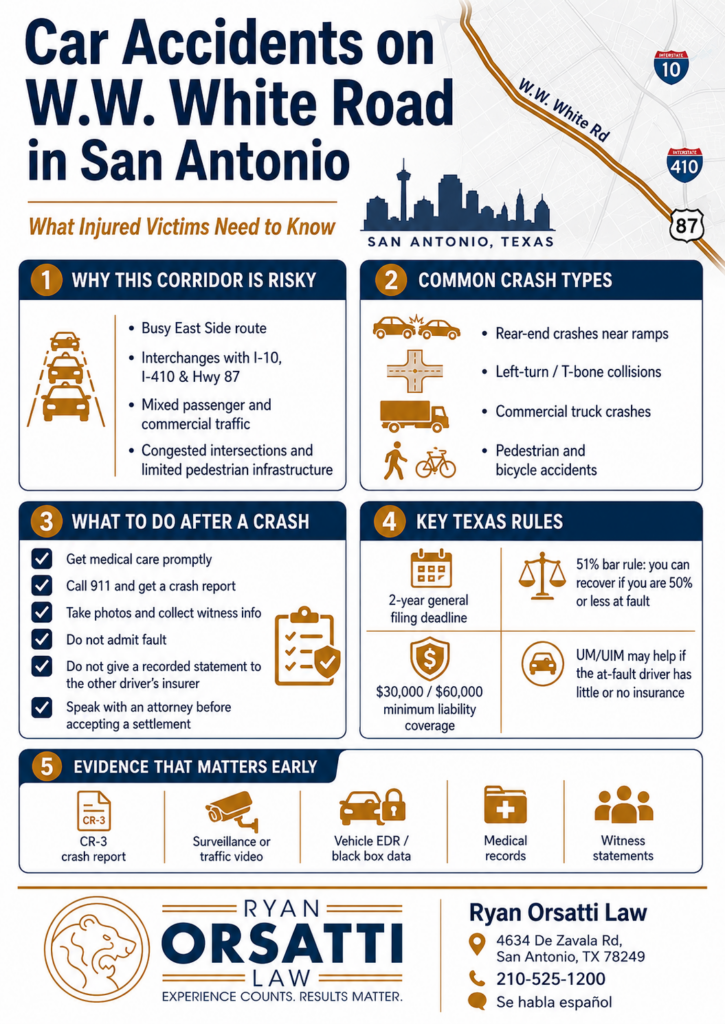
Common Crash Types on W.W. White Road
Rear-End Collisions Near Highway Ramps
Traffic backing up before I-410 or I-10 on-ramps frequently causes rear-end crashes. Fault in rear-end cases is often assigned to the following driver under Texas negligence principles, but it is not automatic—especially if the lead vehicle made an abrupt or improper lane change.
Left-Turn Intersection Crashes
Drivers turning left across oncoming traffic at commercial driveways and cross-streets are among the most common scenarios in East Side corridor crashes. These collisions tend to produce serious injuries because the turning driver’s front end strikes the side of an oncoming vehicle (a “T-bone” or broadside impact).
Commercial Vehicle Crashes
Delivery trucks and semi-trailers serving warehouses and commercial properties along W.W. White Road carry heightened liability risk. When a commercial vehicle is involved, there may be multiple liable parties: the driver, the trucking company, a leasing entity, or a cargo loader. These cases require a different investigation approach than a standard two-car crash.
Pedestrian and Bicycle Accidents
W.W. White Road has limited pedestrian infrastructure in certain segments. Pedestrians crossing outside of marked crosswalks, or cyclists riding against traffic or in unlit conditions, are at significant risk—but driver fault is still highly fact-dependent and worth evaluating carefully.
Who Can Be Held Liable After a W.W. White Road Crash?
Texas follows a proportionate responsibility system under Tex. Civ. Prac. & Rem. Code § 33.001. This means:
- Fault is allocated by percentage among all parties—including you.
- You can recover damages as long as your percentage of fault does not exceed 50%.
- Your recovery is reduced by your own percentage of fault.
Example: If a jury finds your damages are $100,000 and you were 20% at fault (e.g., for speeding slightly), you recover $80,000.
Potentially liable parties in a W.W. White Road crash can include:
| Party | Why They May Be Liable |
|---|---|
| At-fault driver | Speeding, distracted driving, failure to yield, DWI |
| Employer of at-fault driver | Vicarious liability if driver was on the job (respondeat superior) |
| Trucking company | Negligent hiring, inadequate maintenance, hours-of-service violations |
| TxDOT or City of San Antonio | Dangerous road conditions or inadequate signage (requires specific legal procedures) |
| Vehicle manufacturer | Defective brakes, tires, or safety systems contributing to the crash |
What Evidence Matters Most in an East Side Corridor Crash
Evidence in a W.W. White Road crash degrades quickly. Here is what matters most and why:
CR-3 Crash Report. The Texas Peace Officer’s Crash Report (Form CR-3) is typically generated by SAPD or Bexar County deputies. It records fault notations, weather, road conditions, and witness information. You can obtain a copy through TxDOT or the reporting agency. However, a fault notation in the CR-3 is not legally binding—it is one piece of evidence.
Surveillance and traffic camera footage. Businesses along W.W. White Road and municipal traffic cameras at key intersections may have recorded the crash. This footage is typically overwritten within days to weeks. Sending a spoliation letter early preserves your right to demand the footage.
Black box / EDR data. Most modern vehicles have an Event Data Recorder (EDR) that captures pre-crash speed, braking, and steering inputs. For commercial vehicles, electronic logging devices (ELDs) may also document hours of service.
Medical records and emergency transport documentation. Consistency between your reported symptoms and documented treatment is critical. Gaps in treatment are frequently used by defense adjusters to challenge injury severity.
Witness statements. Independent witnesses who saw the crash before the vehicles came to rest are highly valuable. Their accounts are less susceptible to “staging” arguments.
Steps to Take After a Crash on W.W. White Road
At the Scene
- [ ] Call 911 and wait for a police report to be generated
- [ ] Move to a safe location if possible—do not leave the scene
- [ ] Exchange insurance, license, and registration information with the other driver
- [ ] Photograph all vehicles, license plates, road markings, skid marks, traffic signals, and injuries
- [ ] Identify and write down the names and phone numbers of any witnesses
- [ ] Do not admit fault or apologize—even casually
In the Hours and Days After
- [ ] Seek medical evaluation, even if symptoms are mild or delayed
- [ ] Follow all treatment recommendations and attend every appointment
- [ ] Report the crash to your own insurance company—but provide only basic facts
- [ ] Do not give a recorded statement to the other driver’s insurer
- [ ] Preserve any clothing, damaged property, or photos related to the crash
- [ ] Contact a personal injury attorney before accepting any settlement offer
How the Insurance Claim Process Works
Step 1: Opening a Claim
You (or your attorney) notify the at-fault driver’s liability insurer of the crash. The insurer will assign an adjuster and begin investigating. Their goal is to assess and minimize the payout—not to ensure you receive fair compensation.
Step 2: Medical Treatment and Documentation
Your treatment phase is the foundation of your claim’s value. Insurers evaluate the nature of your injuries, the consistency of your treatment, and any pre-existing conditions. Gaps in care or delayed treatment are routinely used to minimize settlements.
Step 3: Demand and Negotiation
Once your treatment is complete (or you’ve reached maximum medical improvement), your attorney submits a demand package documenting your medical expenses, lost wages, and non-economic damages such as pain and suffering. Negotiation with the adjuster follows.
Step 4: Litigation (If Necessary)
If negotiation fails to produce a fair offer, a lawsuit is filed in Bexar County District Court. Most personal injury cases settle before trial, but credible litigation posture—including complete discovery and expert preparation—is what typically moves insurers to improve their offers.
Typical timeline: 8–18 months for straightforward injury claims; 2–4 years for complex or disputed-liability cases, especially those involving commercial vehicles.
What If the At-Fault Driver Has No Insurance?
Texas requires drivers to carry a minimum of $30,000 per person / $60,000 per occurrence in bodily injury liability coverage under Tex. Transp. Code § 601.072. However, a significant portion of drivers on Texas roads—particularly on high-volume corridors like W.W. White—are uninsured or underinsured.
If the at-fault driver is uninsured or underinsured, your own UM/UIM coverage (uninsured/underinsured motorist coverage) may be your primary recovery path. Review your own auto policy carefully. Texas does not require insurers to sell UM/UIM coverage, but they must offer it, and rejecting it must be done in writing.
Attorney Insight: Why East Side Corridor Cases Need Specific Attention
A note from Ryan Orsatti:
Crashes on commercial corridors like W.W. White Road can involve layers that straightforward residential crashes don’t: commercial traffic with employer liability exposure, government entity involvement for roadway conditions (which requires early notice under Tex. Civ. Prac. & Rem. Code § 101.101 for governmental entity claims), and high-volume intersection configurations where fault is genuinely disputed.
One issue I see frequently is injured people waiting weeks or months to consult an attorney because they assume the claim is straightforward. By then, surveillance footage is gone, the EDR data hasn’t been preserved, and the insurer has already locked in a recorded statement. The early phase of a case matters disproportionately—not because it creates leverage, but because it preserves evidence that may not exist later.
Frequently Asked Questions
How long do I have to file a personal injury lawsuit in Texas after a crash on W.W. White Road?
Generally, two years from the date of the crash under Tex. Civ. Prac. & Rem. Code § 16.003. If a government entity is involved (e.g., a claim related to road maintenance by TxDOT or the City of San Antonio), a formal notice of claim must typically be filed within six months under the Texas Tort Claims Act. Missing these deadlines generally bars your claim entirely.
Does the police report determine who is at fault?
No. The CR-3 report reflects the responding officer’s observations and notations, but it is not a legal determination of fault. Fault in a personal injury claim is determined through evidence, witness accounts, expert analysis, and, if necessary, a jury verdict.
What if I was partly at fault for the crash?
Under Texas proportionate responsibility rules, you can still recover damages as long as your fault does not exceed 50%. Your recovery is reduced by your percentage of fault. This is a fact-intensive determination, and a defense insurer will almost always attempt to attribute some fault to you.
Can I still pursue a claim if I didn’t go to the emergency room right after the crash?
Yes, but delayed treatment makes claims harder to pursue. Insurers will argue that a gap between the crash and your first medical visit suggests your injuries were not serious or were caused by something other than the crash. Seeking care promptly—even urgent care—protects both your health and your claim.
Do I need an attorney for a W.W. White Road accident claim?
You are not legally required to have one, but studies consistently show injured claimants represented by attorneys recover more, on average, than those who negotiate directly with insurers. This is especially true in cases involving commercial vehicles, disputed liability, or significant injuries.
What does it cost to hire a personal injury attorney in Texas?
Most Texas personal injury attorneys—including Ryan Orsatti Law—handle these cases on a contingency fee basis. You pay no upfront fees. The attorney’s fee is a percentage of the recovery, and if there is no recovery, there is no fee. Expenses advanced during the case are typically reimbursed from the settlement or verdict.
Contact Ryan Orsatti Law
If you or a family member were injured in a crash on W.W. White Road or anywhere on San Antonio’s East Side, we are available to review your case at no cost and with no obligation.
Ryan Orsatti Law 4634 De Zavala Rd, San Antonio, TX 78249 Phone: 210-525-1200
We handle cases in English and Spanish. Se habla español.
This blog is for informational purposes only, not legal advice. Reading it does not create an attorney-client relationship. Past results do not guarantee future results.
Hurt in an accident in San Antonio? Learn how a San Antonio car accident lawyer can help with your claim. Call 210-525-1200 or request a free consultation.
The firm works on a contingency fee. You pay nothing unless the firm recovers money for you, and that covers case expenses as well as the fee: if there is no recovery, you owe no attorney's fee and no case expenses. Ask for the fee agreement and read the fee and expense section before you sign anything.
Related San Antonio legal resources
Primary legal and public-data sources
- TxDOT: Texas crash reports, data, and statistics
- Texas Civil Practice and Remedies Code Chapter 33: proportionate responsibility
Ryan Orsatti Law
4634 De Zavala Road, San Antonio, TX 78249
General reference links. Consult each source for its current text.