
Quick Answer: If you were in an accident with someone who doesn’t have insurance in Texas, you may still have options through your own uninsured/underinsured motorist coverage, PIP, MedPay, collision coverage, health insurance, or a lawsuit against the at-fault driver. Texas requires drivers to show financial responsibility, but TxDMV estimated that 11.87% of Texas drivers were uninsured as of September 2025. (Texas Department of Motor Vehicles) Ryan Orsatti Law helps injured people in San Antonio and across Texas review coverage, fault, medical bills, and claim strategy after uninsured-driver crashes.
Ryan Orsatti Explains Uninsured Driver Coverage on KENS 5
Ryan Orsatti joined KENS 5’s Great Day SA to explain how UM/UIM coverage can protect you when the driver who caused a crash has no insurance or not enough insurance.
Key Takeaways
- An uninsured driver does not automatically end your injury claim.
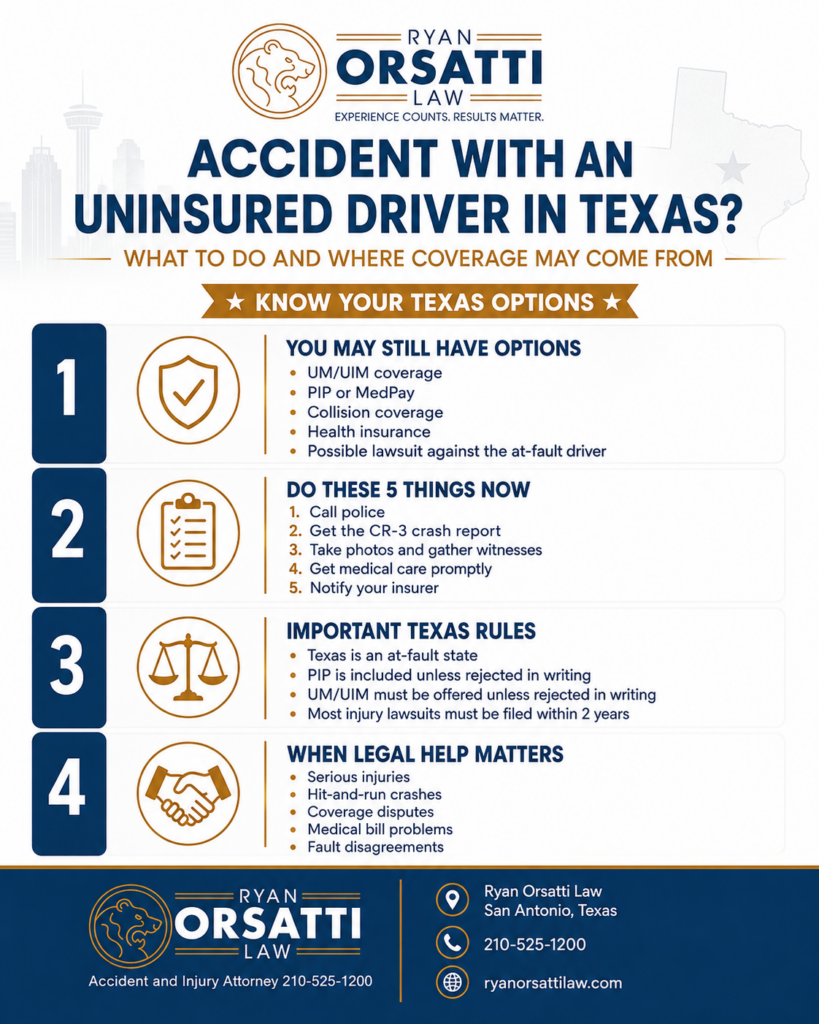
- Texas auto policies include PIP unless rejected in writing, and insurers must offer UM/UIM coverage unless rejected in writing. (Texas Department of Insurance)
- UM/UIM coverage can apply when the other driver has no insurance, not enough insurance, or cannot be found after a hit-and-run. (Texas Department of Insurance)
- A direct lawsuit against an uninsured driver may be legally valid but hard to collect if the driver has no reachable assets or income.
- Most Texas personal injury claims must be filed within two years, but your insurance policy may require prompt notice much sooner. (Texas Statutes)
- The most important early steps are calling police, getting medical care, preserving evidence, and notifying your own insurer.
What should I do first after an accident with someone who doesn’t have insurance?
You should call police, document the crash, get medical care, and notify your own insurance company as soon as possible after an accident with an uninsured driver in Texas. TDI advises calling police if the other driver refuses to provide insurance information, if anyone is injured, or if a hit-and-run occurred. (Texas Department of Insurance)
Your first goal is to create a clean record. That means a police report, photos, witness information, medical documentation, and proof that the other driver had no active coverage.
- Call 911 if anyone is hurt or the crash creates danger.
- Ask for a police response. In Texas, an officer must make a written crash report if the investigated crash caused injury, death, or at least $1,000 in apparent property damage. (FindLaw)
- Take photos and video. Capture vehicle positions, damage, skid marks, debris, traffic signals, license plates, insurance cards, driver’s licenses, and visible injuries.
- Get witness names and phone numbers. Independent witnesses can matter if the uninsured driver later disputes fault.
- Seek medical care promptly. Delayed treatment gives insurers room to argue your injuries were not caused by the crash.
- Request the Texas Peace Officer’s Crash Report, also called the CR-3. TxDOT allows people to obtain a CR-3 through its Crash Report Online Purchase System. (Texas Department of Transportation)
- Notify your insurer. Even when the other driver caused the crash, your own policy may require prompt notice for UM/UIM, PIP, MedPay, collision, or rental coverage.
Do not rely on the other driver’s promise to “pay you back.” In uninsured-driver cases, early documentation is often the difference between a claim that can be evaluated and a claim that turns into a word-against-word dispute.
Can my own insurance pay if the other driver has no insurance?
Your own insurance may pay after an uninsured-driver crash if you have UM/UIM, PIP, MedPay, collision, rental reimbursement, or health insurance coverage that applies. The Texas Department of Insurance explains that uninsured/underinsured motorist coverage pays when you are hit by someone who did not have insurance, did not have enough insurance, or fled the scene in a hit-and-run. (Texas Department of Insurance)
UM/UIM means uninsured/underinsured motorist coverage. It is first-party insurance, meaning it is coverage you bought from your own company to protect you when the at-fault driver cannot fully pay.
| Coverage | When it may apply | What it may help pay | Watch for this issue |
|---|---|---|---|
| UM bodily injury | At-fault driver has no insurance or cannot be identified | Medical bills, lost income, pain, impairment, other injury damages | You still must prove fault, injury causation, and damages |
| UM property damage | Your vehicle is damaged by an uninsured driver | Repairs, total loss value, rental issues, property in the vehicle | Policy limits and deductibles matter |
| PIP | You have PIP and did not reject it in writing | Medical bills, lost wages, and some nonmedical costs | PIP is limited by the amount on your policy |
| MedPay | You purchased medical payments coverage | Medical bills for you and covered passengers | MedPay may have reimbursement issues depending on the policy |
| Collision | Your car was damaged in a crash | Repair cost or actual cash value if totaled | Deductible usually applies |
| Health insurance | You need medical treatment after the crash | Hospital, doctor, imaging, therapy, and surgery bills | Subrogation may apply, meaning the health plan may seek repayment from a settlement |
| Rental reimbursement | Your policy includes rental coverage | Temporary transportation | Daily and total limits usually apply |
Key takeaway: In a Texas uninsured-driver crash, the practical recovery path often starts with your own policy, not the uninsured driver’s empty pocket.
What does UM/UIM coverage pay for in Texas?
UM/UIM coverage may pay for injury damages, vehicle damage, rental needs, and other covered losses when the at-fault driver has no insurance, not enough insurance, or cannot be found. TDI states that Texas insurers must offer uninsured/underinsured motorist coverage and that a driver who does not want it must reject it in writing. (Texas Department of Insurance)
A UM claim is not automatic payment. Your insurer may investigate fault, review medical records, question whether the crash caused your injuries, and dispute the amount of damages. That makes the claim feel similar to a claim against the other driver’s insurance company, even though it is your own insurer.
Texas law requires minimum liability coverage of $30,000 per injured person, $60,000 per crash, and $25,000 for property damage, commonly called 30/60/25 coverage. (Texas Department of Insurance) Those limits do not help you if the other driver has no policy at all, which is why UM coverage can be important after crashes on I-35, Loop 410, Loop 1604, US-281, and other San Antonio roads.
For a deeper coverage explanation, see Ryan Orsatti Law’s Texas UM/UIM coverage guide.
What if I was injured and the uninsured driver cannot pay my medical bills?
You should look first for available insurance layers, including UM/UIM, PIP, MedPay, health insurance, and any other liable party’s policy. TDI explains that PIP can pay medical bills, lost wages, and some nonmedical costs, and all Texas auto policies include PIP unless it was rejected in writing. (Texas Department of Insurance)
Medical bills are often the pressure point in uninsured-driver claims. Emergency room bills, imaging, orthopedic visits, injections, therapy, and surgery recommendations can arrive before liability and insurance coverage are clear.
A hospital lien is a legal claim a hospital may assert against part of a personal injury recovery. Subrogation means a health insurer may claim a right to be repaid from a settlement. These issues should be tracked early because the question is not just “What is the gross settlement?” The practical question is what bills, liens, reimbursements, and case expenses must be resolved from any available recovery.
Attorney Insight: In uninsured-driver cases, adjusters often focus on three things first: whether your policy actually has UM/UIM, whether the crash was reported and documented, and whether your medical treatment matches the injury timeline. A delayed first medical visit, missing witness information, or broad recorded statement can create problems even when the other driver clearly had no insurance.
Can I sue an uninsured driver in Texas?
Yes, you can sue an uninsured driver in Texas if that driver’s negligence caused your injuries or property damage. The bigger question is collectability, because a court judgment may be hard to collect if the driver has no insurance, wages, nonexempt assets, or realistic ability to pay.
Negligence means the other driver failed to use reasonable care, such as by speeding, running a red light, following too closely, failing to yield, or driving distracted. Comparative responsibility means Texas can reduce your recovery by your percentage of fault. Under Texas Civil Practice and Remedies Code § 33.001, a claimant may not recover damages if the claimant’s responsibility is greater than 50%. (Texas Statutes)
A lawsuit may still make sense when:
- The uninsured driver has reachable assets or income.
- There is another responsible party.
- The crash involved a company vehicle, delivery vehicle, rideshare, borrowed car, or unsafe vehicle ownership issue.
- Your UM/UIM carrier requires proof of legal fault and damages.
- The insurer disputes whether the other driver was truly uninsured.
A person can be “judgment proof,” which means a lawsuit may produce a valid judgment that is difficult or uneconomical to collect. That is why coverage investigation often matters as much as liability investigation.
Could someone besides the uninsured driver be responsible?
Someone besides the uninsured driver may be responsible if another person, company, vehicle owner, employer, or commercial entity contributed to the crash. This matters because an uninsured driver may not be the only possible source of recovery.
Examples include a driver working within the course and scope of employment, a commercial vehicle owner, a negligent vehicle entrustment claim, a defective vehicle maintenance issue, or another driver who contributed to the collision. In San Antonio and Bexar County, this can come up in crashes involving delivery vehicles, work trucks, rideshare vehicles, and multi-vehicle collisions on congested highways.
Do not assume “no insurance” means “no claim.” The correct question is broader: who caused the crash, what policies may apply, and what evidence proves each responsibility path?
How long do I have to act after a Texas accident with someone who doesn’t have insurance?
Most Texas personal injury lawsuits must be filed within two years after the claim accrues, but uninsured-driver insurance claims can have earlier policy notice requirements. Texas Civil Practice and Remedies Code § 16.003 sets a two-year limitations period for personal injury claims. (Texas Statutes)
The two-year deadline is not a safe reason to wait. Your own policy may require prompt notice, cooperation, medical documentation, proof of loss, consent before settling with another insurer, or other claim steps. TDI also states that Texas insurance companies must acknowledge a claim within 15 days after receiving notice, though additional investigation may follow. (Texas Department of Insurance)
Act quickly if the crash involved:
- A hit-and-run driver
- Missing witnesses
- Dashcam or surveillance footage
- A commercial vehicle
- Serious injuries
- A denied insurance policy
- A dispute about who caused the crash
- A totaled vehicle
- Multiple injured people
Evidence can disappear within days. Businesses may overwrite surveillance video. Dashcam footage may be deleted. Witnesses may become harder to locate.
What if the uninsured driver left the scene?
If the uninsured driver left the scene, report the crash to police immediately and notify your insurer that you may have a hit-and-run UM claim. TDI warns that uninsured motorist coverage may not pay for a hit-and-run accident if it was not reported to police. (Texas Department of Insurance)
A hit-and-run claim often depends on proof that a crash actually happened, another vehicle was involved, and the unknown driver caused the collision. Photos, vehicle damage patterns, 911 records, nearby camera footage, witness statements, and the CR-3 can all matter.
Ryan Orsatti Law has a separate guide for people looking for a San Antonio hit-and-run lawyer.
What if I also did not have insurance?
You may still have a claim if another driver caused the crash, but being uninsured creates separate legal, financial, and coverage problems. If you did not have your own policy, you likely do not have your own UM/UIM, PIP, MedPay, collision, or rental coverage to fall back on.
Your lack of insurance usually does not answer who caused the crash. Fault is still based on the facts, traffic rules, witness accounts, crash damage, and other evidence. But practically, having no insurance can leave you dependent on the at-fault driver’s ability to pay, another available policy, health insurance, or a direct lawsuit.
If you were uninsured but not at fault, do not leave the scene, do not avoid the police report, and do not ignore medical care. A separate citation issue is usually less serious than losing the evidence needed to prove the crash.
What evidence matters most in an uninsured-driver claim?
The most important evidence in an uninsured-driver claim is proof of fault, proof the other driver lacked insurance, proof of your injuries, and proof of your available coverage. Insurance companies do not pay UM/UIM claims simply because the other driver had no policy.
Important evidence includes:
- The CR-3 Texas Peace Officer’s Crash Report
- Photos and videos from the crash scene
- Driver’s license, plate, and vehicle information
- Any statement that the other driver had no insurance
- TexasSure or insurer verification results, when available
- Witness names and phone numbers
- Medical records and bills
- Work excuse notes and wage records
- Vehicle repair estimates and total loss documents
- Your declarations page showing UM/UIM, PIP, MedPay, collision, and rental coverage
- All letters from insurers denying or confirming coverage
TDI reports that more than 2.4 million Texas state-registered vehicles were not matched to an insurance policy, or about 12% of registered vehicles. (Texas Department of Insurance) That number shows why uninsured-driver evidence should be gathered early, not after weeks of informal back-and-forth.
How can a Texas personal injury lawyer help after an uninsured-driver accident?
A Texas personal injury lawyer can help identify all available insurance, prove fault, organize medical documentation, protect deadlines, and evaluate whether a lawsuit against the uninsured driver makes practical sense. This is especially important when your own insurer disputes UM/UIM coverage, injury causation, damages, or policy conditions.
Ryan Orsatti Law helps injured people in San Antonio and across Texas evaluate uninsured-driver crashes, including UM/UIM claims, PIP and MedPay issues, health insurance reimbursement, vehicle damage, hit-and-run evidence, and medical bill problems. The firm’s San Antonio car accident lawyer page explains more about car accident representation, and this related guide addresses what happens when the at-fault driver does not have enough insurance to cover medical bills.
A lawyer’s role is not just to send a demand. In uninsured-driver cases, the early work often includes reading policy language, verifying coverage, preserving evidence, coordinating medical records, evaluating liens, and deciding whether direct suit, UM/UIM negotiation, or another claim route is the best next step.
To ask about a specific crash, you can contact Ryan Orsatti Law.
FAQ
Can I recover anything if the uninsured driver has no money?
You may still recover through your own UM/UIM, PIP, MedPay, collision, health insurance, or another liable party’s policy if those coverages or claims apply. A lawsuit against the uninsured driver may be possible, but collectability matters. If the driver has no reachable assets or income, a judgment may be difficult to collect.
Does uninsured motorist coverage apply to hit-and-run crashes in Texas?
Uninsured motorist coverage can apply to hit-and-run crashes in Texas if your policy covers the loss and you satisfy policy conditions. Reporting the crash to police is especially important. TDI warns that uninsured motorist coverage may not pay for a hit-and-run accident if the crash was not reported to police. (Texas Department of Insurance)
Is Texas a no-fault state for car accidents?
Texas is not a no-fault car accident state in the way states like Florida use that term. Texas generally follows a fault-based system, meaning the person who caused the crash is responsible for resulting damages. PIP is different because it may pay certain benefits under your own policy regardless of fault.
Should I give a recorded statement to my own insurance company?
You may have a duty to cooperate with your own insurer, but you should be careful with recorded statements after a serious injury crash. A UM/UIM adjuster may ask questions about speed, impact, symptoms, prior injuries, and treatment gaps. Before giving a statement, understand your policy duties and the issues in dispute.
What if the other driver’s insurer says there is no coverage?
A coverage denial may turn the claim into an uninsured-motorist issue if your own policy includes UM coverage and the facts fit the policy language. Save the denial letter, claim number, adjuster information, and all emails. A denied policy does not automatically end the case, but it changes the coverage path.
What documents should I bring to a lawyer after an uninsured-driver crash?
Bring the crash report, photos, witness information, insurance declarations page, medical records, medical bills, health insurance information, repair estimate, total loss documents, wage loss proof, and every letter or email from insurers. These documents help evaluate fault, coverage, damages, deadlines, and whether a UM/UIM claim or direct lawsuit makes sense.
Ryan Orsatti Law
4634 De Zavala Rd, San Antonio, TX 78249
Phone: 210-525-1200
ryanorsattilaw.com
The firm works on a contingency fee. You pay nothing unless the firm recovers money for you, and that covers case expenses as well as the fee: if there is no recovery, you owe no attorney’s fee and no case expenses. Ask for the fee agreement and read the fee and expense section before you sign anything.
This blog is for informational purposes only, not legal advice. Reading it does not create an attorney-client relationship. Past results do not guarantee future results.
Hurt in an accident in San Antonio? Learn how a San Antonio car accident lawyer can help with your claim. Call 210-525-1200 or request a free consultation.
The firm works on a contingency fee. You pay nothing unless the firm recovers money for you, and that covers case expenses as well as the fee: if there is no recovery, you owe no attorney's fee and no case expenses. Ask for the fee agreement and read the fee and expense section before you sign anything.
Related San Antonio legal resources
Primary legal and public-data sources
- TxDOT: Texas crash reports, data, and statistics
- Texas Civil Practice and Remedies Code Chapter 33: proportionate responsibility
Ryan Orsatti Law
4634 De Zavala Road, San Antonio, TX 78249
General reference links. Consult each source for its current text.