
Quick Answer
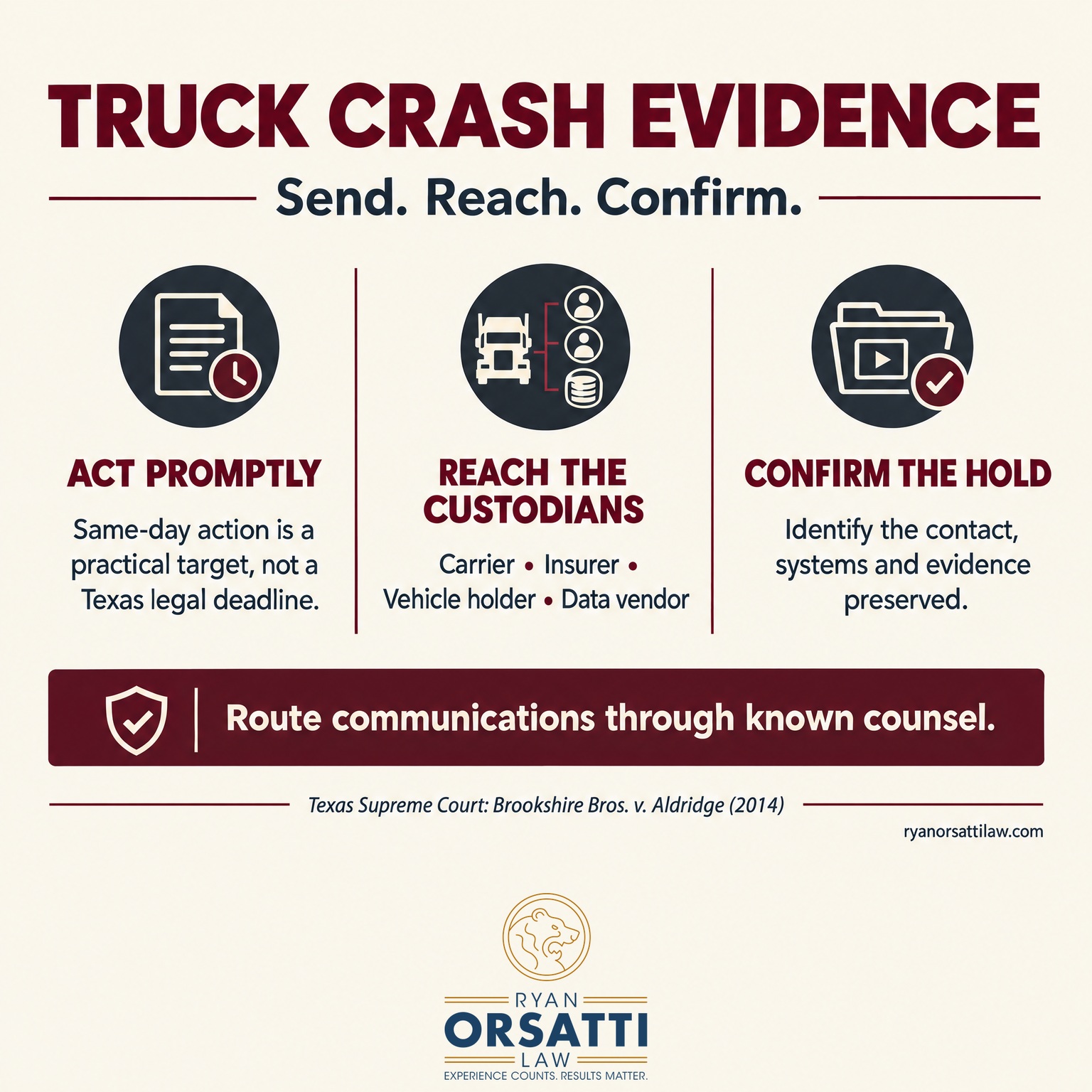
- Send a Texas truck crash preservation letter as soon as the carrier and evidence custodians can be identified. Same-day action is a practical recommendation, not a statutory deadline.
- Reach the carrier’s legal or safety contact, the insurer, and each separate custodian of relevant vehicles or data. Route communications through known counsel when required.
- Confirm which systems and physical items are on hold. A delivery receipt proves delivery, not that a camera vendor stopped deletion or a shop stopped repairs.
Ryan Orsatti Law helps injured people in San Antonio and across Texas address evidence preservation after commercial truck crashes. This Texas truck crash preservation letter checklist focuses on what happens after the notice is prepared: getting it to the right people and confirming action.
Key Takeaways
- Do not wait for a final crash report to send a notice based on reliable information already available.
- The operating carrier, equipment owner, and company storing video may be different entities.
- A carrier’s preservation duty depends on foreseeable litigation and relevant evidence within its possession or control, not merely receipt of a form letter.
- Federal recordkeeping periods do not establish a safe waiting period for a notice.
- A preservation letter does not extend the deadline to file suit or automatically give access to evidence.
How Quickly Should the First Notice Go Out?
The working target is immediate action once counsel can identify the crash and a reliable recipient. Send an initial, focused notice, then supplement it as the vehicle location, technology vendors, and corporate relationships become clear. Do not treat 24, 48, or 72 hours as a legal grace period.
A preservation letter asks another person or company to retain evidence for an expected claim. A litigation hold usually means the company’s internal instruction to stop ordinary deletion or disposal. Spoliation is the loss or destruction of evidence that should have been preserved.
The firm’s existing guide answers the broader question of when a Texas truck crash letter should be sent and who gets it. The practical next question is whether it reached someone who can actually preserve the evidence.
For a crash on I-35 or I-10 near San Antonio, the tractor may be moved while the injured person is still receiving care. A notice can identify the date, approximate time, roadway, driver, unit number, and available photographs without pretending unknown facts are settled. State what is known and correct errors promptly.
Keep the lawsuit deadline separate. Texas Civil Practice and Remedies Code section 16.003 generally gives two years from accrual for a personal injury suit. Accrual means when the claim legally begins; exceptions can change the analysis. Sending letters or negotiating with an adjuster does not itself stop that clock.
What Does Texas Law Require, and What Will the Defense Argue?
Issue: Did the carrier have a duty to retain the particular evidence before it disappeared?
Rule: In Brookshire Bros., Ltd. v. Aldridge, 438 S.W.3d 9 (Tex. 2014), the Texas Supreme Court tied preservation to knowledge, actual or reasonable, of a substantial chance of a claim and material, relevant evidence within possession or control. The judge decides spoliation and a proportionate remedy.
Application, including the defense: A carrier may argue litigation was not reasonably foreseeable, the material was irrelevant, a vendor controlled it, or equivalent evidence remains. A broad letter does not answer every objection. A focused notice, reliable delivery record, and custodian-specific follow-up strengthen the factual record.
Conclusion: Act promptly, explain relevance, and verify control. Lost evidence does not automatically establish liability or justify a jury instruction. The severe Texas instruction generally requires intentional concealment and inadequate lesser remedies, with a narrow exception for negligent loss that prevents a meaningful presentation of a claim or defense.
Attorney Insight: Ask two separate questions: “Did you receive our notice?” and “Which person confirmed that this specific evidence is preserved?” Those answers address different problems. Keep the distinction visible in the case file.
Texas Truck Crash Preservation Letter: A Recipient Checklist
Build the list around evidence custody. A custodian is the person or business holding or managing evidence. Being a custodian does not necessarily make that business responsible for causing the crash.
| Recipient | Evidence to identify | Confirmation to request |
|---|---|---|
| Operating motor carrier | Dispatch, driver records, logs, video accounts, crash investigation | Hold contact and affected systems |
| Driver and equipment owner | Devices, photographs, tractor, trailer, onboard data | Location, custody, and planned movement |
| Insurer or claims administrator | Claim photos, statements, inspections, downloads | Its own hold and investigator identity |
| Tow yard, shop, or salvage facility | Vehicle condition, parts, repair and disposal records | Inspection access and alteration dates |
| Camera, ELD, or telematics provider | Stored data, original files, event history | Retention settings and preservation method |
| Broker, shipper, or loader when relevant | Load assignment, schedules, cargo instructions, messages | Custodian and shipment records |
Start with the operating carrier’s legal department, safety director, or risk contact. Request prompt distribution to fleet, maintenance, information technology, dispatch, and outside vendors managing relevant evidence. Ask for the name of the person coordinating that work.
Copying a registered agent can provide another delivery route, but do not assume it reaches the person controlling a camera account or repair decision. Likewise, the adjuster may manage the claim without controlling the truck or its electronic systems.
Known representation changes the route. Texas Disciplinary Rule 4.02 restricts a lawyer’s communications about the matter with a person or organization known to be represented. Send the request to that lawyer and seek immediate distribution and confirmation. Do not use an operational contact or someone else to bypass counsel. Evaluate separately whether an independent vendor is represented.
How Do You Identify the Correct Company?
Use the USDOT number, tractor and trailer identifiers, license plates, driver information, crash photographs, insurance documents, and tow information. FMCSA’s SAFER Company Snapshot allows a search by company name or carrier identifier. Match the result to the actual vehicle and operation.
Truck branding is a starting point. It does not resolve every lease, employment, ownership, or shipment relationship. Keep a separate line for the operating carrier, tractor owner, trailer owner, and known vendors until records establish how they connect.
If a name remains uncertain, tell the known recipient exactly which vehicle and crash are involved and ask it to identify the responsible entity or custodian. Supplement promptly. This tracing work is one reason commercial vehicle claims require attention to more than the insurer listed at the scene.
How Do You Confirm Delivery and an Effective Hold?
- Identify the event. Include location, date, time zone, driver, unit numbers, and identifiers actually known.
- Match requests to each custodian. Specify relevant vehicles, systems, categories, and reasonable date ranges.
- Use reliable delivery channels. Send through verified business addresses or counsel, with trackable mail or another documented route when appropriate. Retain the complete notice and attachments.
- Check delivery failures. Review bounced messages, returned mail, portal receipts, and acknowledgments. Correct a wrong address immediately.
- Confirm actual preservation. Ask who applied the hold, which systems are covered, whether vendors were contacted, and how routine deletion or disposal was suspended.
- Confirm physical custody. Obtain the vehicle’s location and proposed inspection, repair, movement, sale, or salvage dates. Request retention of relevant removed parts.
- Calendar follow-up and escalation. Match urgency to the earliest identified loss risk. Do not allow an unanswered letter to become the whole strategy.
Keep a delivery log with recipient, role, address, method, transmission time, delivery result, acknowledgment, hold contact, and unresolved evidence. Record facts rather than conclusions: “delivered to counsel” is more precise than “all evidence secured.”
For stored data, ask for native files, meaning the original electronic format, and metadata, meaning information about creation, timing, and other file attributes. A screenshot or selected clip may not preserve the surrounding record. Ask how the original will be retained without demanding unauthorized account access.
Why Can’t You Wait for the Federal Retention Period?
Federal trucking rules preserve particular records for particular periods. They are not a universal timetable for every camera, engine module, or cloud service. First confirm the requirement applies to the carrier, operation, and record.
- Verified federal minimum: 49 C.F.R. section 395.8(k)(1) requires covered motor carriers to retain duty-status records and supporting documents for at least six months from receipt.
- Verified backup requirement: Section 395.22(i) requires a six-month ELD backup on a device separate from the original storage device. ELD means electronic logging device.
- Verified accident-register period: Section 390.15(b) requires the covered accident register for three years after the accident, along with specified required accident reports. This is not a promise that every video survives three years.
These are sourced minimum periods, not estimates or recommended waiting times. A litigation-related duty may require preservation beyond ordinary recordkeeping. Ask the vendor about actual retention settings and whether the relevant recording or data is locked against deletion. Do not invent a universal dashcam overwrite window.
What If No One Confirms Preservation?
Follow up with the known legal contact and identify the specific risk: an announced repair, a salvage sale, a scheduled account purge, or a vehicle about to leave custody. Request a written preservation and inspection agreement addressing timing, access, participants, downloads, and testing that could alter evidence.
A request to preserve does not itself compel production, authorize entry onto private property, or create a court order. When voluntary measures are inadequate, evaluate filing suit and obtaining appropriate discovery or urgent court relief. Texas Rules of Civil Procedure 196.5, 196.7, and 205 address relevant testing, entry, and nonparty discovery procedures.
If the case is in federal court, Federal Rule of Civil Procedure 37(e) specifically governs lost electronically stored information. It considers reasonable preservation steps, whether information can be restored or replaced, prejudice, and, for its most severe remedies, intent to deprive. Do not assume Texas state-court sanctions standards apply unchanged.
Attorney Insight: If the response says “our vendor handles that,” ask who controls the account, whether the carrier can export or lock the files, and whether the vendor received the notice. Outsourcing storage does not, by itself, resolve the legal question of control.
What Should an Injured Person Preserve?
Preservation also applies to your side of the case. Retain original photographs, videos, messages, damaged property, and relevant device data. Tell counsel about repairs, trade-ins, lost phones, account changes, or social-media material. Do not delete relevant content because it seems embarrassing or unhelpful.
Seek needed medical care and give your lawyer the available crash identifiers. You do not need to build a corporate recipient map while recovering. Ryan Orsatti Law’s San Antonio truck accident practice addresses crashes involving 18-wheelers and other commercial vehicles, including the early work of identifying evidence and responsible custodians. Consultations are available in English and Spanish.
Frequently Asked Questions
Is there a 48-hour deadline to send a truck crash preservation letter?
There is no universal Texas 48-hour deadline for this letter. Send it as soon as reliable crash information and recipients can be identified. Same-day action is a practical target because evidence may change before the investigation is complete. The carrier’s legal duty depends on foreseeable litigation and relevant evidence within its possession or control.
Is sending the letter to the insurance adjuster enough?
Do not assume an adjuster-only notice reaches every custodian. The insurer may hold claim materials while the carrier, equipment owner, shop, or technology provider holds other evidence. Identify each relevant holder and use the proper communication route. If the carrier is known to be represented, address its lawyer and request immediate distribution to operational custodians.
Does certified mail prove the truck’s data was preserved?
A delivery record supports proof the notice arrived; it does not establish data was preserved. Ask for a named hold contact, affected systems, vendor notification, and confirmation relevant deletion or alteration was stopped. Save both the delivery record and the response. Follow up on unanswered evidence categories and any imminent loss risk.
Can I wait until the crash report is ready?
Do not wait for the final report if enough reliable information exists to identify the crash and a recipient. Counsel can send an initial focused notice and supplement it as identifiers and custodians become clear. Continue medical care and retain your own original evidence. A free consultation with Ryan Orsatti Law can address immediate preservation steps.
Does a spoliation letter stop the lawsuit deadline?
A preservation letter does not itself stop the limitations clock. Texas generally requires personal injury suits within two years after accrual under section 16.003, subject to applicable exceptions. Evidence preservation and timely filing are separate tasks. Keep both on the calendar, and do not treat ongoing insurance discussions or an unanswered letter as an extension.
Source Notes
- Brookshire Bros., Ltd. v. Aldridge, 438 S.W.3d 9 (Tex. 2014): Texas Supreme Court preservation and spoliation framework; court-authored opinion, verified against the court docket.
- Texas Civil Practice and Remedies Code section 16.003: general personal injury limitations period.
- 49 C.F.R. section 395.8(k) and section 395.22(i): duty-status records and ELD backups.
- 49 C.F.R. section 390.15(b): accident register and specified accident reports.
- FMCSA SAFER Company Snapshot: carrier identification research.
- Texas Disciplinary Rule 4.02: communications with represented persons and organizations.
- Texas Rules of Civil Procedure 196.5, 196.7, and 205: relevant testing, entry, and nonparty discovery.
- Federal Rule of Civil Procedure 37(e): federal treatment of lost electronically stored information.
Talk With Ryan Orsatti Law
For immediate next steps, gather the crash identifiers, retain your original evidence, and contact the firm to discuss a custodian-specific preservation plan.
Ryan Orsatti Law
4634 De Zavala Rd, San Antonio, TX 78249
Phone: 210-525-1200
ryanorsattilaw.com
This blog is for informational purposes only, not legal advice. Reading it does not create an attorney-client relationship. Past results do not guarantee future results.
Hurt in an accident in San Antonio? Learn how a San Antonio truck accident lawyer can help with your claim. Call 210-525-1200 or request a free consultation.
The firm works on a contingency fee. You pay nothing unless the firm recovers money for you, and that covers case expenses as well as the fee: if there is no recovery, you owe no attorney's fee and no case expenses. Ask for the fee agreement and read the fee and expense section before you sign anything.
Related San Antonio legal resources
Primary legal and public-data sources
Ryan Orsatti Law
4634 De Zavala Road, San Antonio, TX 78249
General reference links. Consult each source for its current text.