Quick Answer
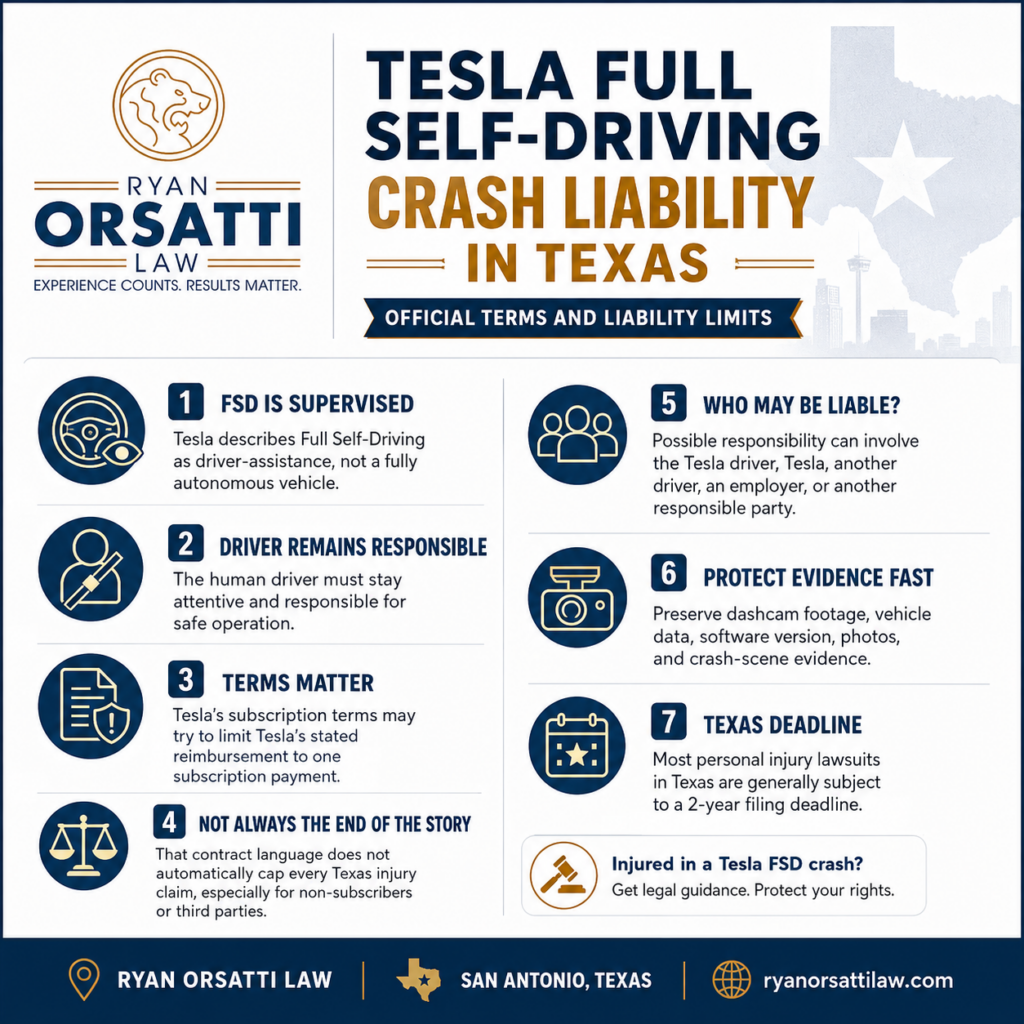
Tesla describes Full Self-Driving (Supervised) as a driver-assistance system, not an autonomous vehicle, and requires the driver to remain attentive and responsible for safe operation. Tesla’s current subscription agreement also limits its stated reimbursement to one subscription payment and sends many subscriber disputes to individual arbitration. Those provisions do not automatically create a universal $99 limit on every Texas crash injury claim. Fault, causation, contract scope, and whether the injured person agreed to Tesla’s terms must be analyzed separately.
Key Takeaways
- Tesla officially classifies Full Self-Driving as FSD (Supervised) and warns that it does not make a vehicle autonomous.
- Tesla’s public subscription agreement says the driver remains responsible and limits Tesla’s stated reimbursement to one subscription payment.
- The one-payment language is not necessarily a complete cap on personal injury damages, especially for a person who never subscribed or agreed to Tesla’s terms.
- Texas may divide fault among the Tesla driver, another driver, Tesla, and other responsible parties.
- Vehicle data, software information, camera footage, warnings, and driver inputs should be preserved before they are overwritten or lost.
- Most Texas personal injury lawsuits are subject to a two-year filing deadline, although exceptions and shorter notice requirements can apply.
What Do Tesla’s Current Full Self-Driving Terms Say About Crash Liability?
Tesla’s current terms place primary operational responsibility on the human driver. The Full Self-Driving (Supervised) Subscription Agreement states that FSD is a driver-assistance program, requires active supervision with the driver’s eyes on the road, and does not make the vehicle autonomous. Tesla also says the subscriber and authorized drivers remain responsible for safe operation and traffic violations.
Tesla’s separate FSD Support page similarly warns that the features require a fully attentive driver and do not replace the driver. The driver remains responsible for the vehicle’s speed, control, and operation at all times. As of July 22, 2026, Tesla lists FSD as a $99-per-month subscription and no longer offers it for outright purchase.
The public agreement contains several provisions that may become important after a crash:
| Issue | Tesla’s current official position | Potential significance in a Texas claim |
|---|---|---|
| Driver responsibility | FSD requires active supervision, and the driver remains responsible for safe operation | Tesla and the driver’s insurer may argue that the human driver should have intervened |
| Autonomous status | FSD does not make the vehicle autonomous | A driver generally cannot defend a crash merely by saying the software was driving |
| Stated reimbursement limit | Tesla says the most it will reimburse is one subscription payment | The clause’s scope and enforceability must be analyzed; it is not automatically a universal injury-damage cap |
| Consequential damages | Tesla disclaims responsibility for incidental, special, and consequential damages | Tesla may raise the disclaimer in a subscriber’s contract-based claim |
| Arbitration | Many disputes between a subscriber and Tesla go to individual AAA arbitration after notice and a 60-day informal resolution period | A subscriber’s claim against Tesla may proceed outside court, depending on the agreement and asserted causes of action |
| Arbitration opt-out | The agreement provides a 30-day opt-out procedure by mailed letter | Proof of a timely opt-out may affect whether Tesla can compel arbitration |
Key takeaway: Tesla’s official terms are potentially important evidence and contract language, but they do not replace the separate Texas analysis of negligence, product liability, causation, damages, and comparative fault.
Is Tesla’s Liability Really Limited to One Subscription Payment?
Tesla’s public agreement says that the most Tesla will reimburse a subscriber is one subscription payment, which is currently $99. That wording does not necessarily mean every person injured in an FSD-related crash is limited to $99 in damages. The legal effect depends on who is making the claim, what claim is asserted, what agreement was accepted, and whether the provision is enforceable under the circumstances.
A contract limitation and a tort claim are not always the same thing. A contract claim concerns duties created by an agreement. A tort claim concerns duties imposed by law, such as the duty to use reasonable care or the potential responsibility of a manufacturer for a defective product.
Tesla may argue that its limitation applies broadly. An injured claimant may respond that the clause does not cover the particular damages, cause of action, or person involved. The exact subscription agreement accepted through the Tesla account should be obtained because Tesla’s terms and product offerings can change.
What If the Injured Person Subscribed to FSD?
A subscriber may face Tesla’s limitation-of-liability and arbitration provisions because the subscriber accepted the FSD agreement. Tesla could seek to enforce those provisions against claims arising from the subscription, but enforceability may depend on the contract language, assent process, cause of action, requested damages, and applicable law.
The current agreement provides for written notice, a 60-day informal resolution period, and then individual arbitration before the American Arbitration Association. It also contains a class-action waiver and permits subscribers to opt out of arbitration by mailing specified information within 30 days after signing.
A subscriber should preserve:
- The version of the agreement accepted
- The date of acceptance
- Subscription invoices
- Any arbitration opt-out letter and mailing proof
- Tesla account communications
- The vehicle’s software-release information
- Records showing whether FSD was engaged
What If the Injured Person Was Another Driver, Passenger, Pedestrian, or Cyclist?
A nonsubscriber can argue that he or she never agreed to Tesla’s subscription terms, liability limitation, or arbitration clause. Whether Tesla can extend any provision to that person requires a fact-specific contract analysis, but a third-party crash victim is not an obvious party to the subscription agreement between Tesla and the subscriber.
The injured person may instead pursue claims against the Tesla driver, the vehicle owner, another negligent motorist, or potentially Tesla under an appropriate tort or products-liability theory. Tesla may still dispute defect, causation, damages, and responsibility even when its subscription contract does not control the claimant.
Who Can Be Liable for a Tesla FSD Crash in Texas?
Liability may be divided among everyone whose conduct or product contributed to the collision. Depending on the evidence, that may include the Tesla driver, another motorist, Tesla, a vehicle owner, a repair company, an employer, or another responsible entity.
Texas does not treat the software’s involvement as an automatic answer. Investigators must determine what the system did, what warnings it provided, what the driver saw, whether intervention was reasonably possible, and whether another person’s conduct independently caused or contributed to the crash.
When Is the Tesla Driver Potentially Liable?
The Tesla driver may be liable when the driver fails to maintain attention, control speed, respond to warnings, intervene when necessary, or otherwise operate the vehicle with reasonable care. Tesla’s own materials repeatedly tell drivers that FSD is supervised and that the driver remains responsible.
Tesla’s owner’s manual says drivers must decide whether it is safe to stop or proceed through intersections and must take over immediately when warned. It also explains that FSD can make unexpected maneuvers and may require intervention in construction zones, complex intersections, low visibility, rain, fog, bright sunlight, and low-light conditions.
A driver may have difficulty relying on “the car did it” as a complete defense when Tesla’s instructions required continuous supervision. That does not necessarily excuse a software malfunction. It means the driver’s conduct and the system’s performance must both be examined.
When Could Tesla Potentially Be Liable?
Tesla could potentially face a claim if legally sufficient evidence shows that a defect, inadequate warning, negligent design decision, or other actionable conduct caused or contributed to the crash. The Texas products-liability statutebroadly defines a products-liability action as one against a manufacturer or seller for injury, death, or property damage caused by a defective product under theories that may include strict liability, negligence, misrepresentation, or breach of warranty.
An FSD-related case normally requires more than proof that the feature was engaged. The claimant may need technical evidence addressing:
- The precise software version
- Vehicle hardware and camera configuration
- Road and weather conditions
- Whether cameras were obstructed or visibility was degraded
- The system’s steering, braking, and acceleration commands
- Driver inputs and intervention
- Attention warnings and their timing
- Whether a safer design or warning would have changed the outcome
Tesla may argue that the human driver had the last opportunity to prevent the collision. A claimant may argue that the system created an unreasonable hazard, failed to detect degraded conditions, gave an inadequate warning, or did not allow enough time for meaningful intervention. The evidence determines whether either argument is supported.
What Is NHTSA Currently Investigating About Tesla FSD?
NHTSA is currently examining whether Tesla FSD adequately detects and responds to reduced-visibility conditions. On March 18, 2026, the agency opened Engineering Analysis EA26002 covering an estimated 3,203,754 Tesla vehicles and identifying nine reduced-visibility crashes, including two injury incidents and one fatal incident. The investigation is ongoing and is not a final finding that a defect caused any particular crash.
The investigation focuses on whether FSD’s degradation-detection system recognizes conditions such as fog, dust, glare, or other limited visibility and provides drivers enough warning and time to take control. NHTSA also stated that Tesla’s system relies on vision-based cameras and raised concerns about possible limitations in incident reporting and classification.
NHTSA’s investigation can provide useful background, but it does not prove liability in an individual Texas case. A specific claimant must still connect the alleged problem to the particular crash, injury, and damages.
How Does Texas Proportionate Responsibility Apply to an FSD Crash?
Texas proportionate responsibility allows a jury or other factfinder to assign percentages of fault among the claimant, defendants, settling persons, and designated responsible third parties. Under Texas Civil Practice and Remedies Code § 33.001, an injured person generally cannot recover if his or her responsibility is greater than 50 percent. A recovery is reduced by the claimant’s assigned percentage when fault is 50 percent or less.
For example, a jury could consider whether:
- The Tesla driver failed to supervise FSD
- The software behaved unexpectedly
- Another driver violated a traffic rule
- Poorly performed repairs affected a camera or sensor
- The injured claimant contributed to the collision
- A roadway condition or another entity played a causal role
Comparative responsibility means Texas can reduce an injured person’s recovery according to that person’s percentage of fault. It also means Tesla and the driver may point at each other, while another motorist or entity may be added to the liability dispute.
Does Texas Automated-Vehicle Law Make FSD an Autonomous System?
Texas automated-vehicle law does not transform consumer FSD (Supervised) into autonomous driving. NHTSA classifies Level 2 systems as driver-assistance technology that can control steering and speed while requiring the human driver to remain fully engaged. NHTSA separately describes automated driving systems as Levels 3 through 5.
Texas now has a TxDMV authorization program for the commercial operation of automated vehicles controlled by automated driving systems. That regulatory program is different from a consumer using Tesla’s supervised Level 2 feature on an ordinary trip.
The distinction matters because a Tesla driver generally cannot assume that Texas law recognizes FSD as a replacement for the driver. Tesla’s official materials and NHTSA’s classification both require continued human supervision.
What Evidence Should Be Preserved After a Tesla FSD Crash?
The most important evidence includes the vehicle itself, event data, dashcam files, software information, driver-monitoring evidence, account records, warnings, and communications with Tesla. Preservation should begin before the vehicle is repaired, sold, totaled, transferred, remotely updated, or returned to a lender.
Tesla vehicles may contain several different sources of information:
- Event Data Recorder: Tesla states that its EDR may record vehicle-dynamics and safety-system information during a crash or near-crash, generally for 30 seconds or less.
- Dashcam: Tesla’s Dashcam may automatically save a safety-critical event, but Tesla warns that it should not be relied upon to record every event.
- Cabin camera: By default, cabin-camera video generally remains inside the vehicle. If data sharing is enabled and a safety event occurs, Tesla may receive a short clip.
- Tesla-held data: Tesla says some camera recordings are not ordinarily linked to the vehicle or account, although information received because of a collision or airbag deployment may be treated differently.
A preservation demand should identify more than “black-box data.” It may need to cover EDR information, diagnostic logs, FSD engagement records, driver inputs, warnings, attention monitoring, software versions, camera status, telemetry, account records, service history, and any information Tesla received from the vehicle.
Attorney Insight: In an FSD case, “Was the system engaged?” is only the first question. Liability often turns on the software version, exact driver inputs, attentiveness alerts, camera visibility, braking and steering commands, warning timing, and whether the evidence was preserved before repair, sale, data overwrite, remote updates, or account deletion.
Ryan Orsatti Law’s guide to evidence that can help a Texas car-accident case explains additional scene, witness, medical, and insurance documentation that may support a claim.
What Should You Do After a Tesla FSD Crash in San Antonio?
After a Tesla FSD crash, address medical and scene safety first, then preserve both ordinary collision evidence and Tesla-specific electronic evidence. San Antonio crashes on I-10, I-35, Loop 410, Loop 1604, or US-281 can involve towing, impoundment, rapid repairs, and insurer inspections that alter the vehicle before its data has been evaluated.
Use this checklist:
- Call 911 and obtain medical care. Report pain, neurological symptoms, dizziness, confusion, and other injuries accurately.
- Photograph the entire scene. Capture vehicle positions, damage, road markings, traffic controls, weather, visibility, debris, and nearby cameras.
- Preserve the Dashcam USB drive. Remove it safely, make verified copies, and avoid overwriting the original.
- Do not authorize destructive inspection or disposal. Preserve the Tesla before repair, salvage, sale, or transfer when a serious injury or disputed malfunction is involved.
- Document the software and account. Photograph the software version, FSD settings, subscription status, warning screens, service notices, and relevant Tesla-app information.
- Save the applicable agreement. Download the agreement accepted through the Tesla account, not merely the current public version.
- Send preservation notices promptly. Notices may be needed for Tesla, insurers, tow yards, repair facilities, other drivers, employers, and businesses with surveillance footage.
- Avoid speculative statements online. Do not post assumptions about whether the driver or software caused the collision.
- Have the evidence evaluated. Serious or technically disputed cases may require an EDR technician, reconstruction professional, software evidence, and formal discovery.
Key takeaway: A normal crash investigation may prove who struck whom, but an FSD investigation must also reconstruct what the software detected, commanded, communicated, and allowed the driver time to do.
How Long Do You Have to File a Tesla Crash Claim in Texas?
Most Texas personal injury lawsuits must be filed within two years after the injury under Texas Civil Practice and Remedies Code § 16.003. Wrongful-death claims generally have the same two-year limitations period, subject to the statute’s accrual language and possible exceptions.
Waiting until the deadline approaches can damage an FSD case even when the lawsuit remains timely. Electronic data may be overwritten, vehicles may be destroyed, software may be updated, witnesses may become unavailable, and video-retention periods may expire.
Additional notice deadlines may apply when a governmental entity or certain other parties are involved. Ryan Orsatti Law’s article about the Texas two-year personal injury deadline and possible exceptions provides more information.
When Can a Texas Personal Injury Lawyer Help With an FSD Crash?
A Texas personal injury lawyer can help when injuries are serious, fault is disputed, Tesla’s software may have contributed, electronic evidence is at risk, or the parties are blaming one another. Counsel can identify potential defendants, preserve the vehicle and data, analyze insurance coverage, coordinate technical inspection, and evaluate whether Tesla’s contract provisions apply to the claimant.
Ryan Orsatti Law helps injured people in San Antonio and across Texas evaluate fault, insurance coverage, medical expenses, evidence preservation, and potential claims arising from serious motor-vehicle crashes. Information about the firm’s motor-vehicle practice is available on the San Antonio car-crash lawyer page.
No lawyer can determine responsibility from the “Full Self-Driving” label alone. The analysis requires the official agreement, software configuration, physical evidence, electronic records, driver conduct, road conditions, medical evidence, and the specific sequence of the collision.
Frequently Asked Questions
Can I Sue Tesla After an FSD Crash in Texas?
You may be able to assert a claim against Tesla if evidence supports a legally recognized defect, inadequate warning, negligent act, or other actionable conduct that caused your injuries. Merely proving that FSD was engaged is not enough. The case generally requires technical evidence connecting the system’s operation to the collision and separating software-related causation from driver or third-party negligence.
Does Tesla’s $99 Subscription Limit Cap Personal Injury Damages at $99?
Not automatically. Tesla’s public agreement says its maximum reimbursement is one subscription payment, currently $99, but the provision’s reach depends on the claimant, the accepted contract, the legal theory, and enforceability. A nonsubscriber may argue that he or she never agreed to the provision. A subscriber may face a more substantial contract and arbitration dispute.
Is Tesla Full Self-Driving Legally Considered Autonomous in Texas?
No. Tesla describes FSD as supervised driver assistance, and NHTSA treats systems that simultaneously assist with steering and speed while requiring continuous driver engagement as Level 2 technology. Tesla’s manuals require the driver to remain attentive and ready to intervene. Texas’s commercial automated-vehicle program addresses a different category of vehicles controlled by automated driving systems.
Can Tesla Force Me Into Arbitration After an FSD Crash?
Tesla may seek arbitration when the claimant subscribed to FSD and accepted the current arbitration provision. The agreement requires notice, an informal resolution period, individual AAA arbitration, and a class-action waiver. A person who timely opted out or never agreed to the contract may have different arguments. The specific accepted agreement and the nature of the claims must be reviewed.
What Data Can Show Whether FSD Caused or Contributed to a Crash?
Relevant evidence may include FSD engagement records, the software version, EDR information, vehicle telemetry, steering and braking commands, accelerator input, driver interventions, attention warnings, cabin-camera information, Dashcam video, camera-obstruction data, service history, and Tesla account records. Not all information is automatically available, so prompt preservation demands and a vehicle inspection may be necessary.
Can the Tesla Driver Still Be Liable When FSD Was Operating?
Yes. Tesla’s terms and owner’s manual state that FSD requires active supervision and that the human driver remains responsible for safe operation. A driver may be liable for failing to watch the road, heed warnings, control speed, or intervene. Tesla may also share responsibility if legally sufficient evidence establishes that its system contributed to the collision.
How Long Do I Have to Bring a Tesla Crash Lawsuit in Texas?
Most Texas personal injury lawsuits must be filed within two years after the injury. Exceptions may extend or alter that deadline, while claims involving governmental entities may require much earlier notice. Evidence-preservation deadlines are often practically shorter because video, electronic information, vehicle components, and third-party records can disappear long before the formal limitations period expires.
Ryan Orsatti Law
4634 De Zavala Rd, San Antonio, TX 78249
Phone: 210-525-1200
ryanorsattilaw.com
This blog is for informational purposes only, not legal advice. Reading it does not create an attorney-client relationship. Past results do not guarantee future results.
Hurt in an accident in San Antonio? Learn how a San Antonio car accident lawyer can help with your claim. Call 210-525-1200 or request a free consultation.
The firm works on a contingency fee. You pay nothing unless the firm recovers money for you, and that covers case expenses as well as the fee: if there is no recovery, you owe no attorney's fee and no case expenses. Ask for the fee agreement and read the fee and expense section before you sign anything.
Related San Antonio legal resources
Primary legal and public-data sources
- TxDOT: Texas crash reports, data, and statistics
- Texas Civil Practice and Remedies Code Chapter 33: proportionate responsibility
Ryan Orsatti Law
4634 De Zavala Road, San Antonio, TX 78249
General reference links. Consult each source for its current text.