
Quick Answer
In Texas, the driver is usually the first potentially responsible party because Tesla’s Autopilot and Full Self-Driving (Supervised) features require an attentive human driver who is ready to take control. Tesla may also share responsibility if a defective design, software behavior, manufacturing problem, or inadequate warning helped cause the crash. Texas law allows fault to be divided among multiple parties, and an injured person who is more than 50% responsible cannot recover damages.
Key Takeaways
- Tesla’s current driver-assistance features do not make the vehicle fully autonomous.
- The Tesla driver may be responsible for failing to supervise the vehicle, respond to warnings, brake, steer, or otherwise avoid the collision.
- Tesla may be responsible if admissible evidence connects a vehicle, software, warning, or manufacturing defect to the crash.
- Texas proportionate responsibility law can divide fault among the driver, Tesla, other motorists, and the injured person.
- Tesla vehicle data, Dashcam footage, software information, phone records, and physical evidence should be preserved before the vehicle is repaired, sold, or salvaged.
- Most Texas personal injury lawsuits must be filed within two years, but valuable electronic evidence may disappear much sooner.
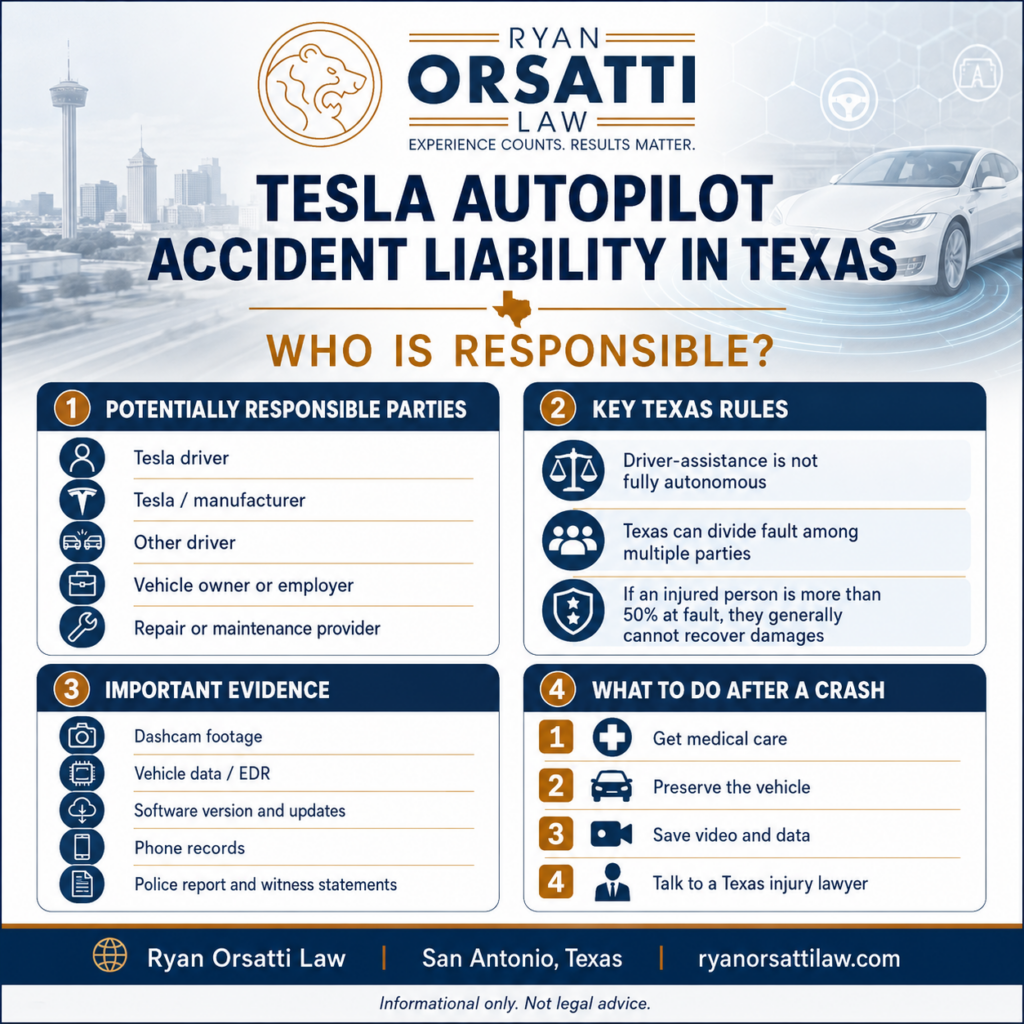
Is Tesla Autopilot Actually Self-Driving in Texas?
Tesla Autopilot and Full Self-Driving (Supervised) are driver-assistance systems, not substitutes for a human driver. Tesla’s current guidance states that these features require active driver supervision and do not make the vehicle autonomous. The driver remains responsible for controlling the vehicle, monitoring traffic, and intervening when necessary.
Tesla’s owner manuals instruct drivers to remain attentive, keep their hands available for steering, and be prepared to take over immediately. The manuals also identify limitations involving poor visibility, faded lane markings, construction zones, sharp curves, pedestrians, intersections, and other conditions.
That distinction matters in a Texas injury claim. A driver generally cannot avoid responsibility merely by saying, “Autopilot was driving.” The driver’s supervision, reaction time, speed, phone use, attention, and response to vehicle warnings may all become part of the liability investigation.
Who Can Be Responsible for a Tesla Autopilot Accident?
A Tesla Autopilot accident may involve responsibility by the driver, Tesla, another motorist, a vehicle owner, an employer, or another business connected to the vehicle. The correct defendants depend on what caused the collision, who controlled the vehicle, whether a defect existed, and what evidence can still be recovered.
| Potentially responsible party | When responsibility may apply | Important evidence |
|---|---|---|
| Tesla driver | Failure to supervise, distraction, excessive speed, delayed braking, ignored warnings, or unsafe use of the system | Driver-monitoring information, phone records, warnings, steering and braking data, witness statements |
| Tesla | Defective software or hardware, inadequate warnings, manufacturing defect, or an unreasonably dangerous design | Software version, vehicle logs, recalls, service history, testing materials, engineering analysis |
| Vehicle owner or employer | Negligent entrustment, unsafe company practices, or a driver acting within assigned work duties | Ownership records, employment documents, driving history, policies, dispatch records |
| Repair facility or parts provider | Improper repairs, sensor calibration problems, or defective replacement components | Repair invoices, diagnostic reports, calibration records, replaced components |
| Another motorist | Unsafe lane change, speeding, failure to yield, distracted driving, or another traffic violation | Crash report, video, vehicle damage, witnesses, electronic data |
Key takeaway: A Tesla Autopilot collision should be investigated as a potential multi-party case until the physical and electronic evidence identifies which human decisions, vehicle behavior, and outside conduct caused the crash.
Is the Tesla Driver Responsible When Autopilot Was Engaged?
The Tesla driver may be responsible because the driver must continue monitoring the road and remain ready to intervene. Evidence that the driver was looking at a phone, sleeping, ignoring alerts, speeding, following too closely, or failing to brake can support a negligence claim even when Autopilot or FSD (Supervised) was active.
The investigation should examine more than whether the system was turned on. It should also determine:
- When the system was activated
- Whether the driver received visual or audible warnings
- Whether driver monitoring detected inattention
- When the driver touched the steering wheel, brake, or accelerator
- Whether the system disengaged before impact
- Whether the driver had enough time to perceive and respond to the hazard
Tesla’s warnings can be important evidence, but they do not automatically decide the case. The full sequence of events must still be reconstructed.
Can Tesla Be Responsible for the Crash?
Tesla may be responsible if a defect in the vehicle, software, warnings, or manufacturing process was a producing cause of the injuries. A producing cause is a Texas product-liability requirement that connects the alleged defect to the injury rather than merely showing that the product had a problem unrelated to the collision.
Under Texas Civil Practice and Remedies Code § 82.005, a design-defect claimant must prove that a safer alternative design existed and that the defect was a producing cause of the injury. The alternative design must have been economically and technologically feasible when the product left the manufacturer’s control, while preserving the product’s usefulness.
A potential claim against Tesla may involve:
- Failure to detect a stopped vehicle or roadway obstruction
- Unsafe steering, acceleration, or braking behavior
- Inadequate driver-attention monitoring
- Misleading or insufficient operational warnings
- Sensor, camera, computer, or wiring failures
- A software update that changed vehicle behavior
- A manufacturing defect unique to the particular vehicle
An unexpected system action does not automatically establish a defect. Engineers, crash reconstructionists, software professionals, and human-factors professionals may need to compare the vehicle’s actual behavior with its design, warnings, operating conditions, and the driver’s actions.
Can Other Parties Share Responsibility?
Other parties may share responsibility when their conduct also contributed to the collision. Texas law permits the factfinder to assign percentages of responsibility to claimants, defendants, settling persons, and qualifying responsible third parties.
For example, an employer may need to be investigated if the Tesla driver was working at the time. A repair facility may be involved if cameras or sensors were improperly repaired or calibrated. Another motorist may remain responsible for creating the initial hazard even if the Tesla failed to respond as expected.
How Does Texas Proportionate Responsibility Affect an Autopilot Claim?
Texas proportionate responsibility law divides fault among everyone whose conduct contributed to the injury. Under Texas Civil Practice and Remedies Code § 33.001, an injured claimant cannot recover damages if the claimant’s responsibility is greater than 50%. If the claimant is 50% or less responsible, the recovery is generally reduced by that percentage.
For example, a jury might find that a Tesla driver failed to supervise the system, that Tesla supplied a defective component, and that another motorist made an unsafe lane change. The jury may assign a percentage to each party based on the evidence.
This rule also matters when the injured person was driving the Tesla. The defense may argue that the claimant ignored warnings, used the feature in unsafe conditions, or failed to intervene. Preserving the actual data is essential because fault should be based on what occurred, not assumptions about how the technology normally works.
What Evidence Can Prove Autopilot Was Involved?
Autopilot involvement may be proven through vehicle data, Dashcam footage, physical evidence, witness accounts, service records, software information, and driver communications. No single record will answer every question, and the available data can vary by Tesla model, model year, software version, settings, and crash circumstances.
Tesla states that its vehicles may contain an event data recorder, or EDR, that records information about vehicle dynamics and safety systems for a short period surrounding a crash. Tesla Dashcam footage may also show roadway conditions, surrounding vehicles, and the moments before impact if the system was properly configured with storage media.
Relevant evidence may include:
- EDR information concerning speed, braking, acceleration, and restraint systems
- Autopilot or FSD engagement and disengagement information
- Driver-attention warnings
- Steering, accelerator, and brake inputs
- Tesla Dashcam and Sentry Mode recordings
- The vehicle’s software version and update history
- Camera, radar, ultrasonic sensor, and computer diagnostic records
- Tesla service and repair records
- The driver’s phone records, messages, and app activity
- Photographs of the roadway, vehicle positions, skid marks, and debris
- Traffic-camera, business-security, and residential-doorbell footage
- The police crash report and 911 recordings
- Tow-yard, salvage, and repair documentation
Federal law generally treats EDR information as belonging to the vehicle’s owner or lessee and restricts access without consent, judicial authorization, or another statutory exception. A lawyer may need to obtain permission, serve discovery, seek a court order, or coordinate a formal download.
Attorney Insight
In a Tesla Autopilot case, the first dispute is often not who was negligent. It is what data still exists. A repaired or salvaged vehicle, overwritten USB footage, undocumented software update, or delayed preservation request can eliminate the strongest evidence of system engagement, warnings, braking, steering, and driver response.
What Has NHTSA Found About Tesla Autopilot Crashes?
NHTSA has identified recurring concerns involving driver attention and delayed intervention, but its investigations do not establish liability in any individual Texas case. In an April 2024 investigation report, the agency stated that it had reviewed 956 crashes in which Autopilot was initially alleged to have been used before August 2023.
NHTSA conducted a closer analysis of 211 frontal-plane crashes. That group included 13 fatal crashes involving 14 deaths and 49 reported injuries. Among 109 crashes with sufficient time information, the hazard was visible for at least five seconds in 59 incidents. Drivers did not brake, or braked less than one second before impact, in 82% of those incidents.
Those numbers should be interpreted carefully. NHTSA warns that manufacturer crash-reporting data is incomplete, depends on different data-collection capabilities, and is not normalized for vehicle mileage or fleet size. Raw crash counts should not be used to compare manufacturers or decide who caused a particular collision.
What Should I Do After a Tesla Autopilot Accident in Texas?
After a Tesla Autopilot accident, obtain medical care, document the scene, preserve the vehicle, and prevent electronic data from being erased. Evidence preservation should begin before repairs, salvage transfers, software changes, or insurance inspections alter the vehicle.
- Call 911 and report the collision. Ask for police and emergency medical assistance when needed.
- Obtain appropriate medical care. Some neck, back, brain, and internal injuries may not be fully apparent at the scene.
- Photograph and record the scene. Capture vehicle positions, damage, road markings, traffic signals, weather, construction conditions, and nearby cameras.
- Save the Tesla USB device. Remove and secure the Dashcam storage device when it can be done safely. Do not overwrite, edit, or repeatedly access the files.
- Do not authorize destructive repairs or disposal. Ask the insurer, repair facility, tow yard, and salvage company to preserve the vehicle.
- Record what the driver said. Note any statement about Autopilot, FSD, warnings, braking, steering, distraction, or an unexpected vehicle movement.
- Preserve account and software information. Save screenshots showing the Tesla model, software version, enabled features, subscriptions, driver profile, and recent updates.
- Identify witnesses and outside video. Nearby businesses and homes may erase recordings within days.
- Avoid public speculation. Social media posts about the technology, injuries, speed, or fault can be taken out of context.
- Consult a Texas personal injury lawyer promptly. Counsel can evaluate whether preservation notices, a vehicle inspection, an EDR download, or legal process directed to Tesla and other parties is appropriate.
What Insurance May Cover a Tesla Autopilot Accident?
Insurance coverage depends on who caused the crash, who owned the Tesla, whether the driver was working, and which policies were in effect. Potential sources may include the driver’s bodily injury liability coverage, an owner’s policy, a commercial or employer policy, the injured person’s UM/UIM coverage, and coverage available to a responsible manufacturer or business.
Uninsured and underinsured motorist coverage, commonly called UM/UIM, may apply when the responsible driver has no insurance or insufficient limits. Ryan Orsatti Law provides information about uninsured and underinsured motorist claims in San Antonio.
Health insurance, personal injury protection, medical payments coverage, disability benefits, and other sources may also affect how treatment is paid while the liability claim is pending. Each policy must be reviewed separately because exclusions, limits, reimbursement rights, and notice requirements can differ.
How Long Do I Have to File a Tesla Accident Lawsuit in Texas?
Most Texas personal injury lawsuits must be filed within two years after the injury under Texas Civil Practice and Remedies Code § 16.003. Exceptions can shorten, extend, or otherwise affect the deadline, so the limitations date should be evaluated from the specific facts rather than assumed.
The filing deadline is not the same as the evidence-preservation deadline. Dashcam footage may be overwritten, vehicles may be sold or destroyed, witnesses may become unavailable, and software may change long before two years pass.
Claims involving a governmental vehicle, public employee, minor, death, or another jurisdiction may raise additional notice or limitations issues. Early investigation protects options even if no lawsuit is immediately filed.
When Should I Contact a Texas Personal Injury Lawyer?
Legal review is particularly important when someone suffered a serious injury, the Tesla may be totaled or salvaged, Autopilot use is disputed, multiple parties may share fault, or an insurer is requesting a recorded statement. These cases can require rapid coordination among medical providers, vehicle inspectors, crash reconstructionists, insurance carriers, and technology professionals.
Ryan Orsatti Law helps injured people in San Antonio and across Texas evaluate fault, insurance coverage, medical expenses, and evidence-preservation issues after serious crashes. The firm handles San Antonio car accident claims, including cases involving catastrophic injuries and wrongful death.
A prompt investigation may include preserving the Tesla, arranging a data download, obtaining available video, documenting software and settings, identifying all applicable policies, and determining whether the evidence supports claims against the driver, Tesla, or another party.
Frequently Asked Questions
Can I Sue Tesla if Autopilot Caused My Crash in Texas?
You may be able to bring a claim against Tesla if evidence shows that a defective design, manufacturing defect, inadequate warning, or other wrongful conduct was a producing cause of the crash. A system error by itself is not enough. Texas product-liability law requires proof connecting the alleged defect to the injury, and a design-defect claim generally requires a feasible safer alternative design.
Is the Tesla Driver Still Liable if Autopilot Was Turned On?
Yes, the Tesla driver may still be liable because Tesla requires drivers using Autopilot or FSD (Supervised) to remain attentive and ready to intervene. The driver’s speed, attention, phone use, reaction to warnings, braking, and steering may be examined. Tesla may also share responsibility if a defect contributed to the same collision.
How Do I Prove Autopilot Was Engaged During the Crash?
Autopilot use may be established through vehicle data, driver-monitoring information, warnings, steering and braking inputs, software records, Tesla account information, Dashcam video, witness statements, and the driver’s admissions. The vehicle and USB storage should be preserved promptly because repairs, software changes, salvage transfers, and routine overwriting can affect the available evidence.
Can a Passenger Make a Claim After a Tesla Autopilot Crash?
A passenger may pursue claims against the parties whose conduct caused the crash, which may include the Tesla driver, another motorist, Tesla, a vehicle owner, or an employer. A passenger is usually not responsible for operating the vehicle, but every claim depends on the facts, available insurance, injuries, and preserved evidence.
Does a Tesla Recall Automatically Prove Tesla Is Liable?
No. A recall may be relevant evidence, but it does not automatically prove that Tesla caused a particular crash. The claimant must still establish that the recalled condition existed in the vehicle, affected its operation, and caused or contributed to the collision and injuries. Tesla may also argue that driver conduct or another event caused the crash.
What if the Tesla Driver Says Autopilot Caused the Accident?
The driver’s statement should trigger a broader investigation, not end the liability analysis. Vehicle data, physical evidence, software information, warnings, driver inputs, video, and witness testimony should be compared. Texas law may allocate responsibility between the driver, Tesla, and other parties if more than one act or defect contributed to the collision.
How Long Do I Have to Sue After a Tesla Accident in Texas?
The general Texas deadline for filing a personal injury lawsuit is two years from the injury date. Exceptions may apply, and claims involving death, minors, governmental parties, or events outside Texas require separate analysis. Electronic and physical evidence may disappear much sooner, so waiting until the limitations deadline can substantially weaken the investigation.
Ryan Orsatti Law
4634 De Zavala Rd, San Antonio, TX 78249
Phone: 210-525-1200
ryanorsattilaw.com
This blog is for informational purposes only, not legal advice. Reading it does not create an attorney-client relationship. Past results do not guarantee future results.
Hurt in an accident in San Antonio? Learn how a San Antonio car accident lawyer can help with your claim. Call 210-525-1200 or request a free consultation.
The firm works on a contingency fee. You pay nothing unless the firm recovers money for you, and that covers case expenses as well as the fee: if there is no recovery, you owe no attorney's fee and no case expenses. Ask for the fee agreement and read the fee and expense section before you sign anything.
Related San Antonio legal resources
Primary legal and public-data sources
- TxDOT: Texas crash reports, data, and statistics
- Texas Civil Practice and Remedies Code Chapter 33: proportionate responsibility
Ryan Orsatti Law
4634 De Zavala Road, San Antonio, TX 78249
General reference links. Consult each source for its current text.