
Quick Answer
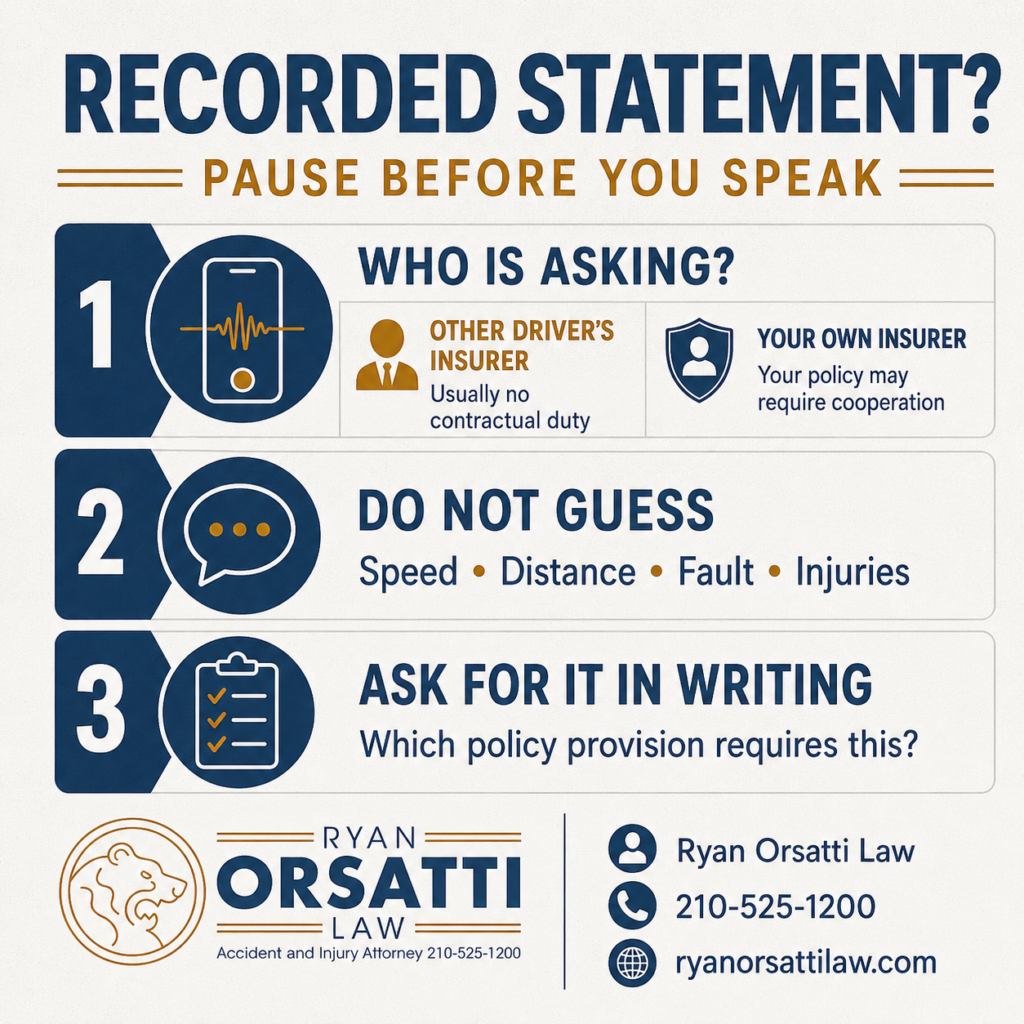
A recorded statement is an audio-recorded interview in which an insurance adjuster asks about a crash, fault, injuries, treatment, and damages. You generally should not give a broad recorded statement to the other driver’s insurer before getting legal advice. Your own insurer is different because your policy may require cooperation, but you can ask why the statement is required, review the policy, and prepare before answering.
Key Takeaways
- You generally have no contractual duty to give a recorded statement to the other driver’s insurance company.
- Your own auto policy may require you to cooperate with your insurer’s investigation.
- Reporting a claim is not the same as agreeing to a detailed recorded interview.
- Do not guess about speed, distance, fault, injuries, prior conditions, or future treatment.
- A recording may be compared with medical records, crash evidence, depositions, and later testimony.
- If you already gave a statement, request a copy and avoid trying to “fix” it with another unprepared call.
What Is a Recorded Statement in an Insurance Claim?
A recorded statement is a question-and-answer interview that an insurance adjuster records and adds to the claim file. The adjuster may ask about how the collision happened, what you observed, when symptoms began, your medical history, missed work, vehicle damage, and other losses.
A recorded statement is usually taken by phone, although video interviews are possible. It is not the same as:
- Reporting the date, location, and basic facts of the crash
- Giving information to a police officer at the scene
- Testifying in a deposition after a lawsuit is filed
- Submitting medical bills or property-damage photographs
- Participating in an examination under oath required by a policy
The distinction matters. You can usually report a claim and provide essential documents without immediately agreeing to an unrestricted interview about every possible issue.
After a San Antonio crash on I-10, I-35, Loop 410, Loop 1604, or US-281, the adjuster may call before you have the police report, vehicle photographs, witness information, imaging results, or a complete diagnosis. Our San Antonio car accident guide explains the broader insurance and evidence issues that can arise.
Should I Give a Recorded Statement After a Texas Car Accident?
You generally should not give a recorded statement to the other driver’s insurer without legal guidance. The Texas Department of Insurance explains that you do not have a contract with the other driver’s insurance company, so your rights and obligations differ from those involved in a claim under your own policy.
The answer changes when your own insurance company is asking. Your policy may require reasonable cooperation for collision, personal injury protection, medical payments, uninsured or underinsured motorist coverage, or a liability claim made against you. Do not ignore your insurer, but do not assume you must provide an unlimited interview immediately.
| Who is requesting the statement? | Are you generally required to give one? | Practical response |
|---|---|---|
| Other driver’s liability insurer | Usually no | Decline the recorded interview and request written communication |
| Your own auto insurer | Possibly, depending on the policy and claim | Ask for the applicable policy provision and scope |
| Trucking company or commercial insurer | Usually no, unless it is also your insurer | Preserve evidence and obtain advice before speaking |
| Rideshare or delivery-company insurer | Fact-dependent | Identify which policy and coverage layer the adjuster represents |
| Police officer investigating the crash | Different legal context | Provide accurate facts, but do not guess or speculate |
Key takeaway: First identify whom the adjuster represents because your duties to your own insurer may be very different from your duties to the other driver’s insurer.
Why Do Insurance Adjusters Ask for Recorded Statements?
Insurance adjusters request recorded statements to investigate coverage, fault, injury causation, and damages. The statement gives the insurer an early version of events that it can compare with the crash report, photographs, witness accounts, medical records, employment documents, and later testimony.
Timing creates much of the risk. According to TxDOT’s 2024 crash facts, 251,977 people were injured in Texas traffic crashes, including 18,218 people who sustained serious injuries. An injured person may receive an adjuster’s call before doctors understand the full medical picture.
Common recorded-statement topics include:
- Speed, braking, lane position, traffic signals, and right of way
- Whether you saw the other vehicle before impact
- Phone, GPS, radio, or other device use
- Seat-belt or helmet use
- Statements made at the scene
- Symptoms immediately after the crash
- When and where you first received medical treatment
- Previous injuries, treatment, surgeries, or similar symptoms
- Missed work and current work restrictions
- Alcohol, medications, fatigue, or distraction
- Vehicle ownership, household drivers, and insurance coverage
Some of these are legitimate investigation topics. The danger is giving incomplete, imprecise, or speculative answers before you have the information needed to answer accurately.
How Can a Recorded Statement Affect Fault or an Injury Claim?
A recorded statement can affect how an insurer evaluates responsibility, causation, credibility, and damages. Under Texas Civil Practice and Remedies Code Chapter 33, a claimant cannot recover damages if the claimant’s percentage of responsibility is greater than 50 percent, and a permitted recovery is reduced by the claimant’s assigned percentage.
Proportionate responsibility means that Texas can reduce a claimant’s recovery according to the claimant’s percentage of fault. A casual answer such as “I may have been going a little fast” or “I did not see the other car” could become part of an argument that the injured person shares responsibility.
Injury-related answers can also create disputes:
- “I’m fine” may be cited when later medical records document pain or neurological symptoms.
- “Only my neck hurts” may be compared with later reports of back, shoulder, or head symptoms.
- “I had back problems before” may be used to argue that current symptoms were preexisting.
- “I barely missed any work” may conflict with later work restrictions or missed appointments.
- An estimated speed or distance may conflict with video, vehicle data, or physical evidence.
A prior statement is not automatically admissible at trial. Admissibility depends on authentication, context, purpose, and other evidentiary requirements. However, Texas Rule of Evidence 801(e)(2) provides that certain statements offered against an opposing party are not hearsay, while Rule 613 addresses prior inconsistent statements.
Attorney Insight: The most damaging answers are often not dramatic admissions. They are ordinary phrases given too early. An injured person may accurately report neck pain on the first day, then develop headaches, numbness, or radiating pain as symptoms evolve. The insurer may later characterize the additional symptoms as inconsistent. Accuracy sometimes means saying, “I am still being evaluated.”
Do I Have to Give a Recorded Statement to My Own Insurance Company?
Your own insurer may require reasonable cooperation under the language of your auto policy, but that does not necessarily require an immediate or unlimited recorded interview. Ask the adjuster to identify the policy provision, the coverage involved, the subjects to be discussed, and whether a written response or narrower interview will satisfy the request.
The Texas Department of Insurance’s claim guidance confirms that an insurer may request information needed to investigate a first-party claim. Texas policies vary, so the policy itself must be reviewed.
Texas law also treats noncooperation seriously in certain circumstances. Texas Insurance Code § 551.1053 addresses an insured’s failure to cooperate when the insurer investigates, settles, or defends a third-party liability claim against its insured. That statute does not make every recorded interview unlimited or automatically mandatory.
Your own insurer may be handling:
- Collision or vehicle-damage coverage
- Rental reimbursement
- Personal injury protection, commonly called PIP
- Medical payments coverage, commonly called MedPay
- Uninsured or underinsured motorist coverage, commonly called UM/UIM
- A liability claim filed against you
- Towing, storage, or total-loss issues
UM/UIM claims require particular care because your insurer may dispute the other driver’s fault, your damages, or whether the other driver was legally uninsured or underinsured. Review the firm’s Texas UM/UIM coverage guidebefore discussing that part of a claim.
What Should I Do When an Adjuster Requests a Recorded Statement?
When an adjuster requests a recorded statement, identify the insurer, request the basis for the interview, and avoid discussing disputed facts until you understand the request. You can be courteous and responsive without consenting to an immediate, unrestricted recording.
Use this checklist:
- Confirm the caller’s identity. Get the adjuster’s name, company, telephone number, email address, and claim number.
- Determine whom the adjuster represents. Ask whether the caller represents you, the other driver, an employer, a trucking company, or another business.
- Ask whether the statement is required. If the adjuster says yes, request the policy provision or legal basis in writing.
- Clarify the scope. Ask whether the interview concerns property damage, liability, bodily injury, medical benefits, UM/UIM coverage, or another issue.
- Request time to review documents. Obtain the crash report, photographs, witness information, medical records, and your policy before answering detailed questions.
- Do not guess. “I do not know,” “I do not remember,” and “I need to review the records” are appropriate when truthful.
- Get legal advice before a broad interview. This is particularly important for disputed fault, serious injuries, prior conditions, missed work, commercial vehicles, or UM/UIM claims.
A concise response to the other driver’s insurer can be:
“I am not agreeing to a recorded statement at this time. Please send your questions and requests in writing.”
Do not provide a long explanation. Conversation before the formal recording starts can still be summarized in the adjuster’s claim notes. Additional communication risks are discussed in our guide to what not to do after a Texas car accident.
What If I Already Gave the Insurance Company a Recorded Statement?
If you already gave a recorded statement, do not assume that your claim is ruined. Preserve the statement, document what happened, continue appropriate medical care, and obtain advice before making additional statements or signing releases.
Take these steps:
- Request the audio recording and any transcript in writing.
- Write down the questions you remember and how you answered.
- Save emails, text messages, voicemails, and claim correspondence.
- Do not call the adjuster to argue about or casually revise your answers.
- Correct a material factual error in a deliberate written communication when appropriate.
- Keep attending medically necessary appointments and accurately report symptoms.
- Do not sign a settlement release before understanding your injuries and coverage.
If you said you felt fine but symptoms later appeared, tell your medical providers when the symptoms began and how they changed. Do not exaggerate or try to reshape the history. Consistent, accurate documentation is more useful than an improvised explanation.
When Should I Speak With a Texas Personal Injury Lawyer?
Consider speaking with a Texas personal injury lawyer before giving a statement if you were injured, fault is disputed, more than one insurance policy may apply, or the crash involved a commercial vehicle. Early review can identify the correct insurer, preserve evidence, clarify policy duties, and prevent an unnecessary interview from controlling the claim.
Legal guidance may be especially helpful when:
- The adjuster claims you caused part of the crash
- You have a concussion, spinal injury, fracture, or surgery recommendation
- Your symptoms are changing or your diagnosis is incomplete
- You had prior treatment involving the same body part
- You missed work or received formal work restrictions
- An 18-wheeler, delivery vehicle, rideshare driver, or company employee was involved
- Your own insurer requests a UM/UIM statement
- The insurer is pressing for a quick settlement or broad medical authorization
Commercial crashes may involve electronic logging data, dash cameras, dispatch records, driver files, and vehicle information that can disappear or be overwritten. The firm’s San Antonio truck accident resource explains why early evidence preservation matters.
Ryan Orsatti Law helps injured people in San Antonio, Bexar County, and across Texas evaluate recorded-statement requests, insurance coverage, fault evidence, medical documentation, and claim deadlines. Whether a statement should be given depends on the insurer, policy, coverage, injuries, and disputed facts.
What Do Texans Ask About Recorded Statements?
The most common questions concern whether a statement is mandatory, what an adjuster may ask, and how the recording can affect a claim. The answers depend primarily on which insurer is requesting the statement and whether the request arises under your own policy.
Do I have to give a recorded statement to the other driver’s insurance company?
You generally do not have a contractual obligation to give the other driver’s insurer a recorded statement before litigation. You may provide basic information needed to identify and report the claim without agreeing to a detailed interview. If legal process is later issued in a lawsuit, different duties and procedures can apply.
Can my own insurance company require a recorded statement?
Your own insurer may require cooperation or claim-related information under your policy. Whether that includes a recorded statement depends on the policy language, coverage, and purpose of the request. Do not ignore the request. Ask for the applicable provision, clarify the scope, review important documents, and obtain legal advice if injuries or coverage are disputed.
Can a recorded statement be used against me in court?
A recorded statement may potentially be offered against you, but it is not automatically admissible. Texas evidence rules concerning authentication, opposing-party statements, prior inconsistent statements, relevance, and other objections may apply. Even if the recording is never played at trial, it can influence claim evaluation, settlement discussions, deposition questions, and defense strategy.
What should I say when an adjuster calls right after the crash?
Confirm your identity, contact information, claim number, accident date, and vehicle information. Avoid guessing about speed, distance, fault, injuries, diagnoses, prior conditions, or future treatment. Tell the adjuster you are not giving a recorded statement at that time and ask that all requests be sent to you in writing.
What if I said “I’m fine” and later discovered an injury?
Saying “I’m fine” does not automatically defeat a Texas injury claim. Seek appropriate medical care, accurately explain when your symptoms began, and follow reasonable treatment recommendations. Medical records may help document the progression of an injury. Avoid giving another broad statement merely to explain the first one without reviewing the circumstances and obtaining advice.
Will refusing a recorded statement delay my insurance claim?
Refusing the other driver’s request may affect how quickly that insurer chooses to evaluate a voluntary claim, but it does not create a contractual duty that otherwise did not exist. If your own insurer made the request, an outright refusal could affect coverage. Ask what information is actually needed and whether documents, written answers, or a limited interview will suffice.
How long do I have to decide whether to give a statement?
An adjuster’s requested response date is not necessarily the deadline for filing a lawsuit. Most Texas personal injury claims are generally subject to a two-year limitations period under Texas Civil Practice and Remedies Code § 16.003, although exceptions and shorter notice requirements may apply. Evidence and policy deadlines can arise much sooner.
Ryan Orsatti Law
4634 De Zavala Rd, San Antonio, TX 78249
Phone: 210-525-1200
ryanorsattilaw.com
This blog is for informational purposes only, not legal advice. Reading it does not create an attorney-client relationship. Past results do not guarantee future results.
Hurt in an accident in San Antonio? Learn how a San Antonio car accident lawyer can help with your claim. Call 210-525-1200 or request a free consultation.
The firm works on a contingency fee. You pay nothing unless the firm recovers money for you, and that covers case expenses as well as the fee: if there is no recovery, you owe no attorney's fee and no case expenses. Ask for the fee agreement and read the fee and expense section before you sign anything.
Related San Antonio legal resources
Primary legal and public-data sources
Ryan Orsatti Law
4634 De Zavala Road, San Antonio, TX 78249
General reference links. Consult each source for its current text.