
Quick Answer
Pre-existing conditions do not automatically defeat a San Antonio personal injury claim. In Texas, the key question is whether the accident caused a new injury or aggravated, meaning worsened, a prior condition. Texas generally gives injured people two years to file a personal injury lawsuit under Texas Civil Practice & Remedies Code § 16.003, and delay can make medical causation harder to prove. (Texas Statutes) Ryan Orsatti Law helps injured people in San Antonio and across Texas document the medical timeline, insurance coverage, and evidence needed to evaluate this issue.
Key Takeaways
- A pre-existing condition does not end your claim, but it usually makes causation more disputed.
- Texas law focuses on what the accident changed, not whether you were perfectly healthy before.
- Insurance adjusters often compare old medical records, new symptoms, imaging, treatment gaps, and prior complaints.
- TxDOT reported 48,522 total crashes in Bexar County in 2024, including 897 suspected serious injuries, which means local injury claims often turn on careful medical documentation. (TxDOT)
- Do not hide prior conditions. The safer approach is to explain the “before and after” difference with records, treating-provider notes, and consistent symptom history.
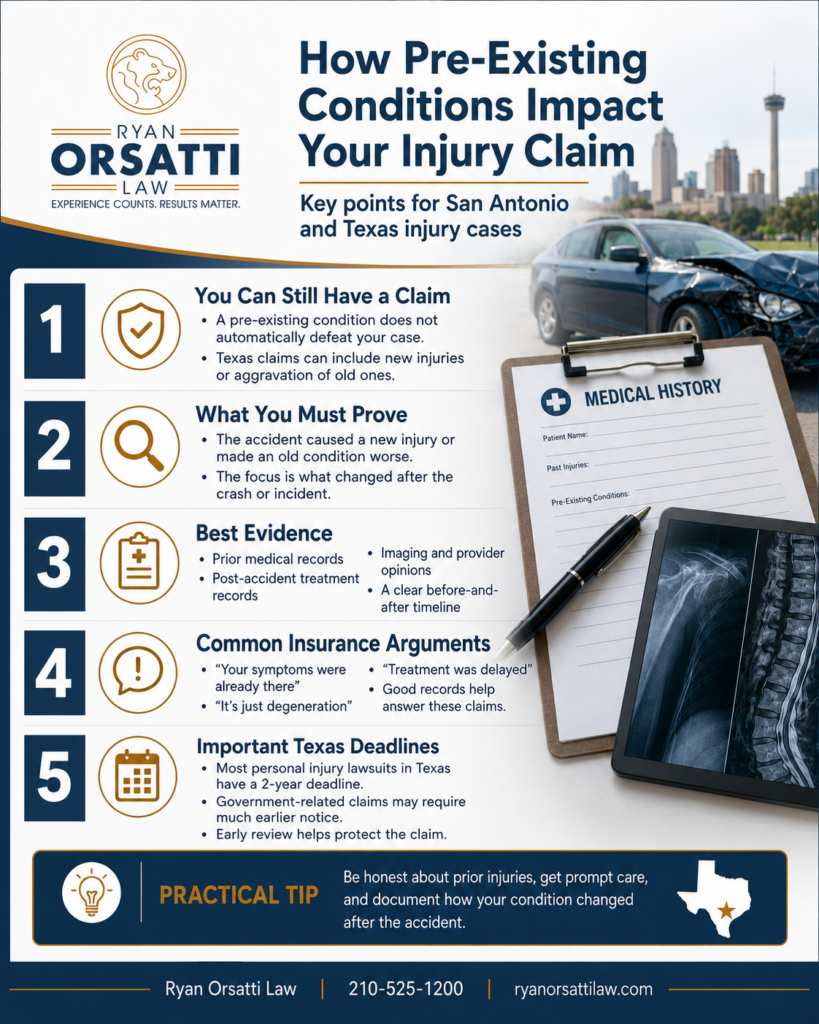
What counts as a pre-existing condition in a San Antonio personal injury claim?
A pre-existing condition is any injury, illness, diagnosis, pain complaint, surgery, or medical limitation that existed before the accident involved in your claim. In a San Antonio personal injury case, the condition may be old, active, dormant, mild, severe, symptomatic, or asymptomatic. The claim usually turns on whether the crash, fall, or other incident made that condition worse.
Common examples include degenerative disc disease, prior herniated discs, arthritis, knee injuries, shoulder injuries, migraines, concussion history, anxiety, diabetes, chronic pain, prior surgeries, and old fractures. The condition does not have to involve the same body part, but disputes become sharper when the old condition and new injury overlap.
What conditions commonly get disputed?
The most disputed conditions are usually back, neck, shoulder, knee, hip, head, and chronic pain conditions because they often appear in older records and imaging. Adjusters may argue that disc degeneration, arthritis, headaches, or prior pain complaints explain your current symptoms. Your response should focus on what changed after the event, including pain level, function, treatment needs, work limits, and objective findings.
For example, a person with manageable low-back pain before a Loop 1604 crash may have a valid claim if the collision caused a new disc herniation, worsened nerve symptoms, required injections, or changed the person’s ability to work. The old condition matters, but the legal and medical focus is the accident-caused worsening.
How does Texas law treat an accident that makes an old condition worse?
Texas law can allow damages for accident-caused aggravation of a prior condition, but not for unrelated medical problems that would have existed anyway. The Texas Supreme Court recognized in Hoke v. Poser that a jury could consider damages directly and proximately caused by a collision, including aggravation of a pre-existing condition. (Justia)
This is often called the “eggshell plaintiff” concept. In plain English, the person who causes harm does not get a discount simply because the injured person was more vulnerable than someone else. At the same time, the injured person still must prove the accident caused the worsening.
Medical causation means the link between the incident and the health change. In complex injury cases, Texas courts may require medical proof beyond lay testimony. In Guevara v. Ferrer, the Texas Supreme Court held that medical causation generally needs expert medical evidence unless the condition and causal link are within common knowledge. (Justia)
How do insurance companies use pre-existing conditions against injured Texans?
Insurance companies often use pre-existing conditions to argue that the accident did not cause the claimed injury, did not make it worse, or caused only a temporary flare-up. This does not mean the argument is correct. It means your records need to show the difference between your medical baseline before the accident and your condition afterward.
Common adjuster arguments include:
- “The MRI only shows degeneration.”
- “The claimant had the same pain before.”
- “The crash was too minor to cause this treatment.”
- “There was a delay in treatment.”
- “The claimant had a prior accident.”
- “The surgery was inevitable.”
- “The new symptoms are unrelated.”
These arguments are usually strongest when the records are inconsistent. They are weaker when the medical file clearly shows a stable prior condition, a new event, prompt symptoms, consistent complaints, objective testing, a reasoned medical opinion, and a treatment plan tied to the accident.
Attorney Insight: The most damaging fact is often not the pre-existing condition itself. It is an unexplained gap, a vague medical history, or a record that says “doing fine” before the claim later says “severe ongoing symptoms.” Before a demand is sent, the medical timeline should compare symptoms, treatment frequency, medications, work limits, and daily function before and after the incident.
What evidence proves the accident changed your condition?
The best evidence is a clear before-and-after medical timeline showing how your symptoms, function, treatment, and objective findings changed after the accident. A pre-existing condition case should not be presented as “I never had a problem before” if that is not true. It should be presented as “this is what my condition was before, and this is how the accident made it worse.”
| Evidence | Why it matters | What to preserve |
|---|---|---|
| Pre-accident medical records | Shows your baseline before the incident | Primary care, orthopedic, chiropractic, pain management, imaging, pharmacy records |
| Post-accident treatment records | Shows timing, symptoms, diagnosis, and treatment plan | ER records, urgent care, specialist visits, therapy notes |
| Imaging before and after the accident | Helps compare old findings to new or worsened findings | X-rays, MRIs, CT scans, radiology reports, image discs |
| Work and activity history | Shows functional change | Missed work, job restrictions, fitness logs, family-care limitations |
| Medication history | Shows whether pain management changed | Pharmacy records, new prescriptions, dosage changes |
| Treating-provider opinions | Helps connect the worsening to the incident | Causation opinions, impairment notes, referrals |
| Crash or incident evidence | Helps show force, mechanism, and timing | TxDOT crash report, photos, witness statements, property damage photos |
Key takeaway: A pre-existing condition claim is strongest when the records show a credible baseline before the accident and a medically supported change afterward.
What should your medical timeline show?
Your medical timeline should show the condition before the accident, the accident date, the first symptoms after the accident, the first treatment visit, and every meaningful change in diagnosis or function. The goal is to make causation understandable. If the defense says your pain was “already there,” the timeline should show whether it became more frequent, more severe, more limiting, or required different treatment.
For example, the timeline may show that before the crash you saw a doctor once every six months for manageable pain, but after the crash you needed emergency care, injections, therapy, work restrictions, or surgical evaluation. That contrast often matters more than the mere existence of an old diagnosis.
How do Texas deadlines, fault rules, and medical bills affect these claims?
Texas deadlines, fault rules, and medical-expense rules still apply when pre-existing conditions are involved. A prior condition does not pause the statute of limitations, remove the need to prove causation, or avoid proportionate responsibility. These rules affect timing, settlement evaluation, litigation risk, and the evidence needed to present the claim.
| Texas issue | Rule or practical effect | Why it matters in a pre-existing condition claim |
|---|---|---|
| Filing deadline | Most Texas personal injury lawsuits must be filed within two years under § 16.003 | Waiting can create treatment gaps and make causation harder to prove |
| Comparative responsibility | Under Texas Civil Practice & Remedies Code § 33.001, a claimant may not recover damages if their responsibility is greater than 50% | Fault disputes can reduce or bar recovery even when the injury evidence is strong (Texas Statutes) |
| Medical bills | Texas Civil Practice & Remedies Code § 41.0105 limits recovery of medical expenses to amounts actually paid or incurred | The medical bill number may differ from the amount legally recoverable (Texas Statutes) |
| Paid-or-incurred evidence | In Haygood v. Garza de Escabedo, the Texas Supreme Court addressed recoverable medical expenses under § 41.0105 | Health insurance adjustments, balances, and liens must be reviewed carefully (Justia) |
| PIP and UM/UIM | TDI explains that Texas auto policies include PIP unless rejected in writing, and insurers must offer UM/UIM coverage | Your own policy may provide benefits even while the injury dispute continues (Texas Department of Insurance) |
Key takeaway: Pre-existing condition claims are not only about medicine. They also require deadline analysis, fault analysis, insurance coverage review, and careful medical-bill evaluation.
Subrogation means a health insurer may claim a right to be paid back from a settlement. Paid-or-incurred means Texas past medical expense recovery is tied to amounts paid or still owed, not every sticker price shown on a bill. Comparative responsibility means Texas can reduce damages by a claimant’s percentage of fault and can bar recovery if the claimant is more than 50% responsible.
What if a government vehicle or public property is involved?
If a City of San Antonio vehicle, VIA bus, public employee, public road condition, or other governmental unit may be involved, notice rules may apply much earlier than the normal lawsuit deadline. Texas Civil Practice & Remedies Code § 101.101 generally entitles a governmental unit to notice of a claim within six months after the incident. (Texas Statutes)
This is separate from proving the medical injury. If your pre-existing condition was aggravated in a crash involving a public vehicle or on public property, you should evaluate notice issues quickly because delay can create both legal and medical proof problems.
What should you do after an accident if you already had a medical condition?
You should be honest about your prior condition and immediately document what changed after the accident. Do not exaggerate, hide old records, or tell a doctor you had “no prior problems” if that is not accurate. In a Texas injury claim, credibility is often as important as the medical evidence.
- Get medical care promptly. Tell the provider what hurt before, what changed after the incident, and whether the pain is new, worse, or different.
- Identify your baseline. Write down your symptoms, limitations, medications, appointments, and work ability before the accident.
- Track the change. Keep a daily or weekly symptom log that records pain, sleep issues, mobility, missed work, and household limitations.
- Save prior records. Do not assume old records hurt you. They may prove your condition was stable before the crash.
- Avoid blanket recorded statements. Adjusters may ask broad questions designed to frame your symptoms as old or unrelated.
- Do not sign broad medical authorizations without review. A narrow request may be appropriate, but an unlimited release can invite unnecessary disputes.
- Review your own insurance. Look for PIP, MedPay, UM/UIM, and health coverage that may help while liability is disputed.
- Talk to a Texas personal injury lawyer before settling. A release can end the claim before future treatment, liens, or causation disputes are fully evaluated.
When should a San Antonio personal injury lawyer review a pre-existing condition claim?
A San Antonio personal injury lawyer should review the claim early if the same body part was injured before, imaging shows degeneration, treatment is delayed, surgery is discussed, the adjuster asks for old records, or the insurer says the injury is “not accident related.” Early review helps identify what records are needed before the claim is framed incorrectly.
Ryan Orsatti Law helps injured people in San Antonio and across Texas evaluate pre-existing condition disputes after serious crashes, falls, and other injury events. The firm can review liability, treatment history, insurance coverage, medical billing, subrogation issues, and whether the evidence supports an accident-related aggravation.
Helpful related resources include the firm’s pages on San Antonio car accident claims, San Antonio traumatic brain injury claims, catastrophic injury claims in San Antonio, and the Ryan Orsatti Law personal injury firm page.
What should Ryan Orsatti Law review before a demand?
Before a demand, Ryan Orsatti Law should review the accident evidence, pre-accident medical history, post-accident records, imaging, bills, health-insurance payments, liens, work loss, prior claims, and policy coverage. The point is to understand both the injury story and the defense story before the insurance company controls the narrative.
That review may include comparing prior imaging to new imaging, asking treating providers for clarification, checking whether PIP or UM/UIM applies, and identifying whether future medical care is reasonably tied to the accident. The goal is not to erase the prior condition. The goal is to prove the accident-caused difference.
How can Ryan Orsatti Law help with this type of claim?
Ryan Orsatti Law can help by building the claim around evidence, not assumptions. Pre-existing condition cases require disciplined file review, clear medical chronology, coverage analysis, and practical communication with providers and insurers. The firm helps injured people in San Antonio, Bexar County, and across Texas evaluate whether an accident caused a new injury or aggravated an old one.
A claim involving prior back problems, an old concussion, arthritis, prior surgery, or chronic pain should not be rushed into settlement before the medical picture is complete. Ryan Orsatti Law can help review whether the claim is ready for demand, whether more documentation is needed, and whether litigation may be necessary to preserve the client’s rights.
To discuss a claim involving a pre-existing condition, use the firm’s contact page or call the number below.
FAQ
Can I still bring a San Antonio personal injury claim if I had back problems before the accident?
Yes, you can still bring a San Antonio personal injury claim if the accident caused a new injury or made your prior back condition worse. The focus is not whether your back was perfect before. The focus is whether medical records, symptoms, imaging, and provider opinions show a meaningful change after the crash, fall, or other incident.
Should I tell the insurance adjuster about my pre-existing condition?
Yes, you should be truthful about prior conditions, but you do not need to give a broad recorded statement or sign an unlimited medical authorization without review. A misleading denial can damage credibility. A careful explanation can help show the difference between your prior baseline and the new or worsened symptoms after the accident.
What if my MRI shows degenerative disc disease after a Texas car crash?
An MRI showing degenerative disc disease does not automatically defeat a Texas car crash claim. Many adults have degenerative findings before a crash. The key question is whether the collision caused new symptoms, worsened old symptoms, changed your function, or required treatment you did not need before the accident.
Does delayed treatment hurt a pre-existing condition claim?
Delayed treatment can hurt a pre-existing condition claim because it gives the insurance company room to argue that the worsening was unrelated. A delay does not automatically end the claim, but it should be explained. Reasons may include hoping symptoms would resolve, lack of transportation, work demands, insurance issues, or delayed specialist availability.
Can PIP help if I had a pre-existing condition before the crash?
PIP may help pay certain accident-related medical bills and lost income under your own auto policy, even while fault or causation is being disputed. The Texas Department of Insurance explains that Texas auto policies include PIP unless rejected in writing. Whether PIP applies depends on the policy, the accident, and the claimed treatment. (Texas Department of Insurance)
How long do I have to sue in Texas if the accident aggravated an old injury?
In most Texas personal injury cases, you generally have two years from the date the cause of action accrues to file suit. That deadline can arrive before treatment is finished. Some claims, including claims involving governmental units, may have additional notice rules, so deadline review should happen early. (Texas Statutes)
What records matter most in a pre-existing condition injury claim?
The most important records are the ones that show your baseline before the accident and the change afterward. That usually includes prior treatment records, post-accident medical records, imaging, medication history, work restrictions, therapy notes, and treating-provider opinions. The stronger the before-and-after comparison, the harder it is to dismiss everything as “pre-existing.”
Ryan Orsatti Law
4634 De Zavala Rd, San Antonio, TX 78249
Phone: 210-525-1200
ryanorsattilaw.com
This blog is for informational purposes only, not legal advice. Reading it does not create an attorney-client relationship. Past results do not guarantee future results.
Hurt in an accident in San Antonio? Learn how a San Antonio car accident lawyer can help with your claim. Call 210-525-1200 or request a free consultation.
The firm works on a contingency fee. You pay nothing unless the firm recovers money for you, and that covers case expenses as well as the fee: if there is no recovery, you owe no attorney's fee and no case expenses. Ask for the fee agreement and read the fee and expense section before you sign anything.
Related San Antonio legal resources
Primary legal and public-data sources
- TxDOT: Texas crash reports, data, and statistics
- Texas Civil Practice and Remedies Code Chapter 33: proportionate responsibility
Ryan Orsatti Law
4634 De Zavala Road, San Antonio, TX 78249
General reference links. Consult each source for its current text.