
Quick Answer: Yes. You can sue for future injuries after a Texas accident when the evidence shows the future harm is reasonably probable, caused by the accident, and supported by a reasonable estimate of cost or impact. Texas generally gives personal injury plaintiffs two years to file suit under Texas Civil Practice & Remedies Code § 16.003, and TxDOT reported 14,905 serious injury crashes in Texas in 2024, so long-term medical needs should be evaluated before settlement. Ryan Orsatti Law helps injured people in San Antonio and across Texas review future damages before major claim decisions are made. (Texas Statutes)
Key Takeaways
- Future injury claims in Texas are usually handled as future damages, meaning losses expected after settlement or judgment.
- Future damages can include medical care, lost earning capacity, pain, mental anguish, impairment, disfigurement, and long-term support needs.
- Texas courts require more than fear or possibility. The evidence should show the future harm is reasonably probable.
- A settlement release can end your right to claim later-developing damages from the same accident, so timing matters.
- Insurance limits, comparative responsibility, medical liens, and health insurance reimbursement claims can all affect the practical value of future damages.
- Serious injury claims should be evaluated before treatment gaps, missing records, or unsupported cost estimates weaken the claim.
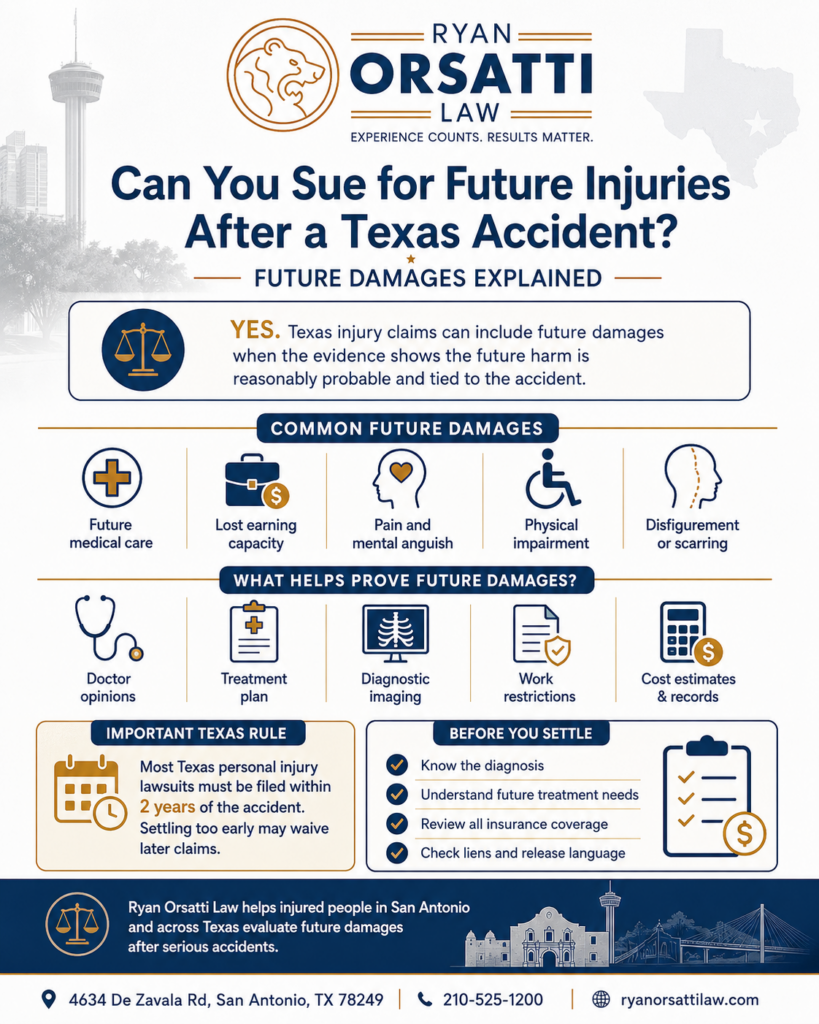
What Are Future Damages in a Texas Personal Injury Case?
Future damages are losses that a person is reasonably expected to suffer after a Texas personal injury case is resolved. In accident cases, this can include future medical care, future loss of earnings, physical impairment, disfigurement, pain, and mental anguish. Texas law recognizes “future damages” as damages incurred after judgment, and “future loss of earnings” includes future loss of income, wages, or earning capacity. (FindLaw)
In plain English, future damages are about what the accident is likely to cost you later. A broken bone that fully heals may have little future-damage value. A spine injury with future injections, surgery risk, work restrictions, or permanent limitations may require a much deeper damages review.
| Future damage category | What it means | Evidence that usually matters |
|---|---|---|
| Future medical expenses | Care expected after settlement or trial | Doctor opinions, treatment plan, surgery recommendation, life care plan, billing estimates |
| Future lost earning capacity | Reduced ability to earn income later | Work restrictions, tax records, wage history, vocational limits, employer records |
| Future pain and mental anguish | Ongoing physical pain or emotional suffering | Medical notes, diagnosis, medication history, counseling records, symptom journal |
| Future physical impairment | Loss of ability to do normal activities | Functional limits, therapy records, activity restrictions, before-and-after witnesses |
| Future disfigurement | Scarring, deformity, or visible physical change | Photos, surgical notes, plastic surgery consults, medical measurements |
| Future household or support needs | Help needed with daily life | Home health estimates, family-care documentation, assistive device costs |
Key takeaway: Future damages are strongest when the medical proof, cost proof, and real-life limitations tell the same story.
Can You Sue for Future Injuries After a Texas Accident?
Yes, but the more precise legal answer is that you sue for accident-caused injuries and include future damages in the same claim. Texas injury cases generally do not treat “future injuries” as a separate lawsuit to bring later. The safer approach is to identify probable future harm before signing a release or allowing the filing deadline to pass.
This issue comes up often after crashes on I-35, Loop 1604, Loop 410, I-10, and US-281 because serious symptoms do not always stabilize quickly. A person may start with emergency care, then later need orthopedic treatment, imaging, injections, surgery consults, neurological evaluation, or long-term pain management.
A future-damages claim is not based on guessing. Texas courts require evidence showing a reasonable probability of future medical expenses, even though exact certainty is not required. The Texas Supreme Court has recognized that future medical expenses, by their nature, cannot be proven with perfect certainty. (Justia Law)
How Does Texas Law Decide Whether Future Harm Is Too Speculative?
Texas law generally looks for reasonable probability, not a remote possibility. Future medical expenses must be supported by evidence that future care will probably be needed and that the expected cost is reasonable. Courts may look at the nature of the injury, past treatment, progress during treatment, and the person’s condition at the time of trial. (FindLaw)
For example, “my back might hurt someday” is usually too vague. “My treating orthopedic doctor recommends a future lumbar fusion if conservative care fails, and the estimated cost range is documented” is a much stronger future-damages theory.
The same logic applies to work limitations. If a San Antonio construction worker, delivery driver, nurse, warehouse employee, or oilfield worker cannot safely return to the same duties, the claim needs proof of physical restrictions, job demands, wage history, and future earning impact.
What Future Injuries Can Be Included After a Texas Accident?
Future injuries after a Texas accident may include worsening symptoms, permanent limitations, later medical procedures, and long-term work restrictions when they are tied to the accident. The key question is not whether the future problem is possible. The key question is whether medical and practical evidence shows it is reasonably probable.
Common future-injury issues include:
- Future surgery after a disc injury, fracture, torn ligament, or joint injury
- Future injections, pain management, or physical therapy
- Permanent work restrictions or reduced earning capacity
- Long-term headaches, dizziness, memory issues, or cognitive symptoms after a traumatic brain injury
- Worsening arthritis or joint degeneration tied to traumatic injury
- Permanent scarring, hardware, gait changes, or reduced range of motion
- Future mental anguish connected to the injury and recovery process
For more serious injury scenarios, Ryan Orsatti Law’s page on San Antonio catastrophic injury cases explains how severe injuries can affect medical care, daily life, and long-term claim evaluation.
How Do You Prove Future Medical Expenses in Texas?
You prove future medical expenses in Texas with medical evidence, cost evidence, and a clear link between the accident and the future care. The strongest proof usually comes from treating doctors, diagnostic testing, treatment recommendations, billing estimates, and, in serious cases, life care planning or economic analysis.
A treating doctor’s records may explain the diagnosis, prognosis, and likely future treatment. A life care planner may organize expected future care needs. An economist may calculate the present value of future losses, especially when the injury affects long-term earning capacity.
The proof should answer three questions:
- What future care is likely needed?
- Why is that care tied to the accident?
- What is the reasonable cost of that care?
Past medical bills are not enough by themselves. A person with $20,000 in past care may still have little future-damage proof if no doctor identifies future treatment. A person with lower past bills may have meaningful future damages if the records show a permanent injury, future surgery risk, or work restrictions.
Do You Have to Wait Until Maximum Medical Improvement Before Settling?
You do not always have to wait for maximum medical improvement, but settling before the future prognosis is clear can be risky. Maximum medical improvement, often called MMI, means the injury has stabilized enough that doctors can better assess lasting limitations and future care. A claim can sometimes resolve before MMI, but only if the future-risk evidence is developed enough to make an informed decision.
This is especially important in neck, back, brain, shoulder, knee, and fracture cases. These injuries may involve delayed imaging, specialist referrals, surgery discussions, or long-term restrictions.
A quick settlement may look helpful when bills are piling up. The problem is that many settlement releases are broad. Texas courts have recognized that releases may encompass unknown claims and damages that develop in the future, depending on the release language and facts. (Texas Courts)
What Evidence Should You Save for Future Injury Damages?
You should save evidence that shows the accident caused the injury, the injury is continuing, and future care or limitations are likely. In Texas accident cases, the future-damages file should include both medical proof and real-life proof. Evidence from the first days after the crash can matter just as much as records created months later.
Use this checklist after a serious Texas accident:
- Medical records from every provider. Save ER, urgent care, primary care, orthopedic, neurology, pain management, physical therapy, chiropractic, and surgical records.
- Diagnostic imaging. Keep MRI, CT, X-ray, EMG, and radiology reports, plus the image discs or portal access if available.
- Written treatment recommendations. Save referrals, surgery recommendations, injection plans, therapy plans, and follow-up instructions.
- Work records. Keep pay stubs, tax records, missed-work notes, job descriptions, and written restrictions.
- Medication and device records. Save prescriptions, brace receipts, assistive device costs, and mileage for treatment travel.
- Photos and videos. Document bruising, scars, casts, surgical wounds, mobility devices, and changes in daily activity.
- Insurance and lien documents. Save health insurance explanation-of-benefits forms, hospital lien notices, and reimbursement letters.
- Crash evidence. Keep photos, witness information, the TxDOT CR-3 crash report, repair estimates, dashcam footage, and any preservation requests.
- Symptom journal. Track pain levels, sleep problems, missed family activities, work limitations, and flare-ups.
- Communication records. Save adjuster letters, recorded-statement requests, settlement offers, and claim numbers.
Subrogation means a health insurer may claim a right to be repaid from part of a settlement. A hospital lien is a legal claim a hospital may assert against part of a personal injury recovery. These issues can affect the net result of a future-damages claim, so they should be reviewed before settlement.
Attorney Insight: Future damages are often won or lost in the documentation. Adjusters discount claims when treatment gaps, vague referrals, or unsupported cost numbers leave room to argue the future care is optional. In serious San Antonio crash cases, the doctor’s prognosis, restrictions, future treatment plan, and billing support should be tied together before a demand is sent.
How Long Do You Have to Claim Future Injuries in Texas?
Future damages do not usually create a new filing deadline in Texas. For most personal injury claims, Texas Civil Practice & Remedies Code § 16.003 gives the injured person two years from the date the cause of action accrues to file suit. If the claim involves a governmental unit, separate notice rules may require written notice much earlier, often within six months under the Texas Tort Claims Act. (Texas Statutes)
This means you should not wait until every future problem fully appears before protecting the claim. The lawsuit deadline can arrive while treatment is ongoing.
There are exceptions and special rules in some cases, including claims involving minors, wrongful death, medical negligence, government vehicles, and certain public entities. The safest step is to identify the defendant type early.
How Do Insurance Limits Affect Future Damages After a Texas Crash?
Insurance limits can affect how future damages are collected, even when the legal damages are much higher. Texas requires minimum auto liability coverage of 30/60/25, which means $30,000 per injured person, $60,000 per accident for bodily injury, and $25,000 for property damage. Serious future medical needs can exceed those limits quickly. (Texas Department of Insurance)
That is why a future-damages investigation should include all available coverage, not just the at-fault driver’s basic liability policy. Depending on the facts, coverage may include:
- Bodily injury liability coverage
- Commercial vehicle or employer coverage
- Umbrella or excess coverage
- Uninsured/underinsured motorist coverage, called UM/UIM
- Personal injury protection, called PIP
- Medical payments coverage, called MedPay
Comparative responsibility also matters. Comparative responsibility means Texas can reduce a person’s recovery by their percentage of fault, and Texas law bars recovery if the claimant’s responsibility is more than 50%. (Texas Statutes)
For commercial crashes, the coverage review may be more complex. Ryan Orsatti Law’s page on San Antonio truck accident claims explains why truck cases often require early preservation of company records, driver logs, maintenance records, and electronic data.
Should You Give a Recorded Statement About Future Injuries?
You should be cautious about giving a recorded statement before you understand your diagnosis, prognosis, and future treatment needs. A recorded statement can be used later to argue that you were not seriously hurt, that symptoms appeared late, or that future care is unrelated. This is especially risky when injuries are still evolving.
Insurance adjusters may ask broad questions early, such as “Are you feeling better?” or “Do you think you will need more treatment?” A person may answer honestly based on that day, then later receive MRI findings or a specialist recommendation that changes the medical picture.
If a statement is required under your own policy, the details matter. The scope, timing, and wording should be handled carefully, especially if UM/UIM, PIP, or MedPay coverage may apply.
What Should You Do Before Settling a Texas Accident Claim With Future Damages?
Before settling a Texas accident claim with future damages, confirm the diagnosis, future treatment plan, insurance coverage, liens, and release language. A settlement should account for known future risks when the evidence supports them. Once a release is signed, the claimant may not be able to reopen the claim for later medical problems from the same accident.
Before signing, consider these questions:
- Has a doctor explained whether the injury is temporary or permanent?
- Are future surgeries, injections, therapy, medications, or follow-ups documented?
- Are the future costs supported by records or estimates?
- Are work restrictions temporary or long-term?
- Have all liability, UM/UIM, PIP, MedPay, and commercial policies been identified?
- Are health insurance reimbursement claims, hospital liens, or provider balances known?
- Does the release waive unknown or future damages?
- Is the settlement being evaluated before the Texas filing deadline?
For a broader overview of the claim process, see Ryan Orsatti Law’s guide on how a personal injury lawsuit works.
How Can Ryan Orsatti Law Help Evaluate Future Damages?
Ryan Orsatti Law helps injured people in San Antonio and across Texas evaluate future damages by reviewing medical proof, fault evidence, insurance coverage, lien issues, and settlement timing. Future damages require more than a demand letter. They require a file that connects the injury, prognosis, cost proof, and real-life impact.
In a serious accident case, that may include:
- Gathering medical records and diagnostic imaging
- Requesting written future-care opinions from treating providers
- Preserving crash evidence before it disappears
- Identifying all available insurance coverage
- Reviewing PIP, MedPay, UM/UIM, and liability coverage
- Addressing hospital liens and subrogation claims
- Evaluating whether the case should settle or proceed further
Ryan Orsatti Law handles Texas personal injury claims and helps people evaluate whether they can bring a Texas car accident lawsuit after a serious crash. To discuss a future-damages issue, you can contact Ryan Orsatti Law.
FAQ
Can I sue later if my injury gets worse after settling in Texas?
Usually, you should assume that a signed settlement release may end your right to pursue more money for the same accident, including later-developing problems. The exact answer depends on the release language and facts. Before settling, review whether future medical care, future wage loss, impairment, and liens have been evaluated.
What future injuries can be included in a Texas accident claim?
A Texas accident claim may include future medical treatment, future surgery, future pain, future mental anguish, future physical impairment, future disfigurement, and future loss of earning capacity. The evidence should show that these losses are reasonably probable and connected to the accident. Pure speculation is not enough.
Do I need a doctor to prove future medical expenses?
A doctor’s opinion is often important because future medical expenses require proof that future care will probably be needed. In serious cases, the claim may also need billing estimates, a life care plan, vocational evidence, or economic analysis. The more disputed the injury, the more important clear medical documentation becomes.
Is future lost earning capacity the same as lost wages?
No. Lost wages usually means income already missed because of the accident. Future lost earning capacity means the injury may reduce your ability to earn income later. Proof may include work restrictions, job duties, wage history, education, physical limitations, and whether the injured person can return to the same type of work.
Does the Texas two-year deadline apply to future damages?
Yes, in most personal injury cases, the future-damages claim must be included within the lawsuit filed before the Texas statute of limitations expires. Future damages do not normally restart the deadline. Government claims, minor claims, wrongful death claims, and medical-negligence claims may involve additional rules that should be reviewed early.
What if the at-fault driver only has minimum insurance?
If the at-fault driver has minimum Texas liability limits, serious future damages may exceed available coverage. The next step is to look for other coverage, such as UM/UIM, PIP, MedPay, commercial policies, employer liability, or umbrella coverage. The facts of the crash and policy language control what may be available.
Should I settle if I still need future treatment?
You should be careful about settling while future treatment is still unclear. A settlement may still be appropriate in some cases, but the decision should be made after reviewing the diagnosis, prognosis, future cost estimates, liens, insurance limits, and release language. The risk is settling before the future value of the injury is known.
Ryan Orsatti Law
4634 De Zavala Rd, San Antonio, TX 78249
Phone: 210-525-1200
ryanorsattilaw.com
This blog is for informational purposes only, not legal advice. Reading it does not create an attorney-client relationship. Past results do not guarantee future results.
Hurt in an accident in San Antonio? Learn how a San Antonio car accident lawyer can help with your claim. Call 210-525-1200 or request a free consultation.
The firm works on a contingency fee. You pay nothing unless the firm recovers money for you, and that covers case expenses as well as the fee: if there is no recovery, you owe no attorney's fee and no case expenses. Ask for the fee agreement and read the fee and expense section before you sign anything.
Related San Antonio legal resources
Primary legal and public-data sources
- TxDOT: Texas crash reports, data, and statistics
- Texas Civil Practice and Remedies Code Chapter 33: proportionate responsibility
Ryan Orsatti Law
4634 De Zavala Road, San Antonio, TX 78249
General reference links. Consult each source for its current text.