
Quick Answer
After a Texas 18-wheeler crash, you should generally not sign any broad medical authorization, HIPAA release, settlement release, recorded-statement agreement, or “any and all records” form from the trucking insurer in the first 72 hours.
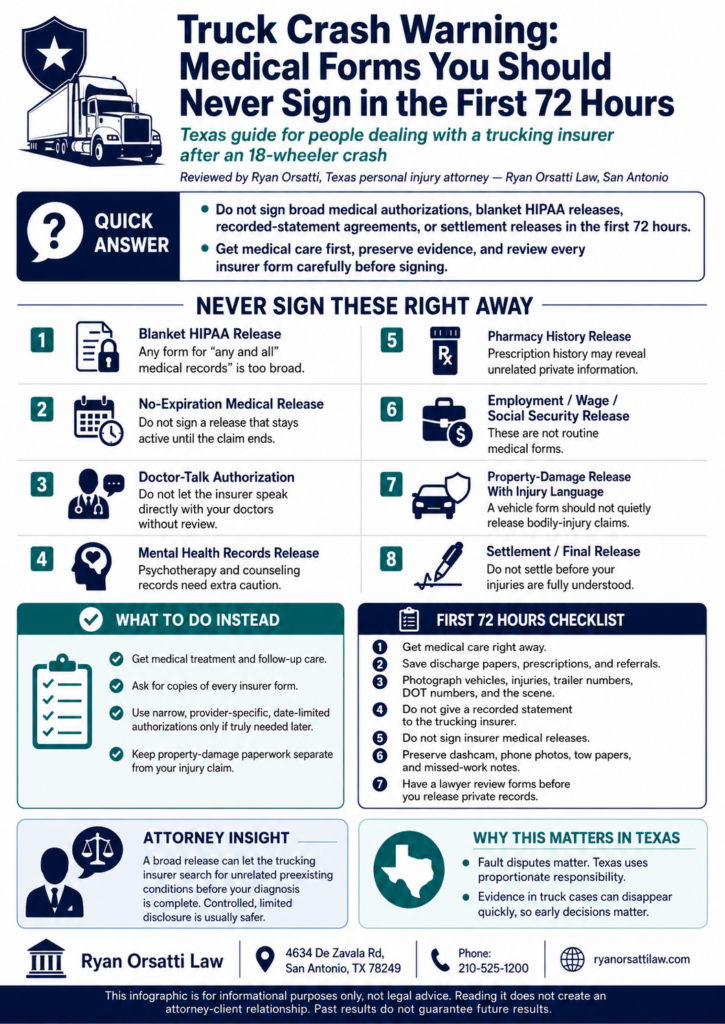
A trucking insurer does not need a blanket release to investigate liability. If medical records are needed later, they can usually be requested in a narrow, date-limited, provider-specific way. The first 72 hours should be used to get medical care, preserve evidence, identify insurance coverage, and avoid giving the trucking company unrestricted access to your private medical history.
Key Takeaways
- Do not sign a blank or broad HIPAA authorization that lets the trucking insurer collect “any and all” medical records.
- Do not sign anything that releases mental health, substance-use, reproductive-health, pharmacy, workers’ compensation, military, or prior-injury records unless a lawyer has reviewed it.
- Do not sign a settlement release, bodily injury release, property-damage release with injury language, or “final payment” form in the first 72 hours.
- Truck crashes are evidence-heavy cases. The same insurer asking for your medical history may also be protecting the motor carrier’s driver logs, ELD data, dashcam video, dispatch records, maintenance files, and safety history.
- In Texas, fault disputes matter because Texas uses proportionate responsibility, meaning a claimant may be barred from recovery if found more than 50% responsible. (Texas Statutes)
Why the First 72 Hours After a Truck Crash Are Different
A collision with an 18-wheeler, dump truck, delivery truck, oilfield truck, or other commercial vehicle is not handled like a routine two-car crash. Trucking companies and their insurers often move quickly because critical evidence can disappear fast.
In matters we handle involving commercial vehicles in San Antonio, Bexar County, Comal County, Guadalupe County, and along I-10, I-35, and Loop 1604, the first few days usually involve two parallel investigations. The injured person is trying to get medical care and figure out what happened. The trucking insurer is trying to control risk, gather statements, evaluate exposure, and look for facts that reduce the value of the claim.
That is why medical-authorization forms matter. A form that looks routine can give an adjuster access to years of unrelated medical history before you even know the full extent of your injuries.
For help with the broader claim process, see our page on San Antonio truck accident claims and our guide to commercial vehicle accident cases in Texas.
What Is a Medical Authorization?
A medical authorization is a signed document that permits a medical provider, hospital, clinic, health plan, or records custodian to disclose protected health information to someone else.
A HIPAA authorization is a specific type of medical release governed by federal privacy rules. Under 45 C.F.R. § 164.508, a valid authorization must identify the information to be disclosed in a specific and meaningful way, identify who may disclose it, identify who may receive it, state the purpose, include an expiration date or event, and include the individual’s signature and date. It must also include required notices about revocation, conditioning of treatment or benefits, redisclosure risk, and plain-language requirements. (eCFR)
That legal structure is important because the problem is usually not whether the form has a signature line. The problem is whether the form is far broader than the trucking insurer reasonably needs.
Forms From a Trucking Insurer You Should Not Sign in the First 72 Hours
1. A Blanket HIPAA Authorization for “Any and All Medical Records”
Do not sign a form that authorizes release of:
- “Any and all medical records”
- “All hospitals, physicians, clinics, pharmacies, and medical providers”
- “Complete medical history”
- “All records from birth to present”
- “All prior injuries, illnesses, conditions, and treatment”
- “Any records relating to physical, mental, emotional, or psychological condition”
This kind of release is often too broad. It may let the insurer search for old injuries, unrelated medical conditions, prior pain complaints, or language it can use to argue that your current symptoms were preexisting.
A narrow authorization, if appropriate later, should usually identify the provider, date range, body part or condition, and purpose. Early in the case, you may not yet know whether you have a concussion, cervical disc injury, lumbar injury, shoulder tear, knee injury, rib fracture, PTSD symptoms, or another condition that requires follow-up care.
2. A Medical Release With No Expiration Date
Do not sign a medical release that has no clear expiration date or that says it lasts “until the claim is resolved.”
HIPAA requires an authorization to include an expiration date or expiration event that relates to the individual or the purpose of the disclosure. (eCFR) A release that lasts indefinitely can create unnecessary privacy risk and may continue operating long after the first urgent records are needed.
A safer form, when one is truly needed, should have a short and specific expiration date.
3. A Release That Allows the Insurer to Talk Directly to Your Doctors
Be careful with any form that authorizes the trucking insurer, claims adjuster, defense lawyer, nurse reviewer, or “representative” to speak directly with your doctors.
Medical records are one thing. Unsupervised conversations are another. A direct provider interview can create confusion, incomplete summaries, or statements taken outside the context of the full medical chart.
If the insurer needs medical information, it can request properly limited records through an agreed process. In litigation, medical records and provider testimony can be handled through formal discovery, subpoenas, depositions, and protective orders when appropriate.
4. A Release for Mental Health, Counseling, or Psychotherapy Records
Do not sign a release that includes mental health, counseling, psychiatric, substance-use, or psychotherapy information without legal review.
Federal rules treat psychotherapy notes separately from ordinary medical records in important ways. HIPAA generally requires authorization for use or disclosure of psychotherapy notes, subject to limited exceptions. (eCFR)
Truck wrecks can cause anxiety, sleep disruption, driving fear, panic symptoms, depression, and trauma responses. That does not mean the trucking insurer should get open access to unrelated counseling history from years before the crash.
5. A Pharmacy, Prescription, or Medication-History Release
A pharmacy release may seem harmless, but it can disclose years of medications for conditions unrelated to the crash.
Adjusters sometimes look at pharmacy data to argue that a person already had chronic pain, anxiety, sleep problems, muscle spasms, or other conditions before the collision. Sometimes that information is relevant. Often it is not relevant in the first 72 hours.
Do not sign a pharmacy release unless the scope is specific and the reason is clear.
6. A Workers’ Compensation, Employment, Wage, Tax, or Social Security Release Hidden in a Medical Packet
Some packets combine several releases together. A “medical authorization packet” may also include permission to obtain:
- Employment files
- Wage records
- Tax records
- Social Security records
- Disability records
- Workers’ compensation records
- Prior claim files
- Military or VA records
These are not routine medical records. They can affect lost-income claims, disability arguments, prior-injury issues, and credibility attacks.
If you were hit by a commercial vehicle while working, the situation may involve a third-party injury claim, workers’ compensation, a nonsubscriber employer, an occupational accident policy, or a separate UM/UIM issue. Those intersections should be reviewed before anything is signed.
7. A “Property Damage Only” Release That Also Releases Injury Claims
Do not assume a form is safe because the adjuster says it is “just for the vehicle.”
Some releases contain language discharging “all claims,” “known and unknown injuries,” “bodily injury,” “personal injury,” “pain and suffering,” or “any claims arising from the accident.” That can be dangerous if you sign it before your medical condition is understood.
A property-damage payment should not release your bodily-injury claim unless that is clearly intended and fully evaluated. If the insurer wants to pay for towing, storage, or vehicle damage, the paperwork should be limited to property damage only.
For more on motor-vehicle claim issues generally, see our page for San Antonio car accident claims.
8. A Settlement Release, “Final Release,” or Bodily-Injury Payment Form
Do not sign a settlement release in the first 72 hours.
Many truck-crash injuries are not fully diagnosed immediately. Pain can worsen after adrenaline fades. Concussion symptoms may show up later. Disc injuries, ligament injuries, internal injuries, and nerve symptoms may require imaging, specialist evaluation, or follow-up treatment.
Texas generally gives injured people two years to bring personal-injury and wrongful-death lawsuits, subject to exceptions and special rules. (Texas Statutes) The fact that the insurer wants a quick release does not mean you should compress a serious injury evaluation into three days.
Medical Authorization Forms: What to Sign, What to Pause, and What to Narrow
| Form or Request | Sign in First 72 Hours? | Why It Matters | Safer Approach |
|---|---|---|---|
| Blanket HIPAA release for “any and all records” | No | Gives broad access to unrelated medical history | Use provider-specific, date-limited authorizations only if needed |
| Release with no expiration date | No | May remain active too long | Add a short expiration date or event |
| Mental health or psychotherapy release | No | Highly private and often unrelated | Review relevance and use protective limits |
| Pharmacy-history release | No | Can reveal unrelated prescriptions | Narrow by date, medication category, and injury relevance |
| Employment, tax, wage, or Social Security release | No | Goes beyond medical issues | Evaluate lost-income claim first |
| Property-damage release with bodily-injury language | No | May waive injury claims | Limit release to vehicle/property damage only |
| Settlement or bodily-injury release | No | May permanently end claim | Wait until diagnosis, prognosis, damages, liens, and coverage are known |
| Your own provider’s intake and treatment forms | Usually yes | Needed to receive care | Read them, keep copies, and avoid insurer-directed language |
Why Trucking Insurers Want Medical Releases Early
A trucking insurer evaluates exposure from two directions: liability and damages.
Liability means who caused the crash. In a truck case, liability may involve the driver, motor carrier, broker, shipper, maintenance company, loading company, or another vehicle.
Damages means the physical, financial, and human harm caused by the crash. Medical records are central to damages because they show diagnosis, treatment, restrictions, pain complaints, imaging findings, referrals, impairment, and future-care needs.
The problem is timing. In the first 72 hours, the insurer may know more about the trucking company’s internal records than you do, while asking you for access to your entire medical life.
Federal motor-carrier regulations require trucking companies to maintain certain safety records. For example, motor carriers must maintain accident registers for three years after qualifying crashes. (eCFR) Carriers must also maintain certain driver records of duty status and supporting documents for at least six months. (eCFR) Driver background and safety-performance-history inquiries are also governed by federal rules. (eCFR)
That evidence can matter just as much as your medical records. A fair investigation should not be one-sided.
Attorney Insight: The “Broad Medical Release” Is Often a Defense Tool
In truck cases, we routinely see adjusters request medical authorizations before the injured person has completed emergency follow-up, imaging, or specialist evaluation. The stated reason is usually “we need records to evaluate your claim.”
That may sound reasonable. But the wording often goes much further than the stated purpose.
A broad release can help the defense build themes such as “preexisting condition,” “degenerative spine,” “prior similar complaints,” “gap in treatment,” “unrelated mental health issues,” or “not as injured as claimed.” Some of those issues may be legitimate later. But they should be addressed with context, not through a rushed release signed while the injured person is still in pain, medicated, without transportation, and trying to replace a totaled vehicle.
The better approach is controlled disclosure: get treatment first, preserve trucking evidence immediately, then provide relevant medical proof in an organized and limited way.
After a Truck Crash, Do These 7 Things Before Signing Any Insurer Form
- Get medical care immediately. Go to the ER, urgent care, or your doctor if you have pain, dizziness, confusion, weakness, numbness, shortness of breath, abdominal pain, or head-impact symptoms.
- Request and keep discharge paperwork. Save ER discharge instructions, imaging orders, prescriptions, work restrictions, referral sheets, and follow-up recommendations.
- Photograph everything. Take pictures of vehicles, injuries, bruising, road debris, skid marks, company logos, trailer numbers, DOT numbers, license plates, and the crash location.
- Do not give a recorded statement to the trucking insurer. You can report basic facts, but a recorded statement can be used to lock you into incomplete answers before you know your diagnosis.
- Do not sign medical authorizations from the trucking insurer. Ask for copies of every form and say you want time to review them.
- Preserve your own evidence. Save dashcam footage, phone photos, text messages, tow-yard documents, repair estimates, receipts, and missed-work notes.
- Ask for legal review before releasing records. A truck case may require spoliation letters, ELD preservation, driver-file requests, maintenance records, dispatch records, and insurance-coverage analysis.
What a Narrow Medical Authorization Should Look Like Later
Sometimes medical records do need to be provided. A serious injury claim cannot usually be evaluated without proof of injury, treatment, causation, and damages.
But later disclosure should be controlled. A narrower authorization may include:
- The exact provider name
- A limited date range
- The specific records requested
- The injury or body part at issue
- The claim number or purpose
- A clear expiration date
- No permission for informal provider interviews
- No unrelated mental health, substance-use, pharmacy, tax, employment, or Social Security records
- A copy requirement for anything released
A better option is often to have your lawyer obtain the records first, review them for completeness and relevance, then produce a clean medical package with billing records, treatment chronology, imaging reports, impairment evidence, and lien information.
How Texas Fault Rules Make Early Forms Riskier
Texas follows a proportionate-responsibility system. Under Texas Civil Practice & Remedies Code § 33.001, a claimant may not recover damages if the claimant’s percentage of responsibility is greater than 50%. (Texas Statutes)
That matters because trucking insurers often investigate fault and damages at the same time. A broad medical release may help them argue your injuries are unrelated. A recorded statement may help them argue you were distracted, speeding, fatigued, or slow to react. Vehicle photographs may be used to dispute force. Treatment gaps may be used to dispute causation.
In San Antonio truck crashes, common defense themes include:
- The injured driver “cut off” the truck
- The crash was a “sudden emergency”
- The injuries were preexisting
- The person delayed treatment
- The person exaggerated pain
- The collision was too minor to cause serious injury
- Another driver or road condition caused the crash
Medical releases should be evaluated with those defense themes in mind.
What About Health Insurance, MedPay, Liens, and Subrogation?
Several payment issues may arise after a truck crash.
MedPay means medical payments coverage under an auto policy. It may help pay medical bills regardless of fault, depending on the policy.
Subrogation means a health insurer or benefit plan may claim a right to be reimbursed from a later settlement.
A hospital lien is a statutory claim a hospital may assert against a personal-injury recovery for certain treatment.
A letter of protection, often called an LOP, is an agreement that a medical provider may wait for payment from a future settlement or recovery.
These issues affect what records and bills should be gathered, what claims must be protected, and what amount may actually go to the injured person after medical bills and liens are addressed. They do not require you to sign a trucking insurer’s blanket medical release in the first 72 hours.
For serious injury claims involving long-term treatment, see our page on San Antonio spinal cord injury cases and our page on burn injury claims in San Antonio.
What You Can Say to the Trucking Adjuster
You do not have to be rude. You can be short and careful.
You can say:
“I am still getting medical care and I am not signing any medical authorization or release today. Please send me copies of all forms you want signed, and I will review them before responding.”
You can also say:
“I am not authorizing access to my full medical history. If specific records are needed later, they can be requested in a limited way.”
Avoid arguing about fault, guessing about speed, minimizing your pain, or saying you are “fine.” Early statements are often incomplete because symptoms evolve.
When Should a Lawyer Get Involved?
A lawyer should usually get involved early when a trucking insurer asks for broad medical releases, recorded statements, or settlement paperwork within the first 72 hours.
That does not mean every claim becomes a lawsuit. It means the evidence needs to be protected before it disappears and private records need to be handled correctly.
Truck cases may involve:
- Commercial insurance policies
- Federal Motor Carrier Safety Regulations
- Driver qualification files
- Driver logs and ELD data
- Dashcam or inward-facing camera footage
- Dispatch and routing records
- Maintenance and inspection files
- Prior crash history
- Drug and alcohol testing issues
- Broker, shipper, loader, or maintenance-company liability
- Multiple injured people competing for limited coverage
Texas requires minimum auto liability coverage of 30/60/25 for ordinary vehicles, but commercial trucking policies may involve much higher limits depending on the vehicle, cargo, and operation. (Texas Department of Insurance) Coverage should be confirmed before any release is signed.
FAQ
Should I sign a HIPAA release from a trucking insurance adjuster?
Usually not in the first 72 hours. A HIPAA release can give the adjuster access to sensitive medical information, including prior records that may have nothing to do with the crash. If records are needed later, the authorization should be narrow, provider-specific, date-limited, and reviewed before it is signed.
Can the trucking insurer deny my claim if I refuse to sign a blanket medical authorization?
An insurer may say it needs records to evaluate your injury claim, but that does not mean you must sign a blanket authorization. You can provide relevant records in a controlled way. Refusing an overbroad release is different from refusing to document your injuries. The safer approach is to gather records first and disclose only what is reasonably related.
What medical records are usually relevant after an 18-wheeler accident?
Relevant records often include ER records, ambulance records, imaging reports, orthopedic records, neurology records, physical therapy notes, pain-management records, surgical records, work restrictions, and billing records related to crash injuries. Prior records may become relevant if the insurer raises a preexisting-condition defense, but the scope should still be limited.
Is a property-damage release safe to sign after a truck crash?
Not always. Some property-damage releases include broad language releasing “all claims,” including bodily-injury claims. Before signing, confirm the release is limited to vehicle damage, towing, storage, rental, or personal property only. If it mentions injury claims, pain and suffering, medical bills, or unknown injuries, do not sign without review.
Why do trucking insurers ask for medical authorizations so quickly?
They want to evaluate damages, identify preexisting conditions, set reserves, and assess defenses. Quick access to records can help them value the claim early, but it can also let them search for unrelated medical history. In the first 72 hours, your priority should be treatment, diagnosis, evidence preservation, and careful communication.
What if I already signed a medical release?
Ask for a copy of what you signed and send a written revocation if appropriate. HIPAA allows an individual to revoke an authorization in writing, except to the extent a covered entity has already acted in reliance on it or another exception applies. (eCFR) A lawyer can help assess what was released and how to limit further disclosure.
Are trucking cases different from regular car accident claims?
Yes. Trucking cases often involve federal safety regulations, driver qualification files, ELD data, maintenance records, dispatch communications, commercial insurance, and multiple potentially liable companies. The injury side is also more complex because crashes with heavy commercial vehicles often cause serious trauma. Early paperwork can affect both privacy and claim value.
What should I do if the adjuster says signing is “standard procedure”?
Ask the adjuster to send the form in writing and do not sign it on the spot. “Standard procedure” does not mean the form is narrow, fair, or safe. Review the wording carefully, especially any language about all medical records, unknown injuries, settlement, final payment, direct doctor contact, or release of all claims.
Talk to Ryan Orsatti Law Before Signing Trucking Insurer Forms
If a trucking insurer is asking you to sign medical authorizations, HIPAA releases, settlement paperwork, or recorded-statement forms after a Texas truck crash, pause before signing. The first 72 hours can shape the rest of the claim.
Ryan Orsatti Law reviews truck-crash claims for injured people in San Antonio, Bexar County, and throughout Texas. We can help identify which forms are routine, which are too broad, and what evidence should be preserved before the trucking company’s records are lost or changed.
Ryan Orsatti Law
4634 De Zavala Rd, San Antonio, TX 78249
Phone: 210-525-1200
ryanorsattilaw.com
This blog is for informational purposes only, not legal advice. Reading it does not create an attorney-client relationship. Past results do not guarantee future results.
Hurt in an accident in San Antonio? Learn how a San Antonio personal injury lawyer can help with your claim. Call 210-525-1200 or request a free consultation. There is no fee unless we win.
Related San Antonio legal resources
Primary legal and public-data sources
- Texas Civil Practice and Remedies Code Chapter 16: limitations
- Texas Civil Practice and Remedies Code Chapter 33: proportionate responsibility
Ryan Orsatti Law
4634 De Zavala Road, San Antonio, TX 78249
Source links verified August 7, 2026.