
Quick Answer
A Texas personal injury lawyer is more likely to take your case when there is evidence someone else was negligent, you have a real injury supported by medical care, there is insurance or another recovery source, and the legal deadline has not expired. In most Texas injury cases, Texas Civil Practice and Remedies Code § 16.003 gives you two years to file suit, but government claims can have much shorter notice deadlines. Ryan Orsatti Law evaluates San Antonio and Texas injury cases by looking at fault, injuries, medical bills, insurance, liens, and likely net recovery before recommending the next step. (Texas Statutes)
Key Takeaways
- A lawyer usually looks first at fault, injury, medical treatment, insurance, deadlines, and proof.
- A case with no injury or no medical treatment is often not a good fit for a contingency-fee personal injury lawyer.
- Texas comparative responsibility can reduce or bar recovery if the injured person is partly at fault.
- Insurance limits matter because Texas minimum auto liability coverage may be only 30/60/25.
- The best consultation is specific: dates, photos, reports, medical records, insurance information, bills, and adjuster communications.
- If one lawyer says no, that does not always mean you have no claim. It may mean the case does not fit that lawyer’s criteria.
What do Texas personal injury lawyers look for first?
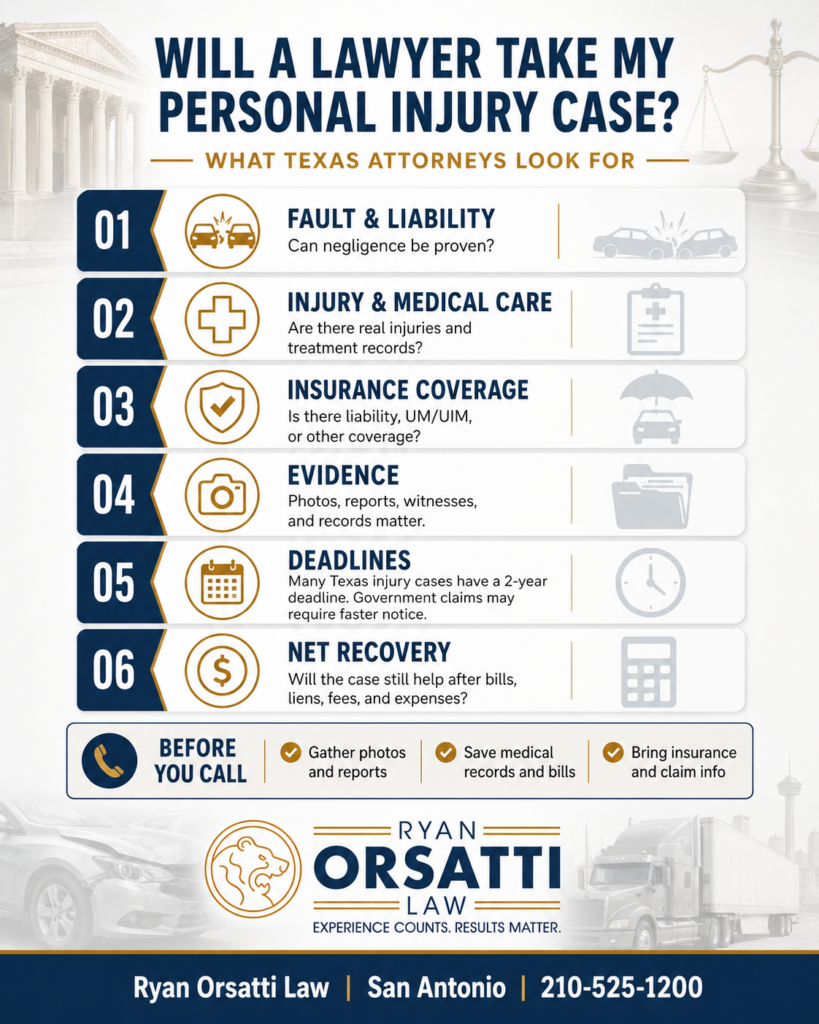
Texas personal injury lawyers usually start with six intake questions: who was at fault, what injury occurred, what medical care exists, what insurance applies, what deadline controls, and whether the evidence can prove the claim. Negligence means someone failed to use reasonable care and caused harm. A contingency-fee case also has to make practical sense after fees, expenses, medical bills, liens, and subrogation are considered.
| Intake factor | What the lawyer is looking for | What can hurt the case | What to bring |
|---|---|---|---|
| Fault | Evidence another person or business caused the injury | Unclear facts, missing witnesses, or shared fault | Photos, video, police report, witness names |
| Injury | A real bodily injury, not just inconvenience | No treatment, only property damage, or unclear symptoms | ER papers, clinic records, imaging, prescriptions |
| Medical treatment | Care that connects the incident to the injury | Long treatment gaps or unrelated prior conditions with no explanation | Provider list, bills, discharge papers |
| Insurance or recovery source | Liability coverage, UM/UIM, commercial coverage, property owner coverage, or other collectible source | No insurance, low limits, or no collectible defendant | Insurance cards, declarations page, adjuster letters |
| Deadlines | Enough time to investigate and file before limitations or notice deadlines | Expired statute of limitations or short government notice deadline | Date, location, defendant identity |
| Net recovery | A likely recovery that can still help after medical bills, liens, expenses, and fees | Medical bills and liens exceeding likely available insurance | Health insurance info, lien notices, billing statements |
Key takeaway: A lawyer is not just asking whether something bad happened. The lawyer is deciding whether the facts, proof, deadline, insurance, and likely net result justify taking responsibility for the claim.
How does a lawyer judge fault in Texas?
A lawyer judges fault by asking whether the evidence can prove the other person’s conduct caused the injury. Texas uses proportionate responsibility, which means your recovery can be reduced by your percentage of fault, and you generally cannot recover if your percentage of responsibility is greater than 50 percent. Texas Civil Practice and Remedies Code § 33.012 also provides that damages are reduced by the claimant’s percentage of responsibility when the claimant is not barred. (Texas Statutes)
In a San Antonio crash case, that evidence may include a TxDOT crash report, photos from Loop 1604 or I-35, body-camera footage, dash-cam footage, witness statements, event data recorder information, vehicle damage patterns, and medical records showing when symptoms began. In a premises case, the evidence may include incident reports, surveillance video, maintenance records, prior complaints, lighting conditions, and photographs of the hazard.
How does medical treatment affect whether a lawyer takes the case?
Medical treatment affects the case because it is usually the main proof that the incident caused a real injury. A lawyer can sometimes evaluate a case before treatment is complete, but no treatment, delayed treatment, or large unexplained gaps make causation harder to prove. Causation means the accident or unsafe condition actually caused the injury being claimed.
This is one reason serious injury cases are evaluated differently from property-damage-only claims. TxDOT reported 14,905 serious injury crashes in Texas in 2024, with 18,218 people sustaining a serious injury, and 251,977 people injured in motor vehicle crashes overall. Those numbers show why documentation matters: a case is stronger when the injury, treatment, and crash facts fit together in the records.
Will a lawyer take my personal injury case if fault is disputed?
A lawyer may take a disputed-fault personal injury case if there is enough evidence to investigate and prove the other side’s responsibility. Disputed fault does not automatically defeat a Texas claim, but it changes the work required. The lawyer will look for independent proof, not just what each driver, property owner, or insurance adjuster says happened.
In car and truck cases, disputed fault often turns on lane position, speed, following distance, traffic-control devices, impact location, witness statements, and whether a driver was distracted. In premises cases, disputed fault often turns on how long the hazard existed, whether employees knew or should have known about it, and whether the injured person had a reasonable chance to avoid it.
What evidence should I save before calling a lawyer?
You should save anything that helps prove what happened, where it happened, who was involved, and how the injury developed. A Texas personal injury lawyer can evaluate the case faster when the proof is organized early. Evidence can disappear quickly, especially video from businesses, dash cams, apartment complexes, rideshare vehicles, or commercial trucks.
- Photos of the scene, vehicles, hazard, injuries, and weather conditions
- Names and phone numbers of witnesses
- Police report number, incident report number, or crash information exchange form
- Medical records, discharge papers, imaging orders, and prescriptions
- Health insurance cards and auto insurance cards
- Texts, emails, letters, or claim numbers from insurance adjusters
- Photos of missed work notes, pay stubs, or employer communications
- Any video from a dash cam, doorbell camera, business, apartment complex, or phone
- The exact date, time, and location, including San Antonio road names or business address
- Notes about pain, limitations, appointments, and missed activities
Will a lawyer take my personal injury case if I waited to get medical care?
A lawyer may still take your case if you waited to get medical care, but the delay creates a proof issue that must be explained. Insurance companies often argue that delayed treatment means the injury was minor, unrelated, or caused by something else. A clear explanation, consistent symptoms, and medical records can help address that issue.
Some delays are understandable. People may hope they will improve, lack health insurance, have transportation problems, need to care for children, or be unable to get a quick appointment. The key is honesty. Tell the lawyer when symptoms started, why care was delayed, what changed, and whether you had prior injuries to the same body part.
Attorney Insight: Adjusters often compare three timelines: the date of the incident, the first medical visit, and the first documented complaint of each injury. A client who says “my neck hurt immediately,” but has records mentioning only knee pain for the first month, has a documentation problem. That does not always ruin the case, but it must be dealt with early and honestly.
How do insurance limits and medical bills affect whether a Texas lawyer accepts a case?
Insurance limits and medical bills affect whether the case can produce a practical recovery after all required payments are addressed. Texas minimum auto liability coverage is only $30,000 per injured person, $60,000 per accident, and $25,000 for property damage, commonly called 30/60/25 coverage. TDI also explains that Texas auto policies include PIP unless the insured rejects it in writing. (Texas Department of Insurance)
Liability coverage pays for harm the at-fault person causes to others. PIP, or personal injury protection, can help pay medical expenses and some lost income regardless of fault, depending on the policy. MedPay is medical payments coverage, which can help with medical bills but usually does not include the same lost-income benefits as PIP.
A lawyer will also evaluate uninsured or underinsured motorist coverage, commercial policies, excess policies, employer responsibility, premises coverage, and whether more than one defendant may be responsible. A case with strong injuries but no available recovery source may be difficult to take on contingency unless there is another viable path.
Why does the lawyer ask about liens, health insurance, and letters of protection?
The lawyer asks about liens, health insurance, and letters of protection because those issues affect what the client may actually receive from a settlement or judgment. Subrogation means a health insurer may claim a right to be reimbursed from a recovery. A hospital lien is a legal claim a hospital may assert against part of an injury recovery.
Texas Property Code Chapter 55 addresses hospital liens, and Section 55.002 refers to a hospital lien for services provided for injuries caused by an accident attributed to another person’s negligence. The statute includes timing requirements, including hospital admission not later than 72 hours after the accident for the lien to attach. (Texas Statutes)
A letter of protection is different. It is an arrangement where a medical provider agrees to wait for payment from a potential future recovery. It is not health insurance, and it can create major net-recovery issues if charges are high, liability is disputed, or insurance limits are low.
What deadlines can keep a Texas lawyer from taking the case?
Expired or short deadlines can keep a lawyer from taking a Texas personal injury case, even when the injury is real. Most Texas personal injury lawsuits must be filed within two years, but claims involving a governmental unit may require written notice much earlier. Under the Texas Tort Claims Act, notice to a governmental unit is generally required not later than six months after the incident, and city charter deadlines can be shorter. (Texas Statutes)
San Antonio is a good example of why local deadlines matter. The City of San Antonio’s Notice of Claim language references written notice within ninety days after death, injury, or property damage is sustained. A claim involving a city vehicle, public property, road defect, or public employee should be reviewed quickly because the notice deadline may arrive long before the two-year lawsuit deadline. (San Antonio Web App)
An insurance claim is not the same as filing a lawsuit. Talking to an adjuster, sending medical bills, or negotiating for months does not automatically protect the court deadline. If the deadline is close, many lawyers will need to know immediately whether suit can be filed properly and whether enough evidence exists to justify filing.
Which personal injury case types does Ryan Orsatti Law evaluate?
Ryan Orsatti Law evaluates Texas personal injury cases involving bodily injury, medical treatment, liability investigation, insurance coverage, and a practical path to recovery. The firm’s work includes San Antonio car accident cases, truck wrecks, motorcycle crashes, premises injuries, catastrophic injuries, oilfield incidents, and wrongful death claims. Ryan Orsatti Law’s website identifies the firm as serving personal injury clients in San Antonio and surrounding areas. (Ryan Orsatti Law)
The firm is more likely to evaluate a case seriously when the client has sought appropriate medical care, the facts suggest someone else caused the injury, there is insurance or another recovery source, and the client can help gather documents. No lawyer can responsibly decide a case from one sentence. The details matter.
When might a property-damage-only claim not need a personal injury lawyer?
A property-damage-only vehicle claim often does not need a personal injury lawyer if there is no bodily injury and no medical treatment. Personal injury lawyers usually focus on injury damages, medical documentation, liability proof, liens, lost income, and insurance recovery. If the only dispute is repair cost, rental reimbursement, or total-loss value, the claim may be better handled directly through insurance or another property-damage process.
There can be exceptions, such as serious diminished value disputes, bad faith concerns, commercial losses, or a property claim connected to bodily injury. But if the question is simply whether a contingency-fee injury lawyer will take a no-injury fender-bender, the answer is often no.
What should I ask about contingency fees before signing?
You should ask for the exact contingency percentage, when the percentage changes, how case expenses are handled, and what the likely net recovery could look like. A contingency fee means the lawyer’s fee is tied to the outcome of the matter instead of being billed hourly as the case moves forward. Texas Disciplinary Rule of Professional Conduct 1.04 requires a contingent fee agreement to be in writing and to state the method for determining the fee, including different percentages for settlement, trial, or appeal and how expenses are deducted. (Texas Center for Legal Ethics)
Ryan Orsatti Law takes most personal injury cases on a contingency fee. In an accepted contingency-fee matter, the client should not be writing a separate attorney-fee check from their own bank account for attorney fees. The written fee agreement controls how attorney fees, case expenses, and any recovery are handled.
Do not assume a bigger advertising budget means better fee terms. If a firm quotes 35% or 37.5% before suit, or 45% after litigation begins, ask what work, risk, and expense justify that percentage. A higher percentage is not automatically improper, but it should be transparent, written, and understood before you sign. You can also review Ryan Orsatti Law’s discussion of contingency fees in personal injury cases.
Why would a Texas personal injury lawyer decline a case?
A Texas personal injury lawyer may decline a case because of conflicts, expired deadlines, weak liability proof, no meaningful injury damages, no recovery source, or case economics that would not help the client. Texas conflict rules also matter. Rule 1.06 states that a lawyer shall not represent opposing parties to the same litigation. (Texas Center for Legal Ethics)
Common reasons a lawyer may say no include:
- The statute of limitations or notice deadline appears expired.
- The injured person appears more than 50% at fault.
- There is no medical treatment or only minor soreness with no records.
- The defendant has no insurance and no realistic ability to pay.
- The medical bills, liens, and expenses may exceed available insurance.
- The lawyer has a conflict of interest.
- The case is outside the lawyer’s practice focus.
- The client’s expectations do not match what the evidence can support.
A declined case is not always a bad case. It may simply be too small for contingency representation, too close to deadline, too expensive to litigate, or not a fit for that lawyer’s caseload. Getting a second consultation can be reasonable, especially if you have new documents or a better explanation of the facts.
What should I do before the consultation so the lawyer can decide faster?
You should prepare a short, organized case packet before the consultation so the lawyer can quickly assess fault, injury, deadline, insurance, and damages. A focused intake call is more productive when the lawyer can see the documents instead of guessing. This is especially true for San Antonio, Bexar County, Comal County, Guadalupe County, Kendall County, Wilson County, Atascosa County, and Medina County cases where local evidence may need to be requested quickly.
- Write the date, time, and exact location of the incident.
- Identify every person, business, vehicle, or property owner involved.
- Gather photos, videos, reports, and witness information.
- List every medical provider you have seen since the incident.
- Gather bills, EOBs, health insurance information, and lien notices.
- Save all adjuster letters, emails, texts, claim numbers, and recorded-statement requests.
- Write down missed work dates, job duties affected, and wage documents.
- Identify any prior injury to the same body part.
- Note whether a government entity, city vehicle, school district, VIA bus, police vehicle, or public property may be involved.
- Prepare questions about fees, expenses, communication, and who will handle the file.
How does Ryan Orsatti Law evaluate whether representation makes sense?
Ryan Orsatti Law evaluates whether representation is likely to improve the client’s practical position after fees, expenses, medical bills, liens, and time are considered. The goal is not to sign every caller. The goal is to determine whether there is a viable liability claim, a real injury, an available recovery source, and a reasonable plan for moving the claim forward.
For injured people in San Antonio and across Texas, Ryan Orsatti Law looks at the full picture: what happened, what can be proved, what treatment says, what insurance exists, what deadlines apply, and whether attorney involvement adds value. You can contact Ryan Orsatti Law to request a case review. The firm’s contact page lists its San Antonio office address and phone number. (Ryan Orsatti Law)
What do people also ask about getting a personal injury lawyer to take a Texas case? (FAQ)
People usually ask whether a Texas injury lawyer will take a case with partial fault, delayed treatment, low insurance, no obvious injury, or a prior lawyer refusal. These are real screening issues. The answer usually depends on evidence, medical documentation, deadlines, insurance, and whether representation is likely to help after fees and case expenses.
Can a Texas personal injury lawyer take my case if I am partly at fault?
Yes, a Texas personal injury lawyer may take your case if you are partly at fault, but your percentage of responsibility matters. Under Texas proportionate responsibility law, being more than 50% responsible generally bars recovery. If you are 50% or less responsible, damages can be reduced by your percentage of fault. (Texas Statutes)
Will a lawyer take my case if I only have soreness and no medical treatment?
A lawyer may talk with you, but a no-treatment soreness case is often hard to take on contingency. Personal injury claims usually require medical proof connecting the incident to an actual injury. If you are still hurting, get appropriate medical care and document your symptoms before assuming the case has no value.
Can I get a lawyer if the at-fault driver has minimum insurance?
Yes, but minimum insurance can limit the practical recovery. Texas minimum auto liability coverage is 30/60/25, meaning $30,000 per injured person, $60,000 per accident, and $25,000 for property damage. A lawyer will also check PIP, MedPay, UM/UIM, commercial coverage, and other possible recovery sources. (Texas Department of Insurance)
What if another lawyer refused my Texas personal injury case?
Another lawyer’s refusal does not always mean your case is invalid. The lawyer may have had a conflict, lacked capacity, disliked the economics, or needed documents you did not have yet. Before a second consultation, gather medical records, photos, insurance information, the exact incident date, and any written reason the first lawyer declined.
How soon should I call a lawyer after an accident in San Antonio?
You should call as soon as you know you are injured or a deadline may apply. Most Texas personal injury lawsuits have a two-year filing deadline, but claims involving the City of San Antonio or another governmental unit can involve much shorter notice periods. Early review helps preserve video, witnesses, records, and insurance information. (Texas Statutes)
Will Ryan Orsatti Law take my personal injury case on contingency fee?
Ryan Orsatti Law takes most personal injury cases on a contingency fee, but the firm must first evaluate liability, injury, treatment, insurance, deadlines, and likely net recovery. Texas contingent fee agreements must be in writing and explain how the fee and expenses are calculated. The written agreement controls the exact terms. (Texas Center for Legal Ethics)
Ryan Orsatti Law
4634 De Zavala Rd, San Antonio, TX 78249
Phone: 210-525-1200
ryanorsattilaw.com
This blog is for informational purposes only, not legal advice. Reading it does not create an attorney-client relationship. Past results do not guarantee future results.
Hurt in an accident in San Antonio? Learn how a San Antonio car accident lawyer can help with your claim. Call 210-525-1200 or request a free consultation.
The firm works on a contingency fee. You pay nothing unless the firm recovers money for you, and that covers case expenses as well as the fee: if there is no recovery, you owe no attorney's fee and no case expenses. Ask for the fee agreement and read the fee and expense section before you sign anything.
Related San Antonio legal resources
Primary legal and public-data sources
- TxDOT: Texas crash reports, data, and statistics
- Texas Civil Practice and Remedies Code Chapter 33: proportionate responsibility
Ryan Orsatti Law
4634 De Zavala Road, San Antonio, TX 78249
General reference links. Consult each source for its current text.