
Quick Answer
If a commercial driver flees the scene of a Texas hit-and-run involving an 18-wheeler or delivery van, call 911, get medical help, do not chase the vehicle, and preserve every clue that can identify the truck, van, driver, employer, route, or insurer. Texas law requires drivers in injury crashes to stop, return if necessary, determine whether anyone needs aid, and remain at the scene until required information is exchanged. (Texas Statutes)
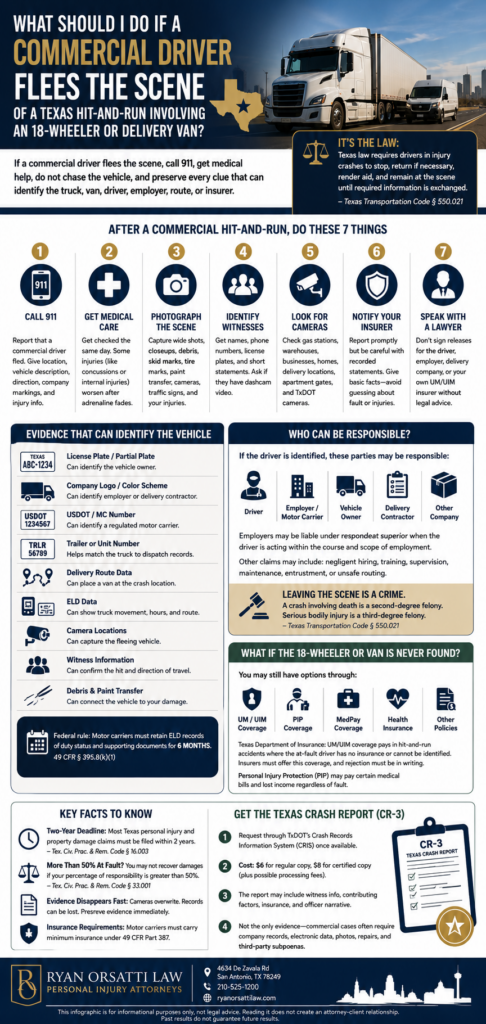
A commercial hit-and-run should be treated as both a crash scene and an evidence scene. The fastest sources of proof are often nearby cameras, dashcam footage, license plate fragments, USDOT numbers, company logos, delivery app records, GPS data, electronic logging device records, dispatch records, and witness statements.
Key Takeaways
- Call 911 immediately and clearly say a commercial vehicle fled the scene.
- Do not chase the truck or delivery van. Your safety and the official report matter more than pursuit.
- Photograph vehicle debris, tire marks, impact points, skid marks, roadway location, traffic cameras, nearby businesses, and your injuries.
- Commercial cases may involve the driver, employer, motor carrier, delivery company, maintenance company, broker, shipper, or your own UM/UIM coverage.
- Federal motor-carrier records can disappear or become harder to obtain. FMCSA guidance states motor carriers must retain ELD records of duty status and supporting documents for six months. (FMCSA)
- Texas personal injury and property damage lawsuits generally have a two-year limitations period under Texas Civil Practice and Remedies Code § 16.003, but insurance notice deadlines and evidence-preservation deadlines can be much shorter. (Texas Statutes)
What should I do first if a commercial driver flees after hitting me in Texas?
The first thing to do after a commercial driver flees is call 911, request medical help, and report the vehicle as an 18-wheeler, box truck, delivery van, company van, work truck, or other commercial vehicle. Texas Transportation Code § 550.026 requires immediate notice to law enforcement for crashes involving injury, death, or a vehicle damaged so it cannot be normally and safely driven. (Texas Statutes)
Tell the dispatcher:
- Where the crash happened, including highway, direction, exit, intersection, mile marker, or nearby business.
- The direction the truck or van went.
- Any company name, logo, color, trailer number, license plate, USDOT number, MC number, or unit number.
- Whether anyone is injured.
- Whether traffic is blocked or there is a fuel spill, cargo spill, or debris hazard.
A commercial hit-and-run on I-35, I-10, Loop 410, Loop 1604, US-281, I-45, I-20, or another Texas corridor can involve moving evidence. Trucks keep traveling. Delivery vans continue routes. Cameras overwrite. Drivers finish shifts. Early reporting gives law enforcement a chance to look for the vehicle while the trail is still fresh.
In a Texas 18-wheeler or delivery-van hit-and-run, the first job is not to prove the whole case at the scene. The first job is to create an official record: call 911, report that a commercial vehicle fled, request EMS if needed, and preserve photos, witness names, license numbers, logos, USDOT numbers, and camera locations.
Is it illegal for a commercial driver to leave the scene of an injury crash in Texas?
Yes, it is illegal for any driver, including a commercial driver, to leave the scene of a Texas crash involving injury or death without complying with the duties in Texas Transportation Code Chapter 550. Section 550.021 requires a driver involved in an injury or fatal collision to stop, return if needed, determine whether someone requires aid, and remain until the driver satisfies the duty to give information and render aid. (Texas Statutes)
Texas Transportation Code § 550.023 also requires the driver to provide identifying information and reasonable assistance to injured people. That usually means the driver should provide name, address, vehicle registration number, liability insurer information, and, when requested and available, a driver’s license. (Texas Statutes)
The criminal case and the injury claim are separate. A police officer or prosecutor decides whether criminal charges are filed. Your civil claim focuses on proving fault, damages, insurance coverage, and legally responsible parties. A criminal arrest can help identify the driver, but you do not have to wait for a criminal conviction before protecting your civil claim.
Texas Transportation Code § 550.021 treats leaving an injury or death crash seriously. The same statute classifies a collision resulting in death as a second-degree felony and a collision involving serious bodily injury as a third-degree felony, while lower-injury or property-damage scenarios are handled under different parts of Chapter 550. (FindLaw)
What evidence can identify the 18-wheeler, delivery van, or company?
The strongest evidence in a commercial hit-and-run often comes from vehicle identifiers, business records, digital route data, and cameras. Do not rely only on memory. Write down or record a voice memo while details are fresh.
Useful identifying evidence includes:
| Evidence | Why it matters | Where it may come from |
|---|---|---|
| License plate or partial plate | Can identify the vehicle owner | Your photos, witness photos, dashcam |
| Company logo or color scheme | Can identify employer or delivery contractor | Truck door, trailer, van wrap, uniform |
| USDOT number or MC number | Can identify a regulated motor carrier | Cab door, FMCSA records, crash photos |
| Trailer number or unit number | Helps match the truck to dispatch records | Trailer rear, side panel, witness video |
| Delivery route data | Can place a van at the crash location | App records, dispatch logs, GPS records |
| ELD data | Can show truck movement, hours, and route | Motor carrier records |
| Camera locations | Can capture the fleeing vehicle | Gas stations, warehouses, homes, TxDOT cameras, businesses |
| Debris and paint transfer | Can connect the vehicle to your damage | Scene photos, vehicle inspection, body shop review |
| Witness information | Can confirm the hit and direction of travel | Nearby drivers, pedestrians, employees |
For interstate motor carriers, federal rules can matter quickly. The Federal Motor Carrier Safety Administration says motor carriers must retain ELD records of duty status and supporting documents for six months, and 49 CFR § 395.8(k)(1) requires retention of records of duty status and supporting documents for not less than six months from receipt. (FMCSA)
That six-month rule does not mean you should wait six months. Some important proof, such as surveillance video, dashcam footage, delivery scans, driver phone data, onboard telematics, or internal incident notes, may be overwritten or disputed much earlier. A spoliation letter, meaning a written preservation demand that tells a company not to destroy relevant evidence, should be sent as soon as the likely company or carrier can be identified.
After a commercial hit-and-run, do these 7 things
- Call 911 and say the commercial driver fled.
Give the dispatcher the location, vehicle description, direction of travel, company markings, and injury information. - Get medical care the same day.
Commercial crashes can cause concussion symptoms, neck injuries, back injuries, fractures, shoulder injuries, and internal injuries that worsen after the adrenaline fades. - Photograph the scene before vehicles move, if safe.
Capture wide shots, closeups, debris, skid marks, gouge marks, broken mirrors, paint transfer, cargo pieces, tire marks, traffic signs, lane markings, and nearby cameras. - Identify witnesses before they leave.
Get names, phone numbers, license plates, and short statements. Ask whether they have dashcam video. - Look for business and home cameras.
Gas stations, convenience stores, warehouses, apartment gates, restaurants, loading docks, school zones, and neighborhood cameras may capture the truck or van. - Notify your own insurer, but be careful with recorded statements.
Your policy may require prompt notice. Give basic facts, but avoid guessing about speed, injuries, or fault before the evidence is reviewed. - Speak with a lawyer before signing releases.
A release is a settlement document that can end your claim. Do not sign one for the driver, employer, delivery company, or your own UM/UIM insurer unless you understand what claims you are giving up.
Who can be responsible if the commercial driver is later identified?
If the fleeing commercial driver is identified, the potential responsible parties may include the driver, the employer, the motor carrier, the vehicle owner, a delivery contractor, or another company that controlled the route, vehicle, cargo, maintenance, or driver. The exact answer depends on the facts.
A key legal concept is respondeat superior, which means an employer may be responsible for negligence by an employee acting within the course and scope of employment. “Course and scope” means the driver was doing work for the company at the time, such as making deliveries, hauling freight, driving to a jobsite, or following dispatch instructions.
Other theories may include negligent hiring, negligent training, negligent supervision, negligent maintenance, negligent entrustment, or unsafe routing. Negligence means a failure to use reasonable care under the circumstances. In a commercial crash, negligence may involve unsafe lane changes, following too closely, fatigue, distracted driving, improper backing, overloaded cargo, poor maintenance, or leaving the scene.
Ryan Orsatti Law’s San Antonio truck accident lawyer page discusses truck-crash claims involving San Antonio highways such as I-10, I-35, Loop 1604, and US-281. The firm also maintains a San Antonio car accident attorneyresource for Texas crash victims dealing with insurance and injury claims.
What if the 18-wheeler or delivery van is never found?
You may still have options if the commercial vehicle is never found, especially through uninsured motorist coverage, underinsured motorist coverage, PIP, MedPay, health insurance, or other available policies. Uninsured motorist coverage, often called UM, is first-party insurance that can apply when the at-fault driver has no insurance or cannot be identified.
The Texas Department of Insurance explains that uninsured/underinsured motorist coverage pays when a person is hit by someone who did not have insurance or did not have enough insurance, and it also pays in hit-and-run accidents. Insurers must offer this coverage, and a policyholder who does not want it must reject it in writing. (Texas Department of Insurance)
PIP, or personal injury protection, is a coverage that may pay certain accident-related medical bills and lost income regardless of fault. Texas Insurance Code § 1952.152 requires insurers to provide PIP coverage in an auto liability policy unless a named insured rejects it in writing. (Justia Law)
MedPay, or medical payments coverage, is different. It generally pays medical bills up to the purchased limit, but it may have reimbursement rights. Subrogation means an insurer or benefit plan may claim a right to be paid back from a settlement. ERISA plans, which are certain employer-sponsored health benefit plans governed by federal law, may also assert reimbursement rights. A hospital lien is a statutory claim by a hospital against injury-case proceeds in certain circumstances.
For more detail on Texas uninsured-driver claims, see Ryan Orsatti Law’s guide, An Uninsured Driver Hit Me in Texas, What Are My Options?.
How do insurance companies evaluate a commercial hit-and-run claim?
Insurance companies evaluate a commercial hit-and-run claim by testing proof of identity, proof of impact, medical causation, fault, damages, and coverage. In practical terms, the adjuster wants to know whether the crash happened as reported, whether a commercial vehicle can be tied to the impact, whether the driver was working, and whether the injuries match the crash forces.
In Bexar County and across Texas, commercial adjusters often focus on these issues:
- Was the truck or van actually involved, or is the identity uncertain?
- Was there independent evidence, such as video, dashcam, photos, debris, or witnesses?
- Was the driver an employee, independent contractor, leased driver, or gig delivery worker?
- Was the vehicle being used for business at the time?
- Did the injured person delay treatment?
- Are there preexisting conditions that the insurer will try to blame?
- Are there multiple policies, including commercial auto, umbrella, excess, UM/UIM, PIP, MedPay, or health insurance?
- Did anyone send preservation letters before company records were lost?
Texas also uses proportionate responsibility, which means fault can be allocated among responsible people or companies. Under Texas Civil Practice and Remedies Code § 33.001, a claimant may not recover damages if the claimant’s percentage of responsibility is greater than 50 percent. (Texas Statutes)
That does not mean the fleeing driver gets a free pass. It means the evidence must be organized to show how the crash happened and why the commercial driver, company, or other responsible party caused it.
Attorney Insight: In commercial hit-and-run files, the most damaging mistake is waiting for the police report before preserving private evidence. The CR-3 matters, but the case may turn on a gas station camera, warehouse gate log, delivery scan, ELD record, dispatch message, or witness dashcam that disappears before the report is ready.
How do I get the Texas crash report after a hit-and-run?
You can usually get the Texas Peace Officer’s Crash Report, often called the CR-3, through TxDOT’s Crash Records Information System after it becomes available. TxDOT currently lists the cost as $6 for a regular copy and $8 for a certified copy, with possible processing fees for credit-card transactions. (Texas Department of Transportation)
In a San Antonio crash, the investigating agency may be the San Antonio Police Department, Bexar County Sheriff’s Office, Texas Department of Public Safety, or another local agency depending on where the wreck happened. In other Texas regions, the agency could be in Comal County, Guadalupe County, Kendall County, Wilson County, Atascosa County, Medina County, Harris County, Dallas County, Tarrant County, Travis County, Hidalgo County, Cameron County, Webb County, Nueces County, or another county.
The crash report may identify the fleeing vehicle if police locate it later. It may also contain witness names, contributing factors, insurance information, roadway conditions, and officer narratives. Still, the CR-3 is not the only evidence. Commercial vehicle cases often require company records, electronic data, photos, repairs, downloads, and third-party subpoenas.
TxDOT reported 14,905 serious injury crashes in Texas in 2024, with 18,218 people sustaining a serious injury. TxDOT also reported that one person was injured in a Texas reportable crash every 2 minutes and 5 seconds in 2024. (Texas Department of Transportation)
How fast should evidence be preserved after a commercial hit-and-run?
Evidence should be preserved immediately because commercial records and video can disappear quickly. The legal deadline to sue may be two years in many Texas injury cases, but the practical deadline to save proof may be days or weeks.
Common preservation targets include:
- ELD records and supporting documents.
- Driver qualification file.
- Dispatch logs.
- GPS and telematics data.
- Delivery route records.
- App scan records.
- Vehicle inspection and maintenance records.
- Pre-trip and post-trip inspection reports.
- Driver phone records.
- In-cab video.
- Dashcam video.
- Repair records.
- Cargo records.
- Surveillance video from businesses near the scene.
- Body shop records for the suspected truck or van.
Federal financial-responsibility rules can also matter. FMCSA explains that it sets insurance requirements under 49 CFR Part 387 for entities applying for and obtaining operating authority, and eCFR Part 387 prescribes minimum levels of financial responsibility for motor carriers of property. (FMCSA)
Those rules do not identify every available dollar in every case. Some local delivery vans may not have the same federal profile as an interstate tractor-trailer. Some companies use layered insurance, self-insured retention, contractor policies, or excess coverage. The investigation should match the vehicle and business model.
Should I talk to the trucking company, delivery company, or insurer?
You should be careful before giving a recorded statement to a trucking company, delivery company, third-party administrator, or insurer. A recorded statement can be used later to challenge how the crash happened, when symptoms began, and whether your injuries were caused by the commercial vehicle.
You can report basic information, such as date, time, location, vehicles involved, and injury status. Avoid guessing about speed, distances, medical diagnoses, or legal fault. Do not sign a medical authorization that lets the insurer search unrelated medical history without understanding its scope.
A letter of protection, often called an LOP, is an agreement where a medical provider may treat now and wait for payment from a future settlement or recovery. An LOP can help some injured people access care, but it can also affect liens, billing, and case valuation. It should be used carefully and transparently.
Ryan Orsatti Law handles personal injury claims involving commercial vehicles, truck crashes, and uninsured or unidentified drivers. To ask about preserving evidence after a Texas commercial hit-and-run, use the firm’s contact page.
FAQ
Can I make a claim if the commercial driver ran but I only have a partial license plate?
Yes. A partial plate can still help identify the vehicle when combined with the company logo, truck color, trailer number, crash location, time of day, witness video, nearby cameras, and delivery route records. Police, investigators, and attorneys often work backward from fragments of information to locate the vehicle, employer, or insurer.
Is a hit-and-run with an 18-wheeler automatically worth more than a normal car crash?
No. The value depends on liability, injuries, medical proof, future care, lost income, impairment, coverage, and available defendants. An 18-wheeler hit-and-run may create stronger evidence of wrongful conduct, but the claim still must be proven. Serious injuries and reliable evidence usually matter more than labels.
What if the delivery van driver says they did not know they hit me?
That defense can come up, especially with large trucks, vans, mirrors, trailers, blind spots, and parking-lot impacts. The answer depends on the damage, sound, vehicle movement, witness testimony, impact severity, driver conduct, and whether a reasonable driver should have known a collision occurred. Photos and video can be critical.
Does uninsured motorist coverage apply to a commercial hit-and-run in Texas?
It may. The Texas Department of Insurance says UM/UIM coverage pays in hit-and-run accidents, but policy language and reporting requirements matter. You should promptly report the crash to police and your insurer, keep the claim documented, and avoid assuming your own insurer will treat the claim as uncontested.
Can the trucking company be responsible if the driver fled the scene?
Possibly. A company may be responsible if the driver was acting in the course and scope of employment or if company negligence contributed to the crash. The investigation may examine hiring, training, supervision, routing, vehicle maintenance, delivery pressure, driver fatigue, and whether the company preserved or destroyed relevant records.
How long do I have to sue after a Texas commercial hit-and-run?
Texas Civil Practice and Remedies Code § 16.003 generally gives two years for personal injury and property damage claims, but some cases have shorter notice requirements, especially if a government vehicle or public entity is involved. Insurance policies may also require prompt notice. Evidence-preservation steps should happen much earlier.
Should I wait for the police to find the driver before calling a lawyer?
No. Waiting can hurt the evidence search. A lawyer can send preservation letters, identify nearby cameras, request records, review your insurance coverages, and coordinate with law enforcement without interfering with the criminal investigation. The goal is to preserve the civil claim while the criminal investigation continues.
Ryan Orsatti Law
4634 De Zavala Rd, San Antonio, TX 78249
Phone: 210-525-1200
ryanorsattilaw.com
This blog is for informational purposes only, not legal advice. Reading it does not create an attorney-client relationship. Past results do not guarantee future results.
Hurt in an accident in San Antonio? Learn how a San Antonio truck accident lawyer can help with your claim. Call 210-525-1200 or request a free consultation.
The firm works on a contingency fee. You pay nothing unless the firm recovers money for you, and that covers case expenses as well as the fee: if there is no recovery, you owe no attorney's fee and no case expenses. Ask for the fee agreement and read the fee and expense section before you sign anything.
Related San Antonio legal resources
Primary legal and public-data sources
Ryan Orsatti Law
4634 De Zavala Road, San Antonio, TX 78249
General reference links. Consult each source for its current text.