
Quick Answer
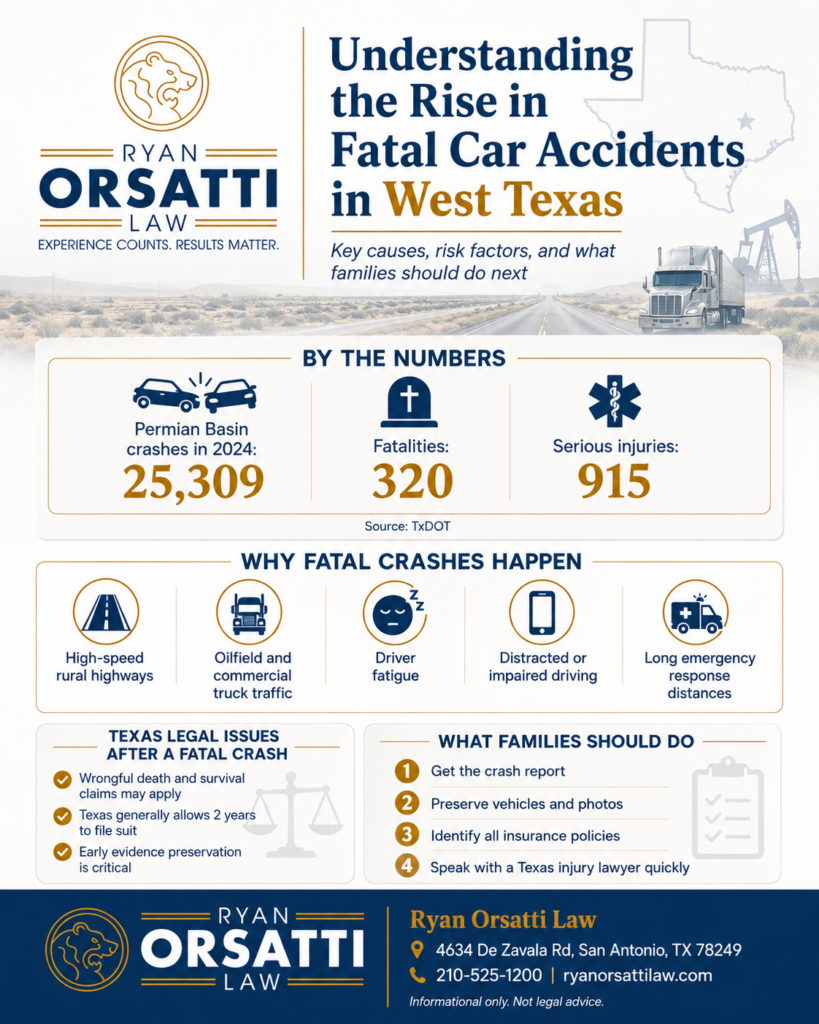
Fatal car accidents in West Texas are tied to a dangerous mix of high-speed rural roads, oilfield and commercial traffic, fatigue, distraction, impairment, long emergency-response distances, and heavy vehicles sharing roads with passenger cars. TxDOT reported that the Permian Basin had 25,309 traffic crashes in 2024, resulting in 320 fatalities and 915 serious injuries. (Texas Department of Transportation)
Statewide, Texas traffic deaths fell from 4,159 in 2024 to 3,769 in 2025, so the issue is not that every Texas roadway is worsening every year. The concern is that West Texas energy corridors remain high-risk, especially when a crash involves commercial vehicles, multiple victims, limited insurance, or disputed fault. (Texas Department of Transportation) Ryan Orsatti Law helps injured people and families in San Antonio and across Texas evaluate evidence, insurance coverage, and wrongful death issues after serious crashes.
Key Takeaways
- West Texas crash risk is concentrated around rural highways, energy-sector routes, FM roads, county roads, and fast-moving commercial traffic.
- TxDOT reported nearly 79,000 crashes and 1,023 deaths across Texas’s five major energy regions in 2024. (Texas Department of Transportation)
- The Permian Basin alone accounted for 25,309 crashes, 320 fatalities, and 915 serious injuries in 2024. (Texas Department of Transportation)
- In Texas, fatal crash cases may involve wrongful death claims, survival claims, insurance coverage disputes, and evidence-preservation issues.
- Families should act quickly to preserve vehicles, crash-scene evidence, dashcam footage, truck data, phone records, and insurance information.
What does the data say about fatal car accidents in West Texas?
The data says West Texas remains a serious crash-risk region even when statewide fatality numbers decline. TxDOT reported that Texas had 3,769 motor vehicle traffic deaths in 2025, down 9.38% from 2024, but its energy-sector data still shows heavy crash concentration in oil and gas regions. (Texas Department of Transportation)
West Texas is not one legal category. In crash discussions, it often refers to the Permian Basin and surrounding corridors, including Midland, Odessa, Ector County, Midland County, Reeves County, Pecos County, Ward County, Andrews County, Crane County, Upton County, and nearby rural highways. These areas combine long-distance driving, commercial transportation, fast roads, and limited time to react.
TxDOT’s Energy Sector Safety Campaign reported nearly 79,000 crashes in Texas’s five major energy regions in 2024. Those crashes resulted in 1,023 deaths, which TxDOT described as one in four of all traffic fatalities in the state. TxDOT also identified failure to control speed and driver inattention as leading contributors in those regions. (Texas Department of Transportation)
Which West Texas counties show serious fatal crash patterns?
TxDOT’s 2024 county-and-road-type report shows that fatal West Texas crashes are not limited to one roadway or one city. Examples include Ector County with 43 fatal crashes and 50 fatalities, Midland County with 32 fatal crashes and 34 fatalities, Reeves County with 10 fatal crashes and 12 fatalities, Pecos County with 9 fatal crashes and 9 fatalities, and Ward County with 7 fatal crashes and 7 fatalities. (Texas Department of Transportation)
| West Texas county example | 2024 fatal crashes | 2024 fatalities | Why it matters in a legal claim |
|---|---|---|---|
| Ector County | 43 | 50 | High crash volume can involve city streets, highways, oilfield routes, and multiple possible evidence sources. |
| Midland County | 32 | 34 | Crashes may involve commuter traffic, commercial vehicles, FM roads, and intersection disputes. |
| Reeves County | 10 | 12 | Remote highway crashes can make vehicle preservation and witness identification harder. |
| Pecos County | 9 | 9 | Long travel distances can affect emergency response, reconstruction, and medical documentation. |
| Ward County | 7 | 7 | Rural road and highway evidence may disappear quickly without early investigation. |
Key takeaway: West Texas fatal crash claims often turn on early evidence preservation because the crash may occur far from witnesses, cameras, medical facilities, and the family’s home county.
Why are fatal car accidents in West Texas so severe?
Fatal car accidents in West Texas are severe because the region combines high speeds, rural roadways, long distances, heavy trucks, fatigue, and limited margin for error. TxDOT reported that rural traffic deaths accounted for 50.12% of all Texas traffic fatalities in 2024, with 2,080 deaths in rural traffic crashes.
A crash on I-20, US-285, SH-158, SH-302, FM roads, or county roads near oilfield activity can become catastrophic quickly. A smaller passenger vehicle may be sharing the road with tankers, sand trucks, service trucks, pickup convoys, and drivers commuting long distances between job sites.
Common severity factors include:
- High posted speeds and drivers traveling too fast for road conditions
- Long stretches of two-lane roads with passing conflicts
- Dust, darkness, glare, rain, fog, and limited lighting
- Commercial vehicles with larger blind spots and longer stopping distances
- Driver fatigue from long shifts or long commutes
- Distracted driving and failure to control speed
- Delayed discovery of the crash or longer EMS transport times
- Vehicle rollovers, head-on impacts, and underride or override events
TxDOT warns that energy-sector drivers may encounter large trucks, tankers, limited visibility, and road-surface wear that can create hazards. TxDOT’s safety guidance tells drivers to maintain safe following distance, avoid truck blind spots, obey stop signs and signals, buckle up, and never drive impaired. (Texas Department of Transportation)
How do oilfield and commercial vehicles change the analysis?
Oilfield and commercial vehicles change the analysis because the responsible party may be more than the driver. A serious West Texas crash may require investigation into a motor carrier, employer, contractor, maintenance company, cargo loader, vehicle owner, lease operator, or company that controlled the route or schedule.
Commercial-vehicle cases also involve different records. FMCSA explains that an electronic logging device, or ELD, synchronizes with a vehicle engine to automatically record driving time for hours-of-service tracking. (FMCSA) FMCSA also states that motor carriers must maintain an accident register for qualifying crashes from the past three years. (CSA Compliance)
That matters because an early investigation can seek:
- ELD records and supporting documents
- Driver qualification files
- Dispatch records
- Maintenance records
- Inspection records
- Dashcam or in-cab video
- GPS and telematics data
- Bills of lading or load documents
- Vehicle event data from the engine control module or event data recorder
How do seat belts, impairment, and distraction affect fault?
Seat belts, impairment, and distraction affect fault because insurers look for every fact that may reduce or shift responsibility. TxDOT reported that in 2024, 45.34% of vehicle occupants killed in crashes where restraint use was applicable and known were reported as not restrained, 1,053 people were killed in crashes involving a driver under the influence of alcohol, and 380 people were killed in crashes involving distracted driving.
Comparative responsibility means Texas can reduce a recovery by a person’s percentage of fault. Under Texas Civil Practice and Remedies Code § 33.001, a claimant may not recover damages if the claimant’s percentage of responsibility is greater than 50%. (Texas Statutes)
This is why fatal crash investigations should not stop at the first police narrative. A complete review may examine toxicology, seat belt evidence, phone data, vehicle damage, road design, lighting, trucking records, and whether a company or driver violated safety rules.
What legal claims can follow a fatal West Texas car accident?
A fatal Texas crash can create both a wrongful death claim and a survival claim. A wrongful death claim belongs to certain family members for their own losses, while a survival claim preserves certain claims the deceased person could have brought if they had survived. (Texas Statutes)
Texas Civil Practice and Remedies Code § 71.004 provides that a wrongful death action is for the exclusive benefit of the surviving spouse, children, and parents of the deceased. (Texas Statutes) A survival claim can involve issues such as conscious pain, medical expenses, and other damages tied to the deceased person’s own claim, depending on the facts.
In a West Texas crash, the claim may also involve:
- Negligent driving
- Commercial vehicle negligence
- Employer responsibility
- Vehicle maintenance failures
- Road construction or work-zone issues
- Drunk driving or drug impairment
- Distracted driving
- Uninsured or underinsured motorist coverage
- Governmental-entity issues if a public vehicle, road condition, or public employee is involved
How long does a family have to file after a fatal Texas crash?
Texas generally gives two years to file suit for personal injury or injury resulting in death. Texas Civil Practice and Remedies Code § 16.003 says a person must bring suit not later than two years after the cause of action accrues, including actions for injury resulting in death. (Texas Statutes)
That two-year deadline is not the only timing issue. If a governmental unit is involved, Texas Civil Practice and Remedies Code § 101.101 provides a notice requirement not later than six months after the incident, and city charter or ordinance notice provisions may also matter. (Texas Legislature Online) Families should not assume they can safely wait until the second anniversary of the crash to act.
What evidence matters most after a fatal West Texas crash?
The most important evidence is the evidence that can disappear quickly. In a serious or fatal West Texas crash, families should focus on vehicles, scene photos, skid marks, debris fields, dashcam footage, cell-phone evidence, truck data, ELD records, dispatch records, inspection records, and witnesses.
A Texas Peace Officer’s Crash Report, often called a CR-3, is useful but incomplete. TxDOT says its online system allows customers to search for crash reports and pay the required $8 fee, and TxDOT also explains that crash data visualizations draw from the Crash Records Information System, or CRIS. (Texas Department of Transportation)
Can the police report decide fault by itself?
The police report does not decide the civil claim by itself. A CR-3 can identify drivers, vehicles, insurance information, road conditions, contributing factors, citations, and the officer’s narrative, but a civil claim may depend on evidence the officer did not have at the scene.
That is especially true in West Texas commercial-vehicle crashes. The officer may not have immediate access to ELD logs, maintenance records, dispatch communications, load documents, in-cab video, cell-phone records, or company safety history. Those records often require prompt preservation requests.
What should a family do in the first week after a fatal West Texas crash?
The first week should focus on preserving evidence, identifying insurance, and avoiding statements that lock in incomplete facts. The safest approach is to gather documents and information without guessing about fault, injury causation, or what insurance is available.
- Get the investigating agency name, officer name, crash location, and report number.
- Request the CR-3 crash report when available.
- Preserve the vehicles before repair, salvage, or destruction.
- Photograph the vehicles, roadway, nearby signs, lighting, debris, and visible injuries.
- Write down witness names, phone numbers, and what each person saw.
- Identify all possible insurance: personal auto, commercial auto, umbrella, UM/UIM, PIP, MedPay, and employer-related coverage.
- Avoid recorded statements to the other driver’s insurer until legal rights and coverage are understood.
- Send preservation requests for dashcam, ELD, ECM, phone, dispatch, and maintenance records if a commercial vehicle was involved.
- Keep funeral, medical, travel, counseling, and lost-income documents.
- Speak with a Texas personal injury lawyer before signing releases or accepting a coverage decision.
How do insurance companies evaluate fatal West Texas crashes?
Insurance companies evaluate fatal West Texas crashes by separating fault, coverage, causation, damages, and policy limits. In a fatal crash, the available insurance can matter as much as the liability evidence because Texas minimum coverage may be far below the harm caused.
TDI explains that Texas requires at least $30,000 of bodily injury coverage per person, $60,000 per accident, and $25,000 for property damage, commonly called 30/60/25 coverage. (Texas Department of Insurance) TDI also explains that PIP and UM/UIM coverages can apply in certain circumstances, including when the other driver has no insurance or not enough insurance. (Texas Department of Insurance)
For first-party auto claims, TDI describes deadlines for insurers to acknowledge a claim, request information, accept or reject a claim after receiving necessary information, and send payment after agreeing to pay. TDI also notes that those prompt-payment rules do not apply the same way when another driver’s insurance company is paying the claim. (Texas Department of Insurance)
What if the at-fault driver was working?
If the at-fault driver was working, the claim may involve employer responsibility, commercial insurance, and company safety records. A crash caused by a driver commuting for personal reasons is different from a crash involving a truck driver, delivery driver, oilfield worker, contractor, or employee acting within the course and scope of work.
The practical questions are direct:
- Was the driver on the clock?
- Who owned the vehicle?
- Who maintained the vehicle?
- Who loaded the vehicle?
- Who controlled the route?
- Was the driver using a company phone or dispatch system?
- Was the vehicle subject to FMCSA or Texas commercial-vehicle rules?
- Were there prior safety problems, inspection violations, or similar crashes?
What if there are multiple victims or limited insurance?
If there are multiple victims or limited insurance, coverage allocation can become a major issue. A minimum Texas liability policy may provide only $60,000 total bodily injury coverage for one crash, even if several people were killed or seriously injured. (Texas Department of Insurance)
That does not mean the case is limited to that one policy. A careful review may look for commercial policies, umbrella coverage, employer coverage, vehicle-owner coverage, UM/UIM coverage, PIP, MedPay, product claims, road-construction issues, or other responsible parties.
Attorney Insight: In West Texas fatal crashes, the first fight is often over missing information, not just fault. The CR-3 may tell you what the officer saw at the scene, but it rarely captures dispatch pressure, fatigue, ELD data, maintenance gaps, in-cab video, cell-phone activity, or whether a company moved the vehicle before it was inspected. Families should treat evidence preservation as a first-week issue.
When should a Texas personal injury lawyer get involved?
A Texas personal injury lawyer should get involved early when a fatal or catastrophic crash involves disputed fault, commercial vehicles, multiple insurance layers, governmental entities, impaired driving, or evidence that may be deleted. Early involvement can help preserve vehicles, request critical data, identify every insurance layer, and prevent avoidable claim mistakes.
Ryan Orsatti Law helps injured people and families in San Antonio and across Texas evaluate serious crash claims, including car accident cases, truck accident cases, wrongful death claims, drunk driving accident cases, and catastrophic injury claims.
The firm’s role is practical: investigate fault, preserve evidence, review insurance, organize medical and economic documentation, communicate with insurers, and prepare the case based on the facts. No lawyer can promise an outcome, but a timely investigation can protect options that may be lost if families wait.
What are the next steps for families dealing with a West Texas fatal crash?
The next steps are to stabilize immediate family needs, secure documents, identify every potential defendant and insurance policy, and speak with a Texas lawyer before signing releases. Fatal crash claims involve deadlines, probate issues, insurance coverage disputes, and evidence that may disappear.
For a family in San Antonio, Bexar County, or elsewhere in Texas dealing with a crash in Midland, Odessa, Reeves County, Pecos County, or another West Texas area, distance can create extra problems. The crash scene, investigating agency, hospital, witnesses, employer, truck company, and insurance adjusters may all be in different places.
Ryan Orsatti Law can review the available facts, identify what evidence needs to be preserved, and help determine whether the case involves a personal auto policy, commercial policy, UM/UIM coverage, employer-related liability, or a wrongful death claim. Families can contact Ryan Orsatti Law to discuss next steps.
FAQ
Are fatal car accidents really increasing in West Texas?
Fatal crash concern in West Texas is rising because crash risk remains concentrated in energy-sector areas, even though Texas statewide deaths declined in 2025. TxDOT reported 25,309 Permian Basin crashes in 2024, with 320 fatalities and 915 serious injuries. Statewide, Texas traffic deaths fell from 4,159 in 2024 to 3,769 in 2025. (Texas Department of Transportation)
Why are West Texas crashes often more deadly than city crashes?
West Texas crashes are often more deadly because rural roads involve higher speeds, longer distances, heavier vehicles, fewer witnesses, less lighting, and longer emergency-response routes. TxDOT reported that rural traffic deaths made up 50.12% of Texas traffic fatalities in 2024, showing that rural crash severity remains a major statewide issue.
What is the deadline to file a Texas wrongful death claim after a fatal crash?
Texas generally requires a lawsuit for injury resulting in death to be filed within two years after the cause of action accrues. That rule comes from Texas Civil Practice and Remedies Code § 16.003. Shorter notice issues may apply if a governmental unit is involved, so families should not wait to review deadlines. (Texas Statutes)
Who can bring a wrongful death claim in Texas after a fatal car accident?
Texas wrongful death claims are for the exclusive benefit of the surviving spouse, children, and parents of the deceased person. That rule is found in Texas Civil Practice and Remedies Code § 71.004. A survival claim may also exist for claims the deceased person could have brought if they had survived. (Texas Statutes)
What evidence should be preserved after a fatal oilfield or truck crash?
Important evidence can include the vehicles, photos, witness information, dashcam video, ELD data, dispatch records, phone records, maintenance files, inspection reports, GPS data, and load documents. FMCSA explains that ELDs record driving time, and motor carriers must maintain certain accident-register records, which can become important after a serious commercial crash. (FMCSA)
Does the police report decide who is legally at fault?
No. A Texas crash report can be important evidence, but it does not always decide civil fault. A serious crash claim may require more evidence than the officer had at the scene, including commercial records, cell-phone evidence, vehicle data, witness statements, photographs, reconstruction analysis, and insurance coverage documents.
What if the at-fault driver has only minimum Texas insurance?
If the at-fault driver has only minimum Texas insurance, the available liability coverage may be limited to 30/60/25 coverage. That means $30,000 per injured person, $60,000 per accident, and $25,000 for property damage. Families should review UM/UIM, PIP, MedPay, commercial, umbrella, and employer-related coverage before signing any release. (Texas Department of Insurance)
Ryan Orsatti Law
4634 De Zavala Rd, San Antonio, TX 78249
Phone: 210-525-1200
ryanorsattilaw.com
This blog is for informational purposes only, not legal advice. Reading it does not create an attorney-client relationship. Past results do not guarantee future results.
Hurt in an accident in San Antonio? Learn how a San Antonio car accident lawyer can help with your claim. Call 210-525-1200 or request a free consultation.
The firm works on a contingency fee. You pay nothing unless the firm recovers money for you, and that covers case expenses as well as the fee: if there is no recovery, you owe no attorney's fee and no case expenses. Ask for the fee agreement and read the fee and expense section before you sign anything.
Related San Antonio legal resources
Primary legal and public-data sources
- Texas Civil Practice and Remedies Code Chapter 71: wrongful death
- Texas Civil Practice and Remedies Code Chapter 16: limitations
Ryan Orsatti Law
4634 De Zavala Road, San Antonio, TX 78249
General reference links. Consult each source for its current text.