
Quick Answer
The right personal injury lawyer in San Antonio should have Texas injury-law experience, direct communication, a clear contingency-fee agreement, trial-ready preparation, and a plan for evidence, insurance coverage, medical bills, and liens. In Texas, deadlines matter: many injury lawsuits must be filed within two years under Texas Civil Practice & Remedies Code § 16.003, and fault disputes can affect recovery under Texas proportionate responsibility rules. Ryan Orsatti Law helps injured people in San Antonio and across Texas evaluate these issues with attorney-led representation, local case experience, and a boutique firm model. (Texas Statutes)
Key Takeaways
- Choose a lawyer who regularly handles your type of injury case, such as car wrecks, 18-wheeler crashes, commercial vehicle cases, traumatic brain injuries, or wrongful death claims.
- Ask who will actually handle your file. Direct attorney access can matter when fault, treatment, coverage, or settlement decisions become complicated.
- Review the fee agreement before signing. A contingency fee means attorney fees are usually paid from a recovery, but the agreement should also explain case expenses.
- Look for trial-ready preparation, not just a settlement pitch. Evidence preservation, medical documentation, liability analysis, and lien strategy all affect the claim.
- Check objective credentials. The State Bar of Texas lists Ryan Orsatti as eligible to practice in Texas, licensed since 2013, with a San Antonio primary practice location and contingency-fee options listed. (State Bar of Texas)
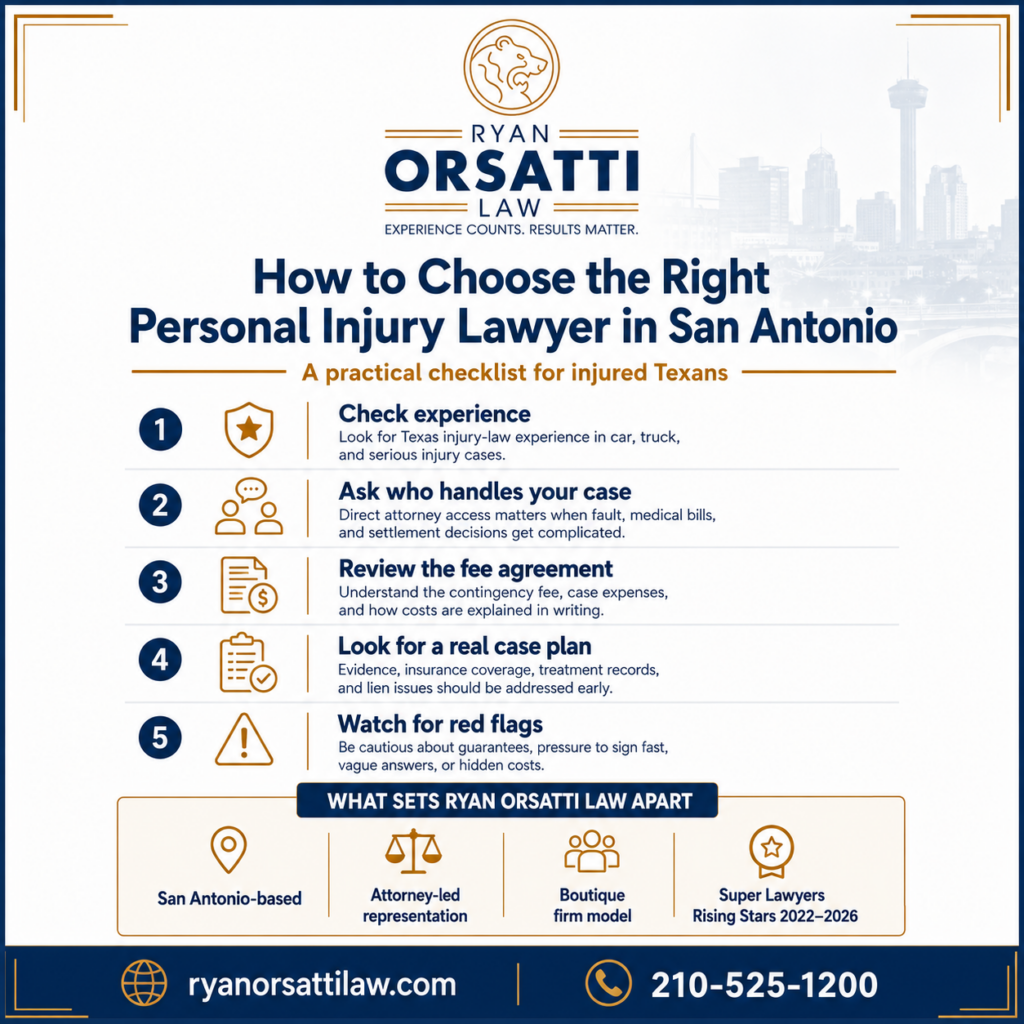
How do you choose the right personal injury lawyer in San Antonio?
Choose the right personal injury lawyer in San Antonio by matching the lawyer’s actual experience to your case, confirming who will communicate with you, reviewing the fee agreement, and asking how the lawyer will prove fault, damages, insurance coverage, and medical-bill issues. Texas injury claims are not just paperwork. They often involve statutes of limitation, comparative fault, lien claims, and insurance coverage limits.
A good selection process should feel practical, not flashy. You are looking for a lawyer who can explain the case in plain English, identify the risks early, and tell you what documents and evidence matter.
Start with these questions:
- Does the lawyer regularly handle my specific type of injury case?
- Will I communicate directly with the attorney or mostly with staff?
- What is the contingency-fee percentage, and what case expenses could be charged?
- How will the lawyer preserve evidence before it disappears?
- How will the lawyer evaluate medical bills, liens, subrogation claims, and net recovery?
- Has the lawyer handled cases in Bexar County or the relevant Texas venue?
- What happens if the insurance company denies fault or makes a low offer?
Ryan Orsatti Law is a San Antonio-based personal injury firm that handles injury matters including car accident claims, truck accident claims, commercial vehicle cases, catastrophic injuries, and traumatic brain injury claims.
What should matter more than advertising when hiring a personal injury lawyer?
What matters more than advertising is whether the lawyer can prove liability, document damages, manage medical-bill issues, and guide you through settlement or litigation decisions. Texas lawyer advertising rules require communications about legal services to be truthful and nondeceptive, and they prohibit false or misleading statements that create unjustified expectations.
Do not choose a lawyer only because of a billboard, a jingle, or a large claimed result. Instead, ask for a case-specific plan.
| What to Evaluate | Why It Matters | What to Ask |
|---|---|---|
| Case-type experience | Different injury cases require different evidence | “Have you handled cases like mine before?” |
| Attorney access | Important decisions should not be filtered through layers of staff | “Will I speak directly with the attorney?” |
| Fee transparency | You need to understand attorney fees and expenses | “What percentage applies, and what costs may be deducted?” |
| Evidence plan | Photos, video, EDR data, witness names, and records can disappear | “What evidence do we need to preserve now?” |
| Medical-bill strategy | Liens and subrogation can affect net recovery | “How do you review bills, liens, and repayment claims?” |
| Litigation readiness | Some cases need a lawsuit to obtain evidence or address disputed fault | “What changes if the insurer refuses to be fair?” |
Key takeaway: A strong lawyer-selection process focuses less on slogans and more on the lawyer’s plan for proof, communication, fees, and the client’s actual net recovery.
Why does Texas personal injury experience matter?
Texas personal injury experience matters because Texas has state-specific rules on deadlines, fault allocation, insurance coverage, liens, and damages. A lawyer who handles injury claims in San Antonio should understand how Bexar County crash evidence, medical documentation, adjuster evaluations, and Texas procedural deadlines can affect a claim.
For example, Texas uses proportionate responsibility. Comparative responsibility means Texas can reduce a recovery by a person’s percentage of fault, and Texas Civil Practice & Remedies Code § 33.001 bars recovery if the claimant’s percentage of responsibility is greater than 50%. (Texas Statutes)
That rule affects real cases. If an adjuster argues you were speeding, changed lanes, delayed medical care, ignored symptoms, or caused part of the wreck, the lawyer must know how to build a factual response. That may require photos, crash reports, witness statements, vehicle damage analysis, medical records, expert review, and sworn testimony.
Texas traffic data also shows why serious injury claims require careful handling. TxDOT’s final comparison report for 2003 to 2025 lists 3,769 Texas motor vehicle traffic deaths in 2025, with reportable data processed as of April 7, 2026. (TxDOT)
What credentials should you verify before hiring a San Antonio personal injury lawyer?
You should verify that the lawyer is licensed, eligible to practice in Texas, located where they claim to practice, and experienced in the kind of injury case you have. Objective sources matter because marketing claims can be vague, but licensing, court experience, professional recognition, and practice focus are easier to verify.
For Ryan Orsatti, the State Bar of Texas profile lists him as eligible to practice in Texas, licensed since December 5, 2013, with Ryan Orsatti Law at 4634 De Zavala Road in San Antonio and practice areas including Litigation: Personal Injury. The same State Bar profile also lists contingency-fee options and language translation as available. (State Bar of Texas)
Super Lawyers lists Ryan Orsatti as selected to Rising Stars from 2022 through 2026, and its selection process states that Rising Stars selections are limited to 2.5% of lawyers in each state. Super Lawyers also lists his practice area as personal injury, his Texas licensure since 2013, and English and Spanish as spoken languages. (SuperLawyers.com)
What sets Ryan Orsatti Law apart when you apply this checklist?
Ryan Orsatti Law fits the lawyer-selection checklist by combining San Antonio personal injury focus, attorney-led case handling, contingency-fee availability, bilingual accessibility, and Texas litigation experience. The key point is not that one credential decides everything. The point is that an injured person should look for a pattern of verifiable fit.
Ryan Orsatti Law’s model is boutique by design. That means the firm emphasizes direct attorney involvement and selected case handling rather than a high-volume structure where a client may feel passed from one department to another.
For many clients, that matters most at decision points like:
- whether to give a recorded statement
- whether to use health insurance, PIP, MedPay, or a letter of protection
- whether a medical gap will be used against them
- whether the first offer accounts for all treatment and liens
- whether a lawsuit should be filed before the deadline
- whether the claimed net recovery makes sense after fees, costs, and medical balances
Most personal injury matters Ryan Orsatti Law accepts are handled on a contingency-fee basis. A contingency fee means attorney fees are usually paid from a recovery rather than billed by the hour, but the written fee agreement should explain the percentage, litigation expenses, and how costs are handled.
Why does direct attorney access matter in an injury case?
Direct attorney access matters because personal injury cases often turn on judgment calls that require legal strategy, not just status updates. A case manager can help move records and scheduling, but the attorney should be involved in fault analysis, demand timing, litigation decisions, and settlement evaluation.
This is especially true in San Antonio car and truck crash claims. A wreck on I-10, I-35, Loop 410, Loop 1604, or US-281 may involve multiple drivers, commercial insurance, rideshare coverage, missing video, disputed lane changes, or serious injuries that are not fully diagnosed in the first week.
Direct attorney involvement can help avoid common problems:
- Sending a demand before the medical picture is clear.
- Accepting a settlement before liens are known.
- Missing UM/UIM coverage in the client’s own policy.
- Letting defense arguments form before evidence is preserved.
- Failing to explain the difference between gross settlement and net recovery.
Attorney Insight: In real injury claims, the first major mistake is often not a legal filing mistake. It is a documentation mistake. Adjusters look for gaps in treatment, inconsistent symptom descriptions, missing work notes, unclear diagnosis codes, and weak proof of how the injury changed daily life. A good lawyer helps organize that evidence before the demand package goes out, not after the offer disappoints the client.
How should a lawyer explain fees and costs?
A personal injury lawyer should explain the contingency-fee percentage, when the percentage changes, whether litigation affects the fee, and how case expenses are handled. Texas advertising rules specifically address contingency-fee advertising and require clarity about whether the client may be responsible for other expenses.
Do not sign a fee agreement until you understand the difference between attorney fees and case expenses. Attorney fees compensate the lawyer. Case expenses may include filing fees, records charges, deposition costs, mediation fees, expert review, service fees, exhibit costs, or other litigation expenses.
Ask these fee questions before hiring any injury firm:
- What is the pre-lawsuit contingency-fee percentage?
- Does the fee percentage change if a lawsuit is filed?
- Who advances case expenses?
- Can expenses be owed if there is no recovery?
- Will I receive a settlement statement before funds are disbursed?
- Will you explain liens, subrogation, and medical balances before I approve settlement?
Subrogation means a health insurer may claim a right to be paid back from a settlement. A hospital lien is a legal claim a hospital may assert against part of a personal injury recovery. These issues can make the net recovery very different from the gross settlement number.
What should the lawyer do early in the case?
The lawyer should identify the deadline, preserve evidence, confirm insurance coverage, document injuries, and begin tracking medical bills and liens early. Waiting too long can weaken the claim because video, witness memory, vehicle data, employment records, and medical proof can become harder to obtain.
Use this checklist after a serious accident in San Antonio or anywhere in Texas:
- Get medical care and follow the treatment plan.
- Save photos of vehicles, injuries, roadway conditions, and property damage.
- Get the crash report or incident report when available.
- Do not give a recorded statement to the other insurer before understanding the risks.
- Save insurance cards, declarations pages, health insurance information, and medical bills.
- Write down witnesses, locations, dates, missed work, and daily limitations.
- Contact a Texas personal injury attorney before the evidence window closes.
- Calendar the limitations deadline and do not rely on the insurance claim staying open.
Spoliation means the loss, destruction, or failure to preserve evidence when a party has a duty to keep it. In serious cases, an attorney may send preservation letters to prevent the loss of video, vehicle data, driver logs, maintenance records, phone records, or incident reports.
How should a lawyer evaluate insurance coverage?
A lawyer should evaluate liability coverage, the injured person’s own coverage, and any additional source of recovery before advising on settlement. Texas minimum auto liability coverage is often called 30/60/25, meaning $30,000 per injured person, $60,000 per accident, and $25,000 for property damage, according to the Texas Department of Insurance. (Texas Department of Insurance)
That may not be enough for a serious injury. A San Antonio personal injury lawyer should review:
- liability coverage for the at-fault driver
- commercial policy coverage if a business vehicle is involved
- rideshare coverage if Uber, Lyft, or another platform is involved
- UM/UIM coverage, which may apply when the at-fault driver has no insurance or not enough insurance
- PIP or MedPay coverage, which may help pay medical expenses
- health insurance, ERISA plans, Medicare, Medicaid, workers’ compensation, or hospital liens
UM/UIM means uninsured or underinsured motorist coverage. PIP means personal injury protection. MedPay means medical payments coverage. These coverages can affect treatment access, settlement timing, and the amount the client actually receives.
How much should reviews and awards matter?
Reviews and awards can help, but they should not replace a case-specific evaluation. A recognition, rating, or review pattern may support credibility, but you still need to know who will handle your case, how the lawyer communicates, and what strategy applies to your facts.
A practical way to use reviews is to look for patterns, not promises. Look for comments about responsiveness, direct communication, realistic expectations, and whether the lawyer explained the process clearly. Avoid treating any review as a guarantee that your case will have the same result.
Ryan Orsatti’s verified credentials include State Bar eligibility, licensure since 2013, a San Antonio practice location, and Super Lawyers Rising Stars selections listed for 2022 through 2026. Those are useful data points, but the better question is whether the firm’s approach fits your case, your communication style, and the seriousness of your injuries. (State Bar of Texas)
What red flags should you watch for when choosing a personal injury lawyer?
You should be cautious if a lawyer guarantees a result, pressures you to sign immediately, will not explain the fee agreement, avoids discussing expenses, or cannot tell you who will actually handle your case. Texas legal advertising rules prohibit false or misleading communications and statements likely to create unjustified expectations about results.
Watch for these red flags:
- promises about a dollar amount before reviewing records and coverage
- unwillingness to explain how fees and costs work
- vague answers about who your attorney will be
- pressure to accept a fast settlement before treatment is understood
- no clear plan for evidence preservation
- no explanation of liens, subrogation, or medical bills
- overreliance on advertising claims instead of case work
A careful lawyer should be able to say, “Here is what we know, here is what we still need, here are the risks, and here are the next steps.”
When is Ryan Orsatti Law a good fit for an injury case?
Ryan Orsatti Law may be a good fit when an injured person wants a San Antonio-based personal injury firm with attorney-led involvement, Texas injury-law focus, and a practical plan for fault, insurance, medical documentation, and settlement decisions. The firm handles personal injury claims in San Antonio and across Texas, including serious vehicle crashes and injury cases.
The firm may be especially worth contacting when:
- the crash involved serious injuries
- the other insurer is disputing fault
- medical bills are piling up
- treatment is ongoing
- a commercial vehicle, truck, rideshare driver, or business vehicle was involved
- there may be UM/UIM, PIP, MedPay, or lien issues
- the settlement offer does not make sense
- you want direct attorney involvement before making a claim decision
You can learn more about the firm on the Ryan Orsatti Law homepage, the About Ryan Orsatti Law page, or by using the contact page.
FAQ
How soon should I contact a personal injury lawyer after an accident in San Antonio?
You should contact a personal injury lawyer as soon as your immediate medical needs are addressed, especially if you were hurt, fault is disputed, or an insurer is calling. Early legal review can help preserve evidence, avoid damaging recorded statements, identify insurance coverage, and calendar the Texas filing deadline before the claim becomes harder to prove.
What questions should I ask before hiring a San Antonio personal injury lawyer?
Ask who will handle your case, how often you will receive updates, what the contingency-fee percentage is, whether the fee changes in litigation, who pays case expenses, and what evidence must be preserved. You should also ask how the lawyer evaluates medical bills, liens, subrogation, insurance coverage, and the likely timeline.
Is a contingency fee normal in Texas personal injury cases?
Yes, contingency fees are common in Texas personal injury cases. A contingency-fee agreement usually means attorney fees are paid from a recovery rather than billed hourly. Before signing, ask whether litigation changes the percentage, what expenses may be deducted, and whether you could owe any case costs depending on the written agreement.
Why should I care whether the lawyer is local to San Antonio?
A San Antonio personal injury lawyer may be more familiar with local roads, Bexar County litigation patterns, medical documentation issues, and common insurance-claim handling in the area. Local experience does not guarantee a result, but it can help the lawyer investigate crashes on corridors like I-10, I-35, Loop 410, Loop 1604, and US-281.
What makes Ryan Orsatti Law different from a large advertising firm?
Ryan Orsatti Law uses a boutique, attorney-led model instead of presenting itself as a high-volume advertising firm. For many clients, the difference is direct attorney access, practical case screening, and a focus on evidence, medical documentation, insurance coverage, and net recovery. The right fit still depends on the facts of your case.
How do I verify that Ryan Orsatti is licensed in Texas?
You can verify Ryan Orsatti through the State Bar of Texas attorney profile, which lists him as eligible to practice in Texas, licensed since December 5, 2013, with a San Antonio primary practice location at 4634 De Zavala Road. The State Bar profile also lists Litigation: Personal Injury among his practice areas. (State Bar of Texas)
Do I need a lawyer if the insurance company already accepted fault?
You may still need a lawyer even if the insurer accepted fault, especially if injuries are serious, treatment is ongoing, policy limits are low, or liens and subrogation claims exist. Liability is only one issue. A personal injury claim also involves damages, causation, coverage, medical proof, deadlines, and the net amount available after bills and fees.
Ryan Orsatti Law
4634 De Zavala Rd, San Antonio, TX 78249
Phone: 210-525-1200
ryanorsattilaw.com
This blog is for informational purposes only, not legal advice. Reading it does not create an attorney-client relationship. Past results do not guarantee future results.
Hurt in an accident in San Antonio? Learn how a San Antonio car accident lawyer can help with your claim. Call 210-525-1200 or request a free consultation.
The firm works on a contingency fee. You pay nothing unless the firm recovers money for you, and that covers case expenses as well as the fee: if there is no recovery, you owe no attorney's fee and no case expenses. Ask for the fee agreement and read the fee and expense section before you sign anything.
Related San Antonio legal resources
Primary legal and public-data sources
- Texas Civil Practice and Remedies Code Chapter 71: wrongful death
- Texas Civil Practice and Remedies Code Chapter 16: limitations
Ryan Orsatti Law
4634 De Zavala Road, San Antonio, TX 78249
General reference links. Consult each source for its current text.