
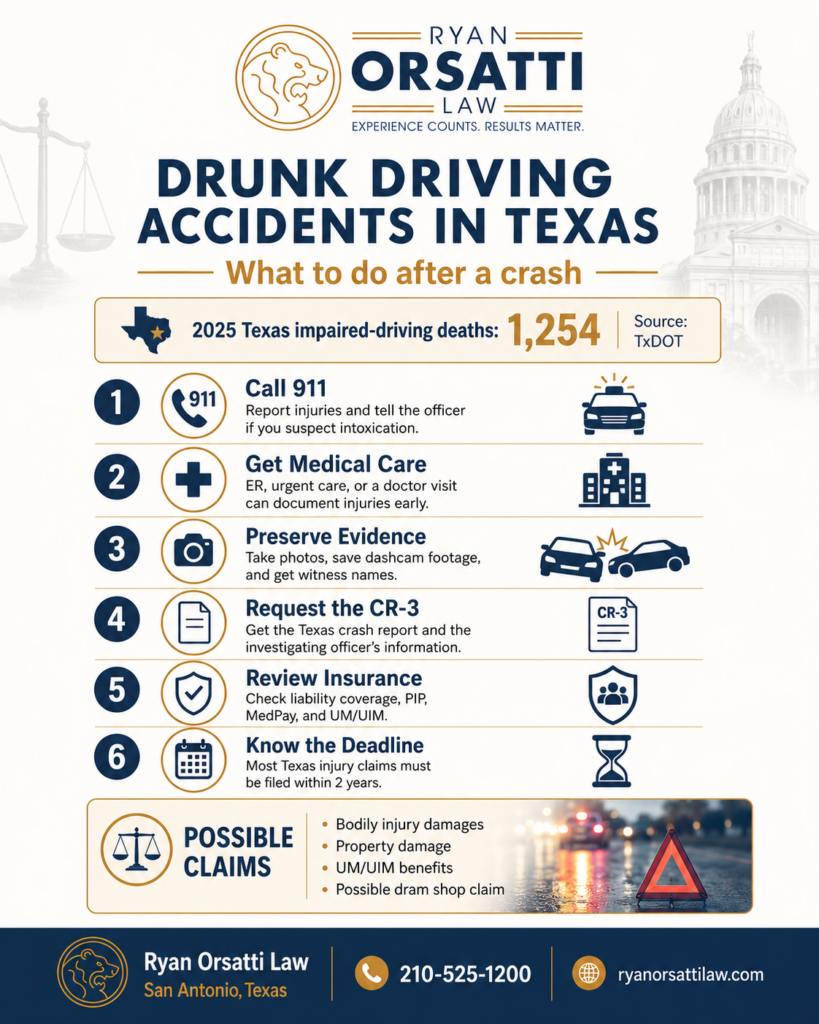
Quick Answer: After a drunk driving accident in Texas, call 911, get medical care, tell the investigating officer why you believe the other driver is impaired, and preserve evidence before insurance adjusters shape the record. Texas gives most injured people two years to file a personal injury lawsuit, and TxDOT reported that 1,254 people died on Texas roads because of impaired driving in 2025. Ryan Orsatti Law helps injured people in San Antonio and across Texas evaluate fault, insurance coverage, medical bills, and evidence preservation after drunk driving crashes. (Texas Statutes)
Key Takeaways
- A Texas drunk driving crash can involve both a criminal DWI case and a separate civil injury claim.
- Do not rely only on the criminal case. Your civil claim needs medical records, crash evidence, insurance review, and proof of damages.
- Texas Penal Code § 49.04 defines DWI as operating a motor vehicle while intoxicated in a public place. (Texas Statutes)
- Texas minimum liability insurance is only 30/60/25, which may be too low for a serious injury crash. (Texas Department of Insurance)
- If a bar, restaurant, or alcohol provider overserved the driver, a Texas dram shop claim may need immediate investigation.
What Makes a Drunk Driving Accident Different From a Regular Texas Car Accident?
A drunk driving accident in Texas is different because it often creates two tracks at once: a criminal DWI investigation and a civil personal injury claim. The criminal case focuses on punishment, bond conditions, probation, jail, license consequences, or restitution. The civil claim focuses on medical bills, lost income, pain, impairment, property damage, and insurance coverage.
Texas law treats driving while intoxicated as a criminal offense when a person operates a motor vehicle in a public place while intoxicated. In a civil injury claim, the injured person still must prove negligence, causation, and damages. Negligence means the other driver failed to use ordinary care, and that failure caused harm.
Drunk driving cases also require faster evidence work than many ordinary crashes. BAC testing, body camera footage, 911 audio, officer observations, bar receipts, ride-share records, witness memories, and surveillance video can disappear or become harder to obtain.
What Should You Do First After a Drunk Driving Accident in Texas?
After a drunk driving accident in Texas, your first steps should be safety, medical care, law enforcement reporting, and evidence preservation. If anyone is injured, killed, or a vehicle cannot be safely driven, Texas Transportation Code § 550.026 requires immediate notice to the appropriate law enforcement agency. (Texas Statutes)
Use this checklist as soon as it is safe:
- Call 911. Tell dispatch the location, whether anyone is injured, and why you believe the other driver may be impaired.
- Get medical help. Do not minimize pain, head symptoms, dizziness, confusion, neck pain, back pain, or numbness.
- Avoid arguing with the other driver. Drunk or impaired drivers may be unpredictable.
- Tell the officer what you observed. Mention odor of alcohol, slurred speech, stumbling, open containers, admissions, or erratic driving.
- Take photos and video if safe. Capture vehicle positions, damage, debris, skid marks, traffic signals, lighting, lane markings, and nearby businesses.
- Get witness information. Independent witnesses can matter if the driver later denies impairment or disputes how the crash happened.
- Save your dashcam footage. Preserve the original file, not just a phone recording of the screen.
- Do not give a recorded statement to the other driver’s insurer without legal guidance.
- Request the Texas Peace Officer’s Crash Report, also called the CR-3. TxDOT allows eligible people to obtain a CR-3 through its Crash Report Online Purchase System. (Texas Department of Transportation)
- Track every medical visit, missed workday, and out-of-pocket expense.
For crashes in San Antonio, this evidence may come from several places depending on where the wreck happened: SAPD, Bexar County deputies, DPS troopers, nearby businesses, highway cameras, private dashcams, or witnesses on corridors like I-10, I-35, Loop 410, Loop 1604, and US-281.
Do You Have to Wait for the Criminal DWI Case Before Filing a Civil Claim?
You usually do not have to wait for the criminal DWI case to finish before starting a Texas civil injury claim. The criminal case and the civil claim serve different purposes. A conviction may help the civil case, but your injury claim should still be investigated on its own timeline.
The civil claim can use evidence from the criminal investigation when available, including officer observations, field sobriety testing, blood or breath results, warrants, admissions, crash diagrams, witness statements, and video. But the injured person’s lawyer may also need to gather separate evidence that the criminal prosecutor is not focused on, such as lost wages, future medical care, liens, subrogation, and insurance limits.
Subrogation means a health insurer may claim a right to be paid back from a settlement. A hospital lien is a legal claim a hospital may assert against part of a personal injury recovery. These issues matter because a settlement number does not tell the whole story unless medical bills, insurance reimbursement claims, and liens are reviewed.
What Evidence Matters Most in a Texas Drunk Driving Accident Claim?
The most important evidence in a Texas drunk driving accident claim usually falls into three categories: impairment evidence, crash-causation evidence, and damages evidence. A strong claim connects all three. It is not enough to show the driver was intoxicated if the insurance company can still dispute how the crash happened or whether the injuries were caused by the wreck.
| Evidence | Why it matters | Practical step |
|---|---|---|
| CR-3 crash report | Identifies drivers, insurance, location, contributing factors, citations, and crash narrative | Request it through TxDOT or the investigating agency |
| Bodycam and dashcam video | May show odor, slurred speech, balance problems, admissions, and officer observations | Send preservation requests quickly |
| Blood or breath testing | May support impairment and timing arguments | Track the criminal case and discovery availability |
| 911 calls and dispatch records | May capture early reports of dangerous driving or impairment | Request before retention issues arise |
| Business surveillance video | May show the crash, vehicle movement, or the driver leaving a bar or restaurant | Identify nearby cameras within days |
| Medical records | Connect symptoms, diagnosis, treatment, and restrictions to the crash | Get evaluated and follow treatment instructions |
| Wage and work records | Support lost income or reduced earning capacity | Save pay stubs, schedules, employer notes, and tax records |
Key takeaway: A drunk driving claim is strongest when impairment evidence is tied directly to how the crash happened and how the injuries changed the person’s life.
Attorney Insight: In drunk driving cases, adjusters often concede the driver made a bad decision but still attack the injury claim. They may argue the treatment was delayed, the medical bills are too high, the crash impact was minor, or the injuries were preexisting. That is why the medical timeline, prior records, diagnostic findings, work restrictions, and lien review matter before a demand is sent.
How Does Insurance Work After a Drunk Driving Accident in Texas?
Insurance after a Texas drunk driving accident usually starts with the drunk driver’s liability coverage, but that may not be enough. The Texas Department of Insurance states that Texas minimum liability coverage is $30,000 per injured person, $60,000 per accident, and $25,000 for property damage. Serious injuries can exceed those limits quickly. (Texas Department of Insurance)
| Coverage | Who may have it? | What it may help pay |
|---|---|---|
| Bodily injury liability | The drunk driver | Medical bills, lost wages, pain, impairment, and other injury damages up to policy limits |
| Property damage liability | The drunk driver | Vehicle repair, total loss, rental-related losses, and damaged property up to policy limits |
| PIP | Your own policy | Medical bills, lost wages, and certain nonmedical costs, unless rejected in writing |
| MedPay | Your own policy, if purchased | Medical bills, usually without wage-loss benefits |
| UM/UIM | Your own policy | Claims when the drunk driver has no insurance or not enough insurance |
| Health insurance | Your own health plan | Medical care, subject to copays, deductibles, liens, and subrogation |
Key takeaway: In a serious drunk driving accident, the right insurance strategy often requires checking the drunk driver’s policy, your own PIP or MedPay, your UM/UIM coverage, health insurance, and any possible dram shop coverage.
TDI explains that Texas auto policies include PIP unless the named insured rejects it in writing, and insurance companies must offer UM/UIM coverage unless it is rejected in writing. (Texas Department of Insurance) PIP can be especially useful early because medical bills and missed work often arrive before the liability insurer is ready to evaluate the claim.
Can You Sue a Bar or Restaurant After a Texas Drunk Driving Accident?
You may be able to sue a bar, restaurant, or alcohol provider after a Texas drunk driving accident if the evidence meets the Texas dram shop standard. A dram shop claim is a claim against an alcohol provider for overservice. Under Texas Alcoholic Beverage Code § 2.02, the key issue is whether it was apparent to the provider that the person was obviously intoxicated to the extent that the person presented a clear danger to himself and others, and whether that intoxication proximately caused the damages. (Texas Statutes)
This is a demanding standard. It is not enough to prove the driver had alcohol in his system after the crash. The evidence usually needs to focus on what the bar, restaurant, club, store, or server knew or should have seen at the time alcohol was provided.
Useful evidence may include:
- Itemized receipts
- Credit card records
- Surveillance video
- Server names
- Witness statements
- Social media posts
- Ride-share records
- Prior stops that night
- BAC retrograde analysis when appropriate
- TABC records or incident history when available
Texas Alcoholic Beverage Code § 2.03 also makes Chapter 2 the exclusive cause of action for providing alcohol to a person 18 years of age or older. (Texas Statutes) Because video and receipts can be overwritten or lost, dram shop investigation should start quickly.
What Damages Can Be Claimed After a Drunk Driving Accident in Texas?
A person injured by a drunk driver in Texas may claim economic and noneconomic damages when the facts support them. Economic damages are measurable financial losses, such as medical bills, lost wages, reduced earning capacity, property damage, and future medical care. Noneconomic damages are human losses, such as physical pain, mental anguish, disfigurement, physical impairment, and loss of enjoyment of life.
In some drunk driving cases, exemplary damages may also be evaluated. Exemplary damages, sometimes called punitive damages, are not meant to repay a bill. They are a penalty or punishment remedy. Texas Civil Practice and Remedies Code § 41.003 requires clear and convincing evidence that the harm resulted from fraud, malice, or gross negligence. (Texas Statutes)
Exemplary damages are not automatic just because the other driver was arrested for DWI. The facts matter, including intoxication evidence, prior DWI history if admissible, how the driver behaved, how the crash happened, and whether Texas law allows the issue to be submitted.
How Does Comparative Responsibility Affect a Drunk Driving Accident Claim in Texas?
Comparative responsibility can still matter in a Texas drunk driving accident case. Comparative responsibility means Texas can reduce or bar recovery based on the injured person’s percentage of fault. Under Texas Civil Practice and Remedies Code § 33.001, a claimant may not recover damages if the claimant’s percentage of responsibility is greater than 50 percent. (Texas Statutes)
Insurance companies may still argue about fault even when the other driver was impaired. They may claim the injured driver was speeding, changed lanes unsafely, failed to keep a proper lookout, had no headlights on, or could have avoided the crash.
That does not mean the insurance company is right. It means the civil claim needs evidence. Photos, vehicle damage, roadway markings, event data, witness statements, phone records, and crash reconstruction may be needed in disputed cases.
How Long Do You Have to File a Drunk Driving Accident Lawsuit in Texas?
Most Texas drunk driving accident injury lawsuits must be filed within two years from the date the claim accrues. Texas Civil Practice and Remedies Code § 16.003 sets a two-year limitations period for personal injury claims and also addresses injury resulting in death. (Texas Statutes)
Do not treat two years as a reason to wait. Some evidence has a much shorter practical life. Surveillance video may be overwritten within days or weeks. Vehicles may be repaired, sold, salvaged, or destroyed. Witnesses may move or forget details. Criminal case evidence may require careful timing and formal requests.
Special deadline issues may apply when a government vehicle is involved, a minor is injured, a death claim exists, the defendant leaves Texas, or another statute controls a specific claim. Those issues need individual legal review.
What Should You Avoid Saying to the Insurance Company?
After a drunk driving accident, avoid giving the other driver’s insurance company broad statements, medical authorizations, or recorded answers before you understand your injuries and coverage. Adjusters may sound helpful, but their job is to evaluate the claim for the insurance company.
Avoid statements like:
- “I’m fine.”
- “I only went to the ER to be safe.”
- “I don’t think I’m badly hurt.”
- “I probably should have seen him.”
- “I do not need more treatment.”
- “You can have my full medical history.”
- “I’ll settle if you just pay the bills.”
You can report the claim and provide basic facts, but be careful with speculation. If you do not know your diagnosis, future treatment plan, missed work, or lien situation, you do not yet know the full claim picture.
When Should You Call a Texas Personal Injury Lawyer After a Drunk Driving Accident?
You should consider calling a Texas personal injury lawyer quickly after a drunk driving accident if you were injured, went to the ER, missed work, have visible vehicle damage, suspect overservice by a bar or restaurant, or are being contacted by insurance adjusters. Early legal help is often about preserving evidence and preventing avoidable mistakes, not rushing into a lawsuit.
Ryan Orsatti Law helps injured people in San Antonio, Bexar County, and across Texas review fault, coverage, medical documentation, liens, and evidence after serious crashes. In a drunk driving case, the early work may include requesting the CR-3, sending preservation letters, identifying coverage, reviewing PIP and UM/UIM, tracking the criminal case, and investigating whether a dram shop claim exists.
This is especially important for crashes on high-speed San Antonio corridors such as I-35, I-10, Loop 410, Loop 1604, US-281, and nearby roads in Comal, Guadalupe, Kendall, Wilson, Atascosa, and Medina counties.
FAQ
Can I sue a drunk driver in Texas if they were not convicted of DWI?
Yes, a civil injury claim may still be evaluated even if the driver is not convicted of DWI. The criminal case and civil claim have different purposes and different proof issues. A conviction can help, but civil evidence may also include officer observations, witness statements, crash facts, medical records, video, and admissions.
What if the drunk driver had no insurance or not enough insurance?
If the drunk driver had no insurance or not enough insurance, your own UM/UIM coverage may become important. TDI explains that UM/UIM can apply when the at-fault driver has no insurance, lacks enough coverage, or flees after a hit-and-run. Review your declarations page and any rejection forms before assuming you do not have coverage. (Texas Department of Insurance)
Can I bring a claim against a bar after a Texas drunk driving crash?
A bar or restaurant may be legally responsible only if the evidence meets Texas dram shop requirements. The key issue is whether the provider served or provided alcohol when it was apparent the person was obviously intoxicated to the extent that the person presented a clear danger, and whether that intoxication caused the harm. (Texas Statutes)
How long does a drunk driving accident claim take in Texas?
A Texas drunk driving accident claim can take months or longer depending on injury severity, treatment length, insurance coverage, disputed fault, liens, and whether litigation is needed. Claims involving surgery, long-term impairment, wrongful death, UM/UIM coverage, or dram shop evidence usually take more investigation than a minor property-damage claim.
Should I use my health insurance after being hit by a drunk driver?
Using health insurance after a drunk driving accident may help you get care and avoid unpaid bills, but reimbursement rights must be reviewed. Subrogation means a health insurer may seek repayment from a settlement. Before resolving the injury claim, medical bills, health insurance payments, hospital liens, and letters of protection should be reconciled.
What if I was partly at fault for the crash?
Texas comparative responsibility can reduce or bar recovery depending on the percentage of fault assigned. If you are found more than 50 percent responsible, Texas Civil Practice and Remedies Code § 33.001 bars recovery. If fault is disputed, evidence like photos, witnesses, roadway conditions, vehicle data, and crash reconstruction can become important. (Texas Statutes)
Do I need the CR-3 crash report for a drunk driving accident claim?
The CR-3 is not the only evidence, but it is usually an important starting point. TxDOT states eligible people can obtain a Texas Peace Officer’s Crash Report through the Crash Report Online Purchase System. The report may identify drivers, insurance, location, citations, contributing factors, and the investigating agency. (Texas Department of Transportation)
Ryan Orsatti Law
4634 De Zavala Rd, San Antonio, TX 78249
Phone: 210-525-1200
ryanorsattilaw.com
This blog is for informational purposes only, not legal advice. Reading it does not create an attorney-client relationship. Past results do not guarantee future results.
Hurt in an accident in San Antonio? Learn how a San Antonio car accident lawyer can help with your claim. Call 210-525-1200 or request a free consultation.
The firm works on a contingency fee. You pay nothing unless the firm recovers money for you, and that covers case expenses as well as the fee: if there is no recovery, you owe no attorney's fee and no case expenses. Ask for the fee agreement and read the fee and expense section before you sign anything.
Related San Antonio legal resources
Primary legal and public-data sources
- TxDOT: Texas crash reports, data, and statistics
- Texas Civil Practice and Remedies Code Chapter 33: proportionate responsibility
Ryan Orsatti Law
4634 De Zavala Road, San Antonio, TX 78249
General reference links. Consult each source for its current text.