
Quick Answer
Truck accidents caused by inexperienced drivers in Texas are dangerous because a commercial driver may have a valid CDL but still lack enough real-world training for heavy traffic, construction zones, bad weather, rural highways, and routes like I-35, I-10, Loop 410, Loop 1604, and US-281. TxDOT reported 39,393 commercial motor vehicle involved crashes in Texas in 2024, including 546 fatal crashes and 1,261 suspected serious injury crashes; Bexar County alone had 2,684 total CMV crashes. (TxDOT) Federal rules require motor carriers to use qualified drivers and keep driver qualification files, so a truck crash investigation should examine hiring, training, supervision, route assignment, and dispatch pressure. (eCFR) Ryan Orsatti Law helps injured people in San Antonio and across Texas evaluate these evidence issues after serious truck crashes.
Key Takeaways
- A CDL does not end the investigation. A truck driver may be licensed but still poorly trained for the load, route, equipment, weather, or traffic conditions.
- In 2024, TxDOT reported 39,393 Texas crashes involving commercial motor vehicles, with 608 fatalities and 1,601 suspected serious injuries. (TxDOT)
- Federal rules require motor carriers to use qualified drivers and maintain driver qualification files, which can include the driver application, motor vehicle records, and road test documentation. (eCFR)
- Important evidence may include the driver qualification file, CDL history, training records, electronic logging device data, dashcam video, dispatch messages, and truck maintenance records.
- Texas generally gives injured people two years to file a personal injury lawsuit, and Texas proportionate responsibility rules can reduce or bar recovery if fault is disputed. (Texas Statutes)
- If a trucking company blames you, early evidence matters. The crash report is only the starting point, not the whole case.
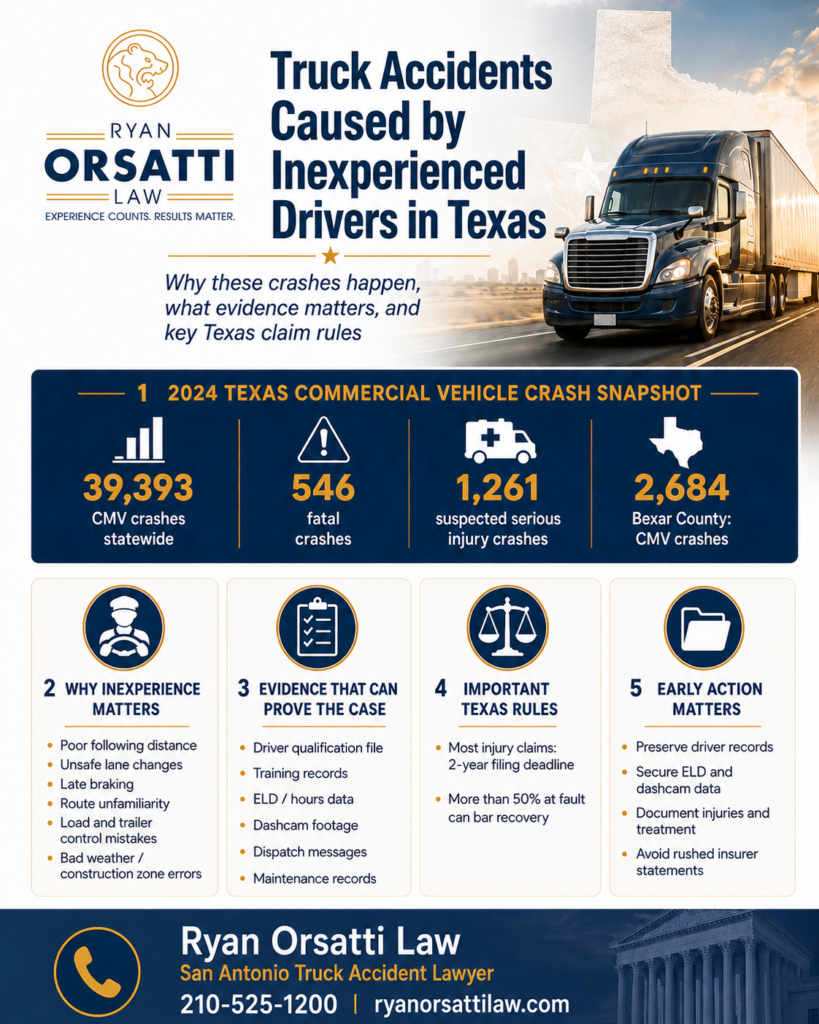
Why are truck accidents caused by inexperienced drivers in Texas so dangerous?
Truck accidents caused by inexperienced drivers in Texas are dangerous because a new or undertrained commercial driver is handling a vehicle that can be far heavier and harder to stop than a passenger car. Federal highway rules identify 80,000 pounds as a common gross weight limit for vehicles operating on the Interstate System, subject to axle and bridge formula limits. (FHWA Operations) Small mistakes with following distance, lane changes, braking, mirrors, load movement, or route planning can become catastrophic when an 18-wheeler is involved.
In San Antonio, the risk is not theoretical. Commercial vehicles move through I-35, I-10, Loop 410, Loop 1604, US-281, and delivery corridors throughout Bexar County every day. A driver who has not learned how to handle merging traffic, construction shifts, steep exit ramps, tight turns, sudden congestion, or wet pavement can create danger for everyone nearby.
TxDOT’s 2024 commercial motor vehicle data shows the scale of the issue. Texas had 39,393 CMV involved crashes in 2024. Bexar County had 2,684 total CMV crashes, including 18 fatalities and 34 suspected serious injury crashes. (TxDOT) Those numbers do not prove that inexperience caused each crash, but they show why commercial vehicle safety matters in Texas.
What counts as an inexperienced truck driver in a Texas accident case?
An inexperienced truck driver is not just someone who recently received a CDL. In a Texas truck accident case, inexperience may mean the driver lacked sufficient training, lacked supervised road time, was unfamiliar with the route, had limited experience with the specific tractor-trailer, or had not been properly prepared for the load, weather, or traffic conditions involved in the crash.
Inexperience can show up in several ways:
- Taking a turn too wide or too tight
- Following too closely in stop-and-go traffic
- Failing to check blind spots before a lane change
- Braking too late for traffic on I-35 or Loop 1604
- Misjudging trailer swing
- Failing to account for cargo movement
- Driving too fast for rain, darkness, or construction
- Getting confused by an unfamiliar delivery route
- Ignoring height, weight, or lane restrictions
FMCSA’s Large Truck Crash Causation Study identified factors such as traveling too fast for conditions, unfamiliarity with the roadway, inadequate surveillance, fatigue, and traffic flow interruption among risk factors associated with serious large truck crashes. (FMCSA) Those are the kinds of issues a careful investigation should test against the facts of the crash.
Does a CDL prove the truck driver was properly trained?
A CDL does not automatically prove that a truck driver was properly trained for the crash scenario. A CDL shows that the driver met licensing requirements, but a civil case may still ask whether the motor carrier properly screened, trained, supervised, and assigned that driver for the route, vehicle, load, and conditions involved.
Federal entry-level driver training rules apply to many first-time Class A or Class B CDL applicants and certain CDL upgrades or endorsements, and FMCSA states that the ELDT rules are not retroactive for drivers who already held the relevant CDL or endorsement before February 7, 2022. (FMCSA) That matters because the investigation may need to identify when the driver was licensed, what training was completed, and what the trucking company did after licensing.
A trucking company should not treat a CDL as the final safety checkpoint. A safe carrier should evaluate driver history, road test performance, prior crashes, violations, equipment familiarity, load experience, and whether the driver needed additional supervised training.
How can route unfamiliarity cause a truck crash in San Antonio?
Route unfamiliarity can cause a truck crash when the driver does not know the road geometry, traffic pattern, construction zone, exit ramp, or delivery approach. In San Antonio, an unfamiliar driver may struggle with tight urban turns near commercial delivery sites, sudden congestion on Loop 410, changing lanes on I-35, or navigating construction along Loop 1604.
A route problem becomes more serious when dispatch gives a driver unrealistic timing, incomplete directions, or a route that is poorly matched to the vehicle. A new driver may rely too heavily on GPS, miss a truck restriction, make a last-second lane change, or attempt a turn that an experienced driver would avoid.
The evidence often lives outside the crash report. Dispatch notes, GPS history, delivery instructions, company route plans, driver messages, and electronic logging device data may show whether the driver was put in a situation beyond their training or experience.
Who may be liable when an inexperienced truck driver causes a crash?
More than one party may be liable when an inexperienced truck driver causes a crash in Texas. Depending on the facts, responsibility may involve the driver, the motor carrier, a trucking company that hired or supervised the driver, a maintenance contractor, a cargo loader, a broker or shipper with unusual control over the work, or another negligent driver.
The driver may be responsible for unsafe driving. The motor carrier may be responsible if it placed an unqualified, undertrained, fatigued, or poorly supervised driver on the road. A maintenance company may be involved if unsafe brakes, tires, lights, or steering contributed. A cargo loader may be involved if shifting or overweight cargo made the truck harder to control.
Texas truck cases are often about systems, not just one driver mistake. A serious crash may trace back to hiring pressure, turnover, weak training, ignored violations, rushed dispatch, poor maintenance, or failure to remove a dangerous driver from service.
Can the trucking company be responsible for poor hiring, training, or supervision?
A trucking company may be responsible if poor hiring, training, supervision, retention, or dispatch decisions caused or contributed to the crash. Federal rules state that a person may not drive a commercial motor vehicle unless qualified, and a motor carrier may not require or permit an unqualified person to drive. (eCFR)
A company-level investigation should ask:
- Did the company check the driver’s employment history?
- Did it review the driver’s motor vehicle record?
- Did it verify CDL status and medical qualification?
- Did it conduct or accept a proper road test?
- Did it train the driver on the specific equipment?
- Did it monitor prior crashes, violations, or complaints?
- Did it assign a new driver to a difficult route without enough support?
- Did dispatch pressure the driver to continue despite fatigue or weather?
The driver qualification file is a key starting point. Federal rules require each motor carrier to maintain a qualification file for each driver it employs, and the file must include items such as the driver’s application and motor vehicle record materials. (eCFR)
Can other companies share fault besides the driver and carrier?
Other companies can share fault if their conduct contributed to the truck crash. A cargo loader may be responsible for an unsafe load, a maintenance contractor may be responsible for missed safety problems, and a parts manufacturer may be involved if a defective component contributed to loss of control.
This is why early preservation matters. If the truck is repaired, the trailer is returned to service, cargo paperwork disappears, or electronic data is overwritten, it can become harder to prove how inexperience interacted with other safety failures.
A Texas truck accident lawyer will usually look beyond the driver’s citation. The better question is often: “What chain of decisions put this driver, this truck, this load, and this route together?”
What evidence proves inexperience caused or contributed to the truck crash?
The best evidence of inexperienced-driver fault often comes from company records, electronic data, and witness details, not just the police report. A Texas Peace Officer’s Crash Report can document the basic crash facts, but proving inexperience may require driver qualification records, training records, ELD data, dashcam footage, dispatch messages, GPS data, maintenance records, and deposition testimony.
TxDOT explains that Texas crash statistics are generated from data in the Crash Records Information System, known as CRIS, and that TxDOT maintains a statewide database of reportable crashes submitted by law enforcement. (TxDOT) That crash data is useful, but a serious truck case often needs deeper carrier-specific evidence.
| Evidence to request | What it may show | Why it matters in an inexperienced-driver case |
|---|---|---|
| Driver qualification file | Application, motor vehicle records, road test documents, medical qualification | Shows whether the carrier properly screened and documented the driver |
| CDL and endorsement history | License class, upgrades, endorsements, restrictions | Helps determine whether the driver was legally qualified for the vehicle and load |
| Training records | ELDT, company onboarding, safety modules, supervised driving | Shows whether the driver received real preparation or only paperwork training |
| ELD and hours data | Driving time, duty status, breaks, possible fatigue | May show whether a new driver was pushed beyond safe limits |
| Dispatch messages | Instructions, deadlines, route changes, delivery pressure | May show whether the company created unsafe pressure or confusion |
| Dashcam or inward camera video | Lane control, speed, mirror checks, distraction, fatigue signs | May reveal errors consistent with lack of experience |
| GPS and route data | Actual route, wrong turns, sudden stops, unfamiliar roads | Helps prove route unfamiliarity or poor planning |
| Maintenance and inspection records | Brake, tire, light, steering, and trailer condition | Shows whether equipment problems combined with driver inexperience |
| Cargo and load records | Weight, securement, shifting cargo, load instructions | Helps determine whether the driver was prepared for the load |
Key takeaway: If inexperience is suspected, the case should focus on the driver’s training path, the company’s safety decisions, and the electronic records that show what happened before impact.
What should I do after a crash with a possibly inexperienced truck driver?
After a crash with a possibly inexperienced truck driver, you should get medical care, preserve evidence, avoid guessing about fault, and speak carefully with insurance companies. Trucking insurers and corporate safety teams may begin investigating quickly, so injured people should act before key video, vehicle data, and company records disappear.
Use this checklist:
- Call 911 and report the crash. Ask for police and medical help if anyone is hurt.
- Get medical care the same day if possible. Delayed treatment gives insurers room to argue the injury was not caused by the crash.
- Photograph everything you safely can. Include vehicle positions, damage, skid marks, debris, road signs, weather, construction, company logos, trailer numbers, and license plates.
- Get witness names and phone numbers. Independent witnesses can matter when the truck driver gives a different account.
- Do not argue fault at the scene. Give factual information to law enforcement, but do not guess about speed, distance, or fault percentages.
- Avoid a recorded statement until you understand your rights. Insurance questions can be framed to shift blame or minimize injuries.
- Preserve your own evidence. Save photos, videos, medical records, discharge papers, repair estimates, missed-work documentation, and all insurer letters.
- Ask a lawyer about a preservation letter. A preservation letter can demand that the trucking company keep driver records, ELD data, dashcam video, maintenance records, and dispatch communications.
- Track symptoms and daily limitations. A short daily note can help connect the crash to pain, sleep issues, mobility problems, missed work, and treatment decisions.
- Do not sign a release without review. A full and final release can end the injury claim before the medical picture is clear.
The first days after a truck crash can shape the entire claim. That is especially true when the trucking company argues the driver was qualified and the injured person caused or contributed to the collision.
How does Texas law affect fault, deadlines, and settlement decisions?
Texas law affects truck accident claims through filing deadlines, proportionate responsibility, and damages proof. In most personal injury cases, Texas Civil Practice and Remedies Code § 16.003 gives an injured person two years from the date the claim accrues to file suit, subject to exceptions that should be reviewed case by case. (Texas Statutes)
Texas also uses proportionate responsibility, which means fault can be divided among the people and companies whose conduct caused the injury. Under Texas Civil Practice and Remedies Code § 33.001, a claimant may not recover damages if the claimant’s percentage of responsibility is greater than 50 percent. (Texas Statutes) If the claimant is not barred, § 33.012 provides for reducing damages by the claimant’s percentage of responsibility. (Texas Statutes)
Comparative responsibility means Texas can reduce your recovery by your percentage of fault. In truck crashes, that rule makes evidence especially important because trucking insurers may argue the injured driver cut off the truck, stopped suddenly, drove in a blind spot, or failed to avoid the collision.
How long do I have to file a Texas truck accident lawsuit?
You generally have two years to file a Texas personal injury lawsuit after a truck accident, but some exceptions and shorter notice issues may apply. The two-year rule is found in Texas Civil Practice and Remedies Code § 16.003, and wrongful death claims also have a two-year limitations rule measured from death. (Texas Statutes)
Do not wait until the deadline is close. In truck cases, evidence may be lost long before the lawsuit deadline. Video may be overwritten, trucks may be repaired, drivers may leave the company, and electronic records may become harder to obtain.
What if the truck driver or insurer blames me?
If the truck driver or insurer blames you, Texas fault rules make early investigation critical. If a claimant is found more than 50 percent responsible, Texas law can bar recovery, and if the claimant is 50 percent or less responsible, damages can be reduced by that fault percentage. (Texas Statutes)
Blame-shifting is common in truck cases. The insurer may focus on your lane position, speed, braking, phone use, or statements at the scene. A careful investigation should compare those claims against physical evidence, dashcam video, ECM or ELD data, witness accounts, vehicle damage, and the truck driver’s own training and qualification records.
How do insurers evaluate inexperienced-driver truck accidents?
Insurers evaluate inexperienced-driver truck accidents by looking for evidence that reduces the trucking company’s responsibility or limits the injury claim. They often review the crash report, photographs, statements, medical records, prior injuries, treatment gaps, fault arguments, driver records, and whether company safety violations can be connected to the crash.
Subrogation means a health insurer may claim a right to be paid back from a settlement. A hospital lien is a legal claim a hospital may assert against part of a personal injury recovery. Those issues can affect the final net recovery even when liability evidence is strong.
Attorney Insight
In an inexperienced-driver truck case, the key question is rarely “Did the driver have a CDL?” The better question is whether the company made a safe assignment. Adjusters often defend these cases by saying the driver was licensed, but licensing is only one layer. I want to see the driver qualification file, prior violations, training records, road test, dispatch instructions, ELD data, and whether the route or load was appropriate for that driver’s actual experience.
Medical documentation also matters. If the injured person waits weeks to treat, misses appointments, or gives inconsistent symptom histories, the insurer may argue the injuries are unrelated or less serious. Clear records, steady treatment, and accurate reporting help connect the crash to the harm.
When should I call a Texas truck accident lawyer?
You should call a Texas truck accident lawyer as soon as possible if you were seriously hurt, the trucking company is disputing fault, the driver seemed unprepared, the crash involved an 18-wheeler or commercial vehicle, or an insurer is asking for a recorded statement. Early legal help is often about preserving evidence before it disappears.
A lawyer can send preservation notices, identify the motor carrier, check insurance issues, request critical records, review the crash report, inspect the vehicles when needed, and help protect you from early statements that may be used out of context.
Ryan Orsatti Law helps injured people in San Antonio and across Texas with serious truck crash claims. The firm’s San Antonio truck accident lawyer page explains truck accident liability issues, and its guide on when to hire a truck accident lawyer in San Antonio explains why timing matters after an 18-wheeler crash.
How can Ryan Orsatti Law help after a truck accident caused by an inexperienced driver?
Ryan Orsatti Law can help evaluate whether driver inexperience, poor training, unsafe dispatch, or weak company supervision contributed to a Texas truck crash. The work usually starts with evidence preservation, insurance identification, medical documentation, fault analysis, and a review of the motor carrier’s safety decisions.
In a serious truck crash, the firm may look at:
- The crash report and scene evidence
- Driver qualification and training records
- CDL and endorsement issues
- Prior driver violations or crashes
- ELD and hours-of-service records
- Dispatch communications and delivery deadlines
- Maintenance and inspection history
- Dashcam, surveillance, or traffic camera footage
- Medical records, bills, work loss, and future care issues
- Health insurance, liens, and subrogation claims
The goal is to understand what happened and who may be legally responsible under Texas law. For people trying to understand case value factors after an 18-wheeler crash, the firm’s article on how 18-wheeler accident compensation may be evaluated in Texas explains common damages and insurance issues.
FAQs About Truck Accidents Caused by Inexperienced Drivers in Texas
Can a trucking company be liable for putting an inexperienced driver on Texas roads?
Yes, a trucking company may be liable if unsafe hiring, training, supervision, retention, or dispatch caused or contributed to a crash. Federal rules require carriers to use qualified drivers and keep driver qualification files. The key issue is whether the company’s conduct can be connected to the collision and the injuries. (eCFR)
Does a valid CDL mean I cannot claim the truck driver was inexperienced?
No. A valid CDL does not prevent an injured person from investigating inexperience, inadequate training, route unfamiliarity, equipment unfamiliarity, or unsafe assignment. Licensing is one piece of evidence. A Texas truck accident claim may still examine company training, road testing, prior violations, dispatch pressure, and whether the driver was prepared for that specific truck, load, and route.
What records can show a truck driver was not properly trained?
Records that may show inadequate training include the driver qualification file, road test certificate, motor vehicle record checks, CDL history, ELDT records, onboarding materials, safety meeting records, prior incident reports, dispatch notes, and supervisor communications. ELD data, dashcam footage, GPS records, and post-crash investigation materials can also show whether the driver lacked safe real-world judgment.
How common are commercial vehicle crashes in Texas?
TxDOT reported 39,393 commercial motor vehicle involved crashes in Texas in 2024, including 546 fatal crashes, 608 fatalities, 1,261 suspected serious injury crashes, and 1,601 suspected serious injuries. Bexar County had 2,684 total CMV crashes that year. Those figures come from reportable Texas Peace Officer’s Crash Reports processed by TxDOT. (TxDOT)
How long do I have to sue after a truck accident in Texas?
Texas generally gives injured people two years to file a personal injury lawsuit after a truck accident, but exceptions can apply. The two-year limitations rule appears in Texas Civil Practice and Remedies Code § 16.003. You should not wait to investigate because video, truck data, driver records, and witness memory can disappear much earlier. (Texas Statutes)
What if the trucking insurance company says I was partly at fault?
If the trucking insurer says you were partly at fault, Texas proportionate responsibility rules make evidence critical. A claimant who is more than 50 percent responsible may be barred from recovery. If the claimant is 50 percent or less responsible, damages may be reduced by that percentage of fault. (Texas Statutes)
Should I give a recorded statement after an 18-wheeler crash?
You should be cautious before giving a recorded statement after an 18-wheeler crash. The insurer may ask questions about speed, distance, injuries, prior medical history, and fault before you have the crash report or medical diagnosis. A statement can be used later to dispute liability or injury causation, even if you were trying to be helpful.
What should I ask a lawyer after a crash with an inexperienced truck driver?
Ask what evidence needs to be preserved, who may be liable, how Texas fault rules apply, whether driver qualification records should be requested, what insurance may be available, and how medical bills and liens will be handled. Also ask how the lawyer will investigate training, supervision, dispatch, route planning, and electronic truck data.
Ryan Orsatti Law
4634 De Zavala Rd, San Antonio, TX 78249
Phone: 210-525-1200
ryanorsattilaw.com
This blog is for informational purposes only, not legal advice. Reading it does not create an attorney-client relationship. Past results do not guarantee future results.
Hurt in an accident in San Antonio? Learn how a San Antonio truck accident lawyer can help with your claim. Call 210-525-1200 or request a free consultation.
The firm works on a contingency fee. You pay nothing unless the firm recovers money for you, and that covers case expenses as well as the fee: if there is no recovery, you owe no attorney's fee and no case expenses. Ask for the fee agreement and read the fee and expense section before you sign anything.
Related San Antonio legal resources
Primary legal and public-data sources
Ryan Orsatti Law
4634 De Zavala Road, San Antonio, TX 78249
General reference links. Consult each source for its current text.