
Quick Answer
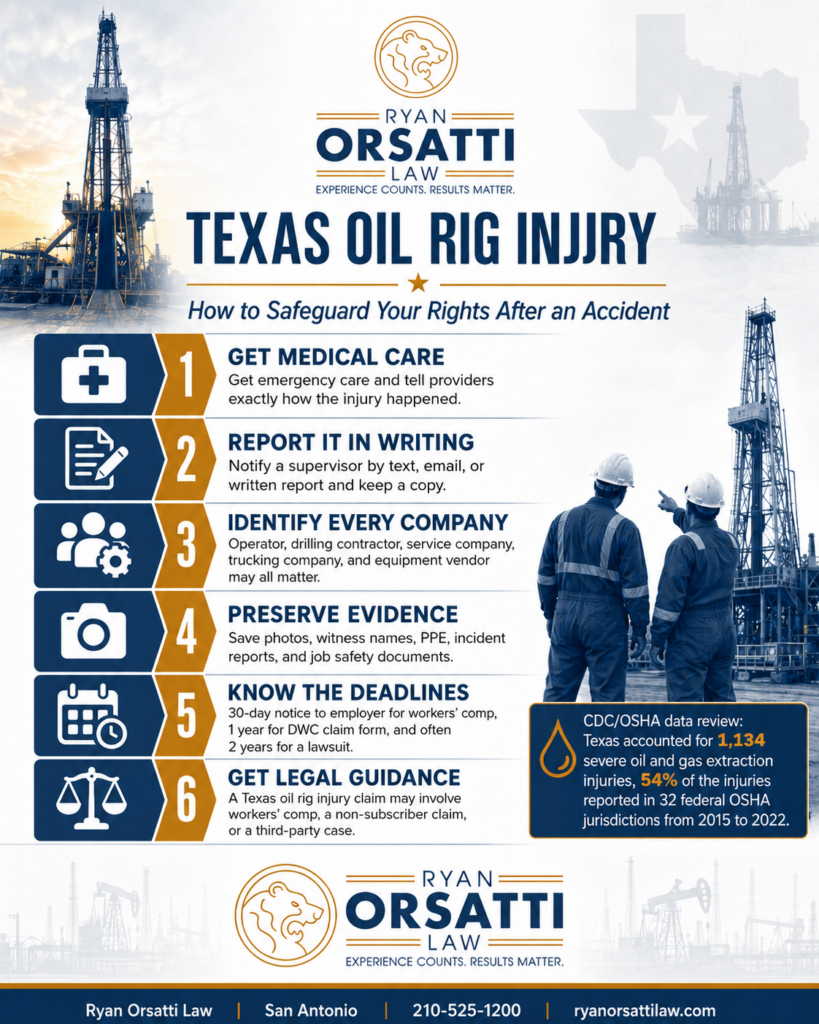
After a Texas oil rig injury, safeguard your rights by getting medical care, reporting the injury in writing, identifying every company involved at the site, and preserving evidence before equipment, logs, photos, and witness access disappear. Texas injury lawsuits are generally subject to a two-year filing deadline, but workers’ compensation, non-subscriber claims, third-party claims, and offshore work can change the legal path. (Texas Statutes)
CDC researchers reviewing OSHA severe injury reports found that Texas accounted for 1,134 severe oil and gas extraction injuries, or 54% of the reported injuries in 32 federal OSHA jurisdictions from January 2015 through July 2022. Ryan Orsatti Law helps injured oilfield workers in San Antonio, South Texas, and across Texas evaluate fault, insurance coverage, evidence, and deadlines after serious rig and wellsite injuries. (CDC)
Key Takeaways
- Do not assume your only option is workers’ compensation. Texas oil rig injury claims may involve a workers’ compensation claim, a non-subscriber employer lawsuit, a third-party negligence claim, or a product claim.
- Identify every company on site. Operators, drilling contractors, well service companies, trucking companies, safety contractors, and equipment vendors may each control different evidence.
- Report the injury in writing and keep a copy. A verbal report can become a dispute later.
- Preserve evidence early. Photos, job safety analyses, incident reports, tool records, PPE, training records, and witness names can matter.
- Be careful with recorded statements, broad medical authorizations, and quick releases.
- Talk with a Texas personal injury attorney before signing settlement paperwork or giving up rights you may not fully understand.
What Should You Do First After a Texas Oil Rig Injury?
After a Texas oil rig injury, your first step is medical care and scene safety, followed by written reporting and evidence preservation. Oilfield sites change fast because equipment is moved, crews rotate, and incident paperwork may be controlled by several companies. The safest legal approach is to document what happened before memories fade and before companies start pointing blame at each other.
Use this checklist as soon as your medical condition allows:
- Get emergency medical care. Tell the provider exactly how the injury happened, what body parts hurt, and whether symptoms started immediately or developed later.
- Report the injury in writing. Send a text, email, or written incident report to a supervisor and keep a copy.
- Ask for the incident report number or copy. If the company will not give it to you, write down who refused and when.
- Identify every company on the jobsite. Get names of the operator, drilling contractor, well service company, trucking company, equipment vendor, and any safety contractor.
- Save photos and video if safe. Photograph the rig floor, stairs, hoses, pressure equipment, failed tools, mud, lighting, warning signs, PPE, and your visible injuries.
- Keep physical evidence. Do not throw away boots, gloves, hard hat, FR clothing, harnesses, or damaged PPE.
- Write down witness names. Include coworkers, supervisors, contractors, drivers, and anyone who saw the hazard before the injury.
- Avoid broad statements about fault. Do not guess. Say what you saw, heard, felt, and were instructed to do.
- Ask whether your employer carries Texas workers’ compensation coverage. Texas private employers can choose whether to carry workers’ compensation in most cases. (Texas Department of Insurance)
- Speak with a lawyer before signing a release. A release may affect claims against an employer, contractor, insurer, or equipment company.
Why Are Texas Oil Rig Injury Claims Different From Ordinary Workplace Injuries?
Texas oil rig injury claims are different because a single incident may involve several companies, high-risk equipment, regulatory duties, and multiple insurance policies. OSHA’s oil and gas drilling and servicing materials identify common hazards and solutions intended to reduce incidents that can cause injuries or fatalities. (OSHA)
Oil and gas work often involves simultaneous operations. One crew may be drilling, another may be moving pipe, another may be transporting fluids, and another may be managing pressure equipment. That creates complicated questions about control, supervision, training, maintenance, and job safety planning.
Common Texas oil rig injury scenarios include:
- Falls from rig stairs, platforms, derricks, tanks, or workover rigs
- Struck-by injuries from pipe, tongs, chains, tools, dropped objects, or vehicles
- Caught-in or caught-between injuries involving rotary tables, machinery, winches, and heavy equipment
- Burns from fires, explosions, hot work, or pressure releases
- Crush injuries during rig-up, rig-down, or forklift operations
- Chemical exposure, including H2S, drilling fluids, solvents, and silica
- Commercial vehicle crashes involving oilfield pickups, tankers, sand trucks, and water trucks
- Wrongful death claims after fatal rig, wellsite, or oilfield roadway incidents
CDC researchers found that most severe oil and gas extraction injuries in the OSHA dataset were caused by contact with objects and equipment, followed by slips, trips, and falls. They also found that machinery was the leading source of injury among contractors and operators. (CDC)
Can You Sue After a Texas Oil Rig Injury?
You may be able to sue after a Texas oil rig injury, but the answer depends on who employed you, whether your employer carried Texas workers’ compensation, and whether another company contributed to the injury. Texas law treats a subscribing employer, a non-subscriber employer, and a negligent third party differently.
| Situation | Possible claim path | Why it matters |
|---|---|---|
| Your employer has Texas workers’ compensation | Workers’ compensation claim against the comp carrier | Workers’ comp may provide medical and income benefits, but it generally limits lawsuits against the covered employer. |
| Your employer does not have Texas workers’ compensation | Non-subscriber negligence claim | A non-subscriber is an employer without workers’ compensation coverage. Texas Labor Code § 406.033 limits certain defenses for non-subscriber employers, but the injured worker still must prove negligence. (Texas Statutes) |
| Another contractor caused or contributed to the injury | Third-party personal injury claim | A third-party claim is a lawsuit against someone other than your employer, such as an operator, vendor, trucking company, or equipment company. |
| A tool, valve, hose, guard, ladder, or machine failed | Product liability or maintenance claim | The claim may focus on design, manufacturing, warnings, inspection, repair, or removal from service. |
| A company truck, sand truck, water truck, or tanker was involved | Commercial vehicle claim | Driver logs, dispatch records, route plans, maintenance records, and insurance coverage may matter. |
| A worker died from the incident | Wrongful death and survival claims | Texas wrongful death and survival law may apply, and different family members may have different legal rights. |
Key takeaway: The most important question is not simply “was I hurt at work?” The better question is “which company controlled the hazard, which insurance applies, and which legal path preserves the most options?”
What If Your Employer Has Texas Workers’ Compensation?
If your employer has Texas workers’ compensation, your claim against that employer usually goes through the workers’ compensation system. Texas Labor Code § 408.001 says recovery of workers’ compensation benefits is generally the exclusive remedy against a covered employer or its agents or employees for a work-related injury or death. (Texas Statutes)
That does not automatically end the analysis. An injured oilfield worker may still have a third-party claim against another company if that company’s negligence contributed to the injury. Examples include a negligent site operator, another contractor, a trucking company, or a maintenance vendor.
What If Your Employer Is a Texas Non-Subscriber?
If your employer is a Texas non-subscriber, you may be able to bring a negligence claim directly against the employer. The Texas Department of Insurance explains that private employers can choose whether to carry workers’ compensation in most cases, and employers that choose not to provide coverage are non-subscribers. (Texas Department of Insurance)
A non-subscriber case is not automatic. You still need proof that the employer, supervisor, agent, or employee failed to use reasonable care and that the failure caused the injury. Helpful proof may include unsafe work instructions, missing guards, rushed operations, poor training, ignored complaints, inadequate staffing, skipped job safety analysis, or failure to stop work when conditions changed.
What If Another Contractor Caused the Oil Rig Injury?
If another contractor caused the injury, you may have a third-party claim even if you also have workers’ compensation. This is common on Texas oilfield sites because the operator, drilling contractor, service contractors, equipment vendors, and trucking companies may all perform different parts of the job.
For example, a wellsite injury may involve a pressure control company, crane operator, casing crew, water hauler, sand hauler, or equipment rental company. A careful investigation looks beyond the name on your paycheck and asks who created the hazard, who controlled the work, who had authority to stop the job, and who had insurance.
What Deadlines Matter After a Texas Oil Rig Injury?
The main Texas personal injury lawsuit deadline is generally two years from the date the claim accrues, but oil rig injuries can involve shorter workers’ compensation and reporting deadlines. Evidence can also disappear long before any lawsuit deadline arrives, which is why early preservation matters.
| Deadline or timing issue | What to know | Source or practical reason |
|---|---|---|
| Texas personal injury lawsuit | Generally two years from accrual for personal injury claims | Texas Civil Practice & Remedies Code § 16.003. (Texas Statutes) |
| Texas wrongful death lawsuit | Generally two years from the death | Texas Civil Practice & Remedies Code § 16.003(b). (Texas Statutes) |
| Workers’ comp notice to employer | Report the injury to your employer within 30 days, or benefits may be disputed | Texas Department of Insurance injured employee FAQ. (Texas Department of Insurance) |
| DWC Form-041 | File the employee claim form with DWC within one year to protect a Texas workers’ compensation claim | Texas Department of Insurance injured employee FAQ. (Texas Department of Insurance) |
| OSHA severe injury report | Employers must report a fatality within 8 hours and an in-patient hospitalization, amputation, or eye loss within 24 hours | OSHA reporting rules. (OSHA) |
| Evidence preservation | Send preservation requests as early as possible | Rig data, JSA forms, photos, inspection records, and witness access can change quickly. |
Key takeaway: Legal deadlines matter, but evidence deadlines are often shorter. A strong Texas oil rig injury investigation should begin before equipment is repaired, moved, inspected by only one side, or returned to service.
What Evidence Should Be Preserved After a Texas Oil Rig Injury?
The evidence to preserve after a Texas oil rig injury includes medical records, incident reports, photos, witness names, job safety documents, equipment records, training materials, and company communications. Spoliation means important evidence was lost or destroyed after someone knew, or should have known, it mattered to a claim.
Important evidence may include:
- Job safety analysis forms, pre-tour meeting notes, toolbox talks, and stop-work reports
- Incident reports, supervisor statements, witness statements, and root cause analysis materials
- OSHA reports, safety audit records, and prior incident history
- Photos or video from the rig, truck, facility, gate, yard, or nearby cameras
- Tool, hose, valve, ladder, harness, forklift, crane, rig, and machinery inspection records
- Maintenance logs, repair records, lockout or tagout records, and equipment manuals
- Training files, certifications, onboarding materials, and written policies
- Work orders, dispatch logs, contractor agreements, master service agreements, and daily drilling reports
- Phone records, radio traffic, emails, texts, and app-based job communications
- PPE, boots, gloves, hard hat, safety glasses, harness, and FR clothing
Ryan Orsatti Law’s oilfield accident response guide covers early preservation steps in more detail.
Attorney Insight: In serious oilfield cases, the incident report is often only the beginning. The stronger evidence is usually in the documents that explain what was supposed to happen before the injury: the JSA, crew assignments, maintenance records, training history, inspection logs, and emails or texts showing who knew about the hazard before the job continued.
How Does Fault Work in a Texas Oil Rig Injury Claim?
Fault in a Texas oil rig injury claim depends on who had control over the work, who created the hazard, and whether the injured worker is being blamed. Comparative responsibility means Texas can reduce a recovery by the injured person’s percentage of fault, and Texas Civil Practice & Remedies Code § 33.001 bars recovery if the claimant’s responsibility is greater than 50% in claims where Chapter 33 applies. (Texas Statutes)
In oilfield cases, companies may argue that the worker should have refused a task, worn different PPE, noticed a hazard, followed a different procedure, or stopped work. Those defenses must be tested against the actual facts. Did the worker have authority to stop the job? Was the hazard visible? Was the work rushed? Was the crew short-handed? Were procedures followed by supervisors? Had similar problems happened before?
Fault evidence often comes from:
- Work instructions given by supervisors
- Whether stop-work authority was real or only on paper
- Whether the hazard was open, hidden, moving, pressurized, or created suddenly
- Whether training matched the task actually being performed
- Whether the worker had proper tools and enough help
- Whether the job changed after the safety meeting
- Whether contractors coordinated simultaneous operations
How Do Medical Bills, Lost Wages, and Liens Affect a Texas Oil Rig Injury Case?
Medical bills, lost wages, and liens can shape the value and timing of a Texas oil rig injury case. Subrogation means a health insurer, workers’ compensation carrier, or benefit plan may claim a right to be repaid from part of a recovery. A hospital lien is a legal claim a hospital may assert against part of a personal injury recovery.
Oil rig injuries often involve emergency transport, trauma care, imaging, surgery, burn care, orthopedic treatment, neurologic treatment, therapy, and long periods away from work. The financial analysis should account for past bills, future care, wage loss, loss of earning capacity, impairment, pain, mental anguish, scarring, disfigurement, and reduced ability to return to oilfield work.
Do not evaluate a settlement based only on the first ER bill. A serious crush injury, burn, spinal injury, traumatic brain injury, amputation, or chemical exposure case may require long-term medical opinions, future cost estimates, and careful lien review before any demand or settlement decision.
Should You Give a Recorded Statement After a Texas Oil Rig Injury?
You should be cautious about recorded statements after a Texas oil rig injury because adjusters and company investigators may use early wording to dispute fault, causation, injury severity, or job status. A short statement given while medicated, in pain, or unsure of the facts can create problems later.
That does not mean you should ignore legitimate reporting duties. You may need to report the injury to your employer, workers’ compensation carrier, or safety personnel. The safer approach is to tell the truth, avoid guessing, avoid minimizing symptoms, avoid accepting blame you do not understand, and speak with a lawyer before giving broad recorded statements to insurers or third-party companies.
How Can Ryan Orsatti Law Help After a Texas Oil Rig Injury?
Ryan Orsatti Law can help by identifying the correct legal path, preserving evidence, investigating all responsible companies, evaluating insurance coverage, and coordinating the medical and damages documentation needed to assess the claim. The firm handles Texas personal injury matters from San Antonio, including oilfield, commercial vehicle, catastrophic injury, and wrongful death cases.
In a Texas oil rig injury case, that work may include:
- Determining whether the employer is a subscriber or non-subscriber
- Sending preservation letters to operators, contractors, trucking companies, and equipment companies
- Investigating safety policies, JSA records, maintenance files, and training materials
- Reviewing OSHA reports and company incident records
- Evaluating third-party claims against contractors, vendors, or vehicle operators
- Tracking medical treatment, wage loss, liens, and insurance issues
- Preparing the claim as if litigation may become necessary, without promising that litigation will occur
You can also review Ryan Orsatti Law’s related resources on Texas oilfield truck accidents and San Antonio truck accident cases if the injury involved an oilfield vehicle, tanker, company pickup, or commercial driver.
What If the Injury Happened in the Eagle Ford, Permian Basin, or Offshore?
If the injury happened in the Eagle Ford Shale, Permian Basin, or another Texas oilfield region, the same core questions apply: who employed you, who controlled the hazard, who was on site, and what insurance applies. South Texas oilfield injuries often involve workers traveling through Bexar, Atascosa, Wilson, Karnes, and surrounding counties, while West Texas cases may involve Midland, Odessa, Reeves County, Pecos County, or other Permian Basin areas.
If the injury happened offshore or on navigable waters, federal maritime law may also matter. The Jones Act, 46 U.S.C. § 30104, gives certain seamen a civil action for injury or death, while the Longshore and Harbor Workers’ Compensation Act may cover certain maritime workers on navigable waters or adjoining areas. These cases need a separate legal analysis. (Legal Information Institute)
FAQ
What should I do immediately after an oil rig injury in Texas?
Get medical care, report the injury in writing, preserve photos and evidence, and identify every company involved in the job. Keep your PPE, write down witness names, and do not sign a release before understanding your rights. Texas oil rig injury claims can involve workers’ compensation, non-subscriber claims, third-party claims, and multiple insurance policies.
Can I sue my employer after a Texas oil rig injury?
You may be able to sue your employer if it does not carry Texas workers’ compensation coverage, but you still need proof of negligence. If the employer has workers’ compensation, that system is usually the exclusive remedy against the employer. A separate third-party claim may still exist against another contractor, operator, trucking company, or equipment company.
How long do I have to file a Texas oil rig injury lawsuit?
Most Texas personal injury lawsuits must be filed within two years, but oil rig cases can involve shorter workers’ compensation notice and claim deadlines. Texas workers’ compensation rules generally require notice to the employer within 30 days and DWC Form-041 within one year. Do not wait because evidence may disappear quickly.
What is a third-party claim in a Texas oilfield injury case?
A third-party claim is a claim against someone other than your employer. In oilfield cases, that may include the operator, drilling contractor, well service company, trucking company, equipment rental company, maintenance contractor, or product manufacturer. These claims matter because workers’ compensation does not always cover the full scope of harm caused by another company.
What evidence matters most after an oil rig accident?
The strongest evidence often includes job safety analysis forms, pre-tour meeting notes, incident reports, witness names, photos, video, maintenance logs, training records, equipment inspection records, and contractor agreements. Physical items such as PPE, broken tools, hoses, ladders, valves, and harnesses may also matter if they help explain how the injury happened.
Should I give a recorded statement to the insurance company?
Be careful with recorded statements after an oil rig injury. You should report truthful facts, but you should not guess about fault, minimize injuries, or sign broad medical releases without understanding the consequences. Adjusters may use early statements to dispute causation, injury severity, job status, or responsibility among contractors.
What if an oil rig injury caused a death?
A fatal Texas oil rig injury may involve wrongful death and survival claims, workers’ compensation death benefits, third-party claims, or a gross negligence analysis depending on the facts. Families should preserve evidence quickly, identify every company on site, request incident documentation, and avoid signing releases before the claim path is reviewed.
Does Ryan Orsatti Law handle Texas oil rig injury cases?
Ryan Orsatti Law helps injured people in San Antonio, South Texas, and across Texas evaluate serious oilfield injury claims. The firm can review employer coverage, third-party fault, evidence preservation, medical documentation, lien issues, and insurance coverage. You can contact Ryan Orsatti Law to discuss the facts of a Texas oil rig injury.
Ryan Orsatti Law
4634 De Zavala Rd, San Antonio, TX 78249
Phone: 210-525-1200
ryanorsattilaw.com
This blog is for informational purposes only, not legal advice. Reading it does not create an attorney-client relationship. Past results do not guarantee future results.
Hurt in an accident in San Antonio? Learn how a San Antonio wrongful death lawyer can help with your claim. Call 210-525-1200 or request a free consultation.
The firm works on a contingency fee. You pay nothing unless the firm recovers money for you, and that covers case expenses as well as the fee: if there is no recovery, you owe no attorney's fee and no case expenses. Ask for the fee agreement and read the fee and expense section before you sign anything.
Related San Antonio legal resources
Primary legal and public-data sources
- Texas Civil Practice and Remedies Code Chapter 71: wrongful death
- Texas Civil Practice and Remedies Code Chapter 16: limitations
Ryan Orsatti Law
4634 De Zavala Road, San Antonio, TX 78249
General reference links. Consult each source for its current text.