
Quick Answer: Yes, a Texas property owner can be liable for a bee attack, but only when the evidence shows more than a random sting. Stronger premises-liability cases usually involve a known hive or colony, a man-made nesting area such as a wall, water meter, shed, playground, or commercial space, or a failure to warn or remove bees after notice. Africanized honey bees matter because the Texas Apiary Inspection Service says they are more defensive and can react to mowers, machinery vibration, loud noises, and close pedestrian activity; Ryan Orsatti Law helps injured Texans evaluate notice, fault, insurance, and medical proof after serious attacks. (Texas Apiary Inspection Service (TAIS))
Key Takeaways
- A random outdoor bee sting usually does not create a strong Texas premises-liability claim by itself.
- A known hive, repeated complaints, visible bee activity, prior pest-control calls, or bees nesting in a structure can change the liability analysis.
- Texas premises liability usually requires proof that the owner knew or should have known about an unreasonable risk and failed to use reasonable care to warn or make the property safer.
- Africanized honey bees are legally important because they can make a known colony more dangerous, especially around mowing, landscaping, playgrounds, apartment buildings, and commercial properties.
- Serious bee attacks require fast medical care. Texas A&M’s Honey Bee Lab advises immediate medical help for breathing trouble, many stings, or known allergy. (Texas A&M Honey Bee Lab)
- Most Texas personal injury lawsuits must be filed within two years, but bee attack evidence can disappear long before then. (Texas Statutes)
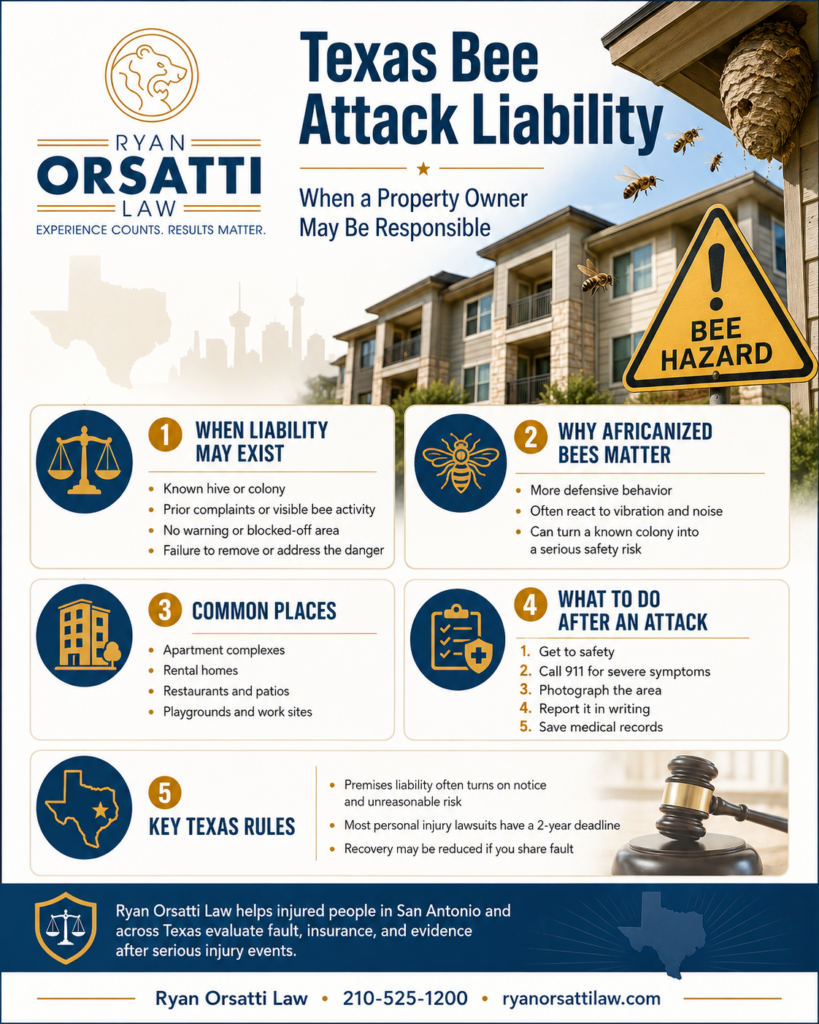
When can a Texas property owner be liable for a bee attack?
A Texas property owner may be liable for a bee attack when a dangerous bee condition on the property was known, should have been known, or was created or controlled by the owner. Premises liability means a claim based on an unsafe condition on land, not just the fact that an injury happened there. The key question is usually whether the owner used reasonable care to warn people or reduce a bee-related danger that posed an unreasonable risk.
Bee attack claims are fact-specific. Texas law does not make every landowner responsible for every wild insect on the property. A claim becomes stronger when there is proof of prior notice, repeated bee activity, a hive in a wall or meter box, a nest near a walkway or playground, or a property manager who ignored reports.
In San Antonio and Bexar County, these cases often arise at:
- Apartment complexes
- Rental homes
- Hotels
- Restaurants with patios
- Shopping centers
- Daycares and schools
- Event venues
- Worksites and landscaping jobs
- Rural properties in nearby counties such as Comal, Guadalupe, Kendall, Wilson, Atascosa, and Medina
The legal issue is not just “were there bees?” The issue is whether someone responsible for the property failed to act reasonably after the danger became known or should have been discovered.
How does Texas premises liability apply to bee and insect attack cases?
Texas premises liability applies to bee and insect attacks when the injury is caused by a dangerous condition on the property rather than a purely random encounter with nature. The Texas Supreme Court has explained that premises-liability claims generally require proof that the owner had actual or constructive knowledge of the condition, the condition posed an unreasonable risk, the owner failed to use reasonable care, and that failure caused the injury.
Actual knowledge means the owner really knew about the danger. Constructive knowledge means the danger existed long enough or was obvious enough that a reasonable property owner should have discovered it.
In a bee attack case, useful questions include:
- Did tenants, employees, customers, or neighbors complain about bees before the attack?
- Were bees entering and leaving the same hole in a wall, roofline, tree, meter box, shed, or playground structure?
- Did management call pest control before, then fail to finish removal?
- Did staff block off the area, post warnings, or redirect visitors?
- Did landscaping, mowing, or construction work disturb a known colony?
- Did the owner keep bees, attract bees, or create a nesting condition?
A serious bee attack may involve ordinary negligence, premises liability, negligent maintenance, contractor negligence, or a combination of theories. The best theory depends on who controlled the area, who knew about the bees, and what reasonable safety steps were missed.
How does Texas law treat wild insects compared with a known hive?
Texas law generally makes random wild-insect cases harder than cases involving a known hive, a controlled bee colony, or bees nesting in an artificial structure. The Texas Supreme Court has applied the ferae naturae doctrine, which means wild animals are usually treated as naturally occurring risks unless the landowner possesses them, attracts them, introduces them, knows of a specific unreasonable risk, or fails to act in a setting where visitors cannot reasonably protect themselves.
That rule is important in bee cases. If someone is stung once by a bee in an open field, wooded area, or ordinary backyard with no prior warning signs, liability may be difficult to prove. If bees are repeatedly entering an apartment wall, water meter, trash area, storage shed, playground feature, or commercial entryway, the case looks different.
Texas courts are more likely to focus on:
- Control of the property
- Knowledge of the specific bee danger
- Whether the nesting area was man-made or maintained by the owner
- Whether visitors, tenants, children, workers, or customers were expected to be in the danger zone
- Whether the owner warned people, blocked access, or called qualified removal help
The law does not require property owners to eliminate every natural risk. It may require reasonable action when a specific, hidden, dangerous condition is known or should be discovered through reasonable inspection.
Why are Africanized honey bees important in Texas bee attack claims?
Africanized honey bees matter because they can make a known colony more dangerous, but their presence alone does not automatically make a property owner liable. The legal issue is still notice, control, reasonable care, and causation. The safety issue is serious because the Texas Apiary Inspection Service describes Africanized honey bees as more defensive and more likely to react to vibration, loud noise, mowers, weed eaters, chainsaws, pedestrian activity, frantic animals, and similar disturbances. (Texas Apiary Inspection Service (TAIS))
The Africanized bee angle matters most when the property owner knew bees were present near people and did not take reasonable steps. For example, an apartment manager who receives repeated reports of bees entering a wall near a breezeway has a different risk profile than a landowner with no notice of a bee swarm passing through open land.
The Texas A&M Honey Bee Lab also warns that Africanized honey bees can nest in many places, including ground cavities, walls, small holes, sheds, garages, vehicles, lumber piles, tires, buckets, and decks. That matters in premises cases because these are places property owners, maintenance companies, and managers may inspect or maintain. (Texas A&M Honey Bee Lab)
Can you tell whether bees are Africanized by looking at them?
No, a property owner, tenant, or injury victim usually cannot tell whether bees are Africanized just by looking at them. Texas A&M materials explain that Africanized honey bees look like European honey bees and typically require laboratory or technical analysis to confirm. The safer assumption is practical, not cosmetic: repeated aggressive bee activity near people should be treated as a serious hazard until evaluated by qualified removal or pest-control personnel. (Legacy Research Center websites)
That point helps avoid a common insurance defense. An adjuster may argue that no one proved the bees were Africanized. But in many premises-liability cases, the main question is not whether the bees were genetically confirmed as Africanized. The question is whether the owner knew about dangerous bee activity and failed to respond reasonably.
What evidence helps prove the owner knew or should have known about the bee danger?
The strongest bee attack evidence usually proves notice before the attack. Notice can come from tenant complaints, employee reports, maintenance records, pest-control invoices, photographs, text messages, emails, camera footage, prior incident reports, or visible bee traffic entering and leaving the same location. In Texas premises cases, proving notice often separates a viable claim from a random-wild-insect defense.
Useful evidence may include:
- Photos or video of bees entering the same opening
- Prior complaints to a landlord, HOA, property manager, or business
- Work orders involving bees, pests, walls, rooflines, water meters, or trash areas
- Pest-control bids, invoices, or incomplete removal records
- Warning signs, cones, blocked-off areas, or the absence of warnings
- Security video showing the attack or prior bee activity
- Witness names and phone numbers
- 911 records, EMS records, and incident reports
- Lease documents, maintenance policies, and inspection logs
- Communications with neighbors, tenants, or employees
What records should be preserved before they disappear?
The most important records to preserve are the ones showing prior knowledge, control, and the condition of the property before the attack. Spoliation means the loss, destruction, or failure to preserve relevant evidence after a dispute is reasonably anticipated. A preservation letter should ask the property owner, manager, contractor, or insurer to save camera footage, maintenance records, pest-control records, prior complaints, emails, photographs, and incident reports.
Video is especially time-sensitive. Many businesses and apartment complexes overwrite surveillance footage within days or weeks. A lawyer can send a preservation request quickly, but the injured person should also document the scene, report the incident in writing, and save all communications.
Attorney Insight: In serious bee cases, insurers often say, “No one can control insects.” The better question is narrower: did someone report bees entering the same hole, did maintenance see a hive, did staff keep sending people into the danger zone, and did the owner delay calling a removal professional? Those details can turn a “random sting” defense into a notice-and-safety dispute.
What should you do immediately after a serious bee attack in San Antonio?
After a serious bee attack, get to safety first, then get medical help and preserve evidence. Texas A&M’s Honey Bee Lab advises immediate medical help if breathing becomes difficult, if a person is stung many times, or if the person is allergic to bee stings. The Texas Apiary Inspection Service also recommends covering your head and face, leaving the area, getting into a car or building, and calling 911 for serious incidents. (Texas A&M Honey Bee Lab)
Use this checklist:
- Move away from the bees immediately. Get into an enclosed car, building, or other safe shelter.
- Protect your head and face. Africanized bee safety guidance emphasizes covering the head and face while leaving the attack area. (Texas Apiary Inspection Service (TAIS))
- Call 911 for severe symptoms. Breathing trouble, throat swelling, dizziness, fainting, many stings, or known allergy should be treated as urgent.
- Do not disturb the hive. Stay away from the colony and do not try to remove it yourself.
- Photograph the location from a safe distance. Capture the hive area, wall opening, meter box, trash area, playground, patio, or other condition.
- Report the incident in writing. Notify the landlord, property manager, business, HOA, employer, or property owner.
- Get names of witnesses. Include tenants, employees, neighbors, bystanders, EMS, and pest-control workers.
- Save medical records and bills. Document the number of stings, allergic reaction, medications, ER care, follow-up care, missed work, and symptoms.
- Be careful with insurance calls. Do not guess about the hive, your medical condition, or fault in a recorded statement.
A serious bee attack can become a medical emergency and an evidence case at the same time. The safest approach is to treat the health issue immediately and preserve the facts before the property condition changes.
Who may be responsible for bee attack injuries in San Antonio or Bexar County?
Several people or businesses may be responsible for a bee attack, but no one is automatically liable just because the attack happened on their property. Possible responsible parties include a property owner, landlord, apartment manager, store operator, hotel, event venue, maintenance contractor, landscaping company, pest-control company, beekeeper, or another person who controlled the danger. Liability depends on notice, control, reasonable care, and causation.
| Setting | Liability question | Evidence to preserve |
|---|---|---|
| Apartment complex or rental home | Did the landlord or manager know bees were nesting in a wall, meter box, roofline, balcony, shed, or common area? | Tenant complaints, maintenance work orders, photos, emails, pest-control records, lease notices |
| Store, restaurant, hotel, or event venue | Did employees know customers or guests were exposed to repeated bee activity in a patio, entrance, walkway, trash area, or outdoor event space? | Incident reports, employee statements, camera footage, prior complaints, warning signs, cleaning logs |
| Daycare, school, or playground | Did staff know bees were near children, play structures, fences, trees, equipment, or buildings? | Parent reports, staff logs, inspection records, playground photos, communications with maintenance |
| Landscaping or worksite | Did a contractor or supervisor send workers to mow, trim, cut, or disturb an area where bee activity had been reported? | Job instructions, safety messages, work orders, witness names, PPE records, photos of the hive area |
| Neighbor, beekeeper, or kept hive | Did someone keep, place, move, or control bees in a way that created a foreseeable danger to others? | Hive location, ownership records, neighbor texts, removal records, photos, prior complaints |
| Public property | Did a governmental unit have notice and control, and do special notice or immunity rules apply? | Photos, agency reports, 911 records, date of incident, written notice, witness names |
Key takeaway: The strongest bee attack cases usually focus on who controlled the property, who knew about the bee danger before the attack, and what reasonable safety steps were skipped.
How do insurance companies defend bee attack claims?
Insurance companies commonly defend bee attack claims by arguing the bees were wild, the owner had no notice, the danger was not preventable, or the injured person failed to avoid the area. In Texas, comparative responsibility means a recovery can be reduced by the injured person’s percentage of fault, and a claimant may not recover damages if their responsibility is greater than 50 percent. (Texas Statutes)
Common defenses include:
- “The bees were wild and naturally occurring.”
- “The property owner had no notice of a hive.”
- “The hive was not visible before the attack.”
- “The injured person ignored warnings.”
- “A contractor, not the owner, controlled the work.”
- “The reaction was caused by a preexisting allergy, not the property condition.”
- “Medical treatment was delayed or unrelated.”
- “There is no proof the bees came from our property.”
These defenses make documentation important. Medical records should clearly describe the sting event, number of stings, symptoms, treatment, and follow-up care. Property evidence should show where the bees were, how long they had been there, who knew, and what was or was not done.
What medical and damages issues matter after multiple bee stings?
The medical issues that matter most after multiple bee stings include allergic reaction, anaphylaxis, number of stings, emergency treatment, hospitalization, medications, scarring, infection, lost income, and lasting symptoms. The CDC reported 788 U.S. deaths from hornet, wasp, and bee stings during 2011–2021, which shows why serious sting events should not be treated as minor by default. (CDC)
Anaphylaxis is a severe allergic reaction that can affect breathing, blood pressure, and consciousness. Texas A&M’s Honey Bee Lab advises immediate medical help when breathing becomes difficult, when a person is stung many times, or when the person has a known allergy. (Texas A&M Honey Bee Lab)
In a personal injury claim, medical proof may include:
- EMS and ER records
- Allergy history
- Photos of swelling, rash, puncture wounds, and bruising
- Prescription records
- Follow-up visits
- Missed work documentation
- Physical restrictions
- Mental health symptoms after a swarm attack
- Funeral and death-related records in fatal cases
Do not assume a bee attack is “too unusual” for a claim. The issue is whether the injuries, medical expenses, lost income, and other harms can be connected to a legally provable failure by someone responsible for the property.
How long do you have to file a bee attack injury lawsuit in Texas?
Most Texas personal injury lawsuits must be filed within two years of the injury under Texas Civil Practice & Remedies Code § 16.003. That deadline is not the same as the practical evidence deadline. Bee attack evidence, including surveillance video, maintenance records, tenant complaints, and pest-control records, can disappear much faster. (Texas Statutes)
Some facts can change the deadline analysis, including government property, a child injury, a death case, or a dispute over when the claim accrued. Do not rely on an insurance adjuster, property manager, or pest-control company to protect your legal deadline.
Ryan Orsatti Law maintains resources on Texas personal injury limitations deadlines and helps injured people evaluate timing, evidence preservation, and claim strategy after serious injury events.
How can Ryan Orsatti Law help after a serious bee attack in Texas?
Ryan Orsatti Law helps injured people in San Antonio and across Texas investigate whether a bee attack involved a known dangerous premises condition, an Africanized bee safety risk, or a random wild-insect event. The firm’s role is to evaluate the evidence, identify responsible parties and insurance coverage, preserve records, and explain the legal risks before important decisions are made.
In a serious bee or insect attack case, a Texas personal injury lawyer may help by:
- Investigating the scene
- Sending evidence-preservation letters
- Requesting incident reports, pest-control records, work orders, and prior complaints
- Identifying homeowner, commercial general liability, renters, contractor, or umbrella insurance
- Interviewing witnesses
- Reviewing medical records and bills
- Evaluating comparative responsibility defenses
- Coordinating with qualified professionals when hive location, removal, or property conditions are disputed
- Preparing a demand or lawsuit if the evidence supports that step
Ryan Orsatti Law handles Texas personal injury claims, including premises liability issues in San Antonio and serious animal attack injury claims. If you were seriously injured by bees at an apartment complex, business, rental property, worksite, or public-facing property, you can contact Ryan Orsatti Law to discuss the facts.
FAQ
Can I sue a Texas property owner if I was attacked by Africanized bees?
Yes, you may be able to sue, but Africanized bees alone do not prove liability. A Texas claim usually depends on whether the owner knew or should have known about a dangerous bee condition, controlled or created the danger, and failed to use reasonable care. Documentation of prior complaints, visible hive activity, and delayed removal can be critical.
Does the property owner have to know about the beehive before being liable?
Usually, the strongest Texas bee attack cases involve actual or constructive knowledge. Actual knowledge means the owner knew about the hive or bee activity. Constructive knowledge means the condition existed long enough or was obvious enough that a reasonable owner should have found it. Without notice, insurers often argue the attack was random and not legally preventable.
What if the bees came from my neighbor’s property in San Antonio?
A neighbor may be responsible if the evidence shows they kept, controlled, attracted, or ignored a known dangerous bee condition that created an unreasonable risk to others. These cases depend on facts such as hive location, prior complaints, property lines, control, warnings, and removal efforts. Photos, texts, HOA reports, and pest-control records can help identify what happened.
What if I was stung at an apartment complex or rental home?
An apartment or rental bee attack may involve a premises-liability claim if management knew or should have known about bees in a common area, wall, roofline, meter box, shed, playground, or other maintained space. Written complaints, work orders, maintenance delays, and pest-control records often matter more than the fact of the sting itself.
Should I give a recorded statement to the insurance company after a bee attack?
Be careful before giving a recorded statement. Insurance adjusters may ask questions designed to support defenses such as no notice, random wild bees, visible danger, preexisting allergy, delayed treatment, or shared fault. You should be truthful, but you do not need to guess about hive history, bee type, property control, or medical causation.
How soon should I contact a lawyer after a serious bee attack in Texas?
You should contact a lawyer as soon as practical after emergency medical needs are handled. Most Texas personal injury lawsuits have a two-year limitations period, but camera footage, maintenance logs, bee removal records, and witness memories may disappear quickly. Early review is especially important for apartment complexes, businesses, worksites, daycares, hotels, and public property. (Texas Statutes)
Ryan Orsatti Law
4634 De Zavala Rd, San Antonio, TX 78249
Phone: 210-525-1200
ryanorsattilaw.com
This blog is for informational purposes only, not legal advice. Reading it does not create an attorney-client relationship. Past results do not guarantee future results.
Hurt in an accident in San Antonio? Learn how a San Antonio personal injury lawyer can help with your claim. Call 210-525-1200 or request a free consultation.
The firm works on a contingency fee. You pay nothing unless the firm recovers money for you, and that covers case expenses as well as the fee: if there is no recovery, you owe no attorney's fee and no case expenses. Ask for the fee agreement and read the fee and expense section before you sign anything.
Related San Antonio legal resources
Primary legal and public-data sources
- Texas Civil Practice and Remedies Code Chapter 16: limitations
- Texas Civil Practice and Remedies Code Chapter 33: proportionate responsibility
Ryan Orsatti Law
4634 De Zavala Road, San Antonio, TX 78249
General reference links. Consult each source for its current text.