
Quick Answer
Severe mental anguish in Texas can be part of a personal injury, wrongful death, or other recognized legal claim, but ordinary stress, worry, or frustration is not enough. Texas courts require evidence of the nature, duration, and severity of the anguish, plus evidence connecting the proof to the amount claimed. Texas Civil Practice and Remedies Code § 16.003 generally gives injured people two years to file a personal injury lawsuit, although shorter notice rules may apply for government-related claims. (Texas Statutes) Ryan Orsatti Law helps injured people in San Antonio and across Texas evaluate whether emotional harm is legally provable and how it fits with medical bills, lost income, and insurance coverage.
Key Takeaways
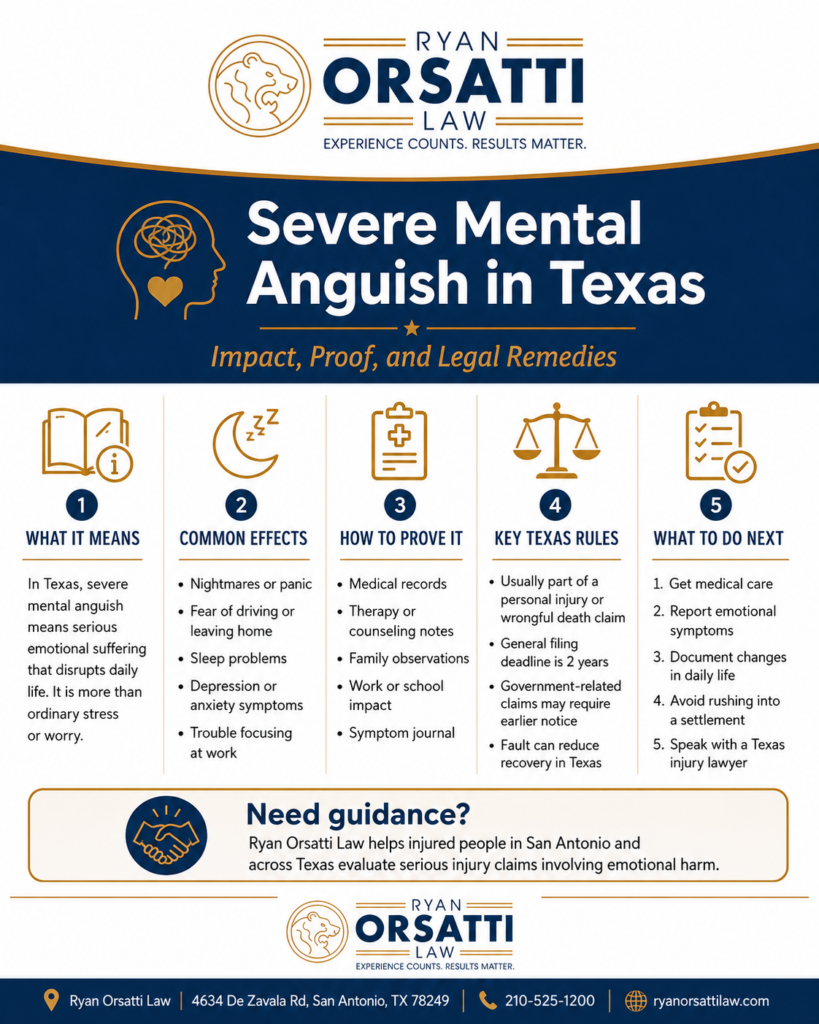
- Severe mental anguish is emotional suffering that substantially disrupts daily life or causes a high degree of mental pain and distress.
- In Texas, mental anguish is usually recovered as damages tied to another valid legal claim, not as a stand-alone negligent emotional distress claim.
- Evidence matters. Medical records, counseling notes, family observations, work disruption, sleep problems, and daily-life changes can all matter.
- Texas courts require proof of both the existence of compensable mental anguish and a reasonable connection to the amount claimed.
- Most Texas personal injury claims have a two-year filing deadline, but claims involving government entities may require notice much sooner.
- Do not settle a serious injury claim before you understand future treatment, mental health documentation, liens, and release language.
Why Does Severe Mental Anguish Matter After Serious Texas Accidents?
Severe mental anguish matters because Texas injury claims are not limited to bills and lost wages. Texas law recognizes non-economic damages, including mental or emotional pain or anguish, when the damages are tied to a legally valid claim. Texas Civil Practice & Remedies Code § 41.001 defines non-economic damages to include mental or emotional pain or anguish, physical pain, loss of consortium, disfigurement, physical impairment, and similar non-pecuniary losses. (Texas Statutes)
For crash-related claims, the human impact is not abstract. TxDOT reported 3,769 Texas motor vehicle traffic deaths in 2025 and estimated $54.2 billion in economic loss from all Texas motor vehicle crashes, with 2025 data based on CR-3 crash reports processed as of April 7, 2026. (Texas Department of Transportation) Those numbers do not prove any individual claim, but they show why serious crashes on I-35, Loop 410, Loop 1604, US-281, and other Texas roads often involve both physical and emotional harm.
What Is Severe Mental Anguish in Texas Personal Injury Law?
Severe mental anguish in Texas means more than being upset after an accident. Texas courts look for proof that the emotional suffering caused a substantial disruption in daily routine or involved a high degree of mental pain and distress. In Gregory v. Chohan, the Texas Supreme Court reaffirmed that mental anguish damages require evidence of the nature, duration, and severity of the suffering.
In plain English, the evidence should show what changed after the injury. That may include panic attacks, nightmares, fear of driving, depression symptoms, withdrawal from family, inability to sleep, loss of concentration, missed work, changed routines, or counseling after a crash, fall, dog attack, workplace incident, or catastrophic injury.
The stronger claims usually connect the emotional harm to a documented event, medical timeline, and real-world life changes. A vague statement like “I was stressed” is usually weak. A documented pattern like “I could not drive on Loop 1604 for months, missed work, began therapy, and my spouse observed nightly panic symptoms” gives the claim more structure.
How Is Mental Anguish Different From Pain and Suffering?
Mental anguish is the emotional side of the harm, while pain and suffering is a broader phrase that often includes both physical pain and emotional distress. In a Texas personal injury claim, these damages are usually presented together with medical expenses, lost income, impairment, disfigurement, and other losses.
For example, a herniated disc may involve physical pain, while the fear of another collision, loss of sleep, and emotional distress from not being able to care for children may support a mental anguish claim. For more context on the broader damages category, see Ryan Orsatti Law’s guide to pain and suffering damages in Texas.
Can You Sue for Severe Mental Anguish in Texas?
You usually do not sue for negligent mental anguish alone in Texas. The Texas Supreme Court has held that Texas does not recognize a general duty not to negligently inflict emotional distress, but mental anguish damages may be recoverable when tied to the breach of another legal duty. (vLex)
That distinction is important. If another driver causes a crash and you suffer physical injuries plus severe emotional trauma, mental anguish may be part of the injury damages. If a family member dies because of negligence, eligible wrongful death beneficiaries may claim their own mental anguish damages. If the conduct was intentional, reckless, or tied to another recognized tort, the analysis may change.
What Kinds of Cases Can Include Severe Mental Anguish Damages?
Severe mental anguish is most often part of a broader Texas injury claim involving a physical injury, death, or legally recognized wrongful act. Common examples include serious car crashes, 18-wheeler collisions, motorcycle crashes, pedestrian injuries, dog attacks, sexual assault claims, workplace incidents, premises cases, catastrophic injuries, and wrongful death cases.
The claim becomes stronger when the emotional harm is tied to a concrete injury or event. Examples include fear after an 18-wheeler crash, depression after a permanent disability, grief after a fatal collision, or PTSD-type symptoms after witnessing a traumatic injury. Texas courts still require proof, even when the event itself was severe.
What Evidence Proves Severe Mental Anguish in Texas?
Evidence that proves severe mental anguish should show what happened, how long it lasted, how severe it was, and how it disrupted daily life. Texas courts have rejected the idea that a jury can simply choose a number without evidence supporting both the existence of the anguish and the amount claimed.
| Evidence Type | Why It Matters | Practical Tip |
|---|---|---|
| Medical records | Show complaints, diagnoses, prescriptions, referrals, and treatment history | Tell doctors about sleep loss, panic, nightmares, fear, depression symptoms, and functional changes |
| Counseling or therapy records | Help document duration, severity, treatment plan, and progress | Keep appointments consistent and follow recommendations |
| Family or friend observations | Show changes others noticed after the injury | Ask close family to write down specific changes, dates, and examples |
| Work and school records | Show missed time, reduced performance, or changed responsibilities | Save work notes, HR records, missed-shift documentation, and accommodation requests |
| Personal journal | Creates a timeline of symptoms, triggers, setbacks, and recovery | Keep entries factual, dated, and specific |
| Photos, videos, and activity records | Show life changes before and after the incident | Preserve photos of injuries, assistive devices, missed events, and changed routines |
| Crash report and evidence | Connect the emotional harm to the event | Request the CR-3 report, scene photos, vehicle photos, 911 records, and witness information when available |
Key takeaway: Severe mental anguish claims are built with specific proof over time, not a single statement that the accident was stressful.
Do You Need a Mental Health Diagnosis to Recover Mental Anguish Damages?
A formal mental health diagnosis is not always required to prove mental anguish in Texas. The Texas Supreme Court has stated that proof can come from the claimant, third parties, or qualified professional testimony, but the evidence still must show nature, duration, and severity.
That said, professional treatment often makes the claim more concrete. Counseling records, medication history, primary care notes, and therapy referrals can help show that the emotional harm was serious, lasted over time, and required treatment. The decision to seek care should be based on health needs first, not litigation strategy.
Can Therapy Records Become Part of the Lawsuit?
Therapy records can become discoverable in some Texas cases if a party relies on a mental or emotional condition as part of a claim or defense and the records are relevant to that condition. Texas Rule of Evidence 510 protects many mental health communications, but it also contains exceptions, including when a party relies on the patient’s condition. (Texas Courts)
This does not mean every mental anguish claim opens every private record. Texas courts distinguish routine mental anguish allegations from claims that rely on a specific mental or emotional condition, diagnosis, treatment, or professional testimony. The Texas Supreme Court addressed that distinction in In re Richardson Motorsports, where reliance on mental health treatment affected discoverability.
What Legal Remedies Are Available for Severe Mental Anguish in Texas?
Legal remedies for severe mental anguish in Texas may include recovery for mental health treatment, lost income, loss of earning capacity, and non-economic damages for emotional suffering, depending on the claim and evidence. Mental anguish is not valued by a fixed formula under Texas law. The proof must connect the emotional harm to the incident and support the amount requested.
Possible remedies may include:
- Past mental health treatment expenses, including counseling, therapy, psychiatric care, or medication management.
- Future mental health treatment if supported by medical evidence.
- Lost wages when emotional symptoms caused missed work.
- Loss of earning capacity if the psychological effects reduce the person’s ability to work long term.
- Non-economic damages for mental or emotional pain or anguish.
- Wrongful death mental anguish damages for eligible family members.
- Related damages such as physical pain, impairment, disfigurement, or loss of consortium when supported by the facts.
Texas proportionate responsibility can also affect recovery. Under Texas Civil Practice and Remedies Code § 33.001, a claimant may not recover damages if the claimant’s percentage of responsibility is greater than 50 percent. (Justia Law) Comparative responsibility means Texas can reduce recovery by the injured person’s percentage of fault, and a finding above 50 percent can bar recovery.
What About Wrongful Death Mental Anguish in Texas?
Wrongful death mental anguish in Texas belongs to specific statutory beneficiaries, not every grieving relative. Texas Civil Practice and Remedies Code § 71.004 provides that a wrongful death action is for the exclusive benefit of the surviving spouse, children, and parents of the deceased. (Texas.Public.Law)
In a fatal crash or other death case, mental anguish damages focus on the surviving family member’s own emotional loss. That may include grief, trauma, changed family relationships, loss of companionship, sleep disruption, and daily-life changes. Ryan Orsatti Law discusses related issues in its guide on fatal car accidents in South Texas.
How Do Insurers Evaluate Mental Anguish Claims?
Insurers often evaluate mental anguish by looking for consistency, documentation, and a clear timeline. They compare the claimed emotional symptoms against medical records, treatment gaps, recorded statements, social media, work activity, prior conditions, and what the injured person told doctors early in the case.
This is why documentation matters from the beginning. If a client waits six months to mention panic, nightmares, or depression symptoms, the insurer may argue the symptoms were unrelated, minor, or caused by something else. That does not always defeat the claim, but it makes proof harder.
Attorney Insight: In serious injury cases, mental anguish proof is strongest when the records show a timeline: what changed after the incident, how long it lasted, what daily routines were disrupted, what treatment was recommended, and whether the client followed through. Gaps, generic complaints, and inconsistent online activity are the points adjusters and defense lawyers often use to discount emotional harm.
What Deadlines Apply to Severe Mental Anguish Claims in Texas?
The general Texas personal injury deadline is two years from the date the cause of action accrues, but severe mental anguish claims can have shorter practical deadlines because evidence disappears. Texas Civil Practice and Remedies Code § 16.003 applies a two-year limitations period to personal injury claims. (Texas Statutes)
Claims involving a governmental unit can require earlier written notice. Texas Civil Practice and Remedies Code § 101.101 requires notice of a Texas Tort Claims Act claim not later than six months after the incident, and some local rules or charters may be shorter. (Texas Statutes) If the crash involved a city vehicle, county employee, road defect, police vehicle, school district vehicle, or other public entity, get legal review quickly.
The legal filing deadline is not the only deadline that matters. Video from businesses, roadway cameras, dashcams, 911 audio, vehicle data, EDR information, and witness memory may be lost long before the two-year mark. For serious cases in San Antonio and Bexar County, early preservation letters can matter.
What Should You Do if Severe Mental Anguish Is Affecting Your Injury Claim?
You should treat severe mental anguish as both a health issue and an evidence issue. Get appropriate medical care, report symptoms honestly, and document how the trauma affects your sleep, work, family life, driving, concentration, and daily routine.
Use this checklist after a serious Texas accident:
- Get medical care for physical injuries first. Emergency care, follow-up care, imaging, and referrals create the foundation of the injury timeline.
- Tell your doctor about emotional symptoms. Mention nightmares, panic, fear of driving, mood changes, depression symptoms, sleep disruption, and concentration problems.
- Ask whether counseling or mental health treatment is appropriate. Follow the provider’s recommendations.
- Keep a dated symptom journal. Track sleep, triggers, missed activities, driving anxiety, work problems, and family impact.
- Save records and bills. Keep therapy invoices, prescriptions, work notes, discharge papers, and referral documents.
- Avoid broad recorded statements. Do not minimize symptoms to an adjuster while you are still in early recovery.
- Be careful with social media. Posts can be taken out of context and used to challenge the seriousness of emotional harm.
- Do not sign a release too early. A release can end the claim before future mental health care, lost income, liens, and long-term symptoms are understood.
For a deeper discussion of trauma symptoms after crashes, see Ryan Orsatti Law’s article on psychological injuries after San Antonio accidents.
How Can Ryan Orsatti Law Help With Severe Mental Anguish Claims in San Antonio?
Ryan Orsatti Law helps injured people in San Antonio and across Texas evaluate whether severe mental anguish is legally provable and how it fits into the broader injury claim. That includes reviewing medical records, counseling documentation, work impact, family impact, crash evidence, insurance coverage, liens, and settlement release language.
These cases require careful documentation. In San Antonio, Bexar County, Comal County, Guadalupe County, Medina County, and nearby areas, serious injury claims may involve crash reports, hospital records, specialist referrals, employer records, therapy documentation, vehicle photos, witness statements, and insurance coverage disputes.
Ryan Orsatti Law focuses on Texas plaintiff-side personal injury work, including car crashes, truck wrecks, catastrophic injuries, and wrongful death matters. Related resources include the firm’s guides to San Antonio catastrophic injury claims and how a personal injury lawsuit works.
FAQ
Is severe mental anguish the same as emotional distress in Texas?
Severe mental anguish and emotional distress are often used to describe similar emotional harm, but Texas courts usually discuss “mental anguish” as the recoverable damage category. The key issue is proof. The claimant must show more than ordinary worry, stress, or frustration and must provide evidence of the nature, duration, and severity of the emotional suffering.
Can I recover mental anguish damages after a Texas car accident?
You may be able to recover mental anguish damages after a Texas car accident if the emotional harm is tied to a valid injury claim and supported by evidence. Stronger proof may include medical records, therapy notes, sleep disruption, fear of driving, work impact, family observations, and a clear timeline connecting the symptoms to the crash.
Can family members recover mental anguish damages after a wrongful death in Texas?
Eligible family members may pursue mental anguish damages in a Texas wrongful death claim. Texas Civil Practice and Remedies Code § 71.004 limits wrongful death beneficiaries to the surviving spouse, children, and parents of the deceased. These damages focus on the surviving family member’s own emotional suffering caused by the death. (Texas.Public.Law)
How do I prove nightmares, anxiety, or PTSD symptoms after a crash?
You prove nightmares, anxiety, or PTSD-type symptoms with consistent documentation. Tell your doctor, follow treatment recommendations, keep a dated symptom journal, save therapy and medication records, and identify witnesses who saw changes in your behavior. The evidence should show what changed, when it began, how long it lasted, and how it affected daily life.
Will my therapy records be private if I claim mental anguish?
Therapy records may remain protected in some situations, but they can become discoverable if you rely on a mental or emotional condition as part of your claim and the records are relevant to that condition. Texas Rule of Evidence 510 includes mental health privilege protections and exceptions, so this issue should be reviewed before litigation strategy is set. (Texas Courts)
How long do I have to file a severe mental anguish claim in Texas?
Most Texas personal injury claims must be filed within two years from the date the claim accrues under Texas Civil Practice and Remedies Code § 16.003. Claims involving government entities can require written notice much sooner, sometimes within six months under the Texas Tort Claims Act. Evidence preservation should start far earlier than the filing deadline. (Texas Statutes)
Ryan Orsatti Law
4634 De Zavala Rd, San Antonio, TX 78249
Phone: 210-525-1200
ryanorsattilaw.com
This blog is for informational purposes only, not legal advice. Reading it does not create an attorney-client relationship. Past results do not guarantee future results.
Hurt in an accident in San Antonio? Learn how a San Antonio car accident lawyer can help with your claim. Call 210-525-1200 or request a free consultation.
The firm works on a contingency fee. You pay nothing unless the firm recovers money for you, and that covers case expenses as well as the fee: if there is no recovery, you owe no attorney's fee and no case expenses. Ask for the fee agreement and read the fee and expense section before you sign anything.
Related San Antonio legal resources
Primary legal and public-data sources
- Texas Civil Practice and Remedies Code Chapter 71: wrongful death
- Texas Civil Practice and Remedies Code Chapter 16: limitations
Ryan Orsatti Law
4634 De Zavala Road, San Antonio, TX 78249
General reference links. Consult each source for its current text.