
A train strikes a vehicle at a San Antonio crossing. The signals weren’t working. The gates didn’t come down. The lights that should have warned drivers were dark. When an injured person or their family tries to hold the railroad accountable, they almost immediately encounter a legal defense that has nothing to do with what happened at the crossing: federal preemption.
Knowing how that defense works, and where it doesn’t, is what separates a claim that moves forward from one that stalls before discovery even begins. Train accident liability in Texas depends heavily on which legal theory is pursued and whether the facts support bypassing federal immunity entirely.
Train Accident Liability Cases in Texas
- Federal law preempts certain state negligence claims against railroads, particularly those targeting train speed when a railroad operated within federally approved limits.
- Federal preemption does not protect railroads from state-law negligence claims arising from the failure to maintain crossing warning systems, gates, and signals.
- Malfunctioning or inadequately maintained crossing equipment creates a viable state-level claim that runs parallel to, and often around, federal immunity defenses.
- Suing Union Pacific or other major railroads in San Antonio requires identifying which claims federal law shields and which it leaves open, a distinction that determines the entire litigation strategy.
- Physical evidence at crossing sites deteriorates quickly, and railroads move promptly to document accident scenes in ways that serve their own interests, making early legal action especially important.
How Federal Preemption in Railway Lawsuits Actually Works
Federal preemption is a constitutional doctrine that displaces state law when Congress has comprehensively regulated a field, thereby signaling that state rules shouldn’t coexist with federal ones.
In railroad litigation, preemption arises most forcefully through the Federal Railroad Safety Act, which gives federal regulators authority over railroad operations including train speed, track standards, and certain safety devices.
When a railroad complies with federal regulations in a particular area, a state negligence claim targeting that same conduct may be preempted.
The practical effect is significant. A lawsuit arguing that a train was traveling too fast at a San Antonio crossing faces preemption if the train was operating within federally prescribed speed limits for that track classification.
The railroad’s defense team will argue that federal law has occupied that field and that state courts cannot impose a higher standard than federal regulations permit. Courts have largely accepted that argument, which is why train speed claims are among the most difficult to sustain in crossing accident litigation.
Where Federal Preemption Stops
Preemption is not a blanket immunity. It applies where federal regulations specifically govern the conduct at issue. Where federal law is silent or where it expressly preserves state law claims, state negligence theories remain viable. Railroad crossing maintenance is one of the most consequential areas where that gap exists.
The Federal Railroad Administration regulates certain aspects of crossing signal devices through federal standards, but courts have distinguished between claims targeting the adequacy of warning system design, which may be preempted, and claims targeting a railroad’s failure to maintain systems that were already in place and functioning, which generally are not.
The Maintenance Loophole in Practice
That distinction is not a technicality. It reflects a deliberate line in how federal courts have interpreted preemption doctrine in railroad cases. Railroads are not federally regulated out of their obligation to keep their own equipment working.
A railroad that installs compliant warning systems and then allows them to fall into disrepair has not satisfied its duty to the public by pointing to federal installation standards. The failure occurred after the federal requirement was met, in the operational domain where state negligence law still governs.
Railroad Crossing Maintenance Negligence as the Central Claim
The crossing warning systems present at San Antonio’s grade crossings serve one purpose: to alert drivers and pedestrians that a train is approaching. Gates, flashing lights, bells, and automated detection systems all exist to prevent exactly the kind of collision that produces train accident liability in Texas claims.
When any of those systems fails because the railroad didn’t maintain it, the negligence analysis focuses on what the railroad knew, when it knew it, and what it failed to do. Maintenance negligence in this context is documented through records the railroad holds internally.
Inspection logs, work orders, repair tickets, and equipment status reports all reflect whether the railroad was monitoring the condition of its crossing warning systems and responding when problems were identified.
Railroads operating in Texas are required to inspect and maintain their crossings, and the documentation of that obligation, or its neglect, lives in the company’s own files.
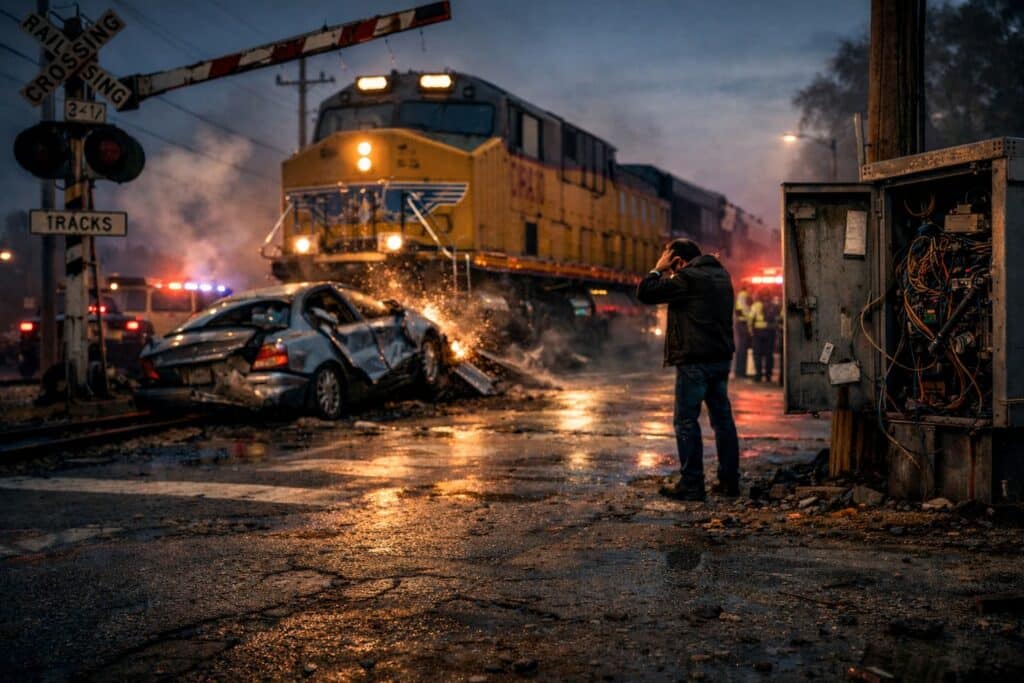
What Malfunctioning Gates and Signal Failures Look Like in Evidence
Physical evidence at the crossing, photographs of signal heads, gate arms, detection loops embedded in the pavement, and control box condition, establishes the condition of the equipment at the time of the crash. But the more revealing evidence often comes from the railroad’s own maintenance history for that specific crossing.
Prior reports of malfunctions at the same crossing, complaints from the municipality or state transportation department, and work orders that were requested but never completed paint a picture of a company that knew its equipment was failing and chose not to act.
The Federal Railroad Administration maintains a public crossing inventory database that contains historical data about specific crossings, including prior accident and incident reports. That database is a starting point for identifying what was known about a crossing’s history before the crash in question.
Suing Union Pacific San Antonio and What That Litigation Involves
Union Pacific is among the most active freight carriers through Bexar County and one of the most experienced defendants in personal injury litigation. Its legal team knows the preemption arguments, deploys them early, and often combines them with comparative fault claims against drivers.
Anticipating that defense structure before filing requires a litigation strategy built around the claims federal law leaves open rather than those it closes. Pursuing a maintenance negligence claim against Union Pacific means moving quickly on several fronts simultaneously.
The railroad will conduct its own post-incident investigation, document the scene, and preserve evidence in ways that serve its interests. An independent investigation, conducted before the crossing equipment is repaired or replaced and before the railroad’s own records become the only account of the equipment’s condition, is essential.
Federal Regulations and the Duty to Report Signal Failures
Railroads operating in Texas have federal reporting obligations when crossing signal systems malfunction. The FRA requires railroads to report certain signal failures and crossing accidents, creating a federal record of incidents that predates any litigation.
Those reports, combined with the railroad’s internal maintenance logs, can establish a timeline showing how long a problem was known before the crash that caused the injury.
When a signal failure that preceded an accident appears in a federally required report that the railroad filed, the preemption argument the railroad might raise becomes considerably harder to sustain.
The railroad cannot simultaneously argue that federal law governs the field and that it satisfied its federal reporting obligations by documenting a defect it never repaired.
Building a Train Accident Liability Texas Claim Around What Federal Law Leaves Open
Litigation strategy in crossing accident cases begins with mapping the preemption landscape before any pleading is filed. Claims targeting train speed within federally permitted limits face the most direct preemption risk.
Claims targeting crossing maintenance failures occupy a more defensible position. Claims targeting the railroad’s response to known equipment defects, including its own internal documentation of prior problems, sit on the most durable ground available.
That mapping exercise requires familiarity with both federal preemption doctrine and the specific factual record of the crossing where the accident occurred. A legal team that treats every railroad crossing case the same way regardless of which claims are viable is likely to walk into preemption arguments it didn’t anticipate.
One that analyzes the specific conduct at issue and builds the claim around what federal law leaves unprotected is operating with a fundamentally different strategic foundation.
Several categories of evidence that support a maintenance-based crossing claim include:
- Photographs and video of the crossing warning systems taken immediately after the crash, before any repairs are made
- The railroad’s inspection and maintenance records for the specific crossing, obtained through discovery or public records requests
- FRA crossing inventory and incident data for the location, accessed through the agency’s public database
- Testimony from municipal transportation officials or state highway department personnel about prior communications with the railroad about crossing conditions
- Records of any prior accidents, near-misses, or reported signal failures at the same location
Presenting these materials to an attorney before the crossing is repaired and before the railroad’s own investigation has shaped the available narrative gives a legal team the clearest possible starting point.
FAQ for Train Accident Liability Texas Cases
Does federal preemption mean I can’t sue a railroad at all if a train hit my car in San Antonio?
Federal preemption limits specific types of claims, particularly those targeting conduct that federal regulations govern directly, such as train speed within approved limits. It doesn’t eliminate all state-law claims against railroads.
Negligence claims arising from the failure to maintain crossing warning systems, the failure to respond to known equipment defects, and other conduct that federal regulations don’t specifically address remain viable in Texas courts.
How do I find out whether a crossing’s signals were malfunctioning before my accident?
The FRA’s public crossing inventory database contains historical data about specific crossings including prior incident reports. The railroad’s own maintenance and inspection records, obtainable through discovery in litigation, often contain the most detailed picture of equipment condition and prior reported problems. Municipal transportation departments sometimes maintain separate records of crossing complaints and communications with the railroad.
What is the statute of limitations for a railroad crossing accident claim in Texas?
Texas’s two-year statute of limitations for personal injury claims under Civil Practice and Remedies Code § 16.003 applies to railroad crossing accident cases. Because physical evidence at crossings is repaired or replaced quickly and the railroad conducts its own investigation immediately after an incident, the practical window for preserving evidence is far shorter than two years. Early consultation with an attorney preserves options that delay forecloses.
Can I pursue a claim against both the railroad and a local government if the crossing was on a public road?
Crossing maintenance responsibility sometimes involves both the railroad and a public entity, particularly where a government agency was responsible for road approaches, signage, or pavement markings leading to the crossing.
Claims against government entities in Texas involve specific procedural requirements including notice deadlines under the Texas Tort Claims Act that differ from standard personal injury timelines. Whether a public entity shares responsibility depends on the specific crossing configuration and the maintenance agreement governing it.
What if the railroad argues the driver should have seen the train coming regardless of the signal failure?
Comparative fault arguments based on sight lines and driver conduct are standard railroad defenses. Accident reconstruction specialists evaluate whether the train was visible from a safe stopping distance given the approach speed, road conditions, and any obstructions present at the time.
Where a functioning warning system would have been the driver’s primary alert and the system failed, the reconstruction analysis often undermines the argument that the driver should have stopped without it.
When Federal Law Becomes a Wall and a Lawyer Finds the Door
Railroads have used federal preemption arguments for decades to narrow the claims injured people can bring, and those arguments sometimes succeed. What they don’t do is close every path. The maintenance gap, the space between federal regulation of crossing design and a railroad’s independent obligation to keep its own equipment working, is where viable claims often live.
Our team at Ryan Orsatti Law analyzes each crossing accident against the specific preemption landscape before building any claim, because the strategy that works in these cases is one built around what federal law leaves open rather than what it shields.
If a signal failed, a gate didn’t come down, or warning lights went dark at a San Antonio crossing, contact us for a free consultation and let’s look at what the railroad’s own records show.
Hurt in an accident in San Antonio? Learn how a San Antonio personal injury lawyer can help with your claim. Call 210-525-1200 or request a free consultation.
The firm works on a contingency fee. You pay nothing unless the firm recovers money for you, and that covers case expenses as well as the fee: if there is no recovery, you owe no attorney's fee and no case expenses. Ask for the fee agreement and read the fee and expense section before you sign anything.
Related San Antonio legal resources
Primary legal and public-data sources
- Texas Civil Practice and Remedies Code Chapter 16: limitations
- Texas Civil Practice and Remedies Code Chapter 33: proportionate responsibility
Ryan Orsatti Law
4634 De Zavala Road, San Antonio, TX 78249
General reference links. Consult each source for its current text.