
Quick Answer
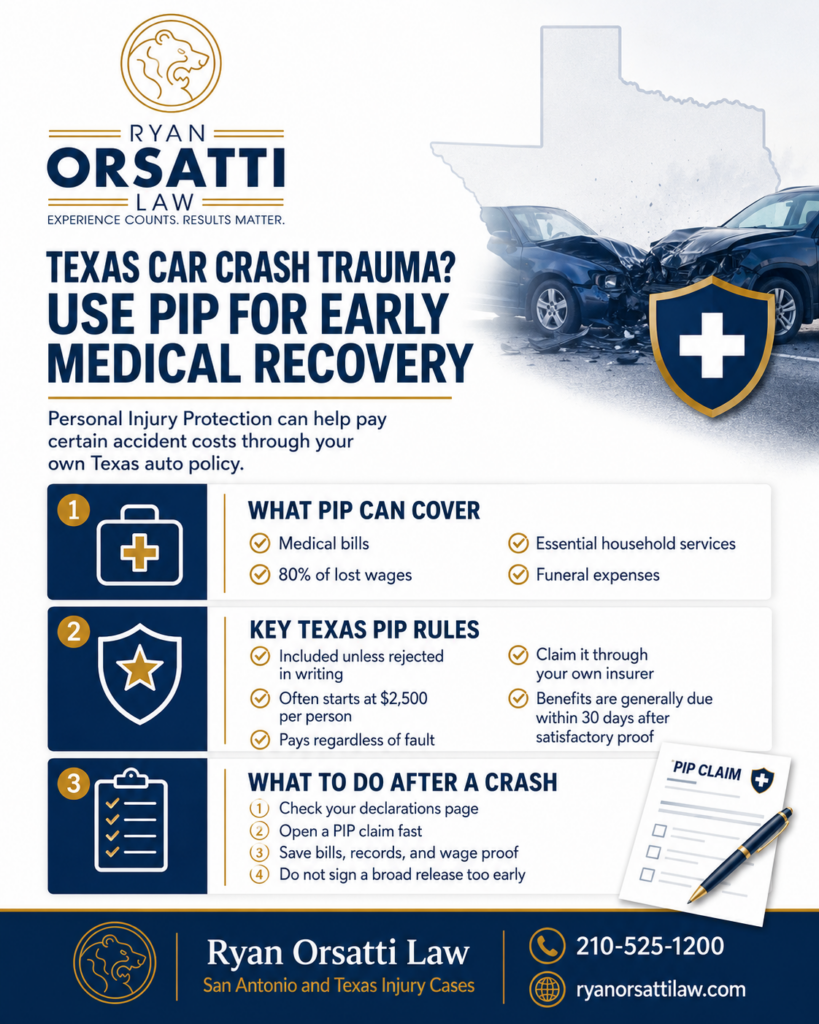
Personal Injury Protection, called PIP, can help pay medical bills, 80% of lost wages, and certain household-service costs after a Texas car accident, regardless of fault, up to your policy limits. Texas auto policies include PIP unless the named insured rejected it in writing, and insurers must provide at least $2,500 per person unless rejected. After a crash, find your declarations page, open a PIP claim with your own insurer, submit medical bills and wage proof, and avoid signing a liability release before your treatment needs are clearer. Ryan Orsatti Law helps injured people in San Antonio and across Texas review PIP, MedPay, health insurance, UM/UIM, and liability coverage after serious wrecks. (Texas Department of Insurance)
Key Takeaways
- PIP is first-party coverage, meaning you claim it through your own auto insurance policy.
- Texas PIP pays regardless of who caused the crash, subject to policy limits and documentation.
- PIP can cover accident-related medical bills, funeral expenses, 80% of lost income, and certain essential services.
- PIP is different from MedPay because PIP includes wage and essential-service benefits.
- Do not assume you rejected PIP. Check your declarations page and ask the insurer for any written rejection.
- PIP helps with early bills, but it does not replace a liability claim against an at-fault driver.
What Is PIP After a Texas Car Accident?
PIP is auto insurance coverage that pays certain accident-related expenses for you, covered household members, authorized drivers, and passengers in the insured vehicle. In Texas, PIP is especially useful because it can pay quickly without waiting for the other driver’s liability insurer to accept fault. Texas Insurance Code § 1952.151 defines PIP as coverage for reasonable expenses arising from an accident and incurred within three years of the crash. (Justia Law)
In plain English, PIP is a short-term medical and wage safety net. It is not the same as a personal injury settlement. It does not pay for pain and suffering, future impairment, or the full value of a serious injury case.
PIP usually matters most in the first few weeks after a wreck, when ambulance bills, emergency-room charges, imaging, prescriptions, follow-up care, and missed work start hitting before the liability claim is resolved.
Is PIP Required in Texas?
PIP is included in Texas auto policies unless the named insured rejected it in writing. The Texas Department of Insurance explains that all Texas auto policies include PIP and that a driver who does not want it must tell the insurance company in writing. The Office of Public Insurance Counsel states that companies must provide $2,500 per person in PIP coverage unless it is rejected in writing. (Texas Department of Insurance)
That means you should not assume you lack PIP just because you never asked for it. Many injured people in San Antonio discover PIP only after a lawyer, medical provider, or adjuster reviews the declarations page.
Look for these words on your policy documents:
- Personal Injury Protection
- PIP
- PIP Basic
- PIP Rejected
- Personal Injury Protection Declined
- Medical Payments, which is different from PIP
If the policy says PIP was rejected, ask for the written rejection. A phone conversation or assumption is not the same thing as a signed rejection.
What Does Texas PIP Pay For?
Texas PIP pays reasonable accident-related medical and funeral expenses, 80% of lost wages, and certain essential household services for people who were not wage earners at the time of the crash. OPIC explains that PIP pays reasonable accident-related medical and funeral expenses within three years of the accident, plus 80% of lost wages or essential services when applicable. (Office of Public Insurance Counsel)
| Expense Type | What PIP May Cover | Common Proof Needed |
|---|---|---|
| Medical bills | Ambulance, ER, imaging, follow-up care, therapy, prescriptions, medical devices | Bills, records, receipts, explanation of benefits |
| Lost wages | 80% of income lost because crash injuries kept you from working | Employer letter, pay stubs, tax records, work restrictions |
| Essential services | Help with ordinary household services the injured person cannot perform | Receipts, task description, proof the service was necessary |
| Funeral expenses | Reasonable funeral expenses after a fatal crash | Funeral invoices and proof of relationship to the accident |
Key takeaway: PIP works best when you document the bill, the crash connection, and why the expense was medically or practically necessary.
How Do You File a PIP Claim After a Texas Car Accident?
You file a PIP claim by notifying your own auto insurer, confirming PIP appears on the declarations page, and submitting proof of accident-related medical expenses, lost wages, or essential services. Texas Insurance Code § 1952.156 requires PIP benefits to be paid periodically as claims arise, but not later than 30 days after the insurer receives satisfactory proof of claim. (Texas Statutes)
Use this checklist before you submit the claim:
- Get the declarations page for every household auto policy.
- Confirm the PIP limit for each covered person.
- Ask whether the insurer claims PIP was rejected.
- Request a copy of any written PIP rejection.
- Open a PIP claim with your own auto insurer.
- Submit the crash report number, if available.
- Send itemized medical bills and records.
- Send wage documentation if you missed work.
- Keep proof of every upload, email, fax, or mailing.
- Do not sign a broad release unless you know exactly what claim it releases.
For San Antonio wrecks, the documents often start with the police crash report, EMS records, ER bills, and follow-up treatment notes. If the wreck happened on I-10, I-35, Loop 410, Loop 1604, US-281, or a Bexar County frontage road, the same PIP rules apply because the coverage comes from the auto policy, not the crash location.
Why Does PIP Matter for Medical Recovery?
PIP matters because early medical gaps can hurt both your health and your injury claim. TxDOT reported 251,977 people injured in Texas motor vehicle traffic crashes in 2024, including 18,218 people with serious injuries, so fast access to post-crash care is a real issue for Texas drivers and passengers.
PIP can help pay for initial treatment while fault, liability coverage, and claim value are still being investigated. That matters when the at-fault driver’s insurer is slow, denies responsibility, or says it needs more time to review the crash.
PIP also helps avoid a common claim problem: delayed treatment. Insurance adjusters often argue that a gap in care means the injury was minor, unrelated, or resolved. A valid PIP claim can make it easier to document symptoms, diagnosis, and treatment before that argument develops.
Attorney Insight: Adjusters do not evaluate medical bills in isolation. They look at timing, consistency, diagnosis, mechanism of injury, treatment gaps, prior similar complaints, and whether the records connect the pain to the crash. PIP helps when it lets the injured person get timely care and creates clean documentation before the liability carrier starts disputing causation.
Does PIP Pay If You Were at Fault?
Yes, Texas PIP benefits are payable without regard to fault. Texas Insurance Code § 1952.155 says PIP benefits are payable without regard to the fault or nonfault of the named insured or recipient, and without regard to collateral sources such as medical, hospital, or wage-continuation benefits. (Justia Law)
This is one of the biggest differences between PIP and a liability claim. A liability claim asks who caused the crash. A PIP claim asks whether the person is covered, whether the expense arose from the crash, whether the proof is satisfactory, and whether benefits remain under the policy limit.
That said, PIP does not protect you from claims made by other people if you caused the crash. It also does not pay to repair your car. It is injury-related first-party coverage.
Can PIP Be Used Alongside Health Insurance?
Yes, PIP can often work alongside health insurance because Texas PIP benefits are payable without regard to collateral sources. In practical terms, PIP may help cover deductibles, co-pays, out-of-network charges, wage losses, and certain services that health insurance may not cover. (Justia Law)
Subrogation means an insurer claims a right to be paid back from a settlement. Texas PIP is generally protected from subrogation, with an exception when the at-fault driver lacked required financial responsibility. That makes PIP different from many health insurance plans and some MedPay claims.
Health insurance can still matter. Medical bills, health-plan liens, ERISA plan claims, hospital liens, and letters of protection can affect the net recovery in a serious injury case. If several payors are involved, the order of payment and documentation can change the final result.
What Is the Difference Between PIP and MedPay in Texas?
PIP is broader than MedPay because PIP can pay medical expenses, funeral expenses, 80% of lost wages, and essential services, while MedPay usually focuses on medical expenses. OPIC states that both PIP and MedPay pay regardless of fault, but MedPay does not pay lost wages or essential services. (Office of Public Insurance Counsel)
| Coverage | Pays Regardless of Fault? | Medical Bills | Lost Wages | Essential Services | Required Offer or Inclusion |
|---|---|---|---|---|---|
| PIP | Yes | Yes | Yes, usually 80% | Yes, when applicable | Included unless rejected in writing |
| MedPay | Yes | Yes | No | No | Not required to be offered by every insurer |
| Liability claim | No | Yes, if another party is legally responsible | Yes, if proven | Sometimes, as damages evidence | Depends on fault and available coverage |
| UM/UIM | Usually requires legal entitlement to recover | Yes, if covered and proven | Yes, if covered and proven | Case-specific | Must be offered and rejected in writing if declined |
Key takeaway: PIP is often more useful than MedPay after an injury crash because it can address income loss and household-service needs, not just medical bills.
For more on related insurance issues, see Ryan Orsatti Law’s guides on uninsured drivers in Texas, UM/UIM coverage in Texas, and what “full coverage” really means.
Will Using PIP Hurt Your Injury Settlement?
Using PIP usually should not reduce your claim against the at-fault driver, but the details matter. Texas Insurance Code § 1952.155 generally prevents a PIP insurer from asserting subrogation against another person or insurer to recover PIP benefits, except where the at-fault driver lacked required financial responsibility. (Justia Law)
A liability claim is different from PIP. The liability claim may include medical expenses, lost wages, pain and suffering, impairment, disfigurement, future treatment, and other damages that PIP does not fully address.
The bigger risk is signing the wrong document. Some insurance forms are routine PIP proof forms. Others may release claims. Before signing a release from any insurer, confirm whether it releases only PIP benefits, only property damage, or the entire bodily-injury claim.
What Mistakes Reduce the Value of a PIP Claim?
The most common PIP mistakes are failing to check the declarations page, waiting too long to submit bills, sending incomplete wage proof, and assuming the at-fault driver’s insurer will pay quickly. PIP is your own coverage, so the claim should usually be opened promptly after the crash.
Common mistakes include:
- Not asking for the written PIP rejection.
- Submitting balance statements instead of itemized bills.
- Sending bills without medical records.
- Claiming lost wages without employer verification.
- Ignoring out-of-pocket receipts.
- Failing to track mileage, prescriptions, braces, or medical devices.
- Signing a broad release too early.
- Treating PIP as the whole injury claim.
TDI warns that before signing a medical settlement release with the other driver’s insurer, an injured person should talk to a doctor about future medical treatment and consider whether the offer is fair. That same caution applies when the person has early bills paid by PIP but ongoing symptoms remain. (Texas Department of Insurance)
How Does PIP Fit With a Texas Car Accident Claim?
PIP is usually one piece of a larger Texas car accident claim. The full claim may involve your PIP coverage, health insurance, MedPay, the at-fault driver’s liability coverage, UM/UIM coverage, hospital liens, subrogation claims, property damage, and the two-year Texas lawsuit deadline under Civil Practice & Remedies Code § 16.003. (Justia Law)
Texas also uses proportionate responsibility in negligence cases. Comparative responsibility means Texas can reduce a recovery by a person’s percentage of fault, and a claimant found more than 50% responsible generally cannot recover damages from another party. PIP is different because it pays without regard to fault, subject to the policy and proof requirements.
For serious crashes, PIP should be coordinated with the overall case strategy. Ryan Orsatti Law helps injured people in San Antonio and across Texas evaluate insurance coverage, medical documentation, lien issues, and evidence preservation after car accidents. You can also review the firm’s San Antonio car accident lawyer page or contact Ryan Orsatti Law directly.
When Should You Call a Texas Personal Injury Lawyer About PIP?
You should consider calling a Texas personal injury lawyer about PIP when injuries are serious, treatment is ongoing, the insurer denies coverage, the at-fault driver is uninsured, or multiple coverages may apply. PIP is designed to be simpler than a liability claim, but serious crash cases often become complicated once medical bills, liens, wage loss, and releases overlap.
Legal help may matter if:
- The insurer says you rejected PIP but cannot produce the rejection.
- The insurer delays payment after receiving complete proof.
- The insurer says treatment is unrelated to the crash.
- You were a passenger in someone else’s vehicle.
- You were hit by an uninsured or underinsured driver.
- You have health insurance, a hospital lien, or an ERISA plan involved.
- You are being asked to sign a release.
- You have concussion symptoms, surgery recommendations, or long-term treatment needs.
The goal is not to turn every PIP claim into a lawsuit. The goal is to make sure early insurance decisions do not damage the larger injury claim.
FAQ
Do I automatically have PIP in Texas?
You may have PIP automatically if your Texas auto policy includes it and you did not reject it in writing. TDI states that all Texas auto policies include PIP and that a driver who does not want it must tell the company in writing. Check your declarations page and request any written rejection before assuming PIP is unavailable. (Texas Department of Insurance)
How much PIP coverage does Texas require insurers to provide?
Texas insurers must provide $2,500 per person in PIP coverage unless it is rejected in writing. Some policies may offer higher PIP limits, but you must check the declarations page to know the exact amount. The available amount is usually a per-person limit, not one shared amount for everyone in the vehicle. (Office of Public Insurance Counsel)
Does PIP cover passengers after a Texas car accident?
Yes, PIP can cover passengers in the insured vehicle, including guest occupants, if the vehicle’s policy includes PIP and coverage has not been validly rejected. Texas Insurance Code § 1952.151 includes the named insured, household members, authorized operators, and passengers of the insured vehicle within the PIP coverage definition. (Justia Law)
Can I use PIP if the crash was my fault?
Yes, PIP pays without regard to fault, subject to the policy limit and proper proof. That makes it different from a liability claim against another driver. If you caused the crash, PIP may still help with your covered medical bills or wage loss, but it will not pay for another person’s injuries or your vehicle repairs. (Justia Law)
How fast does a Texas insurer have to pay PIP?
Texas Insurance Code § 1952.156 generally requires PIP benefits to be paid as claims arise, but not later than 30 days after the insurer receives satisfactory proof of claim. “Satisfactory proof” usually means enough documentation to show coverage, accident connection, and the amount claimed. Keep proof of everything submitted. (Texas Statutes)
Does PIP cover pain and suffering?
No, PIP does not pay pain and suffering. PIP is designed to cover specific economic losses such as medical bills, funeral expenses, 80% of lost wages, and certain essential services. Pain and suffering may be part of a liability claim or UM/UIM claim if the facts, fault, coverage, and evidence support it.
Should I use PIP before health insurance?
There is no one-size-fits-all answer because the best payment order depends on the policy language, medical providers, deductibles, liens, and claim strategy. PIP can often work alongside health insurance because Texas PIP benefits are payable without regard to collateral sources. In serious injury cases, review all coverages before deciding how bills should be submitted. (Justia Law)
Do I still have a claim against the at-fault driver if PIP paid some bills?
Yes, PIP does not usually replace your claim against the at-fault driver. PIP may help with early medical bills and wage loss, while the liability claim may address broader damages such as future care, impairment, pain, and other losses. Do not sign a liability release just because some bills were paid through PIP.
Ryan Orsatti Law
4634 De Zavala Rd, San Antonio, TX 78249
Phone: 210-525-1200
ryanorsattilaw.com
This blog is for informational purposes only, not legal advice. Reading it does not create an attorney-client relationship. Past results do not guarantee future results.
Hurt in an accident in San Antonio? Learn how a San Antonio car accident lawyer can help with your claim. Call 210-525-1200 or request a free consultation.
The firm works on a contingency fee. You pay nothing unless the firm recovers money for you, and that covers case expenses as well as the fee: if there is no recovery, you owe no attorney's fee and no case expenses. Ask for the fee agreement and read the fee and expense section before you sign anything.
Related San Antonio legal resources
Primary legal and public-data sources
- TxDOT: Texas crash reports, data, and statistics
- Texas Civil Practice and Remedies Code Chapter 33: proportionate responsibility
Ryan Orsatti Law
4634 De Zavala Road, San Antonio, TX 78249
General reference links. Consult each source for its current text.