
Quick Answer
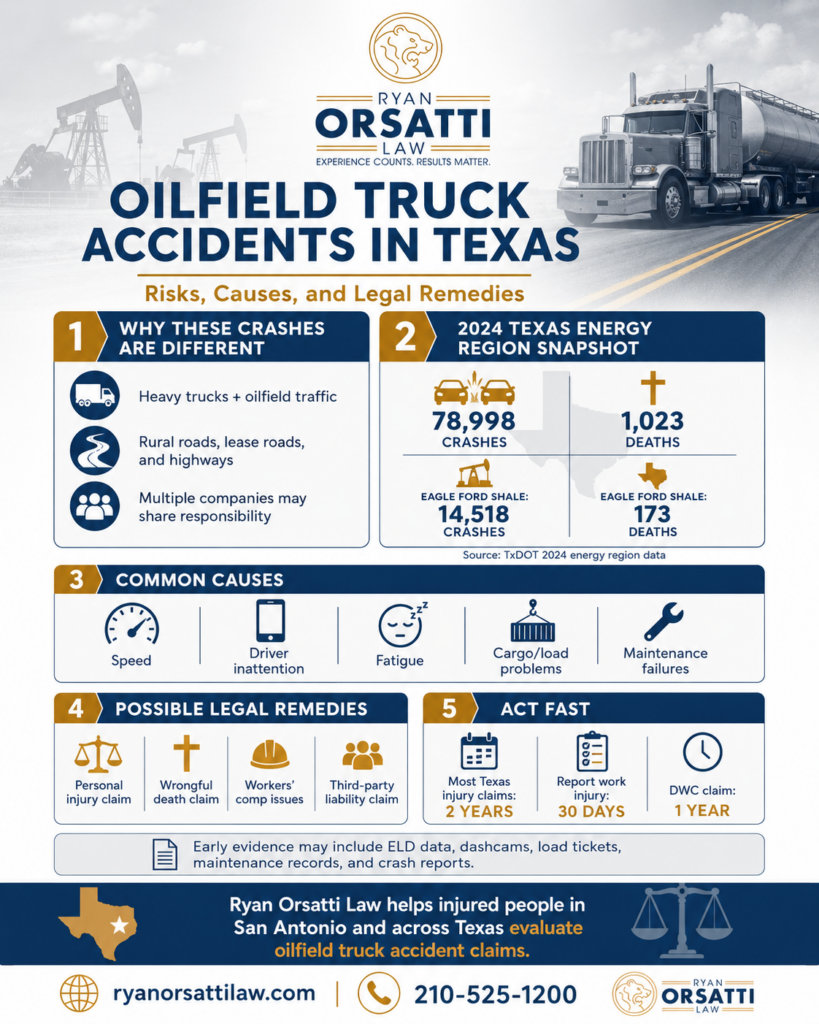
Understanding oilfield truck accidents in Texas starts with one key point: these crashes often involve both roadway trucking rules and oilfield worksite rules. TxDOT reported nearly 79,000 crashes in Texas’s five major energy regions in 2024, with 1,023 deaths, and identified failure to control speed and driver inattention as leading contributors. Injured workers, drivers, passengers, and families should get medical care, report the crash, preserve truck and jobsite evidence, and have fault and insurance coverage reviewed before giving recorded statements or accepting a settlement. Ryan Orsatti Law helps injured people in San Antonio, the Eagle Ford Shale region, and across Texas evaluate serious oilfield truck accident claims. (Texas Department of Transportation)
Key Takeaways
- Oilfield truck accidents can involve a truck driver, motor carrier, lease operator, service company, cargo loader, maintenance vendor, or site contractor.
- In 2024, TxDOT reported 14,518 crashes and 173 deaths in the Eagle Ford Shale energy region alone. (Texas Department of Transportation)
- OSHA identifies highway vehicle crashes as a leading cause of death for oil and gas extraction workers, with about 4 in 10 worker deaths in that industry involving highway vehicle incidents. (OSHA)
- Most Texas personal injury and wrongful death lawsuits must be filed within two years, but workers’ compensation and government-entity notice deadlines can be much shorter. (Texas Statutes)
- Early evidence matters. Electronic logs, dashcam video, truck engine data, load tickets, site sign-in sheets, and maintenance records can become harder to obtain with time.
What Makes Oilfield Truck Accidents in Texas Different From Ordinary Truck Accidents?
Oilfield truck accidents in Texas are different because one crash may involve a public roadway, a jobsite, a commercial motor carrier, several contractors, and multiple layers of insurance. A crash near the Eagle Ford Shale, Permian Basin, or a San Antonio supply route may require investigation into both trucking safety and oilfield operations.
Oilfield transportation often involves water trucks, sand haulers, vacuum trucks, crude oil tankers, pipe trucks, flatbeds, hotshot drivers, and service vehicles. These trucks may travel between rural lease roads, drilling sites, refineries, yards, and public highways such as I-10, I-35, US-281, Loop 410, Loop 1604, and corridors connecting Bexar County with Atascosa, Wilson, Karnes, La Salle, McMullen, Dimmit, and other South Texas counties.
The legal question is rarely just “Who hit whom?” A proper review may ask who owned the truck, who employed the driver, who dispatched the load, who controlled the jobsite, who maintained the brakes, who loaded the cargo, and whether the driver was working under federal trucking rules, oilfield exceptions, or a company safety policy.
For related information, Ryan Orsatti Law has resources on oil field accident cases in San Antonio, San Antonio truck accident claims, and commercial vehicle accident claims.
Why Are Oilfield Truck Accidents So Dangerous in Texas Energy Regions?
Oilfield truck accidents are dangerous because heavy trucks, long rural drives, high-speed roads, fatigue, and industrial cargo can combine in one event. TxDOT’s 2024 energy-region data shows the scale of the risk: nearly 79,000 crashes and 1,023 deaths across the Barnett Shale, Eagle Ford Shale, Anadarko Basin, Haynesville/Bossier Shale, and Permian Basin regions. (Texas Department of Transportation)
OSHA also treats vehicle crashes as a major oil and gas hazard. Its oil and gas safety guidance states that highway vehicle crashes are a leading cause of death for oil and gas extraction workers, and that roughly 4 out of every 10 workers killed on the job in that industry die in a highway vehicle incident. (OSHA)
| Oilfield truck risk | Why it matters | Evidence to preserve |
|---|---|---|
| Heavy trucks and tankers | Large trucks have wider turns, larger blind spots, and longer stopping distances. | Dashcam video, engine control module data, driver logs, GPS data |
| Rural and energy-sector roads | Traffic can include passenger vehicles, work convoys, tankers, and service trucks on roads with limited lighting or shoulders. | Scene photos, road-condition photos, TxDOT crash report, witness names |
| Fatigue and long shifts | Drivers may travel long distances between yards, well sites, disposal sites, and loading areas. | ELD records, dispatch records, time sheets, job tickets |
| Cargo movement | Sand, pipe, fluids, equipment, or tanks may shift if loaded or secured improperly. | Load tickets, bills of lading, cargo securement photos, inspection records |
| Multiple contractors | Oilfield work often involves several companies, which can create fault and insurance disputes. | Master service agreements, work orders, site logs, sign-in sheets |
Key takeaway: Oilfield truck crashes require a broader evidence review than ordinary car wrecks because fault may depend on both driver conduct and the oilfield operation behind the trip.
What Are the Common Causes of Oilfield Truck Accidents in Texas?
Common causes of oilfield truck accidents in Texas include speed, inattention, fatigue, unsafe following distance, bad brakes, tire failures, poor cargo securement, and unsafe jobsite traffic control. TxDOT identified failure to control speed and driver inattention as leading contributors in 2024 energy-region crashes. (Texas Department of Transportation)
How does driver fatigue affect oilfield truck accident claims?
Driver fatigue can affect an oilfield truck accident claim because fatigue may point to unsafe scheduling, excessive driving, poor supervision, or a failure to follow hours-of-service rules. Federal rules generally limit property-carrying commercial drivers to 11 hours of driving after 10 consecutive hours off duty, subject to specific rules and exceptions. (eCFR)
Oilfield operations have specific hours-of-service provisions. Federal regulations state that, for specially trained drivers of commercial motor vehicles specially constructed to service oil wells, certain waiting time at a natural gas or oil well site may be recorded differently and may not count against the 14-hour period. That exception does not make unsafe driving acceptable, but it does make the log review more technical. (eCFR)
How do speed and inattention cause oilfield truck crashes?
Speed and inattention cause oilfield truck crashes by reducing the driver’s ability to react to traffic, stopped vehicles, turns, work convoys, and road hazards. TxDOT’s energy-sector campaign specifically identifies failure to control speed and driver inattention as leading factors in 2024 energy-region crashes. (Texas Department of Transportation)
In practical terms, speed issues often show up in braking data, skid marks, dashcam footage, witness accounts, and crash-scene measurements. Inattention may require phone records, dispatch messages, in-cab camera footage, GPS history, and testimony about what the driver was doing before impact.
How do load shifts and cargo securement failures cause oilfield crashes?
Load shifts and cargo securement failures can cause an oilfield truck to roll over, jackknife, lose cargo, or become unstable during braking or turning. FMCSA cargo securement rules are intended to reduce crashes caused by cargo shifting or falling from commercial motor vehicles in interstate operation. (FMCSA)
Oilfield loads can include pipe, drilling equipment, sand, water, chemicals, tanks, and other heavy materials. Evidence may include load tickets, cargo photographs, scale records, tie-down inspection records, bills of lading, and the identity of the company that loaded or inspected the truck.
How do maintenance problems affect oilfield truck accident liability?
Maintenance problems can affect liability when bad brakes, worn tires, lighting failures, steering problems, or ignored inspection reports contribute to a crash. Oilfield trucks may operate in harsh conditions, including caliche roads, lease roads, dust, mud, heat, and long rural routes.
A maintenance-related claim should usually examine driver vehicle inspection reports, repair invoices, brake records, tire replacement history, out-of-service history, company inspection policies, and prior complaints. The issue is not only whether something broke, but whether the company knew or should have known the truck was unsafe before the crash.
How do jobsite traffic control failures cause oilfield truck accidents?
Jobsite traffic control failures can cause oilfield truck accidents when companies fail to separate pedestrian workers, service trucks, backing vehicles, and public traffic. OSHA identifies struck-by, caught-in, and caught-between hazards as major oil and gas risks, including hazards involving moving vehicles and equipment. (OSHA)
Backing incidents, blind turns, poor lighting, missing spotters, unclear staging areas, and unsafe entry or exit routes can all matter. In those cases, the investigation should include the site safety plan, traffic plan, incident report, supervisor notes, contractor roles, and whether the site operator retained control over the work that caused the injury.
Who Can Be Liable for an Oilfield Truck Accident in Texas?
Several parties may be liable for an oilfield truck accident in Texas, depending on who caused or contributed to the crash. Possible parties include the driver, motor carrier, trucking company, oilfield operator, lease operator, service company, cargo loader, maintenance vendor, parts manufacturer, or a government entity responsible for a road condition.
Texas uses proportionate responsibility in many injury cases. Comparative responsibility means Texas can reduce a plaintiff’s recovery by that plaintiff’s percentage of fault, and a claimant generally may not recover damages if the claimant is more than 50% responsible. (Texas Statutes)
| Potential party | Common claim theory | Evidence that may matter |
|---|---|---|
| Truck driver | Speeding, inattention, unsafe lane change, fatigue, unsafe following distance | Crash report, dashcam, phone records, driver logs, witness statements |
| Motor carrier or trucking company | Unsafe hiring, training, supervision, dispatch, or maintenance | Driver qualification file, safety policies, ELD data, repair records |
| Oilfield operator or site company | Unsafe traffic control, retained control, dangerous site conditions | Master service agreement, site safety plan, sign-in logs, supervisor emails |
| Cargo loader | Improper loading, poor securement, overweight or unstable cargo | Load tickets, bills of lading, securement photos, scale records |
| Maintenance vendor | Bad repair, ignored brake or tire issues | Invoices, inspection sheets, mechanic notes, prior service history |
| Government entity | Road defect, missing sign, dangerous public-road condition, if notice and immunity rules allow | Photos, prior complaints, maintenance records, statutory notice evidence |
Key takeaway: Oilfield truck liability often depends on the business chain behind the truck, not just the name on the driver’s door.
What Legal Remedies May Be Available After an Oilfield Truck Crash?
Legal remedies after an oilfield truck crash depend on whether the injured person was a worker, another driver, a passenger, a pedestrian, or a surviving family member. The available path may include a workers’ compensation claim, a third-party injury lawsuit, a wrongful death claim, a survival claim, or some combination of those options.
What if you were an injured oilfield worker?
If you were an injured oilfield worker, the first question is whether your employer carried Texas workers’ compensation coverage. Texas private employers generally may choose whether to carry workers’ compensation insurance, and an employer that does carry coverage may have exclusive-remedy protections against most employee injury claims. (Texas Department of Insurance)
That does not always end the analysis. If a third party caused the crash, such as another trucking company, cargo loader, site contractor, or product manufacturer, the worker may still have a separate third-party claim. Texas workers should report a work injury to the employer within 30 days and file DWC Form-041 with the Division of Workers’ Compensation within one year, subject to specific rules and exceptions. (Texas Department of Insurance)
What if you were another driver or passenger?
If you were another driver or passenger, your claim may be against the truck driver, motor carrier, oilfield company, or another responsible party. Potential damages, when supported by evidence, may include medical expenses, lost income, loss of earning capacity, physical pain, impairment, disfigurement, property damage, and other legally recognized losses.
Insurance coverage can be more complicated than in an ordinary car crash. Some oilfield vehicles may involve commercial auto coverage, motor carrier coverage, umbrella or excess policies, contractor policies, workers’ compensation coverage, or company-specific risk-transfer agreements. Federal financial responsibility rules also set minimum insurance levels for certain interstate motor carriers and hazardous cargo operations. (eCFR)
What if the oilfield truck accident caused a death?
If an oilfield truck accident caused a death, Texas law may allow wrongful death and survival claims. A wrongful death claim is generally for the benefit of the surviving spouse, children, and parents, while a survival claim preserves certain claims the injured person could have brought if they had lived. (Justia)
Fatal oilfield truck cases often need urgent evidence preservation. The investigation may involve crash reconstruction, company safety policies, driver logs, jobsite records, autopsy findings, medical billing, funeral expenses, and insurance coverage across several companies. Ryan Orsatti Law provides information on wrongful death claims for families evaluating next steps after a fatal crash.
How Long Do You Have to File an Oilfield Truck Accident Claim in Texas?
Most Texas personal injury and wrongful death lawsuits must be filed within two years, but some oilfield truck accident deadlines are much shorter. A work injury may involve a 30-day employer notice requirement and a one-year DWC filing deadline, while claims involving a city or government entity may require written notice within months. (Texas Statutes)
| Issue | Common Texas deadline | Why it matters |
|---|---|---|
| Personal injury lawsuit | Generally 2 years from the injury | Missing the statute of limitations can bar the claim. (Texas Statutes) |
| Wrongful death lawsuit | Generally 2 years from death | Fatal crash claims have their own timing rules. (Texas Statutes) |
| Texas workers’ compensation notice | Report injury to employer within 30 days | Late notice can create benefit disputes. (Texas Department of Insurance) |
| Texas DWC Form-041 | File within 1 year | This preserves an injured worker’s compensation claim. (Texas Department of Insurance) |
| Texas Tort Claims Act notice | Often within 6 months | Government claims require special notice. (Justia) |
| City of San Antonio claim notice | Written notice within 90 days | San Antonio has a shorter city notice period for certain claims. (San Antonio Web App) |
Key takeaway: Do not assume you have two full years to act because oilfield truck accidents can involve work-injury deadlines, government notice deadlines, and evidence deadlines that arrive much earlier.
What Evidence Should You Preserve After an Oilfield Truck Accident?
You should preserve evidence that identifies how the crash happened, why the truck was on the road, who controlled the work, and what insurance may apply. Spoliation means important evidence was lost or destroyed after a party knew or should have known it mattered, so early preservation letters can be critical in serious oilfield truck cases.
A Texas Peace Officer’s Crash Report, commonly called a CR-3, can be requested through TxDOT when available. Texas law generally requires an officer’s crash report for crashes involving injury, death, or property damage of $1,000 or more, and the report is typically filed by the 10th day after the crash. (Texas Department of Transportation)
- Get medical care and document every symptom, including head, neck, back, shoulder, knee, and neurological complaints.
- Request or track the Texas CR-3 crash report.
- Photograph the vehicles, skid marks, debris, cargo, company names, USDOT numbers, trailer numbers, road conditions, and visible injuries.
- Save dashcam video, cell phone photos, texts, dispatch messages, GPS data, and wearable-device data.
- Identify the truck driver, motor carrier, lease operator, site owner, service company, cargo loader, and any maintenance company.
- Get names and contact information for witnesses, coworkers, supervisors, safety personnel, and investigating officers.
- Ask that ELD data, engine control module data, in-cab video, maintenance records, driver qualification files, load tickets, and site logs be preserved.
- Keep medical bills, health insurance notices, wage-loss records, mileage logs, prescriptions, and work restrictions.
- Report a work injury within the required time if the crash happened on the job.
- Avoid signing broad releases or giving recorded statements to adverse insurers before fault, coverage, and medical issues are reviewed.
Ryan Orsatti Law also has a step-by-step resource on what to do after an oilfield accident in Texas.
Should You Give a Recorded Statement to the Trucking Insurer or Oilfield Company?
You should be careful before giving a recorded statement to the trucking insurer, oilfield company, or any party whose interests may be adverse to yours. Your own insurer may require cooperation under your policy, but an adverse insurer may use unclear answers about speed, pain levels, work status, prior injuries, or job duties to dispute fault or damages.
Recorded statements are especially risky in oilfield truck cases because the facts are usually layered. A question that sounds simple, such as where you were coming from, may affect workers’ compensation coverage, employer defenses, third-party liability, and comparative responsibility. It is usually safer to understand the legal and insurance issues first.
How Do Medical Bills, Liens, and Insurance Coverage Affect Oilfield Truck Claims?
Medical bills, liens, and insurance coverage can strongly affect the practical outcome of an oilfield truck claim. Subrogation means a health insurer or benefit plan may claim a right to be paid back from a settlement, and a hospital lien is a legal claim a hospital may assert against part of a personal injury recovery.
Oilfield crashes may involve emergency treatment, ambulance charges, surgery, orthopedic care, traumatic brain injury care, physical therapy, pain management, lost wages, and long-term work restrictions. They may also involve workers’ compensation benefits, health insurance, personal injury protection, MedPay, commercial auto insurance, excess coverage, and lien claims. These issues should be reviewed before settlement because the gross settlement number does not tell you what the injured person may actually keep.
For serious head injuries, Ryan Orsatti Law provides information on traumatic brain injury claims.
How Can Ryan Orsatti Law Help After an Oilfield Truck Accident in Texas?
Ryan Orsatti Law helps injured people in San Antonio and across Texas evaluate fault, insurance coverage, medical documentation, evidence preservation, liens, and deadlines after serious oilfield truck accidents. The firm’s role is to investigate the claim, identify responsible parties, preserve time-sensitive evidence, communicate with insurers, and prepare the case based on the facts and available law.
Oilfield truck cases often require targeted evidence requests. That can include ELD data, engine control module downloads, driver qualification files, dispatch records, safety manuals, maintenance files, load documents, master service agreements, jobsite sign-in sheets, and incident reports. The earlier those materials are requested, the better the chance of understanding what happened before important details fade.
Attorney Insight: In oilfield truck cases, the most valuable early evidence is often not the police report. It is the paperwork and data that explain why the truck was moving, who controlled the job, who loaded it, how long the driver had been working, and whether the company treated the crash as a road accident, a work accident, or both. If that evidence is not requested quickly, later fault disputes become harder to sort out.
What Should You Do Next After an Oilfield Truck Accident in Texas?
After an oilfield truck accident in Texas, the next step is to protect your health, preserve evidence, and get the claim reviewed before key deadlines or evidence problems develop. Serious cases may involve several insurers, workers’ compensation issues, commercial trucking rules, and companies that begin investigating immediately.
If the crash happened in San Antonio, Bexar County, South Texas, the Eagle Ford Shale region, or elsewhere in Texas, Ryan Orsatti Law can review the facts and discuss what information may be needed to evaluate the claim. You can contact Ryan Orsatti Law to discuss an oilfield truck accident, a commercial vehicle crash, or a related injury claim.
FAQ
What should I do first after an oilfield truck accident in Texas?
Get medical care, report the crash, photograph the scene if you safely can, identify the truck and company names, and save all documents. If you were working, report the injury to your employer within 30 days. Oilfield truck cases often involve electronic logs, jobsite records, and commercial insurance, so evidence preservation should begin quickly. (Texas Department of Insurance)
Can I sue my employer after an oilfield truck accident in Texas?
It depends on whether your employer carried Texas workers’ compensation coverage and who caused the crash. Workers’ compensation may be the exclusive remedy against a covered employer, but a separate claim may exist against a third party, such as another trucking company, site contractor, cargo loader, or equipment company. (Texas Statutes)
How is fault decided if several oilfield companies were involved?
Fault is decided by looking at each party’s role in causing the crash. Texas proportionate responsibility can assign percentages of fault among drivers, companies, contractors, and sometimes the injured person. Comparative responsibility means a claimant’s recovery can be reduced by their percentage of fault, and a claimant generally cannot recover if more than 50% responsible. (Texas Statutes)
What if the crash involved a truck hauling oil, water, sand, pipe, or equipment?
The cargo matters because loading, securement, weight, and hazardous-material rules may affect fault and insurance coverage. FMCSA cargo securement rules are designed to reduce crashes caused by cargo shifting or falling from commercial vehicles. Evidence may include bills of lading, load tickets, tie-down photos, scale records, placards, and inspection reports. (FMCSA)
How long do oilfield truck accident cases take in Texas?
The timeline depends on injury severity, treatment length, fault disputes, insurance coverage, workers’ compensation issues, and whether litigation is needed. A serious oilfield truck case may require crash reconstruction, company records, medical opinions, lien review, and multiple insurance investigations. No lawyer can properly predict a timeline without reviewing the facts and evidence.
Do I need a lawyer if the trucking company already accepted fault?
You may still benefit from legal review if the crash caused significant injury, lost income, surgery, long-term treatment, or disputed medical bills. Accepting fault for the collision does not always resolve coverage, causation, lien, subrogation, comparative responsibility, or damages issues. Oilfield truck claims often involve more than one responsible company.
What if the oilfield truck accident happened near San Antonio or the Eagle Ford Shale?
A crash near San Antonio or the Eagle Ford Shale may involve Bexar, Atascosa, Wilson, Karnes, La Salle, McMullen, or other South Texas counties. TxDOT reported 14,518 crashes and 173 deaths in the Eagle Ford Shale energy region in 2024. Local evidence may include public-road evidence, jobsite documents, contractor records, and company dispatch data. (Texas Department of Transportation)
Ryan Orsatti Law
4634 De Zavala Rd, San Antonio, TX 78249
Phone: 210-525-1200
ryanorsattilaw.com
This blog is for informational purposes only, not legal advice. Reading it does not create an attorney-client relationship. Past results do not guarantee future results.
Hurt in an accident in San Antonio? Learn how a San Antonio truck accident lawyer can help with your claim. Call 210-525-1200 or request a free consultation.
The firm works on a contingency fee. You pay nothing unless the firm recovers money for you, and that covers case expenses as well as the fee: if there is no recovery, you owe no attorney's fee and no case expenses. Ask for the fee agreement and read the fee and expense section before you sign anything.
Related San Antonio legal resources
Primary legal and public-data sources
Ryan Orsatti Law
4634 De Zavala Road, San Antonio, TX 78249
General reference links. Consult each source for its current text.