
Quick Answer
Semi-truck accident victims in Texas may have several legal options, including an injury claim against the trucking company’s insurer, a lawsuit against responsible parties, claims under their own PIP, MedPay, UM/UIM coverage, and wrongful death or survival claims if the crash was fatal. Texas generally gives injured people two years to file a personal injury lawsuit, but truck evidence such as driver logs and electronic records can disappear much sooner. Ryan Orsatti Law helps injured people in San Antonio and across Texas evaluate fault, coverage, medical bills, liens, and evidence preservation after serious truck crashes. (Texas Constitution and Statutes)
Key Takeaways
- Texas semi-truck crash cases often involve more than the truck driver. The motor carrier, trailer owner, maintenance company, cargo loader, shipper, broker, or another driver may also be involved.
- The general Texas personal injury filing deadline is two years, but practical evidence deadlines are much shorter.
- Truck cases often turn on records the victim never sees at the crash scene, including ELD data, dispatch records, inspection files, maintenance records, dashcam video, and driver qualification files.
- Texas comparative responsibility can reduce a recovery by the injured person’s percentage of fault and can bar recovery if the injured person is more than 50% responsible.
- Insurance coverage may include commercial trucking liability coverage, excess policies, PIP, MedPay, UM/UIM, and sometimes other business or contractual coverage.
- Do not treat an early settlement offer as a full evaluation of the claim until injuries, future care, wage loss, liens, and all insurance layers have been reviewed.
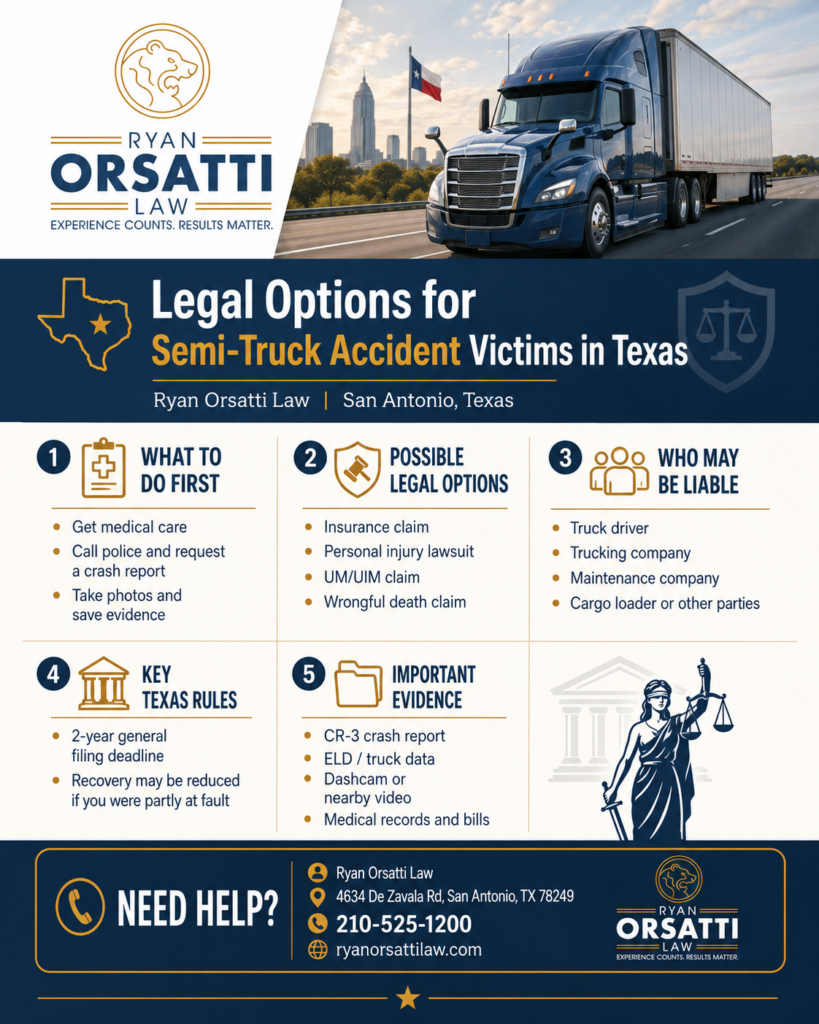
What legal options do semi-truck accident victims have in Texas?
Semi-truck accident victims in Texas can usually pursue a third-party insurance claim, a personal injury lawsuit, and first-party insurance benefits if their own policy applies. The right option depends on who caused the crash, whether the truck was operating for a motor carrier, what insurance applies, and whether the injured person has ongoing medical problems.
A Texas truck accident claim usually starts with a liability investigation. Negligence means someone failed to use reasonable care under the circumstances. In a truck crash, negligence may involve speeding, unsafe lane changes, driver fatigue, distracted driving, improper loading, poor maintenance, unsafe hiring, or failure to follow safety rules.
Common legal options include:
- A bodily injury claim against the trucking insurer. This is usually the first claim opened against the truck driver, motor carrier, or commercial insurer.
- A lawsuit against responsible parties. A lawsuit may be necessary when liability is disputed, coverage is unclear, injuries are serious, or the insurer does not make a reasonable evaluation.
- Claims against multiple defendants. The truck driver may not be the only responsible party.
- PIP or MedPay claims. Personal Injury Protection and Medical Payments coverage may help with medical bills under your own auto policy.
- UM/UIM claims. Uninsured/underinsured motorist coverage may matter if the responsible party has no coverage or not enough coverage.
- Wrongful death and survival claims. If the crash caused death, Texas law may allow claims by certain family members and the estate. (Texas Constitution and Statutes)
Why are Texas semi-truck accident claims different from normal car accident claims?
Texas semi-truck accident claims are different because they often involve commercial safety rules, corporate defendants, multiple insurance layers, and evidence controlled by the trucking company. A passenger-car crash may turn mostly on driver conduct, but an 18-wheeler case may also involve dispatch decisions, hours-of-service records, maintenance history, load securement, driver qualification files, and company safety practices.
The stakes are often higher because of the size and weight of commercial vehicles. TxDOT recorded 39,393 commercial motor vehicle involved crashes in Texas in 2024, including 546 fatal crashes and 1,261 suspected serious injury crashes. In Bexar County alone, TxDOT recorded 2,684 commercial motor vehicle involved crashes in 2024, including 18 fatal crashes and 46 suspected serious injuries. (Texas Department of Transportation)
In San Antonio, these crashes often happen on high-speed corridors such as I-35, I-10, Loop 410, Loop 1604, US-281, and major frontage roads. A local investigation may require crash-scene photos, police reports, nearby business camera checks, 911 records, EMS records, vehicle inspections, and early preservation letters to the carrier.
Who can be legally responsible after a Texas 18-wheeler crash?
The legally responsible party after a Texas 18-wheeler crash may be the truck driver, the trucking company, another company involved in the trip, or another driver on the road. The answer depends on control, employment status, vehicle ownership, maintenance responsibility, cargo responsibility, and what actually caused the collision.
| Potential responsible party | What must be investigated | Common evidence |
|---|---|---|
| Truck driver | Speed, distraction, fatigue, lane use, braking, lookout, impairment | Crash report, witness statements, phone records, dashcam, ELD data |
| Motor carrier | Hiring, training, supervision, dispatch, safety policies, maintenance | Driver qualification file, safety manuals, dispatch records, inspection records |
| Trailer owner | Trailer condition, brakes, lights, tires, coupling system | Ownership records, repair records, inspection photos |
| Maintenance contractor | Whether repair work was done correctly | Work orders, invoices, inspection reports |
| Cargo loader or shipper | Load balance, securement, overweight cargo | Bills of lading, weight tickets, loading records |
| Broker or logistics company | Case-specific control over carrier selection or route decisions | Contracts, communications, carrier vetting records |
| Another driver | Whether a third vehicle contributed to the crash | Crash reconstruction, video, witness statements |
| Government entity | Road defect, work zone design, missing signs, traffic control | Photos, public records, maintenance logs, notice deadlines |
Key takeaway: A truck crash claim should not be limited to the driver until the trip, truck, trailer, cargo, maintenance, and insurance structure have been reviewed.
How long do I have to file a semi-truck accident claim in Texas?
Texas generally gives an injured person two years to file a personal injury lawsuit after a semi-truck crash. Texas Civil Practice & Remedies Code § 16.003 is the main statute of limitations for personal injury claims, and wrongful death claims generally must also be filed within two years from the date of death. (Texas Constitution and Statutes)
The legal deadline is not the only deadline that matters. Some evidence may be overwritten, repaired, deleted, or recycled long before the two-year filing deadline. Claims involving a government vehicle, roadway defect, public employee, or public agency may also involve shorter notice requirements, so those facts should be reviewed early.
What evidence should be preserved after a semi-truck accident in Texas?
The most important evidence after a Texas semi-truck accident includes the crash report, scene photos, witness information, vehicle damage, truck data, driver records, dispatch records, maintenance records, cargo documents, and medical documentation. Much of this evidence is controlled by the trucking company, which is why early preservation matters.
Federal motor carrier rules require carriers to keep certain driver records of duty status and supporting documents for six months, but other evidence may be lost sooner depending on the device, carrier policy, repair schedule, or video system. (FMCSA)
Evidence preservation checklist after a Texas truck crash
- Get medical care and follow the treatment plan.
- Request or track the Texas Peace Officer’s Crash Report, often called the CR-3.
- Save photos and videos of the vehicles, roadway, debris, skid marks, injuries, and visible damage.
- Identify witnesses, including passengers, nearby drivers, businesses, and first responders.
- Preserve your damaged vehicle before repairs or total-loss disposal when possible.
- Save all insurance letters, claim numbers, adjuster emails, and recorded-statement requests.
- Send a preservation letter for ELD data, ECM data, dashcam video, maintenance records, inspection records, and driver qualification materials.
- Keep a medical timeline with every doctor, clinic, imaging study, prescription, work restriction, and bill.
- Track missed work, reduced hours, lost opportunities, and out-of-pocket costs.
- Do not sign a release until all injuries, liens, subrogation claims, and insurance coverage have been reviewed.
What insurance coverage may apply after a Texas semi-truck crash?
Insurance after a Texas semi-truck crash may include the trucking company’s liability policy, excess or umbrella coverage, trailer coverage, shipper or contractor coverage, and the injured person’s own PIP, MedPay, or UM/UIM coverage. The available coverage depends on the truck’s use, cargo, route, contracts, and policy language.
Federal rules set minimum financial responsibility levels for certain interstate motor carriers. For example, 49 C.F.R. § 387.9 lists a $750,000 minimum for certain for-hire interstate property carriers with vehicles over 10,001 pounds, with higher minimums for some hazardous materials. Texas personal auto policies also have coverage rules that may matter to the injured person, including PIP and UM/UIM offers. (eCFR)
| Coverage type | What it may cover | Practical issue |
|---|---|---|
| Trucking liability coverage | Injuries and damages caused by the truck driver or carrier | The insurer may dispute fault, injury causation, or damages |
| Excess or umbrella coverage | Additional coverage above the primary policy | The injured person may not know it exists without investigation |
| PIP | Medical bills and certain lost income under your own policy | Texas auto policies include PIP unless rejected in writing |
| MedPay | Medical bills under your own policy | Usually narrower than PIP and policy-specific |
| UM/UIM | Damages caused by an uninsured or underinsured driver | May matter if the responsible coverage is missing or insufficient |
| Health insurance | Medical treatment while the claim is pending | Subrogation or reimbursement claims may apply later |
Key takeaway: The first insurance policy identified after a truck crash may not be the only coverage that matters.
What damages can semi-truck accident victims claim in Texas?
Semi-truck accident victims in Texas may claim damages for medical bills, future medical care, lost wages, loss of earning capacity, pain, mental anguish, physical impairment, disfigurement, property damage, and other losses supported by the evidence. In fatal cases, wrongful death and survival damages may also be available under Texas law.
Damages must be proven with records, testimony, and facts. Medical bills alone rarely tell the whole story. A serious truck crash may also affect future work capacity, household responsibilities, sleep, mobility, driving anxiety, family life, and long-term treatment needs.
Subrogation means a health insurer may claim a right to be paid back from a settlement or judgment. A hospital lien is a legal claim a hospital may assert against part of a personal injury recovery for accident-related treatment. Texas Property Code Chapter 55 governs certain hospital liens after injury accidents. (Texas Constitution and Statutes)
What if the trucking company says I was partly at fault?
If the trucking company says you were partly at fault, Texas comparative responsibility rules may reduce your recovery by your percentage of responsibility and may bar recovery if you are more than 50% responsible. This makes fault evidence especially important in truck crash cases. (Texas Constitution and Statutes)
Comparative responsibility means Texas can compare the fault of everyone involved. Trucking insurers may argue the injured person changed lanes too quickly, stopped suddenly, followed too closely, entered a blind spot, failed to see the truck, or caused a secondary impact. Those arguments should be tested against physical evidence, vehicle data, witness accounts, video, roadway conditions, and the truck driver’s own conduct.
Should I give a recorded statement to the trucking insurer?
You should be cautious about giving a recorded statement to the trucking company’s insurer before you understand your injuries, rights, and coverage issues. The adverse insurer is not your insurer, and its questions may focus on fault, prior medical history, treatment gaps, and statements that can be used later.
You may have duties to cooperate with your own insurance company, but that does not mean every statement should be casual or unprepared. Before giving any detailed statement, gather the claim information, understand who the adjuster represents, and avoid guessing about speed, distance, pain severity, future treatment, or legal fault.
Attorney Insight: In serious truck cases, adjusters often evaluate the claim before the full medical picture is known. A demand sent before diagnosis, future-care opinions, wage-loss proof, and lien review can leave major value drivers undocumented. The early job is not just opening a claim. It is locking down evidence and building a clean damages record.
When should I talk to a Texas truck accident lawyer?
You should talk to a Texas truck accident lawyer early if the crash caused serious injury, hospitalization, surgery, death, disputed fault, multiple vehicles, commercial insurance issues, or a quick settlement offer. Early legal review is especially useful when evidence is controlled by the trucking company.
Ryan Orsatti Law helps injured people in San Antonio and across Texas evaluate truck crash claims, preserve evidence, identify insurance coverage, document medical damages, and address lien or subrogation issues. For related information, see the firm’s guide on when to hire a truck accident lawyer in San Antonio and the San Antonio commercial vehicle accident lawyer page.
How can Ryan Orsatti Law help after a semi-truck accident in San Antonio or Texas?
Ryan Orsatti Law can help by investigating fault, preserving truck evidence, reviewing insurance coverage, communicating with adjusters, organizing medical documentation, evaluating liens, and preparing the claim for negotiation or litigation when appropriate. The firm represents injured people in San Antonio, Bexar County, and across Texas.
Truck crash work is evidence-driven. The case may require crash reconstruction, medical chronology review, policy-limit analysis, claim-file pressure points, and preservation requests for the truck, trailer, driver, route, cargo, and dispatch records. Ryan Orsatti Law approaches these cases with attorney involvement and a Texas plaintiff-side injury focus.
Additional resources from the firm include the Texas UM/UIM coverage guide and the Texas wrongful death lawsuit guide.
FAQ
Can I sue the trucking company after a semi-truck accident in Texas?
Yes, you may be able to sue the trucking company if its driver, employee, vehicle, maintenance practices, dispatch decisions, hiring practices, or safety policies contributed to the crash. The claim depends on evidence. A Texas truck crash investigation should review the driver, motor carrier, truck, trailer, cargo, route, and insurance structure before deciding who should be included.
How much insurance do semi-trucks have in Texas?
Some commercial trucks must carry higher liability coverage than ordinary passenger vehicles, especially interstate motor carriers covered by federal financial responsibility rules. Federal minimums can include $750,000 for certain for-hire interstate property carriers and higher amounts for some hazardous materials. The actual available coverage may include primary, excess, umbrella, or other policies, depending on the facts. (eCFR)
What is the deadline to file an 18-wheeler accident lawsuit in Texas?
The general Texas deadline for a personal injury lawsuit after an 18-wheeler crash is two years from the date the claim accrues. Wrongful death claims generally have a two-year deadline from the date of death. Some claims may involve shorter notice rules or unusual facts, so the deadline should be reviewed early. (Texas Constitution and Statutes)
What if I was partly at fault for a truck crash in Texas?
Texas uses comparative responsibility. If you are partly at fault, your recovery can be reduced by your percentage of responsibility. If you are more than 50% responsible, Texas law can bar recovery. Because fault percentages matter, evidence such as video, witness statements, vehicle data, crash reconstruction, and roadway evidence can be critical. (Texas Constitution and Statutes)
Who pays my medical bills while the truck accident claim is pending?
Medical bills may be handled through health insurance, PIP, MedPay, payment plans, letters of protection, or other arrangements while the truck accident claim is pending. A third-party trucking insurer usually does not pay bills as they come in. Subrogation, reimbursement claims, and hospital liens should be reviewed before any settlement is signed.
Is a quick settlement offer from the trucking insurer safe to accept?
A quick settlement offer may be risky if your injuries, future treatment, wage loss, liens, and all insurance coverage have not been reviewed. Once a release is signed, the claim is usually over against the released parties. Before accepting, confirm the diagnosis, prognosis, medical bills, future care needs, work impact, and lien or subrogation issues.
What should I do if a loved one died in a semi-truck crash in Texas?
If a loved one died in a Texas semi-truck crash, the family should preserve evidence, obtain the crash report, identify the truck and carrier, and review wrongful death and survival claims. Texas wrongful death claims are generally for the surviving spouse, children, and parents, while survival claims belong to the estate. (Texas Constitution and Statutes)
Do I need a lawyer for a semi-truck accident in San Antonio?
You may not need a lawyer for every minor accident, but serious semi-truck crashes usually justify early legal review. San Antonio truck crashes may involve Bexar County roads, commercial carriers, corporate insurers, medical liens, disputed fault, and evidence controlled by the trucking company. Early review can help protect evidence and avoid decisions based on incomplete information.
Ryan Orsatti Law
4634 De Zavala Rd, San Antonio, TX 78249
Phone: 210-525-1200
ryanorsattilaw.com
This blog is for informational purposes only, not legal advice. Reading it does not create an attorney-client relationship. Past results do not guarantee future results.
Hurt in an accident in San Antonio? Learn how a San Antonio car accident lawyer can help with your claim. Call 210-525-1200 or request a free consultation.
The firm works on a contingency fee. You pay nothing unless the firm recovers money for you, and that covers case expenses as well as the fee: if there is no recovery, you owe no attorney's fee and no case expenses. Ask for the fee agreement and read the fee and expense section before you sign anything.
Related San Antonio legal resources
Primary legal and public-data sources
Ryan Orsatti Law
4634 De Zavala Road, San Antonio, TX 78249
General reference links. Consult each source for its current text.