
Quick Answer
Most interstate for-hire 18-wheelers hauling nonhazardous property must carry at least $750,000 in public liability coverage under federal law. Texas intrastate motor carrier rules can require $500,000, $1,000,000, or $5,000,000, depending on the vehicle, weight, route, cargo, and whether hazardous materials are involved. Ryan Orsatti Law helps injured people in San Antonio and across Texas identify the correct carrier, verify insurance filings, preserve trucking evidence, and evaluate available coverage after serious 18-wheeler crashes. (eCFR)
Key Takeaways
- Texas 18-wheeler insurance requirements depend on route, cargo, vehicle weight, and motor carrier status.
- The common federal minimum for interstate for-hire trucks hauling nonhazardous property is $750,000.
- Texas intrastate rules often require $500,000 for commercial motor vehicles over 26,000 pounds, with higher limits for oil and hazardous-material loads.
- Required insurance is only the starting point. Serious injury cases may involve excess coverage, self-insurance, broker issues, leasing agreements, and UM/UIM coverage.
- Do not assume the insurance card at the scene shows every available policy.
- Texas injury lawsuits generally have a two-year deadline, and insurance negotiations do not automatically pause that deadline. (Texas Constitution and Statutes)
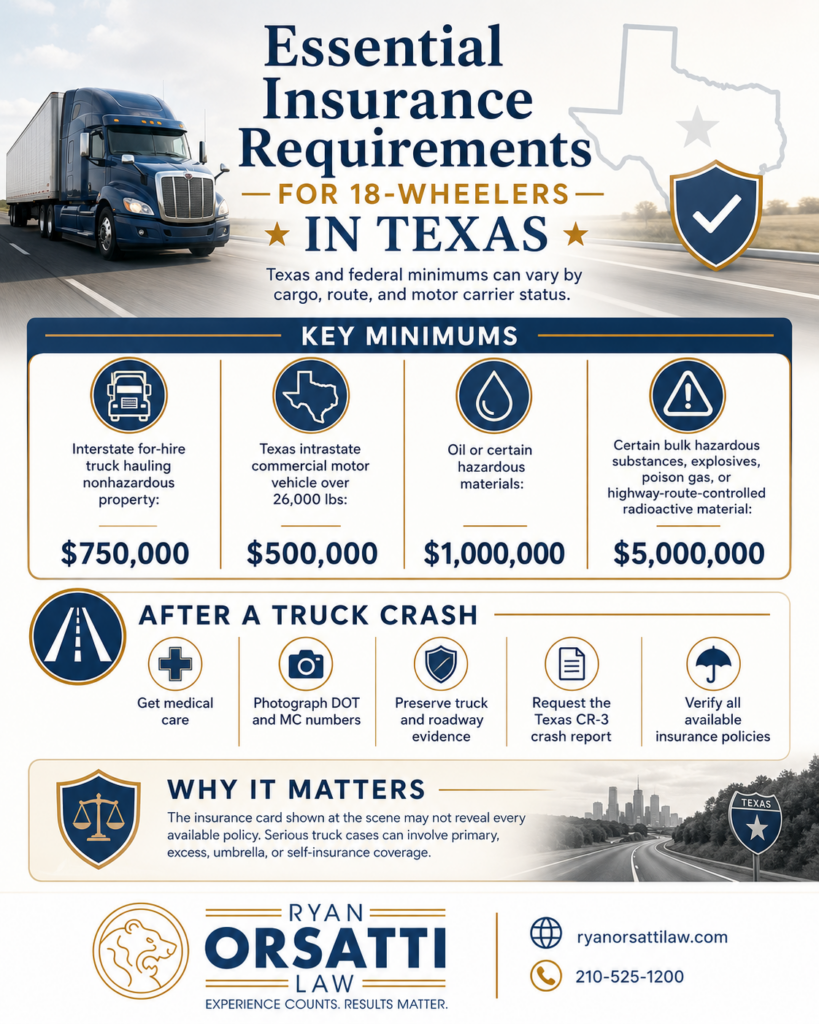
What are the essential insurance requirements for 18-wheelers in Texas?
The essential insurance requirements for 18-wheelers in Texas are liability coverage or financial responsibility that meets either federal motor carrier rules, Texas motor carrier rules, or both. The correct minimum depends on whether the truck is operating interstate or intrastate, whether it is for-hire or private, whether it is hauling hazardous materials, and whether it is registered under Texas motor carrier rules. (eCFR)
In plain English, “public liability” means coverage for bodily injury, death, property damage, and certain environmental restoration obligations caused by the operation of a commercial motor vehicle. A “combined single limit” means one total liability limit applies per occurrence instead of separate per-person and per-accident limits.
For many injured people, the hard part is not knowing that insurance exists. The hard part is identifying the right company, the right policy, the right filing, and whether there are other coverage layers beyond the first policy.
What are the Texas and federal 18-wheeler insurance minimums?
Federal and Texas 18-wheeler insurance minimums can range from $500,000 to $5,000,000 or more, depending on the truck’s operation. Federal law sets a $750,000 minimum for many interstate for-hire property carriers with vehicles rated at 10,001 pounds or more, while Texas rules list separate minimums for intrastate commercial motor vehicles, oil, hazardous materials, farm trucks, buses, and household goods carriers. (eCFR)
| Truck or motor carrier situation | Minimum insurance or financial responsibility | Why it matters after a Texas crash |
|---|---|---|
| Interstate for-hire truck hauling nonhazardous property, GVWR 10,001 pounds or more | $750,000 | Common federal baseline for many interstate tractor-trailers |
| Texas intrastate commercial motor vehicle over 26,000 pounds | $500,000 | Common Texas baseline for many in-state commercial trucks |
| Oil or certain hazardous waste, hazardous materials, or hazardous substances | $1,000,000 | Higher-risk cargo can trigger higher required coverage |
| Certain bulk hazardous substances, explosives, poison gas, or highway-route-controlled radioactive material | $5,000,000 | High-risk cargo can trigger the highest listed minimums |
| Foreign commercial motor vehicle operating intrastate in Texas | At least the applicable 49 C.F.R. Part 387 level | Texas adopted the federal financial responsibility standard for these vehicles through July 1, 2024 |
Key takeaway: The word “18-wheeler” is not enough to determine the correct insurance requirement. Route, cargo, weight, authority, and registration status must be checked before anyone can evaluate coverage.
Does the required insurance limit pay all losses after a serious 18-wheeler crash?
The required insurance limit is a legal floor, not a guarantee that all losses will be paid. A serious Texas truck crash can involve hospital bills, surgery, lost income, future medical care, impairment, multiple injured people, and disputed liability, so the minimum policy may be only one part of the claim evaluation. TxDOT reported 14,905 serious injury crashes in Texas in 2024, with 18,218 people sustaining a serious injury, which shows why minimum limits matter in high-severity crash cases. (Texas Department of Transportation)
A trucking case may involve:
- Primary auto liability coverage
- Excess or umbrella coverage
- Self-insurance or a self-insured retention
- Trailer coverage
- Leasing or interchange agreements
- Broker, shipper, or maintenance contractor issues
- UM/UIM coverage from the injured person’s own policy
- PIP or MedPay, if available under the injured person’s policy
Subrogation means a health insurer may claim a right to be reimbursed from a settlement. A hospital lien is a legal claim a hospital may assert against part of a personal injury recovery. These issues can affect the net recovery after a truck crash, even when liability insurance exists.
What is the MCS-90 endorsement in an 18-wheeler insurance case?
The MCS-90 is a federal endorsement used in certain motor carrier insurance policies to satisfy public liability financial responsibility requirements. It is not the same thing as ordinary extra insurance, but it can become important when an insurer raises coverage defenses, vehicle scheduling issues, or policy exclusions in a federally regulated truck crash. FMCSA identifies the MCS-90 endorsement as an applicable form for for-hire and interstate motor carriers. (FMCSA)
The practical point is simple: if an 18-wheeler crash involves an interstate motor carrier, the insurance analysis should not stop with the declarations page. The full policy, endorsements, FMCSA filings, vehicle schedule, motor carrier authority, and relationship between the driver, tractor, trailer, and carrier all matter.
What insurance documents should be requested after a Texas 18-wheeler crash?
After a Texas 18-wheeler crash, the injured person should seek the full liability insurance picture, not just the card shown at the scene. The key documents may include the declarations page, full policy, endorsements, MCS-90, BMC-91 or BMC-91X filings, excess policies, umbrella policies, self-insurance documents, lease agreements, and any certificate of insurance. FMCSA’s insurance filing guidance lists BMC-91, BMC-91X, BMC-82, BMC-34, and MCS-90 forms for different carrier and filing situations. (FMCSA)
Texas rules also distinguish automobile liability insurance from cargo insurance. Cargo coverage protects certain cargo losses, not an injured driver’s bodily injury claim. For household goods carriers, Texas rules list cargo limits of $5,000 for a single shipper and $10,000 in the aggregate for multiple shippers, which is a separate issue from bodily injury liability coverage.
What should you do after an 18-wheeler crash to protect insurance evidence?
You should document the truck, identify the motor carrier, preserve evidence quickly, and avoid giving a recorded statement before you understand the claim. Trucking evidence can disappear faster than people expect, especially dashcam footage, electronic logging data, dispatch communications, and vehicle data.
- Get medical care and follow discharge instructions.
- Photograph the tractor, trailer, license plates, DOT number, MC number, company name, placards, and visible insurance documents.
- Save dashcam footage, phone photos, location history, tow records, repair estimates, and witness information.
- Request the Texas Peace Officer’s Crash Report, often called a CR-3, when available.
- Do not rely only on the insurance card shown at the scene.
- Send preservation letters for electronic logging devices, driver qualification files, dispatch records, maintenance records, ECM or EDR data, dashcam video, bills of lading, and insurance policies.
- Check your own auto policy for UM/UIM, PIP, or MedPay coverage.
- Track all medical bills, health insurance payments, liens, and out-of-pocket costs.
How can you verify 18-wheeler insurance and operating authority?
You can start verifying 18-wheeler insurance by using the truck’s USDOT number, MC number, legal name, or DBA name in FMCSA public systems. FMCSA’s Licensing and Insurance Carrier Search allows searches by USDOT number, docket number, legal name, DBA name, or state, and the SAFER Company Snapshot allows searches by DOT number, MC/MX number, or company name. (FMCSA Licensing & Insurance)
This public lookup is useful, but it is not always complete enough for an injury claim. A trucking company may use a different legal entity than the name painted on the trailer. The tractor and trailer may be owned by different entities. A driver may be an employee, statutory employee, owner-operator, or leased driver. A Texas San Antonio truck accident lawyer can help connect those facts to the correct insurance coverage requests.
What if the trucking company says it only has minimum insurance?
If the trucking company says it only has minimum insurance, that statement should be verified before claim decisions are made. The minimum policy may not be the only available coverage, and coverage can depend on the named insured, listed vehicles, endorsements, trip details, leasing agreements, excess policies, and whether the motor carrier is self-insured. Texas rules allow a motor carrier to seek self-insured status if it can show financial ability to satisfy bodily injury and property damage obligations.
Your own policy may also matter. Texas law requires UM/UIM coverage to be provided unless the named insured rejects it in writing. UM/UIM means uninsured or underinsured motorist coverage, which may apply if the responsible driver has no coverage or not enough coverage for the injury claim. (Texas Constitution and Statutes)
Attorney Insight: In serious truck cases, the first insurance number you see is often not the whole coverage picture. Adjusters may focus on the primary policy, but a plaintiff-side investigation should also look for excess coverage, self-insured retention documents, MCS-90 issues, trailer ownership, leasing paperwork, and whether other companies controlled the load, route, maintenance, or driver schedule.
How do Texas fault rules affect an 18-wheeler insurance claim?
Texas fault rules affect an 18-wheeler insurance claim because the insurer may try to reduce or deny payment by assigning fault to the injured person or another party. Texas proportionate responsibility means a claimant’s recovery can be reduced by the claimant’s percentage of fault, and Texas law bars recovery if the claimant’s percentage of responsibility is greater than 50 percent. (Texas Constitution and Statutes)
That is why evidence preservation matters. Trucking insurers often evaluate speed, lane position, following distance, brake application, visibility, driver logs, phone use, maintenance, load securement, and whether the injured driver could have avoided the collision. In San Antonio, crashes on I-10, I-35, Loop 410, Loop 1604, US-281, and heavy commercial corridors often require quick collection of physical, electronic, and witness evidence.
How long do you have to file an 18-wheeler accident lawsuit in Texas?
In most Texas personal injury cases, you generally have two years from the date the cause of action accrues to file suit. For wrongful death, Texas Civil Practice and Remedies Code § 16.003 states that suit must be brought not later than two years after the day the cause of action accrues, and the wrongful death cause of action accrues on the death of the injured person. (Texas Constitution and Statutes)
Insurance negotiations do not automatically extend the lawsuit deadline. A claims adjuster can keep discussing coverage, liability, or medical bills while the filing deadline continues to run. Claims involving governmental entities, minors, out-of-state defendants, bankruptcy, or other unusual facts may need separate deadline analysis.
When should you talk to Ryan Orsatti Law about 18-wheeler insurance after a crash?
You should talk to Ryan Orsatti Law about 18-wheeler insurance after a crash if there are serious injuries, disputed fault, multiple vehicles, a commercial carrier, a quick settlement offer, a recorded statement request, missing insurance information, or uncertainty about who owned or controlled the truck. The earlier the insurance and evidence issues are identified, the easier it is to request the right records before they are lost or overwritten.
Ryan Orsatti Law helps injured people in San Antonio, Bexar County, and across Texas evaluate truck insurance, liability, medical bill issues, coverage disputes, and evidence preservation after serious 18-wheeler and commercial vehicle crashes. You can learn more through the firm’s San Antonio commercial vehicle accident lawyer page, read more about Ryan Orsatti Law, or contact Ryan Orsatti Law to discuss the facts of a specific crash.
FAQ
What is the minimum insurance for an 18-wheeler hauling regular freight in Texas?
For many interstate for-hire 18-wheelers hauling nonhazardous property with a gross vehicle weight rating of 10,001 pounds or more, the federal minimum public liability requirement is $750,000. Texas intrastate rules may use a different minimum, including $500,000 for certain commercial motor vehicles over 26,000 pounds. The exact answer depends on route, cargo, and carrier status. (eCFR)
Does Texas require more insurance for hazardous-materials 18-wheelers?
Yes. Both federal and Texas rules can require higher limits for oil, hazardous waste, hazardous materials, hazardous substances, explosives, poison gas, certain bulk materials, and highway-route-controlled radioactive materials. Depending on the cargo and vehicle, the required limit may be $1,000,000 or $5,000,000. The bill of lading, placards, cargo records, and carrier filings should be checked after a crash. (eCFR)
Can I use the trucking company’s cargo insurance for my injuries?
Usually, no. Cargo insurance generally addresses loss or damage to cargo, not bodily injury claims by people hurt in a crash. Texas rules list separate household goods cargo limits, while the liability coverage requirement addresses bodily injury, death, and property damage excluding cargo. After an 18-wheeler crash, the focus should be liability insurance, endorsements, excess coverage, and other responsible parties.
How do I find out what insurance an 18-wheeler company has?
Start with the USDOT number, MC number, legal name, DBA name, and license plate information from the truck, trailer, crash report, or photos. FMCSA’s public Licensing and Insurance Carrier Search and SAFER Company Snapshot can help identify carrier authority and filing information. For an injury claim, those public searches should be supplemented with formal requests for policies, endorsements, and coverage documents. (FMCSA Licensing & Insurance)
What if the 18-wheeler’s insurance is not enough for my injuries?
If the first insurance policy is not enough, the next step is to investigate additional coverage and responsible parties. That may include excess or umbrella policies, self-insurance, broker or shipper involvement, negligent maintenance, trailer ownership, leasing agreements, and your own UM/UIM coverage. Texas UM/UIM coverage must be provided unless rejected in writing, so your own policy should be reviewed. (Texas Constitution and Statutes)
How long do I have to file an 18-wheeler accident lawsuit in Texas?
In most Texas personal injury cases, the lawsuit deadline is two years from the date the claim accrues. For wrongful death, the two-year deadline generally runs from the date of death. Insurance discussions, adjuster delays, and ongoing medical treatment do not automatically pause the filing deadline. Some cases have special notice or deadline issues, so facts matter. (Texas Constitution and Statutes)
Ryan Orsatti Law
4634 De Zavala Rd, San Antonio, TX 78249
Phone: 210-525-1200
ryanorsattilaw.com
This blog is for informational purposes only, not legal advice. Reading it does not create an attorney-client relationship. Past results do not guarantee future results.
Hurt in an accident in San Antonio? Learn how a San Antonio car accident lawyer can help with your claim. Call 210-525-1200 or request a free consultation.
The firm works on a contingency fee. You pay nothing unless the firm recovers money for you, and that covers case expenses as well as the fee: if there is no recovery, you owe no attorney's fee and no case expenses. Ask for the fee agreement and read the fee and expense section before you sign anything.
Related San Antonio legal resources
Primary legal and public-data sources
Ryan Orsatti Law
4634 De Zavala Road, San Antonio, TX 78249
General reference links. Consult each source for its current text.