
Quick Answer
Texas motorcycle helmet laws allow some riders age 21 or older to ride without a helmet if they meet the statutory training or health-insurance exception, but wearing a helmet is still one of the strongest ways to protect your health and your injury claim. If you are hurt in a Texas motorcycle crash, helmet use can affect how insurance companies argue comparative responsibility, medical causation, and the value of head, face, neck, and brain-injury damages. Ryan Orsatti Law helps injured riders in San Antonio and across Texas evaluate fault, insurance coverage, medical documentation, and helmet-related claim issues after serious crashes.
Key Takeaways
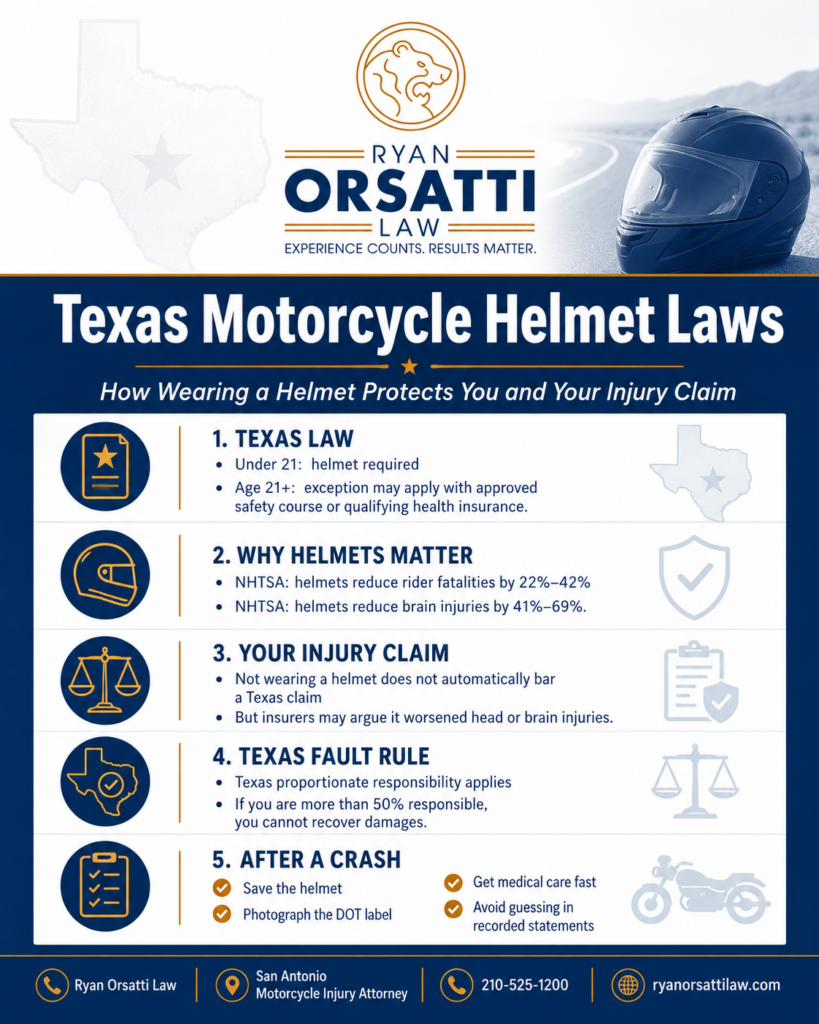
- Texas generally requires motorcycle operators and passengers to wear protective headgear, but riders age 21 or older may qualify for an exception if they completed approved motorcycle safety training or have qualifying health insurance.
- Wearing a DOT-compliant helmet can reduce the risk of death and brain injury, and it can also reduce the insurance company’s ability to blame you for head-injury damages.
- Not wearing a helmet does not automatically defeat a Texas motorcycle injury claim, but it can create a comparative-responsibility fight if the injury involves the head, face, neck, or brain.
- Save the helmet, take photos of the DOT label, preserve the motorcycle, and get medical care quickly after a crash.
- Do not guess in a recorded statement about helmet type, fit, speed, impact angle, or medical symptoms.
- Serious motorcycle crashes in San Antonio, Bexar County, and nearby counties should be evaluated early, especially when there are disputed fault facts, traumatic brain injury symptoms, UM/UIM issues, or missing evidence.
What are the Texas motorcycle helmet laws in 2026?
Texas motorcycle helmet law starts with a general rule: motorcycle operators and passengers must wear protective headgear on a public street or highway. Under Texas Transportation Code § 661.003, a rider age 21 or older may qualify for an exception if the rider completed an approved motorcycle safety course or has qualifying health insurance coverage for motorcycle-crash injuries. (Texas Statutes)
Texas law treats helmet compliance and injury-claim strategy as two different issues. A rider may be legally allowed to ride without a helmet, but an insurance company can still argue that helmet nonuse made a head injury worse. That is why the safer claim position is usually clear: wear a DOT-compliant helmet, keep proof of the helmet, and document the crash facts early.
| Texas rider situation | Is a helmet required? | What to save after a crash |
|---|---|---|
| Rider or passenger under 21 | Yes | Helmet photos, crash report, medical records, witness names |
| Rider age 21 or older with approved motorcycle safety training | May qualify for exception | Course certificate, license information, helmet photos if worn |
| Rider age 21 or older with qualifying health insurance | May qualify for exception | Health-plan proof showing motorcycle-injury medical benefits |
| Passenger | Same helmet-law analysis applies | Passenger age, helmet proof, medical records, insurance documents |
| Rider wearing a helmet | Stronger safety and evidence position | Helmet, DOT label, receipt, photos, impact damage |
Key takeaway: Even when Texas law may allow an adult rider to ride without a helmet, wearing and preserving a compliant helmet can help protect both the rider’s body and the rider’s injury claim.
Can police stop a rider just to check helmet-law training or insurance?
Texas law says a peace officer may not stop or detain a motorcycle operator or passenger solely to determine whether the rider completed a safety course or has qualifying health-insurance coverage. Texas law separately allows an officer to stop and detain a motorcycle operator or passenger to inspect protective headgear for compliance with helmet safety standards. (Texas Statutes)
That distinction matters after a crash because legality is only one part of the claim. The insurance adjuster may still ask whether you wore a helmet, whether it was DOT-compliant, whether the chin strap was fastened, and whether the helmet was damaged in the impact.
Does PIP or MedPay satisfy the Texas helmet-law insurance exception?
PIP and MedPay are not the same thing as qualifying health insurance for the Texas helmet-law exception. The Texas Department of Insurance has stated that personal injury protection and medical payments coverage are not “health insurance plans” for this purpose, and a health plan may issue “MOTORCYCLE HEALTH” proof showing medical benefits for motorcycle-related injuries.
PIP means personal injury protection coverage under an auto policy. MedPay means medical payments coverage. Those coverages can still help pay certain medical bills after a crash, but they should not be treated as automatic proof that a rider qualifies for the helmet-law health-insurance exception.
How does wearing a helmet protect your safety after a Texas motorcycle crash?
Wearing a compliant motorcycle helmet protects riders by reducing the risk of death and brain injury in a crash. NHTSA reports that helmets reduce motorcycle rider fatalities by 22 to 42 percent and brain injuries by 41 to 69 percent, depending on the study and crash population. (NHTSA)
The Texas numbers show why this matters. TxDOT reported that in 2025, 557 motorcyclists were killed and 2,468 were seriously injured on Texas roads, and more than half of fatal motorcycle crashes involved collisions with other vehicles. TxDOT also reported that 37 percent of motorcycle fatalities happened at intersections. (TxDOT)
In San Antonio, that risk is not abstract. Riders on Loop 1604, I-10, I-35, Loop 410, US-281, and busy frontage roads often deal with sudden lane changes, left-turn conflicts, distracted drivers, and drivers who misjudge motorcycle speed and distance. A helmet cannot prevent every injury, but it can be powerful evidence that the rider took safety seriously.
Can not wearing a helmet hurt your Texas motorcycle injury claim?
Not wearing a helmet can hurt a Texas motorcycle injury claim if the insurance company can connect helmet nonuse to the injuries being claimed. It does not automatically end the case, but it can become part of a Texas comparative-responsibility argument, especially when the claimed injuries involve traumatic brain injury, skull fracture, facial trauma, dental injury, or neck trauma.
Comparative responsibility means Texas can reduce a claimant’s recovery by the claimant’s percentage of fault. Under Texas Civil Practice and Remedies Code Chapter 33, a claimant may not recover damages if the claimant’s percentage of responsibility is greater than 50 percent. (Texas Statutes)
The key fight is usually causation. Causation means whether a fact actually caused or worsened an injury. If a driver ran a red light and hit a rider, the driver may still be primarily at fault for causing the crash. But if the rider was not wearing a helmet and suffered a head injury, the defense may argue the rider made the head injury worse.
What if my injuries were not head injuries?
Helmet nonuse should matter less when the injuries are unrelated to the head, face, neck, or brain. If the rider suffered a broken leg, shoulder injury, road rash, torn ligament, or spinal injury with no plausible helmet connection, a helmet argument may be weaker.
That does not mean the insurance company will ignore it. Adjusters often use any fact they think may reduce the claim. A careful response separates crash fault from injury causation, then ties the medical records to the actual body parts injured.
What if I was wearing a helmet and still had a concussion?
A helmet does not eliminate the risk of concussion or traumatic brain injury. A helmet can reduce the severity of certain injuries, but the brain can still move inside the skull during a violent impact, sudden stop, or ejection.
If you had symptoms such as headache, dizziness, nausea, confusion, memory gaps, light sensitivity, sleep changes, or mood changes, report them to your doctor as soon as possible. Ryan Orsatti Law handles motorcycle crash cases involving head-injury allegations and can help injured riders evaluate whether medical documentation supports a Texas traumatic brain injury claim.
Attorney Insight: Insurance adjusters often focus on helmet facts early because they know jurors may have strong opinions about motorcycle safety. The best response is evidence, not argument. Preserve the helmet, photograph the DOT label, document symptoms quickly, and avoid guessing about speed, impact angle, or whether the helmet “prevented” an injury.
What kind of helmet best protects your body and your injury claim?
A DOT-compliant motorcycle helmet best protects your body and your claim because it is designed to meet federal helmet-safety standards. NHTSA explains that compliant helmets should have a DOT symbol on the outside back of the helmet and a certification label referencing FMVSS No. 218. (NHTSA)
A novelty helmet is a problem for both safety and claims. NHTSA warns that novelty helmets do not meet federal safety standards and should not be worn. If a rider suffers head trauma while wearing a novelty helmet, the insurance company may argue the helmet was essentially the same as not wearing a compliant helmet.
When buying or saving helmet evidence, look for:
- A DOT symbol on the outside back of the helmet.
- A manufacturer or brand label.
- A model designation.
- A label stating “DOT.”
- A reference to FMVSS No. 218.
- A certification label.
If the crash already happened, do not throw away a damaged helmet just because it looks ruined. Helmet cracks, scrapes, strap damage, visor damage, and impact marks may help show the force and direction of the crash.
What evidence should you save if you wore a helmet in a motorcycle crash?
You should save the helmet, photograph it, preserve the motorcycle, document your injuries, and avoid giving away physical evidence before the claim is evaluated. The helmet may prove that you used safety gear, show impact direction, support a traumatic brain injury claim, or rebut an adjuster’s claim that you were careless.
Follow this checklist after a Texas motorcycle crash:
- Photograph the helmet from every side. Include the front, back, left side, right side, visor, chin strap, interior padding, and any damaged areas.
- Photograph the DOT and certification labels. Make sure the photos are clear enough to read the label.
- Save the helmet exactly as it is. Do not clean it, repair it, repaint it, or keep wearing it.
- Preserve riding gear. Save the jacket, gloves, boots, pants, backpack, eyewear, and any torn or bloodied clothing.
- Take photos of the motorcycle before repair or disposal. Include crush damage, scrape marks, tire marks, lighting, brake components, and handlebar position.
- Get medical care and report all symptoms. Do not minimize headaches, dizziness, vision changes, confusion, nausea, neck pain, or memory problems.
- Avoid recorded statements until you understand the issues. Do not guess about speed, distance, helmet fit, or whether the helmet was buckled.
- Talk with a Texas motorcycle injury lawyer early if the injuries are serious. Early review can help preserve video, witness statements, insurance information, and damaged evidence.
For a broader crash-response checklist, see Ryan Orsatti Law’s guide on what to do immediately after a motorcycle accident in San Antonio.
How do insurance companies use helmet facts after a Texas motorcycle crash?
Insurance companies use helmet facts to argue about damages, credibility, and sometimes comparative responsibility. They may ask whether the rider wore a helmet, what kind it was, whether it was DOT-compliant, whether the strap was fastened, where the helmet is now, and whether the claimed injuries match the crash mechanics.
The most common defense argument is not always “the rider caused the crash.” It is often “the rider made the injury worse.” That difference matters. A careless driver may have caused the collision, but the insurance company may still try to reduce head-injury damages by blaming helmet nonuse.
This is also where medical documentation becomes critical. Emergency room notes, imaging, neurology visits, therapy records, dental records, concussion evaluations, and primary-care follow-ups can either support or weaken a helmet-related claim. Gaps in care give adjusters more room to argue that symptoms were minor, unrelated, delayed, or caused by something else.
How long do you have to file a Texas motorcycle accident lawsuit?
In most Texas personal injury cases, the lawsuit deadline is two years from the date the injury claim accrues. Texas Civil Practice and Remedies Code § 16.003 provides the general two-year limitations period for personal-injury claims. (Texas Statutes)
Do not wait two years to investigate a motorcycle crash. Helmet evidence can disappear, motorcycles can be repaired or salvaged, nearby video can be overwritten, witnesses can move, and medical documentation can become harder to connect to the crash. If the defendant is a government employee, city vehicle, county vehicle, school district, or other public entity, additional notice rules may apply much earlier.
When should you contact a Texas motorcycle injury lawyer?
You should contact a Texas motorcycle injury lawyer early if the crash caused serious injuries, involved a disputed helmet issue, included head or brain symptoms, or if the insurance company is blaming you. Early legal review is especially important in crashes involving commercial vehicles, hit-and-run drivers, uninsured motorists, rideshare drivers, dangerous road conditions, or missing video evidence.
Ryan Orsatti Law helps injured motorcyclists in San Antonio, Bexar County, and across Texas evaluate liability, insurance coverage, medical bills, subrogation, and evidence preservation. Subrogation means a health insurer may claim a right to be paid back from a settlement. A hospital lien is a legal claim a hospital may assert against part of a personal injury recovery.
A lawyer’s role is not just to argue about fault. In a helmet-related claim, a lawyer may need to:
- Preserve the helmet, motorcycle, and gear.
- Request crash reports and insurance information.
- Locate witnesses and nearby video.
- Evaluate DOT helmet evidence.
- Analyze medical causation.
- Respond to comparative-responsibility arguments.
- Review PIP, MedPay, liability, UM, and UIM coverage.
- Address hospital liens, health-insurance reimbursement claims, and treatment documentation.
For more on representation after a rider crash, visit Ryan Orsatti Law’s San Antonio motorcycle accident lawyer page or the firm’s guide on whether to get a lawyer for a motorcycle accident.
What should San Antonio riders do after a helmet-related motorcycle crash?
San Antonio riders should get medical care, preserve the helmet and motorcycle, document the scene, avoid guessing in insurance calls, and evaluate the claim before key evidence disappears. This is especially true on high-speed corridors like I-10, I-35, Loop 410, Loop 1604, US-281, and busy intersections where TxDOT says motorcycle fatalities frequently occur statewide. (TxDOT)
A practical first week should look like this:
| Time period | What to do | Why it matters |
|---|---|---|
| Same day | Get medical care and report all symptoms | Creates a medical record tied to the crash |
| Same day | Photograph helmet, gear, motorcycle, roadway, and injuries | Preserves physical evidence before repairs or disposal |
| 1 to 3 days | Identify witnesses and nearby video sources | Video and witness memory may disappear quickly |
| 1 to 7 days | Notify insurers, but avoid guessing in recorded statements | Protects accuracy and avoids speculative answers |
| First week | Review coverage, liens, and fault issues | Helps identify liability, PIP, MedPay, UM, UIM, and reimbursement issues |
Key takeaway: The first week after a motorcycle crash can shape the entire claim, especially when helmet use, head injury, fault, or insurance coverage is disputed.
Ryan Orsatti Law evaluates motorcycle crash claims involving San Antonio, Bexar County, Comal County, Guadalupe County, Kendall County, Wilson County, Atascosa County, and Medina County. The firm can review the crash facts, medical records, insurance coverages, and evidence-preservation issues before an injured rider makes decisions that may affect the claim.
FAQ
Is a motorcycle helmet required for all riders in Texas?
Texas generally requires motorcycle operators and passengers to wear protective headgear, but riders age 21 or older may qualify for an exception if they completed approved motorcycle safety training or have qualifying health insurance. Riders under 21 should treat helmet use as required. Even when an adult exception applies, wearing a DOT-compliant helmet remains the safer medical and claim decision. (Texas Statutes)
Can I still bring an injury claim if I was not wearing a helmet in Texas?
Yes, not wearing a helmet does not automatically prevent a Texas motorcycle injury claim. The bigger issue is whether helmet nonuse caused or worsened the specific injuries being claimed. If the case involves head, face, neck, or brain trauma, expect the insurance company to raise comparative-responsibility and medical-causation arguments under Texas law. (Texas Statutes)
Does PIP or MedPay satisfy the Texas motorcycle helmet-law health-insurance exception?
No, PIP and MedPay are not treated as health insurance plans for the Texas motorcycle helmet-law health-insurance exception. The Texas Department of Insurance has stated that those coverages do not qualify for that purpose. PIP and MedPay may still help pay certain medical expenses after a crash, but they are separate from the helmet-law exception.
What kind of motorcycle helmet should I wear in Texas?
You should wear a DOT-compliant motorcycle helmet that meets FMVSS No. 218. NHTSA says compliant helmets should have a DOT symbol on the outside back and a certification label. Avoid novelty helmets because they do not meet federal safety standards and can create safety and claim problems if a head injury is involved. (NHTSA)
Should I give my damaged helmet to the insurance adjuster?
Do not give your damaged helmet to an insurance adjuster without first understanding how it may be used. The helmet is physical evidence. Photograph it, save it, and keep it in a safe place. If the claim involves head injury, facial trauma, or disputed safety facts, the helmet may need to be inspected, documented, and preserved.
How long do I have to file a Texas motorcycle accident lawsuit?
Most Texas motorcycle injury lawsuits are subject to a two-year limitations period under Texas Civil Practice and Remedies Code § 16.003. Some cases can involve shorter notice issues, especially if a government entity may be responsible. Do not wait until the deadline is close because helmet evidence, video, witnesses, and medical documentation can become harder to preserve. (Texas Statutes)
Where can I find an approved Texas motorcycle safety course?
The Texas Department of Licensing and Regulation provides information about motorcycle and ATV operator safety programs and a tool for finding approved motorcycle safety training schools. If you are relying on training for the Texas helmet-law exception, save your course documentation and keep it with your riding records. (Texas DLR)
When should I call Ryan Orsatti Law after a motorcycle crash?
Call Ryan Orsatti Law after a motorcycle crash if you have serious injuries, head-injury symptoms, disputed fault, missing evidence, a damaged helmet, or an insurance company blaming you. The firm can evaluate fault, coverage, medical documentation, helmet evidence, and next steps for injured riders in San Antonio and across Texas. You can reach the firm through the Ryan Orsatti Law contact page.
Ryan Orsatti Law
4634 De Zavala Rd, San Antonio, TX 78249
Phone: 210-525-1200
ryanorsattilaw.com
This blog is for informational purposes only, not legal advice. Reading it does not create an attorney-client relationship. Past results do not guarantee future results.
Hurt in an accident in San Antonio? Learn how a San Antonio traumatic brain injury lawyer can help with your claim. Call 210-525-1200 or request a free consultation.
The firm works on a contingency fee. You pay nothing unless the firm recovers money for you, and that covers case expenses as well as the fee: if there is no recovery, you owe no attorney's fee and no case expenses. Ask for the fee agreement and read the fee and expense section before you sign anything.
Related San Antonio legal resources
- San Antonio motorcycle-accident representation
- Texas personal-injury services
- Contact Ryan Orsatti Law
Primary legal and public-data sources
- Texas Transportation Code Chapter 661: motorcycle protective headgear
- Texas Civil Practice and Remedies Code Chapter 33: proportionate responsibility
Ryan Orsatti Law
4634 De Zavala Road, San Antonio, TX 78249
General reference links. Consult each source for its current text.