
Quick Answer
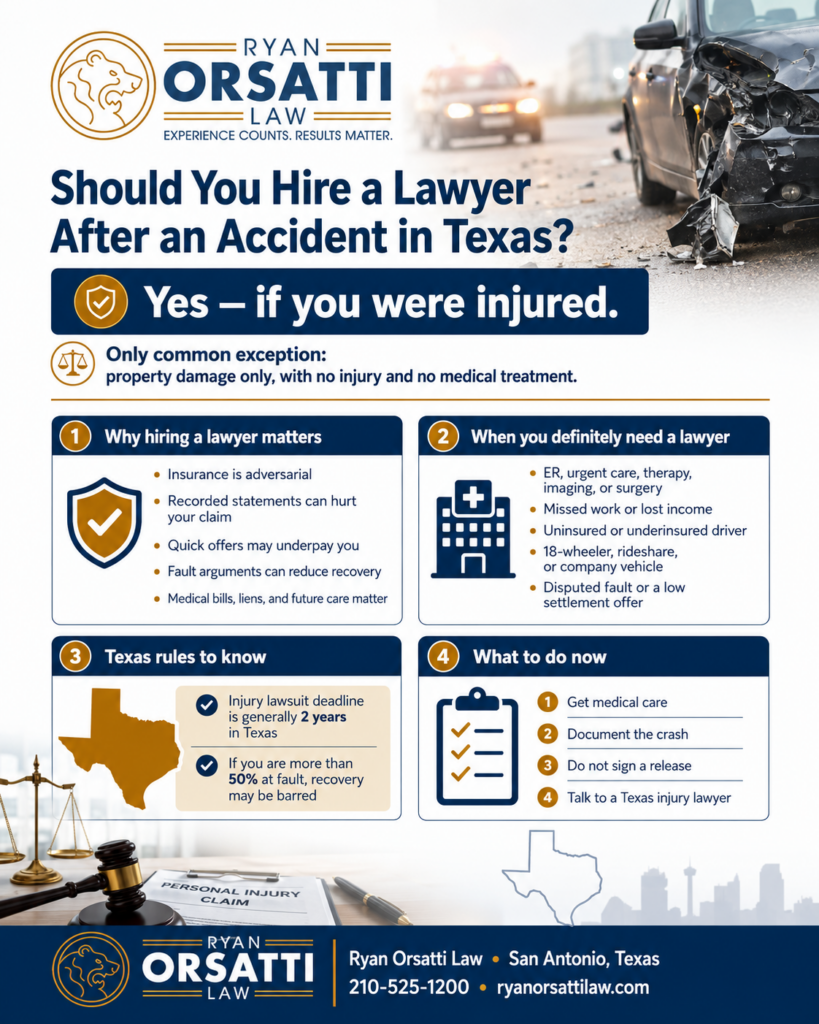
Yes. If you were injured or received medical treatment after an accident in Texas, you should hire a lawyer because the claim process is adversarial, the insurance company is not on your side, and an early mistake can reduce your claim without you ever knowing it. The only common situation where you may not need an attorney is a property-damage-only crash with no injury, no medical treatment, no missed work, and no dispute about vehicle repairs or total-loss value.
Texas generally gives injured people two years to file a personal injury lawsuit, but insurance companies start building their file immediately. TxDOT reported 251,977 people injured in Texas motor vehicle crashes in 2024, including 18,218 people with serious injuries, which shows why injury claims should be treated as more than paperwork. (Texas Statutes) Ryan Orsatti Law helps injured people in San Antonio and across Texas deal with fault, insurance coverage, medical documentation, liens, and settlement timing before rights are affected.
Key Takeaways
- If you were hurt, treated, or may need treatment, the safer answer is yes, hire a Texas personal injury lawyer.
- The at-fault insurance company does not represent you, does not give you legal advice, and has a financial incentive to pay less than the full value you may be able to prove.
- You usually do not need an attorney only when the claim is limited to vehicle property damage and there is no injury or medical treatment.
- Insurance companies may use recorded statements, broad medical authorizations, treatment gaps, prior medical history, low early offers, and fault arguments to reduce what they pay.
- Texas fault law matters. If you are found more than 50% responsible, you may recover nothing, and any smaller fault percentage can reduce your recovery. (Texas Statutes)
- Do not sign a bodily-injury release until you understand your diagnosis, future treatment, all available insurance, liens, and subrogation.
Should you hire a lawyer after an accident in Texas?
Yes, if the accident caused any injury, symptoms, medical treatment, missed work, or uncertainty about your health, you should hire a lawyer after a Texas accident. The insurance claim process is not a neutral customer-service process. It is an adversarial system where each side protects its own financial and legal position.
That point matters because the at-fault driver’s insurance company does not owe you loyalty. Its adjuster may sound helpful, but the adjuster’s job is to investigate the claim, apply the policy, document defenses, and resolve the claim for an amount the company can justify. That may be much less than the full amount you could prove with proper medical records, liability evidence, wage documentation, lien analysis, and legal pressure.
In a Texas injury claim, the question is not only, “Who caused the wreck?” The real questions are: Can fault be proved? Can the injuries be connected to the crash? What insurance applies? Are there coverage limits? Are there liens? Are there future medical needs? Did the injured person say or sign something that gave the insurer a defense?
If the crash happened in San Antonio, Bexar County, Comal County, Guadalupe County, Kendall County, Wilson County, Atascosa County, or Medina County, the same basic rule applies. If you were hurt, get legal advice early. Ryan Orsatti Law’s San Antonio car accident lawyer page explains how vehicle injury claims are evaluated.
Why is the insurance claim process adversarial?
The insurance claim process is adversarial because the injured person is trying to prove losses, while the insurance company is looking for reasons to limit, reduce, delay, or deny payment. That does not mean every adjuster acts illegally. It means the insurer’s financial interest is different from yours.
Adversarial means each side has its own goal. Your goal is to be fully and fairly compensated for injuries, medical bills, lost income, pain, impairment, future care, and the disruption the crash caused. The insurance company’s goal is to close the claim for the lowest amount it can defend under its file, policy, and evaluation system.
This is why hiring a lawyer is usually necessary when there is an injury. Without a lawyer, you may not know what evidence is missing, what coverage exists, what your medical records actually say, whether your bills are being attacked, whether your future treatment was included, or whether the release you signed ended rights you did not understand.
Texas law recognizes that insurance claim handling can create serious disputes. For example, Texas Insurance Code § 541.060 identifies certain unfair settlement practices in claims by insureds or beneficiaries, including misrepresenting material facts or policy provisions and failing to attempt in good faith to make a prompt, fair, and equitable settlement when liability is reasonably clear. (Texas.Public.Law) For third-party claims against the at-fault driver’s insurer, the legal remedies are different, but the practical risk is the same: the insurer is not your advocate.
When do you not need an attorney after a Texas accident?
You usually do not need an attorney only when there is no injury, no medical treatment, no missed work, and the claim is strictly property damage to a vehicle. If the only issue is repairing or replacing the car, and fault and valuation are clear, many people can handle that part directly with insurance.
That exception should stay narrow. You should not call a case “property damage only” if you had pain, stiffness, headaches, dizziness, numbness, anxiety while driving, sleep problems, a doctor visit, an ER visit, urgent care, chiropractic treatment, physical therapy, imaging, injections, or missed work. Once medical treatment enters the picture, the claim is no longer only about the car.
A property-damage-only claim may still require careful documentation. TDI explains that insurers may pay only actual cash value on a totaled vehicle and that you should be prepared to negotiate if you believe the amount is too low. (Texas Department of Insurance) But a vehicle-value dispute is different from a bodily-injury claim. The risk is much higher when a release could cut off medical, wage, and pain-and-suffering damages.
| Situation | Do you likely need a lawyer? | Why |
|---|---|---|
| No injury, no treatment, car repair only | Usually no | The claim is limited to property damage |
| Soreness, headaches, or delayed symptoms | Yes | Insurers often dispute causation and treatment timing |
| ER, urgent care, imaging, therapy, injections, or surgery | Yes | Medical proof and damages must be built correctly |
| Missed work or reduced earning ability | Yes | Wage loss needs documentation and legal framing |
| Fault dispute or police report problem | Yes | Texas fault percentages can reduce or bar recovery |
| Low early settlement offer | Yes | The offer may exclude future care, liens, or full damages |
| UM/UIM, PIP, MedPay, or hit-and-run issue | Yes | Your own policy language may control recovery |
| Commercial vehicle, rideshare, delivery, or 18-wheeler | Yes | Evidence and insurance layers can disappear quickly |
Key takeaway: If there is any injury or medical treatment, treat the claim as adversarial and get a lawyer involved before the insurance company frames the case for you.
What do insurance companies do that can hurt your injury claim?
Insurance companies may use legal claim tactics that reduce the value of an injury claim, even when the injured person never realizes it happened. Common tactics include quick calls, recorded statements, broad medical authorizations, low early offers, delay, fault shifting, treatment-gap arguments, prior-condition arguments, and releases signed before the medical picture is complete.
These tactics are not always illegal. Many are routine claim-handling methods. The problem is that an unrepresented injured person may not understand how a casual answer, missing document, or early signature can become the reason the insurer later pays less.
| Insurance tactic | Why it can hurt you | How a lawyer helps |
|---|---|---|
| Friendly early phone call | The adjuster may document statements about pain, speed, fault, work, or prior injuries | Limits communication to accurate, necessary facts |
| Recorded statement | Small wording mistakes can be used to dispute fault or injury causation | Prepares you or blocks unnecessary statements |
| Broad medical authorization | The insurer may search unrelated medical history for blame-shifting material | Narrows record requests to relevant treatment |
| Fast settlement offer | The offer may come before diagnosis, future care, or lien amounts are known | Waits for a medically supported demand package |
| “Minor damage” argument | The insurer may argue low vehicle damage means no injury | Uses medical proof, mechanism, and symptoms to respond |
| Treatment-gap argument | Delayed treatment can be used to claim you were not really hurt | Documents why the delay happened and what records show |
| Prior condition argument | Old back, neck, or head issues may be used to deny new injury or aggravation | Separates prior history from crash-related aggravation |
| Comparative fault argument | The insurer may assign you a percentage of blame | Preserves scene, witness, video, and crash-report evidence |
| Policy-limit silence | You may not know whether coverage is too low or whether more coverage exists | Investigates all available insurance layers |
| Release pressure | A signed release can end the claim permanently | Reviews settlement terms before rights are waived |
Key takeaway: Insurance companies reduce claim exposure by controlling the file, and a lawyer helps make sure the file includes the evidence that supports the injured person’s side.
Why are recorded statements risky after a Texas accident?
Recorded statements are risky because insurance companies may use your own words to dispute fault, injuries, treatment timing, and credibility. Even an honest person can hurt a valid claim by guessing, minimizing symptoms, forgetting details, or answering questions before the medical facts are known.
A common example is the injured person who says “I’m okay” because they are embarrassed, polite, or still full of adrenaline. A few days later, the neck pain, back pain, headaches, dizziness, or numbness gets worse. The insurer may then compare the later medical records to the early statement and argue the injury was exaggerated, delayed, or unrelated.
You should be especially careful with questions like:
- “How fast were you going?”
- “Did you see the other car before impact?”
- “Could you have done anything to avoid the crash?”
- “Are you injured?”
- “Have you ever had neck or back pain before?”
- “Did you miss any work?”
- “Are you feeling better now?”
- “Can we record this just to move the claim along?”
If you are injured, talk to a lawyer before giving a recorded statement to the at-fault insurance company. Ryan Orsatti Law has a related guide on the insurance adjuster’s friendly phone call.
Why are quick settlement offers dangerous?
Quick settlement offers are dangerous because they often come before the injured person knows the diagnosis, treatment plan, future care needs, lost income, liens, and full insurance picture. Once a bodily-injury release is signed, the claim is usually over, even if symptoms get worse later.
TDI’s auto insurance guide explains that when another driver causes an accident, that driver’s insurance company may offer a settlement for accident-related medical bills and ask for a release promising no more claims. TDI also tells consumers to talk to their doctor about future medical treatment before deciding whether the offer is fair. (Texas Department of Insurance)
That warning is important. A quick offer may look helpful when bills are arriving, your car is damaged, and you are missing work. But the offer may not include future injections, MRI findings, therapy, surgery risk, wage loss, impairment, pain, loss of enjoyment, health insurance reimbursement, or a hospital lien.
A hospital lien is a legal claim a hospital may assert against part of a personal injury recovery. Subrogation means a health insurer or benefit plan may claim a right to be paid back from a settlement. These issues affect the amount the client actually keeps, not just the gross settlement number.
Attorney Insight: The biggest insurance-company advantage is information imbalance. The adjuster knows the claim process, the policy language, the release language, the company’s evaluation range, and the common defenses. The injured person often knows only that they are hurt and bills are piling up. A lawyer’s first job is to close that gap before the insurer turns uncertainty into a discount.
How do insurance companies use “minor damage” against injured people?
Insurance companies often use minor vehicle damage to argue that the crash could not have caused a real injury. That argument can be misleading because the legal issue is not whether the bumper looks dramatic. The issue is whether the collision caused or aggravated a medical condition that can be proven with records.
Low property damage is one data point. It is not a medical diagnosis. People can experience neck injuries, back injuries, concussions, shoulder injuries, knee injuries, and aggravation of prior conditions in crashes that do not look severe in photos.
In San Antonio crashes on Loop 410, Loop 1604, I-10, I-35, Bandera Road, Culebra Road, Blanco Road, and US-281, insurers may compare vehicle photos against the medical bills and argue the treatment is too much. A lawyer can respond with medical records, symptom timing, mechanism of injury, prior-record analysis, treating-provider opinions, and evidence showing why the injury claim is legitimate.
For more on cases that look simple but are not, see Ryan Orsatti Law’s guide on signs a simple car accident case is more complicated than it seems.
How do insurance companies use treatment gaps and prior medical history?
Insurance companies use treatment gaps and prior medical history to argue that the accident did not cause the injury, the injury healed quickly, or the medical care was unrelated. This is one of the most common ways an injury claim gets underpaid.
A treatment gap means there is a delay between the crash and medical care, or a delay between treatment visits. Sometimes the gap has a reasonable explanation. The injured person may have hoped pain would go away, lacked health insurance, had transportation problems, could not miss work, or could not get an appointment quickly. But if the reason is not documented, the insurer may use the gap against the claim.
Prior medical history can also be used unfairly. If you had old neck pain, back pain, headaches, anxiety, arthritis, or a previous crash, the insurer may argue your current symptoms are not from the new accident. Texas law still allows claims for aggravation of a pre-existing condition when the evidence supports it, but the medical proof must be organized carefully.
A lawyer helps by building a clear timeline:
- What your condition was before the accident
- What changed immediately after the accident
- When symptoms were first reported
- What doctors found
- What treatment was recommended
- Whether imaging showed injury
- Whether the crash aggravated a prior condition
- Whether future care is reasonably expected
Why does Texas fault law make hiring a lawyer more important?
Texas fault law makes hiring a lawyer more important because insurance companies can reduce your claim by assigning you part of the blame. Under Texas Civil Practice & Remedies Code § 33.001, a claimant may not recover damages if the claimant’s percentage of responsibility is greater than 50%. Under § 33.012, recoverable damages are reduced by the claimant’s percentage of responsibility if the claimant is not barred. (Texas Statutes)
Comparative responsibility means Texas can compare the fault of the people and entities involved. This gives insurers a powerful tool. Even if the other driver caused the crash, the insurer may argue you were speeding, distracted, following too closely, failed to brake, changed lanes unsafely, failed to mitigate damages, or made your injuries worse by delaying care.
A 20% fault argument can substantially reduce a claim. A 51% fault argument can end it. That is why the first few days matter. Photos, video, witness names, dashcam footage, vehicle damage, the CR-3 crash report, 911 audio, and scene measurements can all matter when the insurer tries to rewrite what happened.
How can insurance coverage limits underpay a serious claim?
Insurance coverage limits can underpay a serious claim because an insurance company usually pays only up to the policy’s dollar limits, even when the injury is worth more. TDI explains that Texas requires minimum liability coverage of $30,000 per injured person, $60,000 per accident, and $25,000 for property damage, commonly called 30/60/25 coverage. TDI also warns that minimum limits may be too low in serious accidents. (Texas Department of Insurance)
That means a crash can cause $100,000 in medical bills, but the at-fault driver may carry only $30,000 in bodily-injury limits. If you do not know how to identify all available coverage, you may settle for less than the available recovery sources.
Other coverage may matter, including:
- Liability coverage
- Personal injury protection, called PIP
- Medical payments coverage, called MedPay
- Uninsured/underinsured motorist coverage, called UM/UIM
- Collision coverage
- Health insurance
- Employer or commercial auto policies
- Rideshare or delivery-app coverage
- Umbrella or excess insurance
TDI explains that PIP can pay medical bills, lost wages, and some nonmedical costs, and Texas auto policies include PIP unless rejected in writing. TDI also explains that UM/UIM can apply when the other driver has no insurance, not enough insurance, or leaves the scene. (Texas Department of Insurance) If you were hit by a driver who fled, Ryan Orsatti Law’s San Antonio hit and run lawyer page explains why UM/UIM review can be important.
Why is a lawyer necessary when your own insurance is involved?
A lawyer is often necessary when your own insurance is involved because your insurer may become adverse once you make a PIP, MedPay, UM/UIM, collision, or other first-party claim. You paid premiums, but the company may still dispute coverage, medical necessity, causation, limits, deductibles, exclusions, or the value of the loss.
This is especially common in UM/UIM claims. The other driver may be uninsured or underinsured, but your own carrier may still evaluate the claim like an adverse insurer. It may question whether the other driver was legally responsible, whether your injuries were caused by the crash, whether the medical bills are reasonable, and whether your damages exceed the at-fault driver’s limits.
Texas Insurance Code Chapter 542 sets claim-handling deadlines for insurers, including deadlines to acknowledge a claim, accept or reject a claim after receiving required information, and pay after accepting the claim. TDI summarizes these deadlines by explaining that insurers generally have 15 business days after getting the information they need to decide whether to pay, may extend by 45 days if they explain why, and must give written reasons for rejection. (Texas Department of Insurance)
A lawyer can track what was requested, what was provided, what the policy says, whether the insurer’s position makes sense, and whether additional legal action may be required.
What does a lawyer do that an injured person cannot easily do alone?
A lawyer protects the claim by investigating liability, preserving evidence, controlling insurer communications, organizing medical proof, identifying coverage, valuing damages, handling liens, and preparing the case for litigation if settlement discussions are not reasonable. The work is not just sending a demand letter.
In a Texas accident case, a lawyer may:
- Review the crash report, scene evidence, and witness accounts.
- Send preservation letters for video, dashcam, vehicle data, and company records.
- Stop unnecessary recorded statements to adverse insurers.
- Limit medical authorizations to relevant records.
- Identify liability, PIP, MedPay, UM/UIM, commercial, and excess coverage.
- Track medical treatment, diagnoses, bills, and future care opinions.
- Analyze prior medical history before the insurer uses it unfairly.
- Document lost income and work restrictions.
- Address hospital liens and health-plan reimbursement claims.
- Prepare a damages demand supported by evidence.
- Negotiate from a documented position.
- File suit when needed to protect deadlines or obtain evidence through discovery.
In commercial vehicle and 18-wheeler crashes, evidence may include driver logs, dashcam footage, electronic control module data, dispatch records, inspection records, and maintenance files. Ryan Orsatti Law’s guide on when to hire a truck accident lawyer in San Antonio explains why early preservation matters in those cases.
What should you do before the insurance company controls the claim?
You should get medical care, document the crash, preserve evidence, avoid recorded statements, and contact a lawyer before the insurance company controls the claim narrative. The first week is often when the insurer gathers facts, but it is also when your side must gather proof.
- Get medical care if you have pain, headaches, dizziness, numbness, confusion, weakness, or worsening symptoms.
- Photograph vehicle damage, the scene, road conditions, traffic controls, injuries, and anything that helps show what happened.
- Save dashcam footage immediately.
- Get witness names and phone numbers.
- Request or preserve the crash report information.
- Report the claim to your insurer, but do not guess about fault or injury severity.
- Do not give a recorded statement to the at-fault insurer before legal review.
- Do not sign a broad medical authorization.
- Do not sign a bodily-injury release.
- Keep every bill, discharge paper, work note, prescription, and insurance letter.
- Avoid posting about the crash or your activities online.
- Contact a Texas personal injury lawyer if there is any injury or treatment.
Ryan Orsatti Law’s page on how car accident settlements work explains the settlement process in more detail.
How does Ryan Orsatti Law help after an injury accident in Texas?
Ryan Orsatti Law helps injured people in San Antonio and across Texas evaluate whether the insurance company is treating the claim fairly, whether evidence is missing, and whether settlement should wait until the medical and coverage picture is complete. The firm’s role is to protect the injured person from being underpaid in a system designed around proof, leverage, and deadlines.
The firm looks at the questions that often decide injury claims:
- What evidence proves fault?
- Is the insurer trying to blame you?
- What medical treatment has occurred?
- Is more treatment expected?
- Are the medical records consistent?
- Are there prior conditions the insurer will use?
- What coverage exists?
- Are the policy limits too low?
- Is there PIP, MedPay, UM/UIM, or commercial coverage?
- Are there hospital liens or subrogation claims?
- Has an adjuster requested a recorded statement or release?
- Has the insurance company made a low early offer?
- Does the case need litigation to obtain evidence or protect the deadline?
In practical terms, hiring a lawyer is not only about filing a lawsuit. It is about preventing the insurance company from quietly building a one-sided file while you are trying to recover.
To discuss a specific accident, you can contact Ryan Orsatti Law.
FAQ
Do I need a lawyer after a Texas accident if I went to the doctor?
Yes. If you went to the doctor after a Texas accident, you should hire a lawyer because the claim now involves medical causation, billing, treatment timing, insurance coverage, and possible future care. The at-fault insurer may try to minimize the injury, blame prior conditions, or offer a release before your treatment picture is complete.
What if the insurance adjuster seems nice and says they just need my statement?
A friendly adjuster can still be gathering information for an adverse claim file. The tone of the call does not change the insurer’s financial interest. A recorded statement can be used to dispute fault, symptoms, treatment gaps, or prior injuries. If you were hurt, speak with a lawyer before giving a recorded statement to the at-fault insurer.
When is it okay not to hire a lawyer after a crash?
It is usually okay not to hire a lawyer only when there is no injury, no pain, no medical treatment, no missed work, and the claim is limited to property damage. If the insurer fairly pays to repair or replace the vehicle and no bodily-injury release is involved, many people can handle that narrow claim directly.
Why do insurance companies make quick settlement offers?
Insurance companies may make quick settlement offers to close claims before the injured person knows the full diagnosis, future treatment needs, wage loss, liens, or available insurance. A quick offer can feel helpful, but it may be far below what the evidence would support later. Do not sign a bodily-injury release without understanding what rights end.
Can an insurance company underpay me without me knowing?
Yes. An insurance company can underpay an unrepresented injured person by omitting future medical care, ignoring lost income, using treatment gaps against the claim, blaming prior conditions, applying low internal ranges, or failing to identify other coverage. If you sign a release, you may never find out what the claim could have supported.
What if the crash looked minor but I have pain now?
If a crash looked minor but you have pain now, treat it as an injury claim, not just a car-damage claim. Insurance companies often argue that minor vehicle damage means no real injury, but medical proof matters more than bumper photos. Get evaluated, follow medical advice, document symptoms, and talk to a lawyer before settling.
What if the other driver’s insurance limits are too low?
If the other driver’s limits are too low, your own PIP, MedPay, UM/UIM, collision, or health insurance may become important. Texas minimum liability limits are 30/60/25, and TDI warns those limits may be too low for serious accidents. A lawyer can investigate all available coverage before settlement. (Texas Department of Insurance)
How soon should I hire a lawyer after an accident in Texas?
You should hire a lawyer as soon as you know you are injured, need medical care, may miss work, or are being contacted by an adjuster. Texas may give you two years to file many injury lawsuits, but evidence can disappear quickly and insurance statements can happen within days. Early legal review helps prevent avoidable claim damage.
Ryan Orsatti Law
4634 De Zavala Rd, San Antonio, TX 78249
Phone: 210-525-1200
ryanorsattilaw.com
This blog is for informational purposes only, not legal advice. Reading it does not create an attorney-client relationship. Past results do not guarantee future results.
Hurt in an accident in San Antonio? Learn how a San Antonio car accident lawyer can help with your claim. Call 210-525-1200 or request a free consultation.
The firm works on a contingency fee. You pay nothing unless the firm recovers money for you, and that covers case expenses as well as the fee: if there is no recovery, you owe no attorney's fee and no case expenses. Ask for the fee agreement and read the fee and expense section before you sign anything.
Related San Antonio legal resources
Primary legal and public-data sources
Ryan Orsatti Law
4634 De Zavala Road, San Antonio, TX 78249
General reference links. Consult each source for its current text.