
Quick Answer: Hidden swimming pool dangers in Texas include unsupervised access, broken or climbable barriers, defective above-ground pool designs, drain entrapment, slippery decks, cloudy water, and poor emergency planning. The CDC says more children ages 1 to 4 die from drowning than any other cause, and Texas DFPS reported 38 child drownings in 2026 as of its June 17 update. After a serious pool injury or drowning in San Antonio, preserve photos, video, gate evidence, maintenance records, incident reports, and medical records before evidence disappears. Ryan Orsatti Law helps injured families evaluate fault, insurance coverage, and Texas deadlines after serious pool accidents. (CDC)
Key Takeaways
- Texas pool danger is not limited to deep water. Children can drown quickly, silently, and in small amounts of water.
- The most important safety layers are active supervision, secure barriers, self-closing and self-latching gates, safe drain covers, clear water, and a working rescue plan.
- San Antonio residential pools are subject to local permit and barrier rules, including barrier requirements tied to the 2024 International Swimming Pool and Spa Code as adopted by the city.
- Defective pool products can matter. In 2025, the CPSC recalled about 5 million above-ground pools because external straps could allow children to climb in.
- In most Texas personal injury and wrongful death cases, the lawsuit deadline is two years, but evidence can disappear within days.
- Ryan Orsatti Law helps families in San Antonio and across Texas evaluate serious pool injury, near-drowning, and drowning claims.
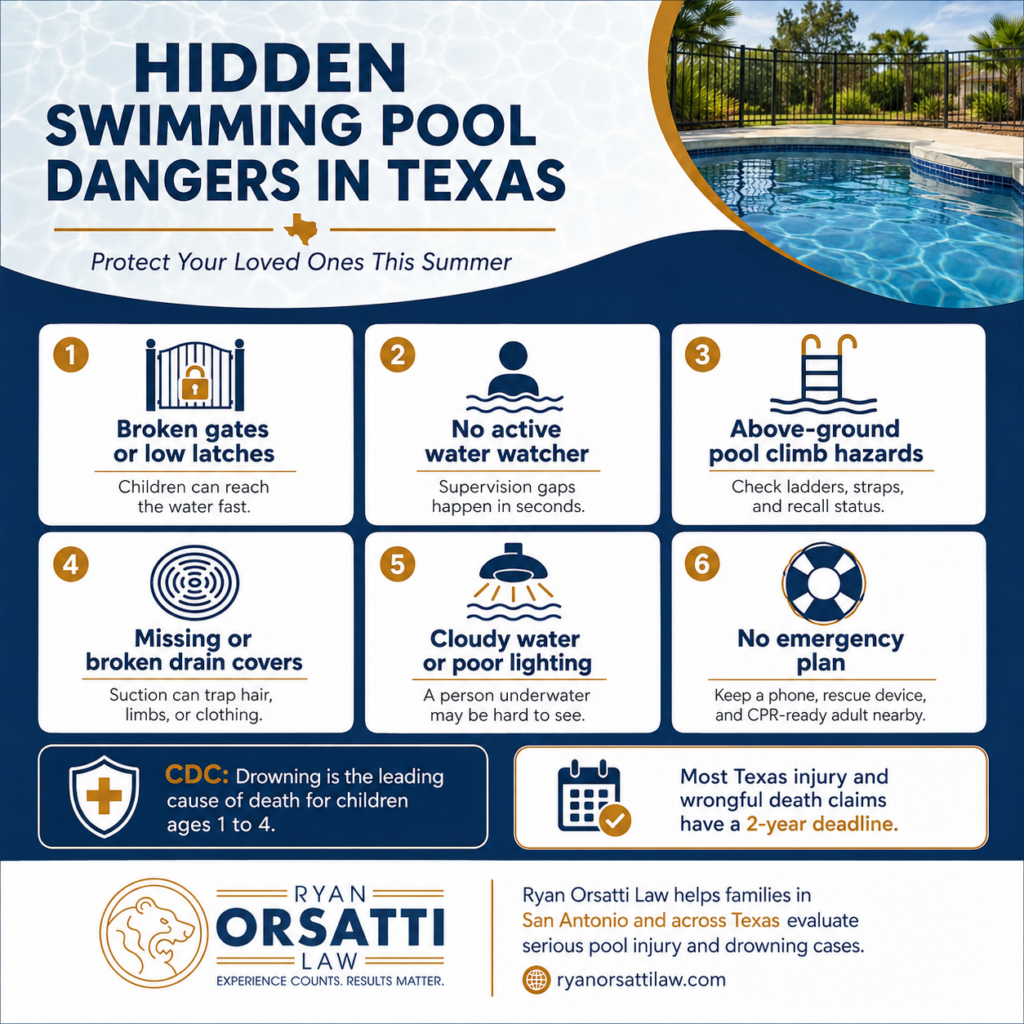
What hidden swimming pool dangers should Texas families check first?
Texas families should first check whether children can access the pool without an adult noticing. The biggest hidden dangers are usually not dramatic. They are broken gates, climbable fences, unsecured ladders, missing drain covers, cloudy water, slippery decks, poor lighting, and no assigned adult watching the water.
| Hidden pool danger | Why it matters | What to check or document |
|---|---|---|
| Broken gate or low latch | Children can enter the pool area before an adult sees them | Gate closure, latch height, gaps, photos, video |
| Furniture or toys near fence | A child may climb over a barrier | Chairs, planters, coolers, pool toys, nearby trees |
| No assigned Water Watcher | Adults may assume someone else is watching | Who was assigned, where adults were standing, phone use |
| Above-ground pool ladder or exterior straps | Children may climb in even when the ladder is removed | Product brand, model, straps, ladder, recall status |
| Missing or broken drain cover | Suction can trap hair, limbs, jewelry, or clothing | Drain cover, pump system, maintenance records |
| Cloudy water | A submerged person may be hard to see | Water clarity, chemical logs, maintenance history |
| Slippery deck or loose tile | Falls can cause head, neck, back, or orthopedic injuries | Photos, shoes, surface condition, prior complaints |
| Poor lighting or missing depth markers | Swimmers may misjudge depth or hazards | Light fixtures, signs, depth markers, nighttime photos |
| No emergency plan | Rescue delays can worsen injury | Phone access, rescue ring, shepherd’s hook, CPR response |
Key takeaway: Pool safety is layered. A working barrier, active supervision, safe equipment, clear water, and an emergency plan each reduce a different risk.
Why are children at special risk around Texas swimming pools?
Children are at special risk because drowning can happen quickly, silently, and when adults briefly look away. Texas DFPS warns that drowning can happen in almost any amount of water, indoors or outdoors, and that children should never be left unsupervised near water. (Texas DFPS)
The CDC reports that drowning is the leading cause of death for children ages 1 to 4 in the United States. It also reports that more than 4,000 unintentional drowning deaths occur each year nationwide. (CDC)
For Texas families, the danger is not just backyard pools. Apartment pools, neighborhood pools, hotel pools, splash areas, water parks, short-term rentals, and above-ground pools can all create serious risk if access, supervision, equipment, or maintenance fails.
What is a Water Watcher, and why does it matter?
A Water Watcher is a sober, distraction-free adult whose only job is to watch children in and around the water. The CPSC recommends designating a Water Watcher and says that person should not be reading, texting, using a phone, or doing other distracting activities. (U.S. Consumer Product Safety Commission)
At family gatherings, the risk increases when everyone assumes someone else is watching. A safer system is to assign one adult at a time, make the handoff clear before that adult steps away, and keep phones, alcohol, and side conversations out of the supervision role.
What layers of protection should a Texas pool have?
A Texas pool should have multiple layers of protection because no single safety measure prevents every drowning. The CPSC recommends barriers, door alarms, pool covers, self-closing and self-latching devices, secure ladders, recall checks, drain safety, swim instruction, and CPR training. (U.S. Consumer Product Safety Commission)
For a backyard pool in San Antonio, that means looking beyond whether the water “looks fine.” The safer question is whether a child can reach the water without being seen, whether the equipment is safe, whether the pool is maintained, and whether someone could call for help immediately.
What Texas and San Antonio pool safety rules may apply?
The pool safety rules depend on whether the pool is at a private home, apartment complex, HOA, hotel, school, public facility, daycare, summer camp, or commercial property. Texas DSHS lists state pool statutes and 25 Texas Administrative Code Chapter 265, Subchapter L for public swimming pools and spas, while San Antonio uses the 2024 International Swimming Pool and Spa Code with local amendments for pool permits and barriers. (Texas Health Services)
A legal claim after a pool injury often turns on the specific pool setting. A backyard pool case may focus on residential barriers, supervision, homeowner conduct, and insurance. An apartment, hotel, HOA, gym, or municipal pool may involve maintenance records, inspection requirements, staffing, incident reports, prior complaints, and public pool regulations.
Do San Antonio private residential pools need barriers?
Yes. San Antonio’s pool permit bulletin says private residential swimming pools and spas must comply with the 2024 International Swimming Pool and Spa Code as adopted and amended by the city. The bulletin states that Section 305 barriers are intended to protect against potential drownings and near-drownings by restricting access, and that outdoor pools generally must have barriers unless a recognized safety-cover exception applies. (Docs Online)
The same San Antonio bulletin states that the upper edge of the barrier must be at least 48 inches above grade. It also states that barrier openings must not allow a 4-inch diameter sphere to pass through. (Docs Online)
For families, this means pool barriers are not just cosmetic. If a fence, gate, latch, door, or opening allows unsupervised access, that condition can become central to both safety prevention and legal responsibility after an injury.
Do apartment, HOA, hotel, or community pools have different rules?
Yes. Apartment, HOA, hotel, and community pools may be subject to public or semi-public pool rules, local codes, lease requirements, HOA rules, maintenance standards, and property management policies. Texas DSHS identifies Texas Health and Safety Code pool provisions and 25 Texas Administrative Code Chapter 265, Subchapter L as public swimming pool and spa rules. (Texas Health Services)
For regulated public pools and spas, Texas rules include emergency communication requirements. The Texas Administrative Code requires an emergency telephone, emergency monitoring contact device, or alternate communication system capable of immediately summoning emergency services, readily accessible within 200 feet of the pool or spa. (texas-sos.appianportalsgov.com)
Do above-ground pools have unique hidden risks?
Yes. Above-ground pools can create a hidden access risk because children may climb into them even when adults think the ladder has been removed. The CPSC recalled about 5 million 48-inch-and-taller above-ground pools in 2025 because external compression straps could create footholds, and the agency linked the hazard to nine child drownings, including incidents in Texas. (U.S. Consumer Product Safety Commission)
Parents should check the pool brand, model, height, straps, ladder, and recall status. If a recalled or unsafe pool is involved in an injury, keep the pool components, packaging, manual, purchase records, online listing, and photographs before anything is repaired, discarded, or returned.
Can a Texas pool owner or operator be legally responsible after a drowning or pool injury?
A Texas pool owner or operator can be legally responsible if the evidence proves a duty, an unsafe condition or negligent conduct, failure to use reasonable care, causation, and legally recoverable damages. In premises liability, the Texas Supreme Court has described the need to show knowledge of an unreasonably dangerous condition, failure to use reasonable care, and proximate cause.
Premises liability means a legal claim based on a dangerous condition on property. In pool cases, that may involve a broken gate, missing safety equipment, slippery deck, defective drain cover, unclear depth marking, bad lighting, poor maintenance, or a known access hazard.
Not every pool injury creates a claim. But after a serious injury, near-drowning, or drowning, the facts need to be preserved quickly because property owners, insurers, maintenance contractors, product manufacturers, and witnesses may all have different accounts of what happened.
What if the injured person or a parent is blamed?
Texas uses proportionate responsibility, which means fault can be divided among people or companies involved in causing the injury. Under Texas Civil Practice and Remedies Code § 33.001, a claimant may not recover damages if the claimant’s percentage of responsibility is greater than 50 percent. (Texas Statutes)
In pool cases, insurers may argue lack of supervision, ignored warning signs, alcohol use, trespassing, unsafe diving, or failure to follow pool rules. Fault issues can be different for a young child than for an adult, and a parent-blame argument does not automatically end a case. The specific facts, age of the child, property condition, safety rules, and warnings all matter.
How long do you have to file a Texas swimming pool injury claim?
In most Texas personal injury and wrongful death cases, the lawsuit deadline is two years from the date the claim accrues. Texas Civil Practice and Remedies Code § 16.003 is the main limitations statute for personal injury and injury-resulting-in-death claims. (Texas Statutes)
Do not treat the two-year deadline as a reason to wait. Surveillance video may overwrite quickly. Pool equipment may be repaired. A broken gate may be fixed. Water chemistry records, incident reports, lifeguard schedules, rental records, and witness memories can become harder to obtain with time.
What should you do after a swimming pool drowning, near-drowning, or serious pool injury in San Antonio?
After a serious swimming pool injury in San Antonio, call 911, get medical care, preserve the scene, identify witnesses, and avoid recorded statements or releases before legal review. Nonfatal drowning can range from no injury to brain damage or permanent disability, so medical follow-up matters even when a person survives. (CDC)
Use this checklist after a pool injury:
- Call 911 immediately. Focus first on rescue, CPR, and emergency medical treatment.
- Get the injured person evaluated. Near-drowning can involve breathing problems, brain injury, and delayed complications.
- Photograph the pool area. Capture the gate, latch, fence, ladders, stairs, straps, drain covers, signs, depth markers, lighting, water clarity, deck surface, and rescue equipment.
- Preserve video quickly. Ask the property owner, hotel, apartment complex, HOA, daycare, camp, or business to preserve surveillance footage.
- Identify witnesses. Get names, phone numbers, and brief notes about what each person saw.
- Request written incident records. Ask for incident reports, maintenance logs, lifeguard schedules, inspection records, and emergency response documentation.
- Keep product evidence. Save the ladder, drain cover, pool cover, gate hardware, pump parts, manuals, packaging, receipts, and product labels if a defect may be involved.
- Avoid signing releases too early. Do not sign settlement papers, property releases, or broad medical authorizations before understanding medical bills, liens, future care, and legal rights.
Ryan Orsatti Law’s San Antonio swimming pool accident guide covers related local issues, including pool owner responsibilities and evidence preservation after a serious incident.
What evidence matters most in a Texas pool injury case?
The most important evidence is the evidence that shows how the injured person reached the water, what condition the pool area was in, who was responsible for supervision or maintenance, and whether the danger was known before the incident. Photos, videos, gate evidence, maintenance logs, safety records, witness statements, and medical records often drive the liability analysis.
In a San Antonio or Bexar County pool case, useful evidence may include:
- Gate latch condition and whether the gate self-closed
- Fence height, openings, climbable objects, and nearby furniture
- Door alarms, window access, and pool covers
- Lifeguard schedules, training records, and incident reports
- Pool maintenance records and water clarity records
- Prior complaints about broken gates, lighting, slippery surfaces, or unsafe behavior
- Drain cover condition and pump system information
- Product brand, model number, recall status, and purchase records
- EMS records, hospital records, and follow-up medical records
- Photos of bruising, cuts, oxygen use, intubation, therapy, or neurologic symptoms
Attorney Insight: In serious pool cases, the defense often tries to make the case about adult supervision instead of the property condition. That is why early photos of the gate, latch height, broken closure, missing ladder lock, cloudy water, drain cover, or recalled pool component can matter as much as witness statements.
What injuries can happen in swimming pool accidents besides drowning?
Swimming pool accidents can cause brain injuries, spinal injuries, broken bones, lacerations, chemical injuries, electrocution injuries, and serious respiratory problems. Near-drowning cases may involve oxygen deprivation, hospitalization, therapy, and long-term neurologic issues, especially when CPR, intubation, or intensive care is required.
Common pool-related injuries include:
- Nonfatal drowning and oxygen deprivation
- Traumatic brain injury from falls or diving
- Neck, back, and spinal cord injuries
- Broken wrists, ankles, hips, shoulders, or facial bones
- Cuts from broken tile, glass, drains, or metal fixtures
- Chemical burns from improper pool chemical handling
- Electric shock from lights, pumps, wiring, or nearby equipment
- Entrapment injuries from drains, suction, or pool equipment
For cases involving brain injury symptoms after a near-drowning, fall, or diving incident, Ryan Orsatti Law’s San Antonio traumatic brain injury page explains why medical documentation and long-term symptom tracking can be important.
What insurance may apply after a Texas swimming pool injury?
The insurance that may apply depends on where the pool was located and who controlled the property, supervision, equipment, or event. A backyard pool may involve homeowner’s insurance, while an apartment, hotel, HOA, daycare, gym, or public facility may involve commercial general liability coverage, excess coverage, government notice issues, or contractor insurance.
Potential insurance sources may include:
| Pool setting | Possible coverage or responsible party | Practical issue |
|---|---|---|
| Private home pool | Homeowner’s insurance | Policy exclusions and household facts matter |
| Apartment pool | Property owner, manager, maintenance contractor | Prior complaints and gate repairs can be important |
| Hotel pool | Hotel operator, owner, security, maintenance vendor | Video and incident reports should be preserved quickly |
| HOA or community pool | HOA, management company, pool vendor | Rules, access control, and maintenance logs matter |
| Daycare or summer camp pool | Facility, staff, transportation, supervision policies | Staffing and supervision records are critical |
| Public or school pool | Government entity or school district | Notice deadlines and immunity issues may apply |
| Defective pool product | Manufacturer, seller, distributor | Product model, recall status, and components must be saved |
Key takeaway: Pool injury claims can involve more than one insurance policy, so the early investigation should identify every property owner, operator, manager, vendor, and product source.
How can Ryan Orsatti Law help after a serious pool injury in Texas?
Ryan Orsatti Law helps injured people and families in San Antonio, Bexar County, and across Texas evaluate fault, insurance coverage, medical documentation, evidence preservation, and legal deadlines after serious swimming pool injuries. The goal is to identify what happened, who had legal responsibility, what insurance may apply, and what evidence must be preserved.
The firm can help review whether the incident involves a private homeowner, apartment complex, hotel, HOA, daycare, summer camp, public facility, maintenance vendor, security company, or defective product. In fatal cases, Ryan Orsatti Law can also help families understand Texas wrongful death issues and who may bring a claim under Texas law.
For drowning cases involving death, the firm’s San Antonio wrongful death lawyer page explains how Texas wrongful death claims generally work. For cases involving a child’s injury settlement, Ryan Orsatti Law’s guide to minor child injury settlement issues explains why court approval and protection of settlement funds may matter.
Families can also contact Ryan Orsatti Law to discuss a serious pool injury, near-drowning, or drowning incident involving a San Antonio, Bexar County, or Texas property.
FAQ
Can I sue if my child drowned or nearly drowned in a Texas swimming pool?
You may have a Texas claim if evidence shows that a property owner, operator, supervisor, maintenance company, or product manufacturer failed to use reasonable care and that failure caused the injury or death. Pool cases are fact-specific. Gate condition, supervision, prior complaints, warnings, maintenance records, product defects, and medical causation all matter.
What is the Texas deadline for a swimming pool accident lawsuit?
In most Texas personal injury and wrongful death cases, the deadline is two years under Texas Civil Practice and Remedies Code § 16.003. Some cases can involve special rules, including claims involving minors, government entities, schools, or medical issues. Evidence may disappear long before the legal deadline, so preservation should begin quickly. (Texas Statutes)
Are apartment pools in San Antonio required to have safety equipment?
Apartment pools may be subject to Texas public or semi-public pool rules, local codes, property policies, and lease-related safety duties. Texas public pool rules include emergency communication requirements within 200 feet of the pool or spa when the pool is open. In a claim, incident reports, inspection records, gate condition, and maintenance logs may be important. (texas-sos.appianportalsgov.com)
Is an above-ground pool dangerous if I remove the ladder?
Removing the ladder may not be enough if the pool has other climbable features. In 2025, the CPSC recalled about 5 million 48-inch-and-taller above-ground pools because external compression straps could create footholds that let children climb in even when the ladder was removed. Families should check brand, model, straps, ladder security, and recall status. (U.S. Consumer Product Safety Commission)
What evidence should I save after a pool injury at a hotel, Airbnb, or apartment in Texas?
Save photos and video of the gate, latch, fence, signs, depth markers, lighting, drain covers, deck surface, pool equipment, and water clarity. Get witness names, incident reports, surveillance preservation requests, medical records, and the names of property managers or staff. Do not rely on the property owner to preserve everything without a written request.
Who can bring a Texas wrongful death claim after a drowning?
Under Texas wrongful death law, the claim is generally for the benefit of the surviving spouse, children, and parents of the deceased. Texas Civil Practice and Remedies Code § 71.004 addresses who may bring the action and when a personal representative may bring it. Family status and probate issues should be reviewed carefully. (Texas Statutes)
Do I need a lawyer after a nonfatal drowning?
Legal help is worth considering after a nonfatal drowning if there was hospitalization, brain injury concern, disputed fault, unsafe property conditions, a defective product, or significant medical bills. Nonfatal drowning can lead to brain damage or long-term disability, and the early investigation can determine whether insurance, maintenance records, or product evidence may apply. (CDC)
Ryan Orsatti Law
4634 De Zavala Rd, San Antonio, TX 78249
Phone: 210-525-1200
ryanorsattilaw.com
This blog is for informational purposes only, not legal advice. Reading it does not create an attorney-client relationship. Past results do not guarantee future results.
Hurt in an accident in San Antonio? Learn how a San Antonio wrongful death lawyer can help with your claim. Call 210-525-1200 or request a free consultation.
The firm works on a contingency fee. You pay nothing unless the firm recovers money for you, and that covers case expenses as well as the fee: if there is no recovery, you owe no attorney's fee and no case expenses. Ask for the fee agreement and read the fee and expense section before you sign anything.
Related San Antonio legal resources
Primary legal and public-data sources
- Texas Civil Practice and Remedies Code Chapter 71: wrongful death
- Texas Civil Practice and Remedies Code Chapter 16: limitations
Ryan Orsatti Law
4634 De Zavala Road, San Antonio, TX 78249
General reference links. Consult each source for its current text.