
Quick Answer
A herniated disc from an accident in Texas can support a personal injury claim if the evidence shows another person or company’s negligence caused or aggravated the disc injury. These claims usually turn on medical timing, MRI findings, nerve symptoms, treatment consistency, fault evidence, and available insurance. Texas generally gives injured people two years to file a personal injury lawsuit, and urgent symptoms like bladder or bowel problems, worsening weakness, or numbness in the saddle area should be treated as a medical emergency. (Texas Statutes)
Ryan Orsatti Law helps injured people in San Antonio and across Texas evaluate herniated disc claims, preserve evidence, review insurance coverage, and document how the injury affects work, daily life, and future care.
Key Takeaways
- A herniated disc means disc material has pushed through the outer layer of a spinal disc, which may irritate nearby nerves and cause pain, numbness, tingling, or weakness. (Mayo Clinic)
- An MRI may help confirm the location of a herniated disc, but the claim also needs proof connecting the injury to the accident. (Mayo Clinic)
- Texas law can reduce a claim based on the injured person’s percentage of fault, and recovery can be barred if that percentage is more than 50%. (Texas Statutes)
- Insurance adjusters often focus on treatment gaps, prior spine problems, delayed reporting of radiating pain, and whether the symptoms match the MRI findings.
- Do not settle a herniated disc claim before you understand the diagnosis, treatment plan, future care, liens, subrogation claims, and all available insurance coverage.
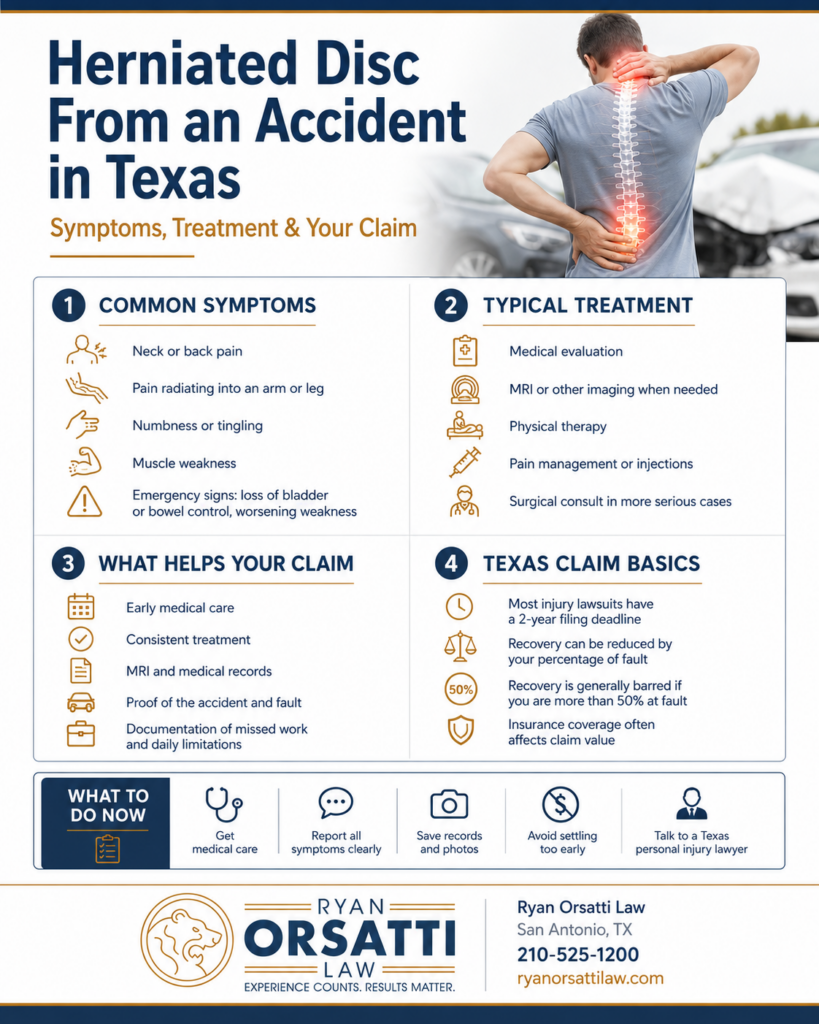
What is a herniated disc from an accident in Texas?
A herniated disc from an accident is a spinal injury where disc material pushes through the disc’s outer layer and may irritate a nerve. The Mayo Clinic explains that herniated discs most often occur in the lower back, but they can also occur in the neck and cause arm or leg symptoms depending on the nerve involved. (Mayo Clinic)
A spinal disc sits between the bones of the spine. It works like a cushion. In a crash, fall, work incident, or other traumatic event, the body can bend, twist, compress, or extend with enough force to injure the disc or aggravate an existing disc problem.
The legal question is different: can the medical records, crash facts, and timing show that the accident caused or worsened the disc injury?
What symptoms should you watch for after an accident?
After an accident, watch for neck pain, back pain, pain running into an arm or leg, numbness, tingling, muscle weakness, and symptoms that worsen with sitting, standing, bending, lifting, coughing, or driving. A herniated disc can affect one side of the body, and the symptom pattern often depends on whether the disc is in the neck or lower back. (Mayo Clinic)
A herniated disc in the lower back may cause pain into the buttock, thigh, calf, or foot. A herniated disc in the neck may cause pain into the shoulder or arm. Numbness, tingling, and weakness matter because they can show nerve involvement, not just ordinary soreness.
Some symptoms start immediately. Others become clearer over several hours or days as inflammation develops and adrenaline fades. That timing can become important in a Texas injury claim because insurance adjusters often compare the first medical records against later MRI findings.
What herniated disc symptoms are a medical emergency?
Seek emergency care if you have worsening weakness, loss of bladder or bowel control, or numbness in the areas that would touch a saddle. Mayo Clinic identifies those symptoms as possible signs of cauda equina syndrome, a serious condition involving compressed nerve roots that requires emergency attention. (Mayo Clinic)
Do not treat those symptoms as routine back pain. A personal injury claim can wait. Possible spinal cord or nerve root emergencies should be evaluated immediately.
How do doctors diagnose a herniated disc after a Texas accident?
Doctors usually diagnose a herniated disc through a physical exam, neurological findings, medical history, and imaging when needed. Mayo Clinic states that doctors may check reflexes, muscle strength, walking ability, and sensation, and an MRI can confirm the location of a herniated disc and identify affected nerves. (Mayo Clinic)
An X-ray usually cannot show a herniated disc, but it may help rule out fractures, tumors, infection, alignment problems, or other causes of pain. A CT scan, MRI, myelogram, or nerve study may be considered depending on the symptoms and medical judgment. (Mayo Clinic)
In a Texas personal injury claim, the MRI is important, but it is rarely the whole story. The stronger proof usually comes from a consistent timeline: accident, early neck or back complaints, radiating symptoms, physical exam findings, imaging, treatment, work restrictions, and follow-up care.
| Medical proof | What it may show | Why it matters in a Texas herniated disc claim |
|---|---|---|
| EMS, ER, urgent care, or primary care records | First report of neck pain, back pain, numbness, tingling, or weakness | Early complaints help connect symptoms to the accident |
| MRI report | Disc herniation location, nerve contact, stenosis, or other spinal findings | Imaging can support the diagnosis, but it must match symptoms |
| Neurological exam | Reflex changes, weakness, sensory loss, or positive straight-leg raise | Objective findings can make the injury harder to dismiss as soreness |
| Physical therapy notes | Pain levels, range of motion, functional limits, progress, or setbacks | Treatment consistency helps show the injury’s real-world impact |
| Injection or surgical consultation | Whether conservative care failed or more invasive treatment was considered | Future care and severity affect claim evaluation |
| Prior medical records | Old disc problems, prior pain, or no prior similar complaints | Prior records can help address causation and aggravation arguments |
| Work restriction notes | Limits on lifting, sitting, standing, driving, or job duties | Lost income and loss of earning capacity need documentation |
Key takeaway: A herniated disc claim is stronger when the medical records tell a consistent story from the accident through diagnosis, treatment, and daily limitations.
What treatment is common for a herniated disc after an accident?
Treatment for a herniated disc often starts with conservative care, such as avoiding painful movements, medication, and physical therapy. Mayo Clinic states that conservative treatment often helps within days or weeks, but surgery may be considered if symptoms do not improve after about six weeks or if there is serious pain, numbness, weakness, walking difficulty, or bladder or bowel problems. (Mayo Clinic)
Common treatment may include:
- Emergency evaluation or urgent care
- Primary care follow-up
- Anti-inflammatory medication or muscle relaxers when medically appropriate
- Physical therapy
- Pain management evaluation
- Epidural steroid injections
- Orthopedic, neurology, or neurosurgery evaluation
- Surgery in selected cases
The legal claim should follow the medicine. If a doctor recommends physical therapy, follow-up, injections, or a surgical consultation, missed appointments may give the insurance company an argument that the injury improved, was not serious, or was not accident-related.
How do you prove an accident caused or aggravated a herniated disc in Texas?
You prove an accident caused or aggravated a herniated disc by building a medical and factual timeline that connects the event to the symptoms, diagnosis, and treatment. In Texas, the issue is often not whether an MRI shows a disc problem, but whether the evidence shows the accident caused a new injury or made an existing spine condition worse.
Aggravation means an accident made a pre-existing condition symptomatic, worse, or more disabling. Many adults have age-related spine findings, and Mayo Clinic notes that disc herniation can occur gradually through aging, while twisting, lifting, falls, or trauma may also play a role. (Mayo Clinic)
Insurance adjusters often argue that a herniated disc is degenerative, meaning related to aging or wear and tear. A good claim response usually focuses on what changed after the accident: new radiating pain, new weakness, new treatment, new work restrictions, new injections, or new surgical recommendations.
Ryan Orsatti Law has more on proving these cases in its guide to a herniated disc personal injury claim in Texas and its related discussion of herniated discs from car wrecks.
Attorney Insight: In Texas herniated disc claims, adjusters often look for gaps between the accident, the first complaint of neck or back pain, the first report of radiating symptoms, and the first MRI. A strong file should connect those dots with medical records, not just attach a scan and assume causation is obvious.
What Texas laws affect a herniated disc accident claim?
Texas herniated disc claims are affected by filing deadlines, fault rules, medical bill rules, liens, and insurance coverage. The core deadline is Texas Civil Practice & Remedies Code § 16.003, which generally gives two years to file a personal injury lawsuit, although some claims can involve shorter notice rules or different deadlines. (Texas Statutes)
Comparative responsibility means Texas can reduce a person’s recovery by that person’s percentage of fault. Under Texas Civil Practice & Remedies Code Chapter 33, a claimant generally cannot recover damages if the claimant’s percentage of responsibility is more than 50%. (Texas Statutes)
Texas also has a paid-or-incurred medical expense rule. Texas Civil Practice & Remedies Code § 41.0105 limits recovery of medical or health care expenses to the amount actually paid or incurred by or on behalf of the claimant. (Texas Statutes)
A hospital lien is a legal claim a hospital may assert against part of a personal injury recovery for accident-related care. Texas Property Code Chapter 55 addresses hospital and emergency medical services liens tied to accident injury claims. (Texas Statutes)
Subrogation means a health insurer or benefit plan may claim a right to be paid back from a settlement. Texas law also addresses contractual subrogation rights in certain personal injury and wrongful death recoveries. (Texas Statutes)
How does insurance affect a herniated disc claim in Texas?
Insurance often controls how much money is realistically available for a herniated disc claim, even when the injury is serious. Texas drivers generally must carry minimum liability coverage of $30,000 per injured person, $60,000 per accident, and $25,000 for property damage, often called 30/60/25 coverage. (Texas Department of Insurance)
That minimum coverage can be a major problem in a herniated disc case involving MRI costs, injections, lost wages, or surgery. That is why the insurance investigation should include all possible coverage sources, not just the at-fault driver’s first policy.
Coverage to review may include:
- Bodily injury liability coverage from the at-fault driver
- Employer or commercial vehicle coverage
- Rideshare, delivery, or trucking coverage when applicable
- Personal injury protection, called PIP
- Medical payments coverage, often called MedPay
- Uninsured or underinsured motorist coverage, called UM/UIM
- Health insurance
- Umbrella or excess insurance
The Texas Department of Insurance explains that uninsured and underinsured motorist coverage can help when the other driver has no insurance or not enough insurance, and Texas insurers must offer UM/UIM coverage unless it is rejected in writing. (Texas Department of Insurance)
What should you do after an accident if you think you have a herniated disc?
If you think you have a herniated disc after an accident, get medical care, clearly report radiating symptoms, preserve evidence, and avoid settling before you understand the diagnosis and future treatment. The claim can be harmed if the records only say “back pain” for weeks and later show nerve symptoms that were never documented.
Use this checklist:
- Get medical care quickly. Report neck pain, back pain, numbness, tingling, weakness, and pain traveling into an arm or leg.
- Use precise symptom descriptions. Say where the pain starts, where it travels, what makes it worse, and whether it affects sleep, work, sitting, standing, walking, or driving.
- Follow the treatment plan. Missed therapy, missed appointments, or long gaps can be used against the claim.
- Ask what warning signs require urgent care. Bladder or bowel issues, worsening weakness, or saddle numbness need immediate attention.
- Save accident evidence. Keep photos, videos, witness names, the crash report number, insurance information, and vehicle damage photos.
- Track missed work and restrictions. Save employer notes, pay stubs, disability forms, and written restrictions.
- Do not minimize symptoms in recorded statements. Casual phrases like “I’m fine” can be used later.
- Do not sign a broad medical authorization without review. Insurers often request wide access to prior medical history.
- Identify every insurance policy. Liability, PIP, MedPay, UM/UIM, commercial, and umbrella coverage may all matter.
- Speak with a Texas personal injury lawyer before settling. A release usually ends the injury claim, including future treatment claims.
How long can a herniated disc claim take in Texas?
A Texas herniated disc claim can take time because the claim should not usually be evaluated before the diagnosis, treatment plan, future care needs, medical bills, liens, and insurance coverage are understood. A person with short conservative treatment may reach that point sooner than someone who needs injections, surgical evaluation, or long-term work restrictions.
The process often includes medical treatment, records collection, bill review, insurance coverage review, lien and subrogation analysis, demand preparation, negotiation, and possible litigation. The deadline to file suit is separate from the time it takes to treat or negotiate.
A practical rule is this: do not rush a herniated disc claim just because the adjuster asks for a quick settlement. A settlement before the medical picture is clear can leave the injured person responsible for later care, missed work, or unresolved lien issues.
What makes herniated disc claims difficult for insurance companies?
Herniated disc claims are difficult because insurers often dispute causation, severity, treatment necessity, and whether the crash was strong enough to cause the injury. They may compare the property damage, medical history, symptom timing, and MRI wording to argue the disc finding was pre-existing or unrelated.
Common insurance arguments include:
- The MRI shows degeneration, not trauma.
- The person had prior back or neck pain.
- Symptoms were not reported at the first visit.
- Treatment did not start quickly enough.
- There was a gap in therapy.
- The crash damage looked minor.
- Surgery or injections were excessive.
- The person’s job, age, weight, or lifestyle caused the condition.
These arguments do not automatically defeat a claim. They do mean the file needs careful medical documentation and a clear explanation of what changed after the accident.
When should you call a Texas personal injury lawyer for a herniated disc?
You should call a Texas personal injury lawyer early if you have radiating pain, numbness, weakness, an MRI-confirmed disc injury, recommended injections, possible surgery, disputed fault, commercial vehicle coverage, UM/UIM issues, or a prior spine condition. These facts often create disputes that should be addressed before the claim is packaged or settled.
Ryan Orsatti Law helps injured people in San Antonio, Bexar County, and across Texas evaluate fault, insurance coverage, medical documentation, liens, and settlement timing in serious injury claims. That includes crashes on local roads like Loop 1604, I-10, I-35, Loop 410, US-281, and claims in nearby counties such as Comal, Guadalupe, Kendall, Wilson, Atascosa, and Medina.
For serious spine injuries with long-term limitations, you can also review Ryan Orsatti Law’s page on San Antonio catastrophic injury claims. To ask about a specific accident, use the firm’s contact page.
How does a herniated disc claim fit into Texas crash statistics?
Herniated disc claims are part of a broader Texas crash problem that creates major medical, financial, and legal consequences every year. TxDOT’s 2003 to 2025 comparison report recorded 3,769 Texas traffic deaths in 2025 and estimated $54.2 billion in economic loss from motor vehicle crashes, based on reportable crash data processed as of April 7, 2026. (Texas Department of Transportation)
Those numbers do not count every person living with nonfatal spine pain after a wreck. For many people, the most important issue is not the statewide statistic. It is whether their own records prove the injury, the cause, the treatment need, and the available insurance.
FAQ
Can I sue for a herniated disc after an accident in Texas?
Yes, you may be able to sue for a herniated disc after an accident in Texas if another person or company’s negligence caused or aggravated the injury. The claim usually needs proof of fault, medical causation, damages, and timely filing. An MRI helps, but the timeline of symptoms, treatment, and medical opinions often matters just as much.
What if my herniated disc symptoms started days after the accident?
Delayed symptoms can still be part of a Texas injury claim, but they must be documented carefully. Many people notice worse neck pain, back pain, numbness, tingling, or radiating pain after adrenaline fades. The longer the delay before medical care, the more likely an insurer is to argue the symptoms came from something else.
Is a bulging disc the same as a herniated disc in a Texas accident claim?
A bulging disc and a herniated disc are not always the same medical finding, and the wording in the MRI report matters. In a Texas claim, the key issue is not only the label. The more important questions are whether the disc finding matches the symptoms, affects a nerve, required treatment, and was caused or aggravated by the accident.
Do I need an MRI to prove a herniated disc claim in Texas?
An MRI is often important because it can confirm the location of a herniated disc and whether nerves are affected. But an MRI alone does not prove a Texas injury claim. You also need evidence of the accident, early complaints, physical exam findings, treatment, work limits, and a medical explanation connecting the injury to the event.
How long do I have to file a herniated disc lawsuit in Texas?
Texas generally gives injured people two years to file a personal injury lawsuit under Texas Civil Practice & Remedies Code § 16.003. Some cases can involve shorter notice requirements, especially if a government entity is involved. Do not wait until treatment is finished to evaluate the deadline, because missing it can end the claim.
Should I give a recorded statement about my neck or back injury?
Be careful with recorded statements after a herniated disc accident claim in Texas. Adjusters may ask questions before you know the diagnosis, MRI findings, or future treatment plan. A short statement like “I’m okay” or “just sore” can later be used to dispute nerve symptoms, treatment, or causation.
What if I had back problems before the accident?
A prior back or neck problem does not automatically prevent a Texas herniated disc claim. The issue is whether the accident caused a new injury or aggravated an existing condition. Prior records, symptom changes, treatment history, and physician opinions can help show what was different after the accident.
Can a herniated disc claim include future medical treatment?
Yes, a Texas herniated disc claim may include future medical treatment if the evidence supports it. Future care can involve physical therapy, injections, follow-up imaging, pain management, surgery evaluation, or long-term restrictions. The claim should not be evaluated seriously until future medical needs are reasonably understood and documented.
Ryan Orsatti Law
4634 De Zavala Rd, San Antonio, TX 78249
Phone: 210-525-1200
ryanorsattilaw.com
This blog is for informational purposes only, not legal advice. Reading it does not create an attorney-client relationship. Past results do not guarantee future results.
Hurt in an accident in San Antonio? Learn how a San Antonio personal injury lawyer can help with your claim. Call 210-525-1200 or request a free consultation.
The firm works on a contingency fee. You pay nothing unless the firm recovers money for you, and that covers case expenses as well as the fee: if there is no recovery, you owe no attorney's fee and no case expenses. Ask for the fee agreement and read the fee and expense section before you sign anything.
Related San Antonio legal resources
Primary legal and public-data sources
- Texas Civil Practice and Remedies Code Chapter 16: limitations
- Texas Civil Practice and Remedies Code Chapter 33: proportionate responsibility
Ryan Orsatti Law
4634 De Zavala Road, San Antonio, TX 78249
General reference links. Consult each source for its current text.